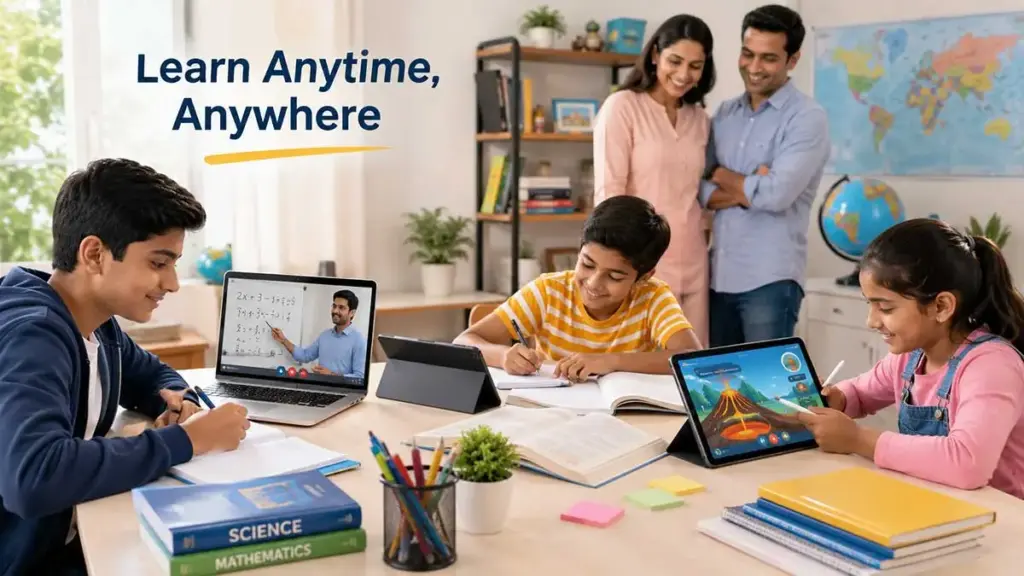

Let’s be honest: online classes can feel amazing one day and exhausting the next. One minute a brilliant animation makes everything click, and the next you’re watching something that has nothing to do with homework.
These online learning tips for school students are here to help. Whether you’re in a CBSE school, taking online tuition, or revising for exams with digital resources, a few small habits can help you stay focused, learn on your own, and still have time to be a kid.
What Is Online Learning?
Online learning just means studying through a phone, tablet, or computer: live classes, recorded lessons, quizzes, assignments, and interactive resources. For Indian students, it works best alongside classroom teaching, with help from NCERT textbooks, DIKSHA, and SWAYAM.
But watching videos isn’t the same as learning. You also need a routine, active participation, regular practice, and a safe place to do it all.
15 Practical Online Learning Tips for School Students
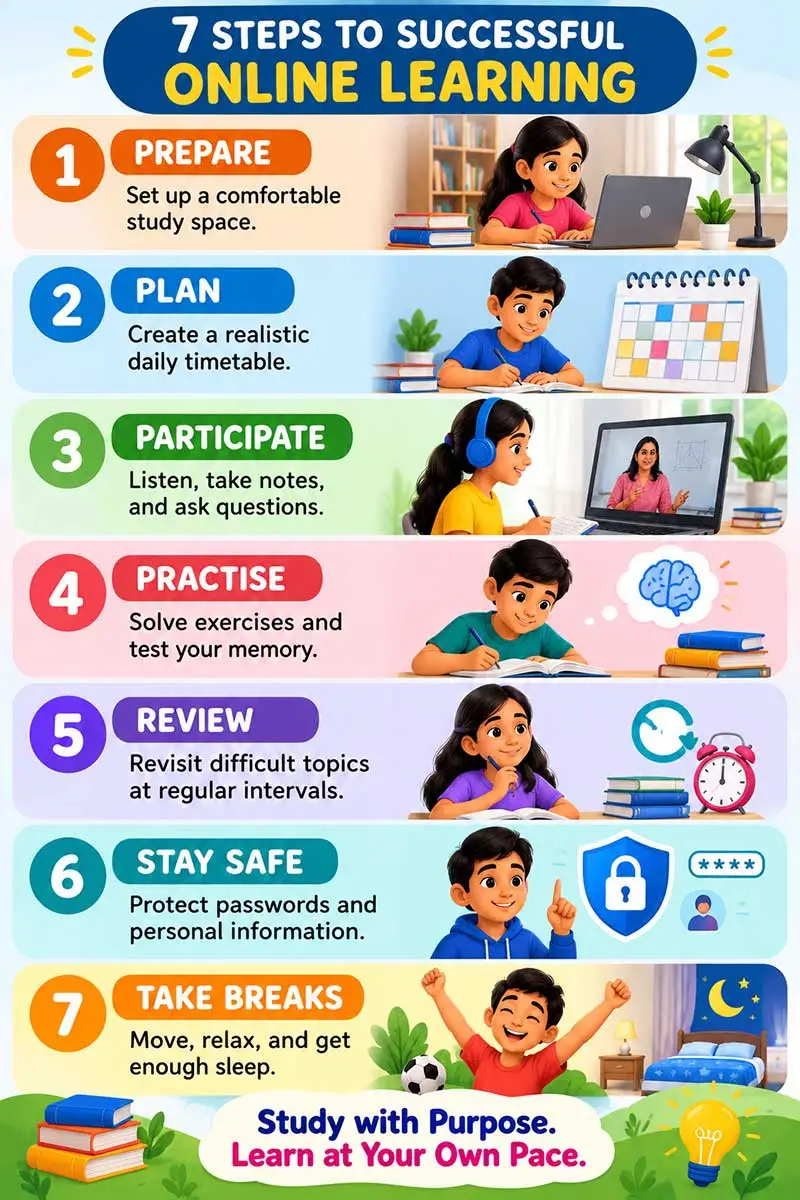
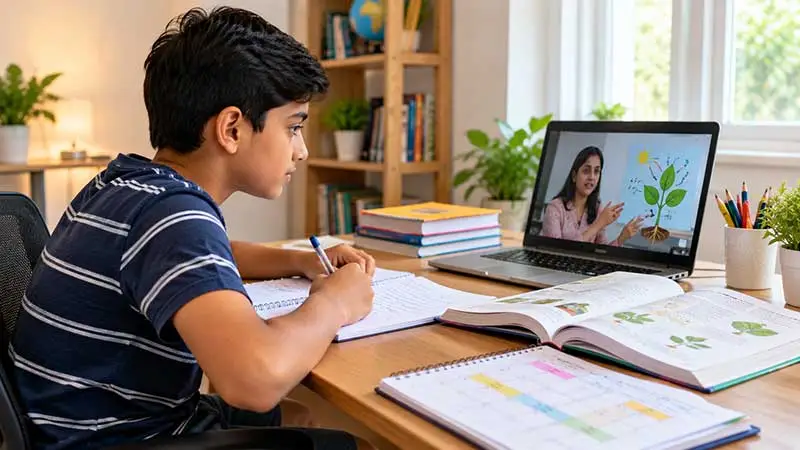
1. Create Your Own Study Corner
You don’t need a fancy room. A tidy corner of your bedroom or the family living space is enough, as long as it’s quiet and well lit. Your brain soon treats that spot as “learning mode.”
- Keep your books, notebooks, and pens within reach.
- Put your screen at a comfortable height and sit somewhere that supports your back.
- Hide the toys and other tempting distractions.
Sharing a room with a sibling? Agree on quiet time during important classes.
2. Build a Daily Routine You Can Actually Follow
Without a timetable, homework slips, revision gets skipped, and one hour of “educational” videos quietly turns into three. A simple plan fixes that: fit in classes, homework, self-study, meals, exercise, and sleep. Try 30 minutes after school going over the day’s lessons, then homework and a quick revision in the evening.
Note deadlines on a planner or calendar, and break big assignments into bite-sized pieces.
Practical tip: Choose three important tasks a day instead of ten. A small plan you stick to beats a perfect one you give up on by Wednesday.
3. Know What You Want Before You Start
“Study Science” is a bit vague, isn’t it? Try something you can actually tick off:
- Explain photosynthesis in your own words.
- Solve ten linear equations.
- Learn and use five new English words.
- Revise one chapter and answer five practice questions.
When you finish, ask yourself honestly: did I do it? If not, what got in the way? Adjust, and try again tomorrow.
4. Show Up, and Really Show Up
Logging in doesn’t count as learning. The lessons that stick are usually the ones you joined in on.
- Arrive on time with your books ready.
- Resist the urge to open other tabs.
- Jot down key points and speak up when something doesn’t make sense.
- Join in polls, discussions, and quick exercises.
If you feel shy about asking in front of everyone, use the chat if your teacher allows it, or catch them after class. Chances are someone else has the same doubt.
5. Take Notes in Your Own Words
Copying everything on the screen feels productive, but it’s mostly typing. Write down main ideas, definitions, formulas, and questions that still bug you. A few styles to try:
- Cornell method: Divide the page into notes, key questions, and a summary.
- Mind maps: Connect related ideas with branches and keywords.
- Comparison tables: Line up the differences between events, processes, or concepts.
Studying the water cycle? List evaporation, condensation, precipitation, and collection, then explain each one as if you were teaching a friend. Then spend five minutes after class marking what still feels shaky.
Get a free Cornell notes template (PDF)
6. Make Videos and Apps Work for You
Here are some trusted places to start:
- DIKSHA: Digital resources aligned with school curricula and textbooks.
- NCERT: Textbooks and supplementary material for school subjects.
- SWAYAM: Online courses at different levels; check whether a course suits your age.
- Khan Academy: Explanations and practice, especially for maths and science.
Begin with what your teacher recommends, and pick resources that match your class and syllabus. And remember, watching someone solve a problem isn’t the same as solving it yourself.
7. Test Yourself, Then Test Yourself Again
Rewatching a lesson can fool you. It feels familiar, so you assume you know it. Active recall means pulling information out of your memory before you check the answer. Spaced revision means coming back to a topic over days and weeks instead of cramming the night before.
Here’s an easy way to start: study a concept, close the book, and write down everything you remember. Then try some practice questions and fix your mistakes. Learn a Science chapter on Monday, test yourself on Tuesday, and retry the tricky questions later that week. Handmade flashcards work as well as apps.
Download the Revision Tracker (PDF)
8. Study in Short Bursts
Nobody can stare at a screen for hours and stay sharp. Try 25 minutes of focused study, then a five-minute break, and repeat. After a few rounds, take a longer rest. This is the Pomodoro technique, but treat it as a starting point, not a rule.
Use your breaks to stand up, stretch, or drink some water, not to disappear into your phone. And in a live class, follow your teacher’s schedule, not your timer.
9. Tame the Distractions
You pick up your phone “just to check one thing,” and twenty minutes vanish. Before you study, switch on Do Not Disturb, close unrelated tabs, and keep your phone out of reach unless the lesson needs it. If one device does everything, make a simple deal with yourself: study first, scroll later.
Parents, building good habits will work far better than watching over your child’s shoulder.
10. Ask for Help Early
It’s easy to misunderstand something online without anyone noticing, so don’t struggle alone for hours. Find the exact step that’s confusing you, check your notes, and then ask a teacher, parent, or classmate.
Be specific. “I don’t understand algebra” is hard to answer; “Why do we subtract 5 from both sides?” is easy. A doubt notebook helps you track what’s still unclear.
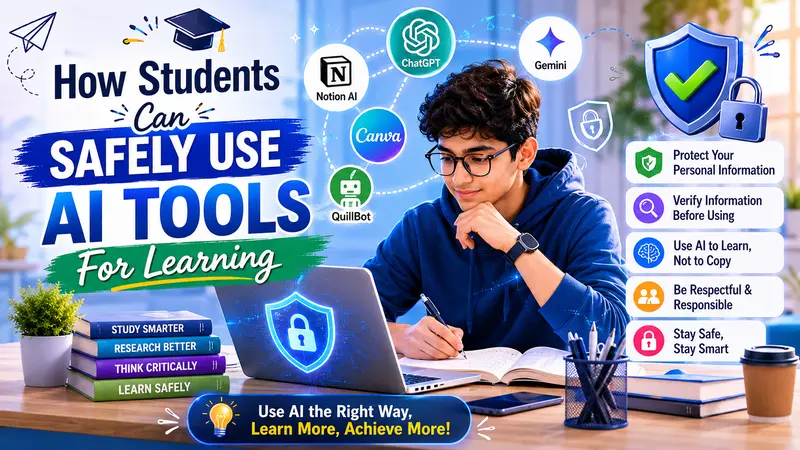
11. Treat AI as a Study Buddy, Not a Shortcut
AI tools can simplify explanations, create practice questions, and help you brainstorm. But they can also be wrong or drift away from your syllabus, so use them with your teacher’s and parents’ guidance. Some prompts worth trying:
- “Explain fractions with simple examples for a Class 5 student.”
- “Give me five questions on the water cycle without the answers.”
- “Quiz me on this chapter and explain my mistakes afterwards.”
Double-check important facts against your textbook, never hand in AI-written work as your own, and don’t use it in exams where it isn’t allowed. The real goal is to understand a topic well enough to explain it yourself.
12. Don’t Leave Assignments to the Last Minute
Instructions can arrive on several platforms, so keep every deadline in one place and check it daily. Start big projects early. Before you hit submit, make sure that:
- Every question is answered, and your facts and calculations are checked.
- Spelling and formatting look right.
- You’ve attached the correct file, and it opens properly.
For exams, mix chapter revision with practice tests. When you get something wrong, study the mistake. It teaches you more than your score does.
13. Look After Your Eyes, Back, and Sleep
Long screen hours, slouching, and late nights leave anyone tired and cranky. Sit upright, keep the screen at a comfortable distance, and move around between sessions. Keep your phone out of bed if it’s stealing your sleep.
The 20-20-20 rule is a handy reminder: every 20 minutes, look at something about 20 feet away for 20 seconds. If your eyes keep hurting, it’s worth seeing a doctor.
14. Go at Your Own Pace
One of the best things about online learning is that you can replay a hard lesson as often as you need and skip ahead through what you already know.
Keep a simple weekly tracker with three headings: Completed (you can explain it), Needs practice (you get it but can’t use it yet), and Needs help (still confusing). Check it every weekend. Try not to compare yourself with classmates; measure yourself against your own progress.
Download the Weekly Progress Tracker (PDF)
15. Step Away from the Screen
Learning isn’t only about screens. After a Science demo, try a safe activity your teacher suggests. After reading a story online, summarise it in a notebook. After geometry, hunt for shapes around your home. A healthy day has room for homework, hobbies, exercise, family, and rest. The goal isn’t to spend as much time online as possible. It’s to use technology with purpose.
How to Create an Effective Online Study Timetable
A good timetable gives you structure without making every minute a chore. Adapt this example to your own school timings and homework load.
| Time | Activity |
| 4:00–4:15 PM | Snack and relaxation |
| 4:15–4:45 PM | Review today’s lessons |
| 4:45–5:00 PM | Short break |
| 5:00–5:40 PM | Homework or a difficult subject |
| 5:40–6:00 PM | Outdoor play or exercise |
| 6:00–6:30 PM | Online lesson or practice |
| 6:30–6:45 PM | Recall and revision |
| Evening | Dinner, family time, reading, rest |
Download the printable Daily Study Planner (PDF)
This is just an example. Tweak it to fit your hours, workload, and need for rest.
Best Digital Tools for School Students
The best tool is the one that helps you reach a specific goal. You don’t need every platform out there; a few reliable ones are plenty.
| Tool | Best use |
| DIKSHA | Curriculum-linked resources |
| NCERT | Textbooks and supplementary material |
| SWAYAM | Structured online courses |
| Khan Academy | Explanations and practice |
| Google Classroom | Classwork and assignments |
| AI assistants | Explanations and guided practice |
For Indian school students, the Ministry of Education’s DIKSHA platform and NCERT resources are great starting points. Visit DIKSHA and NCERT to see what’s on offer.
How Should You Choose an Educational App?
Before you install an app or sign up for a course, ask yourself:
- Does the content match my class and syllabus?
- Is it accurate and age-appropriate?
- Can I use the main features for free?
- Does it collect my personal information?
- Will ads or notifications distract me?
Parents, go through privacy settings and payment requirements together with younger children. And never share passwords, home addresses, or private photos with unfamiliar platforms.
How Can Students Stay Safe While Learning Online?
Online learning connects you with teachers and classmates, so a few safety basics matter:
- Use strong, unique passwords. Turn on multifactor authentication when you can.
- Join trusted classes only. Use links from official school channels, and check with a teacher or parent before joining an unfamiliar meeting.
- Guard your personal information. Don’t share your phone number, address, live location, or private photos with strangers.
- Think before you click. Watch out for suspicious links, fake scholarship offers, and messages demanding urgent payment or login details.
- Be kind. Don’t bully classmates, share embarrassing screenshots, or record and pass around lessons without permission.
- Speak up if something feels wrong. If someone sends inappropriate messages or makes you uncomfortable, stop replying and tell a trusted adult.
- Check your sources. Verify important claims, and be wary of sensational headlines and AI-generated misinformation.
- Secure your devices. Keep apps updated and lock devices when you’re not using them.
Parents, make sure your child knows they can tell you about an online mistake without fearing an instant punishment. For more guidance on digital education and online safety, consult the Ministry of Education and NCERT.
In short: Online learning works best with a steady routine, a distraction-free space, active participation, regular practice and revision, trusted resources, screen breaks, and good safety habits.
A Printable Online Learning Checklist
Before class: Charge my device, check the internet, keep books ready, and silence notifications.
During class: Listen, take notes in my own words, and ask when something is unclear.
After class: Summarise the lesson without peeking at my notes, finish homework, and note deadlines.
End of the week: Review what I’ve covered, spot topics needing practice, and plan the next week.
Download the printable Class Checklist (PDF)
Download all 5 worksheets in one PDF
Key Takeaways
- Plan your learning: Set realistic goals and follow a flexible timetable.
- Participate actively: Take notes, ask questions, and practise.
- Revise regularly: Use active recall, spaced revision, and practice questions.
- Choose reliable tools: Start with NCERT, DIKSHA, and other curriculum-aligned resources.
- Use AI responsibly: Verify facts and do your own work.
- Stay safe and healthy: Protect your information, take breaks, and sleep well.
For more guidance, explore these related CBSEGuide resources:
- Effective Study Techniques for Students
- How to Create an Effective Daily Study Routine
- How to Make Online Learning More Effective and Engaging
- How to Create a Study Schedule That Actually Works
- CBSE Study Planner for Students
- How to Create a Perfect Study Timetable for CBSE Students
- Effective Study Techniques: Complete Guide
Frequently Asked Questions About Online Learning
1. How can school students make online learning more effective?
Set clear goals, stick to a routine, join live classes actively, take notes, practise questions, and revise often.
2. What are the best online learning platforms for CBSE students?
NCERT and DIKSHA are great places to begin. SWAYAM and Khan Academy can add more depth, depending on the subject and your level. Choose what matches your syllabus and your teacher’s advice.
3. Can AI tools help with studies?
Yes, they can explain concepts, suggest practice questions, and help organise revision. Just verify important information, protect your personal data, and follow your school’s rules. AI should support your thinking, not replace it.
4. How can parents support children who study online?
Give them a good study space, help build routines, check deadlines, review safety settings, and encourage breaks.
5. What if the internet connection is slow?
Use lower-bandwidth resources, download permitted materials for offline use, fall back on textbooks, and tell your teachers if connectivity affects attendance.
6. How can I tell whether I’ve understood a lesson?
Close the book or video and explain the main ideas in your own words. Then try practice questions without peeking at the answers. If you get stuck, revisit the lesson and ask your teacher.

Student Success Desk focuses on practical learning strategies, study techniques, and academic improvement tips for school students.