

Let’s be honest — most students have tried making a study timetable at least once. They sit down with a ruler, write out a beautiful colour-coded schedule, follow it for exactly two days, and then quietly abandon it.
Sound familiar?
The problem usually isn’t laziness. It’s that the timetable wasn’t built for the actual student — it was built for an imaginary, perfectly disciplined version of them. This guide will help you create something different: a schedule that’s realistic, flexible, and actually works.
Why a Timetable Matters More Than You Think
CBSE students carry a genuinely heavy load — multiple subjects, class assignments, projects, tuition, and the slow-building pressure of board exams. Without some kind of structure, it’s easy to spend three hours on a subject you already know well and barely touch the one that’s keeping you up at night.
A good timetable doesn’t restrict you. It actually gives you more freedom, because you stop spending mental energy wondering what you should be doing right now. Students who learn to use a study planner effectively for better time management often find it much easier to stay consistent with their timetable throughout the academic year. That question has already been answered.
The real benefits aren’t abstract either:
- You stop cramming the night before exams
- Weaker subjects get the attention they actually need
- You can have an evening off without guilt, because the work is genuinely done
- Exam season feels like preparation rather than panic
Start Here: Know What You’re Working Toward
Before you build any schedule, spend ten minutes thinking honestly about your goals. Vague intentions produce vague timetables.
Short-term goals might look like:
- Finishing the current chapter before Friday
- Getting homework done before tuition
- Revising one unit every Sunday
Long-term goals might include:
- Scoring above 90% in your board exams
- Building confidence in Mathematics
- Preparing seriously for JEE, NEET, CUET, or an Olympiad
Write these down somewhere visible. They’ll keep you honest on the days when motivation dips — and those days will come.
Building Your Timetable, Step by Step
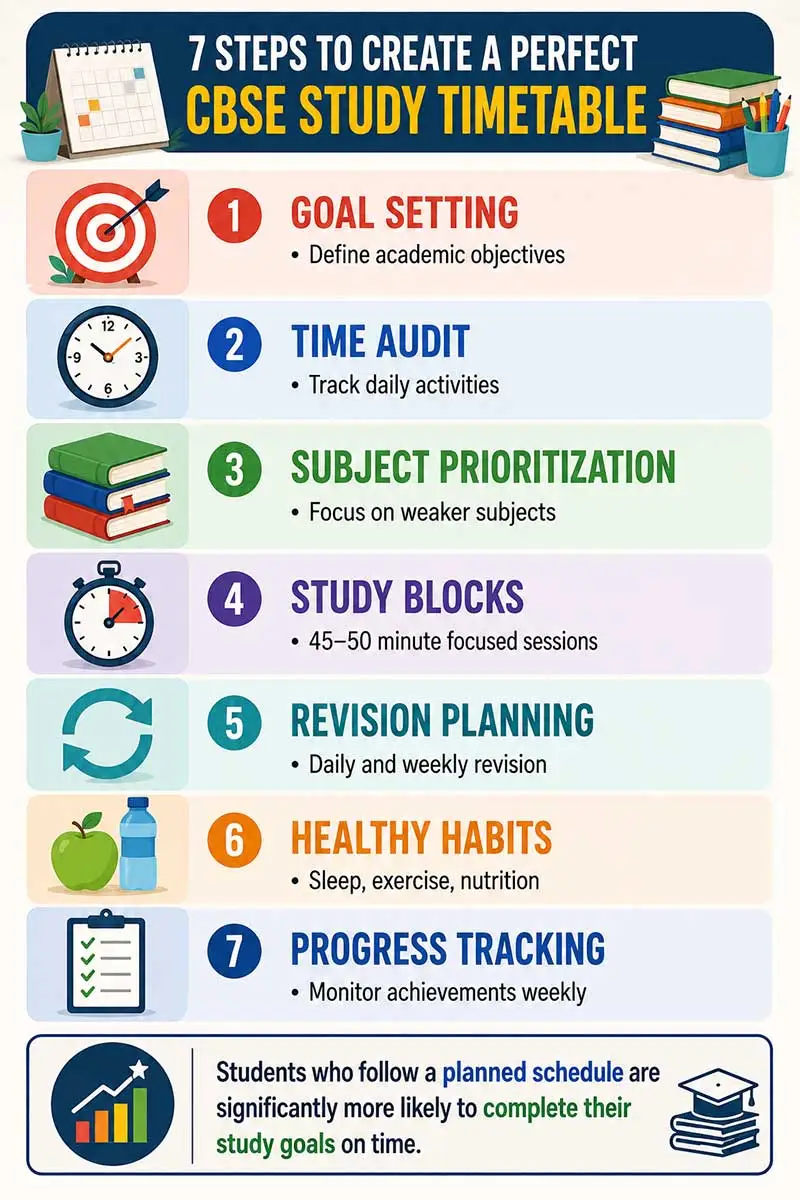
Step 1: See Where Your Time Actually Goes
Most students dramatically overestimate how many free hours they have. Before you plan anything, map out a typical day:
| Activity | Time Required |
| School | 6–8 hours |
| Homework | 1–2 hours |
| Meals | 1–2 hours |
| Sleep | 7–9 hours |
| Physical activity | 30–60 minutes |
| Some kind of break | 30–60 minutes |
Once you add all of that up, you’ll see what’s actually left. For most students, it’s somewhere between two and four hours of genuine study time on a school day. Work with that reality — don’t fight it.
Step 2: Know Your Subjects Honestly
This step requires a little self-awareness. Every student has subjects they enjoy and subjects they avoid. The problem is, the ones we avoid are usually the ones that need the most time.
Do a quick, honest assessment:
| Subject | How confident am I? | Does it need extra time? |
| Mathematics | Medium | Yes |
| Science | High | Not urgently |
| English | High | No |
| Social Science | Medium | Sometimes |
| Hindi | Low | Definitely |
Your timetable should reflect this. Strong subjects need maintenance, not hours of daily drilling. Weaker subjects deserve the prime study slots — when you’re most alert, not half-asleep at 10pm.
Step 3: Study in Blocks, Not Marathons
Sitting down for three continuous hours of studying sounds impressive. It also doesn’t work particularly well for most people.
Your brain retains information better when it gets regular breaks. Two approaches that actually help:
Option A (longer blocks):
- Study for 45–50 minutes
- Take a 10-minute break
Option B (shorter bursts — the Pomodoro method):
- Study for 25 minutes
- Take a 5-minute break
- Repeat four times, then take a longer break
Try both and see which feels right for you. The point is the same: your concentration has limits, and working with those limits beats pretending they don’t exist. Combining these methods with smart study techniques can significantly improve productivity and retention.
Step 4: Build Revision In From the Start
This is the step most students skip — and then wonder why they can’t recall what they studied two weeks ago.
A rough guide that works well:
- 70% of study time on new material
- 20% on revisiting what you’ve already covered
- 10% on testing yourself
Students can also use official learning resources and textbooks developed by NCERT to strengthen their conceptual understanding and revision process.
That last 10% is more valuable than it sounds. Trying to recall something — even imperfectly — strengthens memory far more than reading the same page again.
A Sample Daily Timetable
This is a starting point, not a prescription. Adjust it around your school hours, tuition schedule, and natural energy levels.
| Time | Activity |
| 5:30 AM – 6:00 AM | Wake up and settle in |
| 6:00 AM – 7:00 AM | Quick revision of yesterday’s topics |
| 7:00 AM – 2:00 PM | School |
| 2:00 PM – 3:00 PM | Lunch and genuine rest |
| 3:00 PM – 4:00 PM | Homework |
| 4:00 PM – 5:00 PM | Mathematics |
| 5:00 PM – 5:30 PM | Break / exercise / fresh air |
| 5:30 PM – 6:30 PM | Science |
| 6:30 PM – 7:00 PM | Break |
| 7:00 PM – 8:00 PM | Language subject |
| 8:00 PM – 9:00 PM | Dinner and family time |
| 9:00 PM – 9:45 PM | Light revision |
| 10:00 PM | Sleep |
If you’re not a morning person, that’s fine — shift everything later. What matters is the structure, not the exact start time.
If You Also Have Tuition or Coaching
Many CBSE students juggle school, coaching classes, and self-study, and it can feel like there’s barely room to breathe. A few things that help:
Pay attention in class. It sounds obvious, but genuinely engaging during school hours reduces the amount of work you need to do later. An hour of real attention beats three hours of catching up.
Don’t try to study everything every day. That’s the road to burnout. Rotate subjects, prioritize what’s most urgent, and trust the weekly plan.
Keep a buffer. Life gets in the way — extra homework, a bad day, a family event. Build 30–60 minutes of flex time into your day for these moments. It’ll save you from falling behind and feeling like the whole plan has collapsed.
A Weekly Template to Get You Started
| Day | Main Focus |
| Monday | Mathematics + Science |
| Tuesday | English + Social Science |
| Wednesday | Mathematics + Hindi |
| Thursday | Science + English |
| Friday | Social Science + Revision |
| Saturday | Practice tests / past papers |
| Sunday | Full revision + plan next week |
Sundays spent planning the week ahead might be the highest-leverage habit on this entire list. Ten minutes of planning saves hours of confusion.
The Mistakes That Sink Most Timetables
It’s worth naming these directly, because they’re very common:
Planning for a superhuman version of yourself. If you’ve never studied six hours a day, building that into your timetable from day one will just set you up to feel like a failure. Start with what’s achievable and build from there.
Skipping breaks to study more. This usually backfires. Your concentration drops, you absorb less, and you end up needing more time to learn the same thing.
Forgetting revision entirely. Learning without revisiting is like filling a bucket with a hole in it.
Copying a friend’s timetable. Your friend has different strengths, a different school schedule, and different energy patterns. A plan that works for them may not fit you at all.
Never updating it. Your academic priorities shift throughout the year — before exams, after exams, during project season. Your timetable should shift too.

In-Article Image Description:
A realistic classroom and home-learning scene featuring diverse Indian students reviewing a colorful weekly study planner. A teacher is helping students organize subjects and revision sessions while parents observe supportively. The environment is bright, organized, and focused on academic planning. No text visible in the image.
Sleep, Exercise, and Health Are Part of the Plan
This isn’t a footnote. Students who sleep well and stay physically active genuinely perform better — in concentration, memory, and the ability to handle exam pressure. Developing healthy habits that improve concentration while studying can make a noticeable difference in academic performance.
Sleep: Aim for 7–9 hours. Cutting sleep to study more is almost always a bad trade.
Exercise: Even 30 minutes of walking or sport makes a real difference to focus and mood. Don’t treat it as optional.
Food: Hydration and regular meals matter more to concentration than most students realize. A hungry, thirsty brain isn’t a productive one.
How Parents Can Actually Help
Parents who want to support their children’s studies often don’t know what’s most useful. Understanding how parents can help children study without pressure can create a more positive and productive learning environment at home. Here’s what genuinely makes a difference:
Create a quiet space. It doesn’t need to be perfect, but reducing noise and interruptions during study hours helps enormously.
Focus on effort, not just marks. A student who follows their timetable consistently deserves recognition for that, regardless of what the test score says.
Check in without hovering. A weekly conversation about how the schedule is working — what’s going well, what needs adjusting — is far more useful than constant monitoring.
Keep expectations realistic. A timetable is meant to reduce stress, not add to it. If the schedule is causing more anxiety than it’s relieving, something needs to change.
Printable PDF Resource
1. Download Weekly Study Planner for CBSE Students
Purpose
To organize daily study sessions and weekly goals.
Sections Included
- Weekly goals
- Subject-wise schedule
- Homework tracker
- Revision planner
- Notes section
2. Download Exam Readiness and Revision Checklist
Purpose
To help students track exam preparation progress.
Sections Included
- Subject checklist
- Chapter completion tracker
- Revision status
- Practice test records
- Confidence rating scale
Frequently Asked Questions
How many hours should I actually study each day?
Somewhere between two and five hours of focused self-study is realistic for most CBSE students, depending on your grade and what’s coming up. Quality matters far more than total hours.
When is the best time to study?
Whenever you’re most alert. For many students, early morning works well. For others, the evening is more natural. Know yourself.
Do I need to study every subject every day?
No. Rotate based on what’s coming up, what needs the most work, and what you’ve recently covered. Trying to touch everything daily usually means touching nothing properly.
What if I miss a session?
Don’t panic, and don’t try to compensate by doubling up the next day. Use your buffer time, adjust quietly, and move on.
Is it okay to include leisure in my timetable?
It’s not just okay — it’s necessary. Rest, hobbies, and time with family or friends make sustained studying possible. A timetable without any space for living isn’t one you’ll follow for long.
Do board exam students need a different approach?
Yes. As board exams approach, shift more time toward revision, sample papers, and full mock tests. The learning phase should mostly be behind you; practice and consolidation take over.
One Last Thing
The goal isn’t to create the most impressive-looking timetable. It’s to create one you’ll actually follow — one that fits your real life, respects your limits, and still gets you where you want to go.
Start simple. Be honest about your time and your weak spots. Build in breaks and revision. And review it every week or two, because a plan that isn’t working deserves to be changed, not just abandoned.
A good study timetable, followed consistently over months, is genuinely one of the most powerful things a CBSE student can do for their academic future. The students who learn to plan their time well don’t just do better in exams — they carry that skill with them for the rest of their lives.

Student Success Desk focuses on practical learning strategies, study techniques, and academic improvement tips for school students.