What Are Effective Study Techniques?
Let’s start with a simple truth: studying hard and studying well are not the same thing. Effective study techniques are practical methods that help you understand what you learn, remember it, and actually use it when it matters. Instead of piling on more hours with your textbook, you can lean on active recall, spaced repetition, practice testing, focused study sessions, tidy note-taking, and regular revision to get far more out of the time you already have.
For CBSE students, this matters even more. Doing well isn’t only about knowing facts. You need to understand concepts, apply them, handle different kinds of questions, and revise a large part of the syllabus without losing your sanity.
| In simple terms: Effective studying means learning actively instead of just reading. Techniques like active recall, spaced repetition, practice questions, focused sessions, good notes, and a planned revision routine help you understand more, remember longer, and feel a lot less panicked the night before an exam. |
Why Do Some Study Methods Work Better Than Others?
Here’s something many students learn the hard way: not all study time is equal. You can spend three hours rereading a chapter and remember less than a friend who spent one hour testing herself and solving questions.
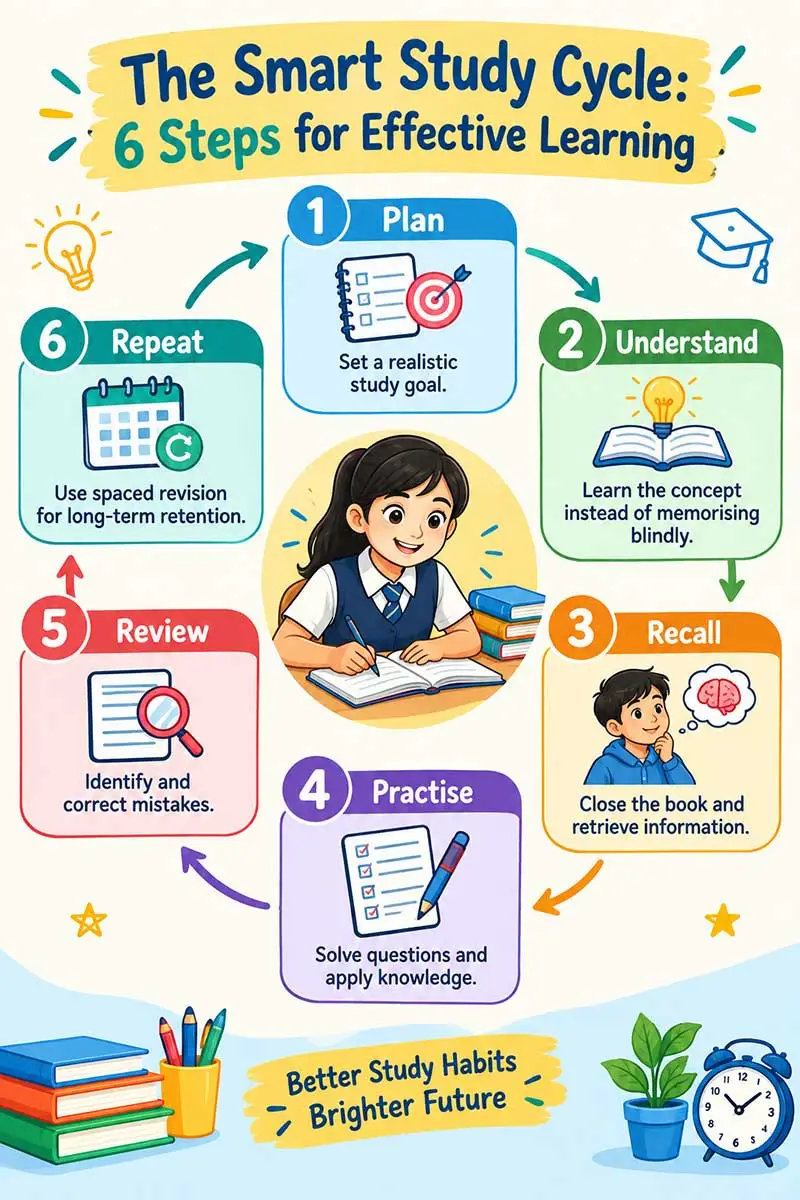
Good learning usually happens in three stages:
- Understand: Figure out what the concept really means.
- Retrieve: Try to remember it without peeking at the answer.
- Apply: Use it to solve problems and answer questions.
That’s why it helps to move beyond passive reading. Try this after studying the causes of the French Revolution. Close your textbook and ask yourself:
“What were the main causes, and can I explain each one without looking?”
If you can explain it in your own words, you’re pulling the idea out of your memory rather than simply recognising it on the page. That’s the difference that counts.
If you’d like extra academic support and revision material, you can also explore these CBSE study resources.
10 Effective Study Techniques for Students
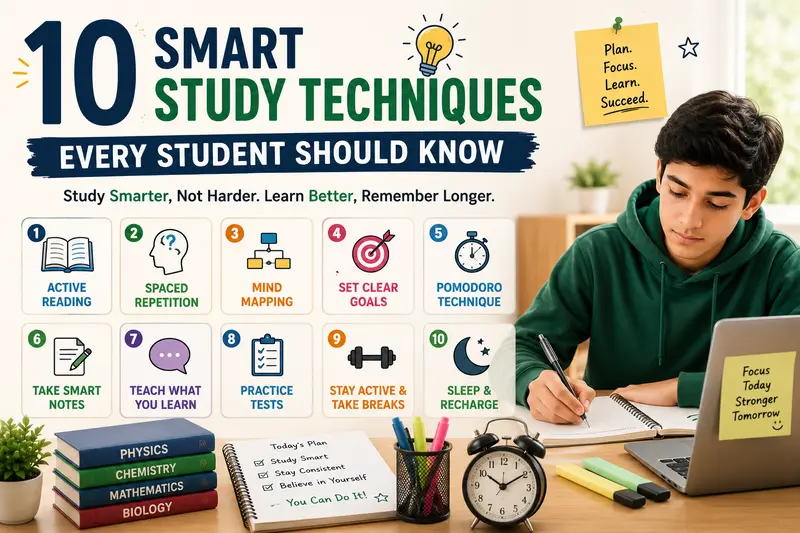
1. Use Active Recall
Active recall is one of the most powerful ways to strengthen memory. Instead of reading your notes again and again, close the book and try to pull the information out of your own head.
How to practise active recall
When you finish a topic:
- Close your textbook.
- Write down everything you can remember.
- Open your notes and check.
- Spot what you missed or got wrong.
- Review only those weak areas.
- Test yourself again a little later.
Example
Say you’re studying the human digestive system. Rather than reading the same page for the fifth time, quiz yourself:
- What does the stomach do?
- Where does digestion begin?
- What is the small intestine’s job?
- What are digestive enzymes?
- How do nutrients get absorbed?
It turns a quiet reading session into something more interactive, almost like having a conversation with yourself.
2. Practise Spaced Repetition
Spaced repetition simply means revisiting information at growing intervals instead of trying to cram everything into one sitting. Here’s a schedule you can borrow:
| Review | When to Revise |
| First review | Same day |
| Second review | 1–2 days later |
| Third review | About a week later |
| Fourth review | 2–3 weeks later |
| Final review | Before the exam |
Think of this as a guide, not a rule. Adjust it to the subject and to how well you actually remember the material.
Spaced repetition works especially well for:
- Definitions
- Formulae
- Vocabulary
- Dates
- Scientific terms
- Important facts
- Diagrams
- Languages
Pairing it with your school’s revision material is a great way to build a routine you can genuinely stick to.
3. Use Practice Testing
Practice testing just means answering questions before you look at the answers. It can take many forms:
- Previous-year questions
- Sample papers
- Chapter tests
- MCQs
- Short-answer and long-answer questions
- Quizzes you make yourself
The real value? It shows you exactly what you can’t recall yet, and it’s far better to discover that at your desk than in the exam hall.
A simple method
After finishing a chapter, spend 15–20 minutes answering questions without looking at your textbook. Then check your work and sort each mistake into one of four types:
A: I didn’t know the concept.
B: I knew it but forgot it.
C: I misunderstood the question.
D: I made a careless mistake.
That little sorting exercise tells you what kind of revision you actually need.
For more practice material, take a look at these CBSE sample papers and examination resources.
4. Try the Feynman Technique
The Feynman Technique is all about explaining a concept in simple language, as if you were teaching it to a friend who has never heard of it.
The four steps
Step 1: Pick a topic.
Step 2: Explain it in plain, simple words.
Step 3: Notice where your explanation gets shaky.
Step 4: Go back to the textbook and fill those gaps.
For example, instead of memorising a complicated definition of photosynthesis, start with this:
“Plants use sunlight to make food from water and carbon dioxide.”
Then add the scientific details your syllabus expects.
This is a lifesaver for the student who says, “I understand it when I read it, but I can’t explain it in the exam.”
5. Use the Pomodoro Technique Carefully
The Pomodoro technique splits your study time into focused stretches followed by short breaks. A simple version looks like this:
25 minutes: Focused study
5 minutes: Short break
25 minutes: Focused study
5 minutes: Short break
25 minutes: Focused study
15–20 minutes: Longer break
But don’t feel locked into 25 minutes. Older students often prefer 45–50 minutes of study with a 10-minute break. What really matters is having a clear stretch of uninterrupted concentration.
During that stretch:
- Keep your phone out of reach.
- Close unrelated browser tabs.
- Stay away from social media.
- Keep the books you need nearby.
- Decide exactly what you want to finish.
6. Use the SQ3R Method for Difficult Chapters
SQ3R stands for Survey, Question, Read, Recite, Review. It sounds fancy, but it’s really a friendly way to tackle a tough chapter:
- Survey: Quickly scan the headings, diagrams, tables, and summaries.
- Question: Turn each heading into a question.
- Read: Read the section carefully to find the answers.
- Recite: Close the book and explain the main ideas out loud.
- Review: Come back later and test your understanding.
It’s especially handy for theory-heavy subjects like Science, Social Science, Biology, and some Humanities subjects.
7. Make Mind Maps and Concept Maps
Sometimes ideas make more sense when you can see how they connect. A mind map about Water Resources, for instance, could have branches for:
- Sources
- Uses
- Conservation
- Rainwater harvesting
- Groundwater
- Water scarcity
- Management
Stick to short keywords instead of full paragraphs. Mind maps are wonderful for a quick look at a whole chapter just before an exam.
8. Use Interleaving Instead of Studying Only One Type of Problem
Interleaving means mixing related topics or question types while you practise. Instead of solving 30 identical maths problems in a row, you might try:
- 5 algebra questions
- 5 geometry questions
- 5 statistics questions
- 5 application-based questions
This forces your brain to work out which method to use, rather than repeating the same procedure on autopilot. It’s particularly useful for Mathematics and Science problem-solving.
9. Teach Someone Else
Teaching is one of the best tests of whether you truly understand something. You can explain a topic to:
- A classmate
- A sibling
- A parent
- A study partner
- An imaginary classroom
Ask your listener to interrupt whenever something isn’t clear. And if you can’t explain an idea without constantly checking your textbook, that topic probably needs another look.
10. Use Past Papers and Marking Criteria
Once you’re comfortable with the basic concepts, it’s time to practise answering questions in exam-like conditions. Here’s a routine that works well:
- Pick a previous paper or sample paper.
- Set a realistic time limit.
- Keep your books and notes away.
- Attempt the paper on your own.
- Check your answers carefully.
- Note down the mistakes you keep repeating.
- Revise the weak topics.
- Try another paper a little later.
And don’t only check whether the final answer is right. Pay attention to how your answers are structured, because that’s often where marks are won or lost.
How Can Students Improve Memory and Retention?
Good memory isn’t about repeating things over and over. It’s about connecting new information to what you already know, which makes it much easier to hold on to.
Try these memory strategies
- Chunking: Break big pieces of information into smaller groups.
- Mnemonics: Create memorable phrases or abbreviations.
- Association: Link new information to something familiar.
- Visualisation: Turn abstract ideas into an image or a mental scene.
- Storytelling: Weave a sequence of facts into a story.
- Self-testing: Recall information without looking at your notes.
Example of chunking
Instead of memorising a long list of unrelated facts, sort them into categories. For example, under Types of resources:
- Renewable: Solar, Wind, Water
- Non-renewable: Coal, Petroleum, Natural Gas
When information has a structure, your memory has something to hold on to.
How Should Students Make Notes?
Good notes help you revise quickly. They shouldn’t turn into a second copy of the textbook.
A useful note-taking structure
Topic: Photosynthesis
Definition: One or two lines
Key points:
- Needs sunlight
- Uses carbon dioxide
- Uses water
- Produces glucose
- Releases oxygen
Important equation: Write it out clearly.
Diagram: Add a labelled diagram if it helps.
Self-test: Write three questions at the bottom.
The Cornell note-taking system also works nicely for school students. Just divide your page into three parts:
- Main notes
- Keywords or questions
- Summary
Try to review your notes soon after the lesson, so any misunderstandings get fixed early instead of growing into bigger problems.
How Can Students Concentrate Better While Studying?
Concentration depends on your surroundings, your physical condition, your technology habits, and how tough the task is. The good news is that a lot of it is in your control.
Create a distraction-free study space
Before you begin:
- Keep only the materials you need on your desk.
- Put your phone on silent, or better, in another room.
- Turn off unnecessary notifications.
- Keep water nearby.
- Decide exactly what you’ll work on in this session.
- Choose a comfortable, well-lit spot.
Try the “one-task rule”
Instead of writing this on your to-do list:
Study Science
Try writing this:
Complete and test myself on Chapter 3: Acids, Bases and Salts
A specific target makes it so much easier to get started. And if your focus keeps slipping, take a short, planned break instead of drifting off to social media.
How to Create an Effective Study Schedule
A good timetable is realistic, flexible, and specific. Start by listing:
- Your subjects
- Chapters still remaining
- Upcoming tests
- Homework
- Revision needs
- Practice-paper needs
- Breaks and personal activities
Then divide your available time across them.
Weekly study planning checklist
| Task | Completed? |
| List subjects and chapters | ☐ |
| Identify difficult topics | ☐ |
| Schedule revision | ☐ |
| Include practice questions | ☐ |
| Include breaks | ☐ |
| Keep time for hobbies and exercise | ☐ |
| Review progress at the end of the week | ☐ |
One gentle warning: don’t make a timetable that leaves no room for rest. A schedule you can’t realistically follow will end up abandoned within a week or two.
A Sample Daily Study Schedule for Students
Treat this as an example, not a fixed timetable. Adjust it to your school timings, tuition, homework, travel, sleep, and personal needs.
| Time | Activity |
| 6:30–7:00 AM | Quick revision or flashcards |
| School hours | Classes and active participation |
| 4:00–5:00 PM | Rest, snack, outdoor activity |
| 5:00–5:50 PM | Mathematics / problem-solving |
| 5:50–6:05 PM | Break |
| 6:05–6:55 PM | Science / concept study |
| 6:55–7:30 PM | Dinner and rest |
| 7:30–8:20 PM | Language / Social Science |
| 8:20–8:35 PM | Break |
| 8:35–9:00 PM | Active recall and revision |
| 9:00 PM onward | Get ready for tomorrow and wind down |
Use it as a starting point, then tweak it until it feels like your own routine.
What Should Students Do Before an Exam?
In the final days before an exam, the goal is retrieval, practice, and targeted revision, not relearning the entire syllabus from scratch.
7-day revision checklist
Days 7–6: Review the major concepts.
Days 5–4: Practise your weak chapters.
Day 3: Attempt a timed paper.
Day 2: Analyse your mistakes and revise the difficult areas.
Day 1: Do a light revision of formulae, definitions, diagrams, and key concepts.
Exam morning: Glance through brief notes if you need to, and avoid starting a brand-new difficult topic unless it’s absolutely necessary.
It’s also a good idea to follow the latest official exam information and curriculum requirements from the Central Board of Secondary Education (CBSE). You can find them on the CBSE Official Website.
For curriculum-related learning, National Council of Educational Research and Training (NCERT) textbooks should stay at the heart of your preparation. Here’s the NCERT Official Website.
Common Study Mistakes to Avoid
Studying for Long Hours Without a Plan
Long sessions don’t automatically mean good learning. Give every session a specific goal.
Rereading Everything
Rereading creates a comfortable feeling of familiarity, but it doesn’t tell you whether you can actually recall the material.
Studying Only the Easy Subjects
It’s natural to stick with subjects you enjoy and postpone the tough chapters. Try to set aside regular time for your weaker areas.
Ignoring Mistakes
Mistakes are useful feedback. Keep a mistake notebook with:
- The question
- Your answer
- The correct answer
- The reason you slipped
- The correct method
Leaving Revision Until the Last Minute
Last-minute cramming piles on pressure and leaves you almost no time to find and fix learning gaps.
Using the Phone During Every Break
If every five-minute break turns into a 30-minute scroll, your whole schedule can fall apart very quickly.
Sacrificing Sleep
Sleep is not wasted study time. A routine you can keep up needs proper rest and recovery.
One-Page Study Checklist
Before studying
☐ Decide today’s topic
☐ Set a specific goal
☐ Keep required materials ready
☐ Remove distractions
During studying
☐ Understand the concept
☐ Make concise notes
☐ Use active recall
☐ Solve practice questions
☐ Mark difficult areas
After studying
☐ Test yourself without notes
☐ Check your mistakes
☐ Review difficult points
☐ Schedule the next revision
Every week
☐ Review completed chapters
☐ Identify weak subjects
☐ Practise previous or sample questions
☐ Update your study timetable
☐ Take adequate breaks
Download Printable One-Page Study Checklist ⬇️
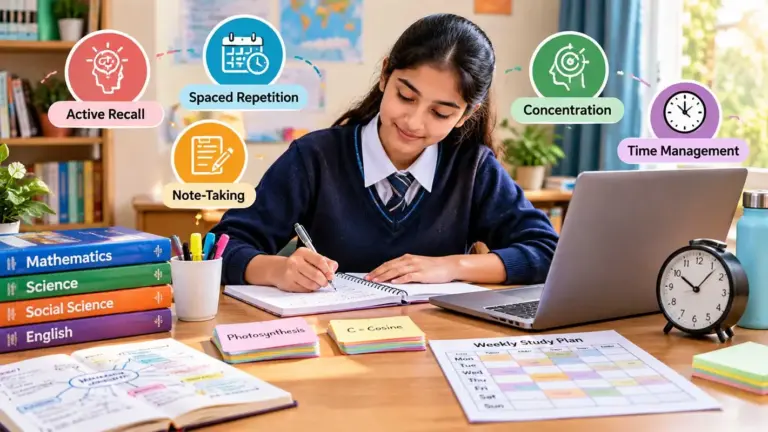
IMAGE:
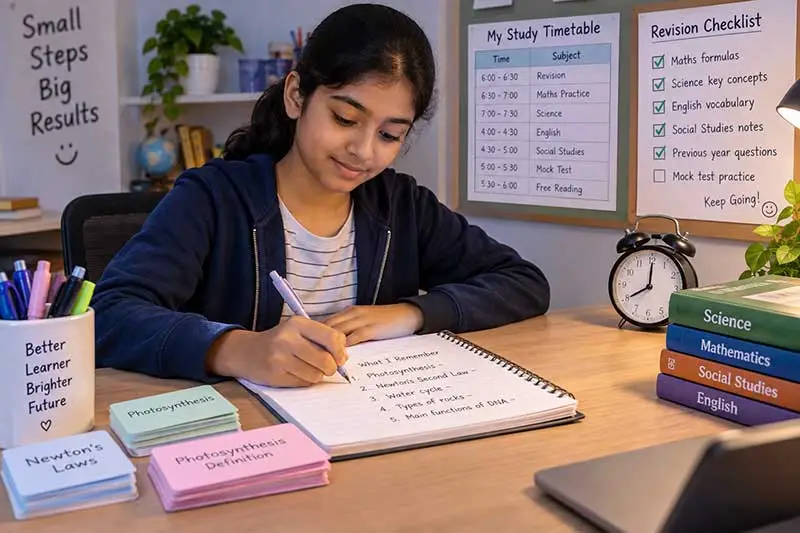
Indian student practicing active recall by writing answers from memory at a study desk with flashcards and revision checklist
File name: indian-student-active-recall-study-desk.png
Key Takeaways
- Active recall trains you to retrieve information, not just recognise it.
- Spaced repetition spreads revision over time and helps you remember for the long run.
- Practice testing shows you the gaps before the exam does.
- Use mind maps, concise notes, and memory techniques to organise what you learn.
- Break big tasks into smaller, specific study goals.
- Keep your phone and notifications away during focused sessions.
- Build a realistic timetable with room for revision, practice, breaks, sleep, and everything else in your life.
- Learn from your mistakes instead of just counting marks.
- Practise with previous and sample papers to get used to exam conditions.
- Steady, consistent effort beats last-minute cramming almost every time.
Frequently Asked Questions
1. What is the most effective study technique for students?
There’s no single technique that works equally well for every student or every subject. Active recall, spaced repetition, practice testing, focused study sessions, and deliberate practice are all useful. The best approach is to combine them based on the subject, your goal, and how far along your preparation is.
2. How many hours should a student study every day?
It depends on your age, grade, school workload, homework, exams, and personal needs. Rather than counting hours, focus on the quality and purpose of each session. And remember to include planned breaks and enough sleep.
3. Is studying at night better than studying in the morning?
Neither is automatically better for everyone. Some students focus best in the morning, others prefer the evening. What matters is your concentration, consistency, enough sleep, and a schedule that fits your daily responsibilities.
4. How can I remember what I study for a longer time?
Use active recall and spaced repetition. After learning a topic, close your book and explain or write down what you remember. Then review it again at growing intervals, and use practice questions to strengthen your recall.
5. How can I stop getting distracted while studying?
Begin with a specific goal, remove unnecessary devices and notifications, keep your study area tidy, and use timed focus sessions. If you need your phone for learning, switch off unrelated apps and notifications while you study.
6. Should students make handwritten notes?
Handwritten notes can be really helpful, especially when you summarise concepts, draw diagrams, or organise ideas in your own way. But the key is how you make them. Copying an entire textbook isn’t nearly as useful as writing concise notes that support understanding and recall.
7. How should I study one day before an exam?
Don’t try to learn the whole syllabus from scratch. Focus on key concepts, formulae, definitions, diagrams, question types you’ve practised often, and topics you know are weak. Use active recall and short practice tests rather than rereading the textbook.
8. How can CBSE students prepare effectively for board examinations?
Start by understanding the prescribed curriculum and learning objectives. Study your NCERT materials carefully, practise relevant questions, revise systematically, and keep an eye on official CBSE examination information. Good preparation blends conceptual understanding, written practice, revision, and time management.

Student Success Desk focuses on practical learning strategies, study techniques, and academic improvement tips for school students.