

A Practical Guide for Students
Quick answer: A study schedule works when it fits your real day, puts the important subjects first, builds in revision, and leaves room to rest. List your subjects and deadlines, see how much time you honestly have, set small daily goals, and check in once a week to tweak the plan instead of abandoning it.
What Is a Study Schedule?
A study schedule is a plan for what you will study, when, and for how long. It takes the guesswork out of your evenings, so you are not deciding at 6 p.m. where to begin.
The best ones are more than a grid of subject names. Instead of “Mathematics, 5:00–6:00 p.m.”, write “Solve 10 algebra questions and fix my mistakes.” Now you know exactly what “done” looks like.
A good schedule is realistic, specific, balanced, flexible, and measurable. The aim is not to study every spare minute. It is to use your time well, day after day.
Why Do Many Study Timetables Fail?
We have all done it: a new term begins, we draw up a gorgeous timetable, and by Thursday it is forgotten. The common culprits:
- Planning more hours than you really have.
- Giving every subject equal time, whatever its difficulty.
- Vague goals like “study Science”.
- Forgetting homework, travel, tuition, and family commitments.
- Long sessions with no breaks, and revision saved for the last few days.
- Treating one missed session as the end of the plan.
Picture a Class 10 student who plans five hours every evening after school. It works for a couple of days, then tiredness wins. Starting with two or three focused sessions and adjusting from there would have served them far better.
The best timetable is not the toughest one. It is the one you can actually stick to.
How to Create a Study Schedule Step by Step
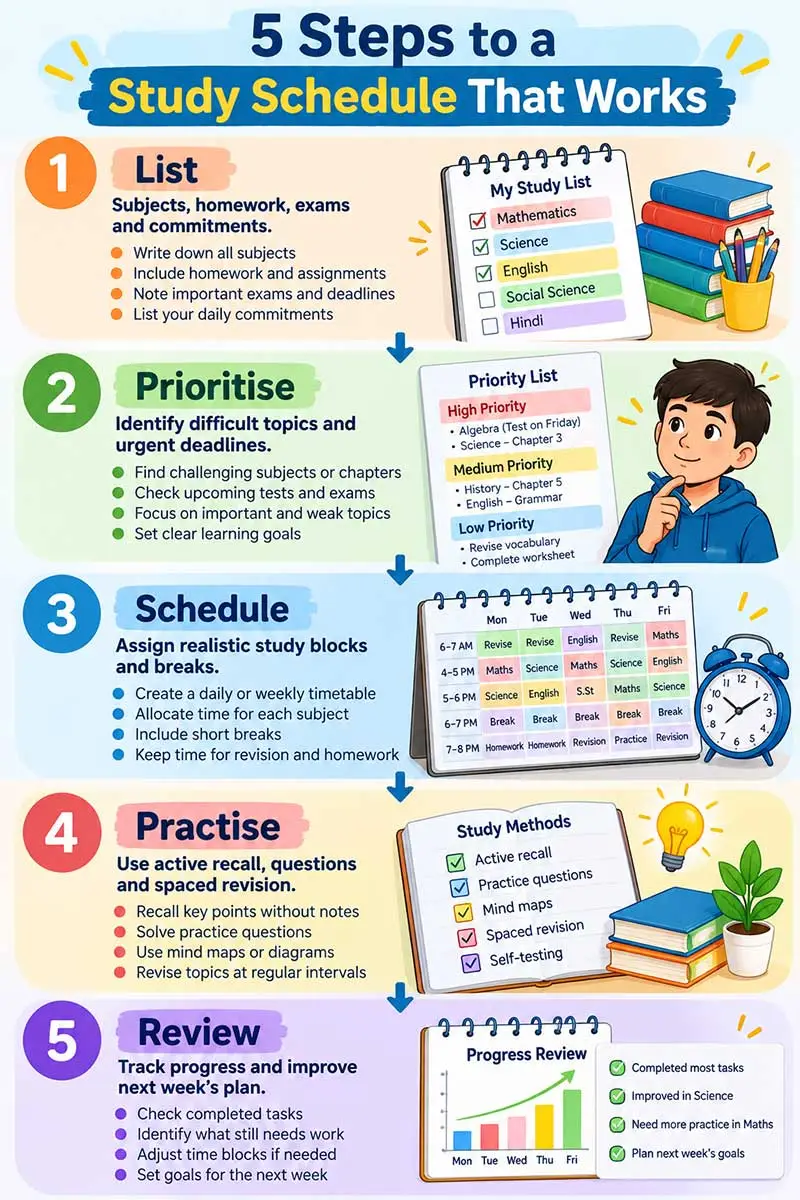
Here are eight steps to build a timetable that suits your goals and your everyday life.
Step 1: List Your Subjects and Responsibilities
Write down everything you need to study: subjects, homework, projects, practicals, and upcoming tests. A CBSE student’s list might include Mathematics, Science, Social Science, English, and a second language, plus practicals and entrance preparation in Classes 11–12.
Then note your fixed commitments: school and travel, tuition, meals and chores, exercise and family time, and sleep. Whatever hours remain are your real study time. Plan around that, not an imaginary routine.
Step 2: Identify Your Priorities
Not every subject needs the same attention every day. Look for topics that are tricky, often tested, or coming up soon.
| Priority | Type of task | Example |
| High | Urgent or difficult | Revise a Mathematics chapter before Friday’s test |
| Medium | Important but less urgent | Practise Science numericals |
| Low | Routine or already familiar | Review vocabulary or completed notes |
Give high-priority tasks your sharpest hours, but do not ignore the easier subjects for too long. For curriculum and exam resources, the official CBSE Academic website is worth bookmarking. Always follow the syllabus for your current session, not old notes.
Step 3: Set Specific, Achievable Goals
Vague goals are hard to start and hard to judge. Turn each subject into something you can finish and check.
| Vague goal | Better study goal |
| Study Physics | Understand Newton’s laws and solve 8 numericals |
| Learn History | Review one chapter and recall 10 key events |
| Study Mathematics | Solve 15 questions and correct errors |
Plan the next action, not just the subject: “Complete questions 1–10” is far easier to begin than “finish Mathematics.” Split big chapters across several days.
Once you have given each question an honest try, NCERT solutions on Cogniks can help you check your answers and see where you slipped.
Step 4: Give Each Task the Time It Needs
Estimate how long each task will take, then slot it in. Maybe 45 minutes for Maths practice, 30 for language revision, 40 for Science. Treat these as starting guesses. Give difficult or urgent subjects more time and set aside a small daily slot for reviewing old material.
Do not fill every minute. A packed schedule falls apart the moment school hands you an extra assignment.
Step 5: Find Your Best Study Hours
Some of us focus well after a short rest following school; others think best early in the morning. Try different slots and notice when hard material makes the most sense. Many students do homework after school, tackle Maths or Physics in the early evening, and keep flashcards for later.
Never trade sleep for extra study hours. A timetable should help you learn, not leave you exhausted at school.
Step 6: Study in Focused Blocks
Longer is not automatically better. Two popular rhythms are 25 minutes of study with a 5-minute break, or 45 minutes with a 10-minute break. Younger students usually prefer shorter blocks.
In each block, keep only what you need on the desk, silence your phone, focus on one task, and take a real break afterwards. For more ideas, explore effective study techniques and adapt them to your subjects.
Step 7: Build in Revision
The biggest mistake students make is spending all their time on new lessons. Without revision, even well-understood topics fade. Try spaced revision: return to a topic at growing intervals.
| When to revise | What to do |
| Same day | Recall the main ideas without your notes |
| Next day | Answer a few questions from memory |
| After 3–4 days | Solve problems or explain the topic aloud |
| After one week | Take a short self-test |
| After 2–4 weeks | Review difficult points and test yourself again |
Treat these gaps as a starting point, not a formula. If you keep forgetting something, revisit it more often, and keep revision notes short.
Step 8: Review Your Schedule Every Week
Spend 10–15 minutes each week asking yourself: Which tasks did I finish? Which subjects need more time? Which sessions kept getting interrupted?
If a 30-minute task keeps taking 60, change the estimate. If a slot never works, move the task. Tweak the same schedule each week rather than starting from scratch every day.
How to Choose the Right Study Method
Your timetable decides when you study. Your methods decide what you do with that time.
| Study method | How it works | Best suited for |
| Active recall | Close the book and retrieve from memory | Definitions, dates, formulas |
| Spaced repetition | Review over days or weeks | Languages, terminology |
| Practice questions | Solve before checking solutions | Maths, Science, exam prep |
| Mind maps | Connect related ideas visually | Biology, History |
| Self-explanation | Explain a concept in your own words | Difficult concepts |
| Practice tests | Answer under timed conditions | Board and competitive exams |
Recall and spaced practice work because they make you retrieve information instead of just rereading it. After studying the water cycle, close your textbook and draw it from memory, then fix any errors.
For more subject-specific guidance, see CBSE study resources and exam preparation tips.
Sample Daily Study Timetable for Indian Students
Here is a starting point for a middle- or secondary-school student.
Example: Daily Timetable for a School Day
| Time | Activity |
| 6:00–7:00 a.m. | Wake up, get ready, light revision or flashcards |
| 7:00 a.m.–3:00 p.m. | School and travel, adjusted to actual timings |
| 3:00–4:00 p.m. | Lunch and rest |
| 4:00–4:45 p.m. | Homework and school assignments |
| 5:00–5:45 p.m. | Mathematics practice |
| 5:45–6:15 p.m. | Outdoor play or physical activity |
| 6:15–7:00 p.m. | Science or another demanding subject |
| 7:00–7:30 p.m. | Dinner or family time |
| 7:30–8:15 p.m. | Language or reading, then pack bags and plan tomorrow |
| 8:15 p.m. onward | Relax and follow a bedtime routine |
This is an example, not a requirement. Shift the times to match your school hours, tuition, age, and sleep needs. What matters is the balance of homework, focused study, revision, activity, and rest.
How to Plan a Weekly Study Schedule
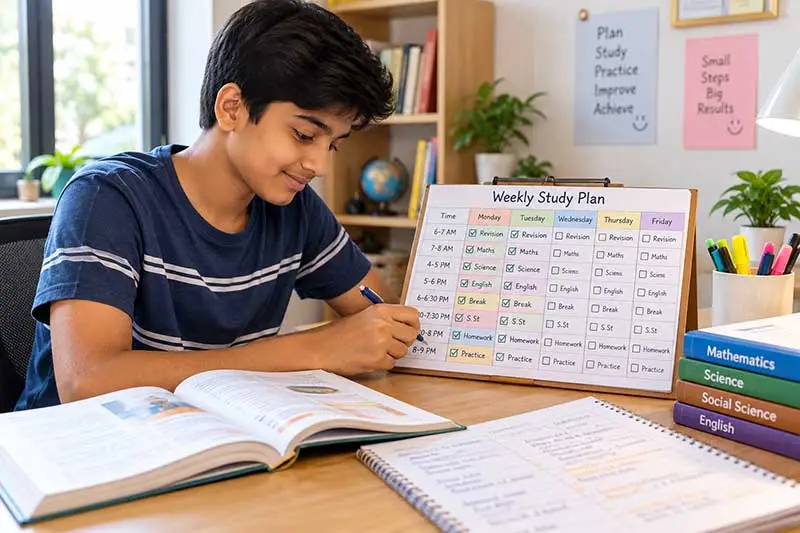
A daily timetable tells you what to do today. A weekly plan makes sure every subject gets its turn. List the chapters, assignments, and tests due this week, then spread them across the days.
Example of a Weekly Subject Rotation
| Day | Main focus | Additional task |
| Monday | Mathematics | Review English vocabulary |
| Tuesday | Science | Practise a language lesson |
| Wednesday | Social Science | Solve Mathematics questions |
| Thursday | Mathematics | Revise Science concepts |
| Friday | English and second language | Complete pending homework |
| Saturday | Difficult or unfinished chapters | Take a short self-test |
| Sunday | Weekly revision | Plan the next week |
A rotation like this stops you from studying only your favourites. On Sunday, carry forward only the most important unfinished tasks, or the backlog just grows.
How Much Time Should You Spend Studying Every Day?
There is no magic number. It depends on your age, class, workload, and exam dates. Primary students do best with short, guided sessions and frequent breaks. Classes 9–10 need a balanced routine with written practice, and Classes 11–12 need a subject-specific plan covering concepts, practicals, and any entrance preparation. Increase your hours only when your routine feels manageable, because more hours do not mean better learning if you are tired.
Study Schedule for CBSE Board Exams
Class 10 and 12 students need a timetable that blends finishing the syllabus, revising, and timed practice. Start by checking the syllabus for your session. The NCERT textbook portal has textbooks for Classes I–XII, and CBSE shares official sample question papers and examination resources too.
Divide Your Preparation into Three Phases
- Phase 1, understand the syllabus: find unfinished chapters, learn from textbooks and notes, ask teachers about tricky topics, and finish the essential textbook questions.
- Phase 2, revise and practise: revisit chapters with active recall, solve chapter-wise questions, practise diagrams and formulas, and keep an error notebook.
- Phase 3, test and refine: attempt sample papers within time limits, check them against the marking scheme, and revise weak areas.
Do not wait for the whole syllabus to be finished before revising. Revisit completed chapters as you go.
How Should You Allocate Time Before an Exam?
| Time remaining | Main priority |
| 2–3 months | Complete the syllabus and begin regular revision |
| 4–6 weeks | Strengthen weak chapters and practise questions |
| 2–3 weeks | Revise key concepts and attempt sample papers |
| Final few days | Review concise notes, formulas, and common errors |
Adapt these guidelines to your own dates, and avoid learning topics from scratch in the final days. Focus on closing gaps and getting enough rest.
How to Make Your Study Schedule Work
A timetable is only the first step. These habits help you actually follow it.
- Try the two-minute rule. Before each session, set out your books and write down the task. Starting gets easier.
- Keep your phone away. Leave it outside your study area or use Do Not Disturb.
- Track completion, not just hours. Two hours at a desk can achieve very little. Count questions solved, chapters revised, and mistakes corrected.
- Prepare hard tasks in advance. If Maths is a struggle, pick the exact exercise before you sit down.
- Have a recovery rule. When you miss a session, do not try to win back every lost minute. Move the task to the next suitable slot and carry on. Consistency means coming back to the plan, not following it perfectly.
- Protect sleep and breaks. Late nights leave you too tired to learn well the next day. Keep a steady bedtime and make time for meals, movement, and fun.
Common Study Schedule Mistakes to Avoid
| Mistake | Better approach |
| Planning every minute | Leave buffer time for the unexpected |
| Studying only easy subjects | Put difficult subjects in your focused hours |
| Revising only before exams | Schedule short, regular revision |
| Copying a friend’s timetable | Adapt your schedule to your own needs |
| Giving up after one bad day | Resume with the next planned task |
Printable Study Schedule Checklist
Copy this into a notebook or print it as a simple planning sheet at the start of each week.
Weekly Planning
- I have listed my subjects, assignments, and upcoming tests.
- I know my three most important priorities.
- I have given my tasks realistic time slots, with breaks, sleep, and revision included.
Daily Progress
- I know the specific task for each session.
- I kept distractions away and practised recalling without my notes.
- I checked my answers and corrected mistakes.
End-of-Week Review
- I reviewed what I completed and which subjects need more attention.
- I adjusted unrealistic time estimates and planned next week.
Use it as a guide, not a test of perfection.
Key Takeaways
- A good study schedule is realistic, specific, flexible, and measurable.
- List your commitments first, then see how much time you really have.
- Set clear goals for each session and prioritise difficult or urgent topics.
- Combine active recall, spaced revision, and practice questions, and balance study with breaks and sleep.
- Review weekly, and if you miss a session, return to the plan instead of abandoning it.
Start small, follow your plan for a week, and improve it based on what works for you.
Frequently Asked Questions
1. How do I create a study schedule for the first time?
List your subjects, commitments, and deadlines. Pick two or three tasks per day, give them realistic time slots, and add breaks and revision. Follow it for a week before changing much.
2. How many hours should a student study daily?
There is no universal number. It depends on your age, class, and workload. Aim to complete meaningful tasks rather than chase a figure.
3. What is the best time to study?
When you can concentrate without interruptions. Pick a consistent slot, morning or evening, that does not cut into sleep.
4. How can I follow my timetable consistently?
Set small, specific goals, remove distractions, track completed tasks, and leave buffer time. Change any session that keeps proving unrealistic.
5. Is the Pomodoro technique effective for studying?
It can be. Alternating focused work with short breaks helps manage distractions. A common version is 25 minutes on, 5 minutes off, though longer sessions are fine if they suit you.
6. How should I prepare a timetable for CBSE board exams?
Start with the current syllabus and exam dates. Finish the syllabus, revise regularly, practise written answers, and attempt sample papers.
7. Should I study one subject or several in a day?
Two or three subjects a day spreads the workload, though demanding tasks sometimes need a longer, uninterrupted session.
8. What if I cannot complete my timetable?
Work out why: the plan may be too demanding, or something unexpected came up. Prioritise unfinished work, adjust future sessions, and carry on.
9. Should I make a daily or weekly schedule?
Both. The weekly plan spreads subjects and revision across the week; the daily plan turns it into specific tasks and time slots.

Student Success Desk focuses on practical learning strategies, study techniques, and academic improvement tips for school students.