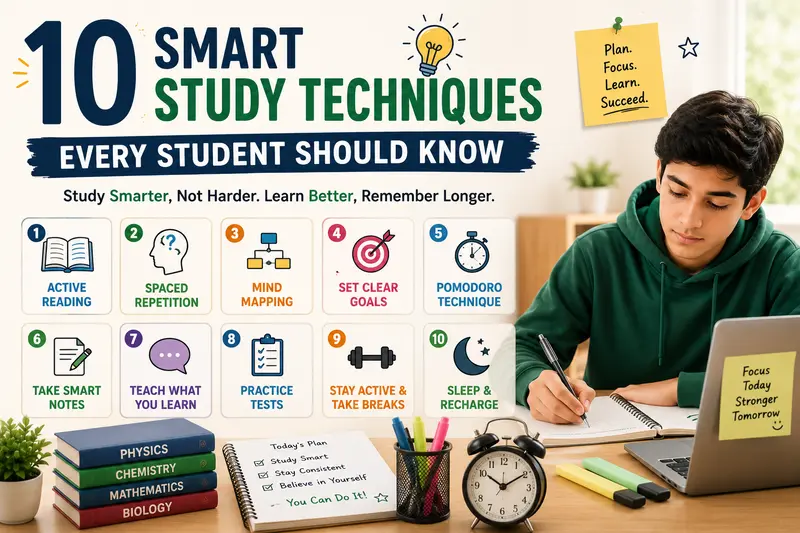
Studying smarter, not harder, means using methods that help you understand ideas, remember them for longer, and walk into an exam knowing what you can actually do. The basics are simple: test yourself instead of rereading, revise at spaced intervals, practise questions early, keep notes short, and plan a timetable you can really follow. Steady habits beat cramming every time.
What Does Studying Smarter Actually Mean?
It means judging your effort by what you learn, not by how long the book stayed open. Picture two Class 10 students preparing for a science test.
- Student A reads the chapter three times, highlights half the page, and spends two hours with the textbook.
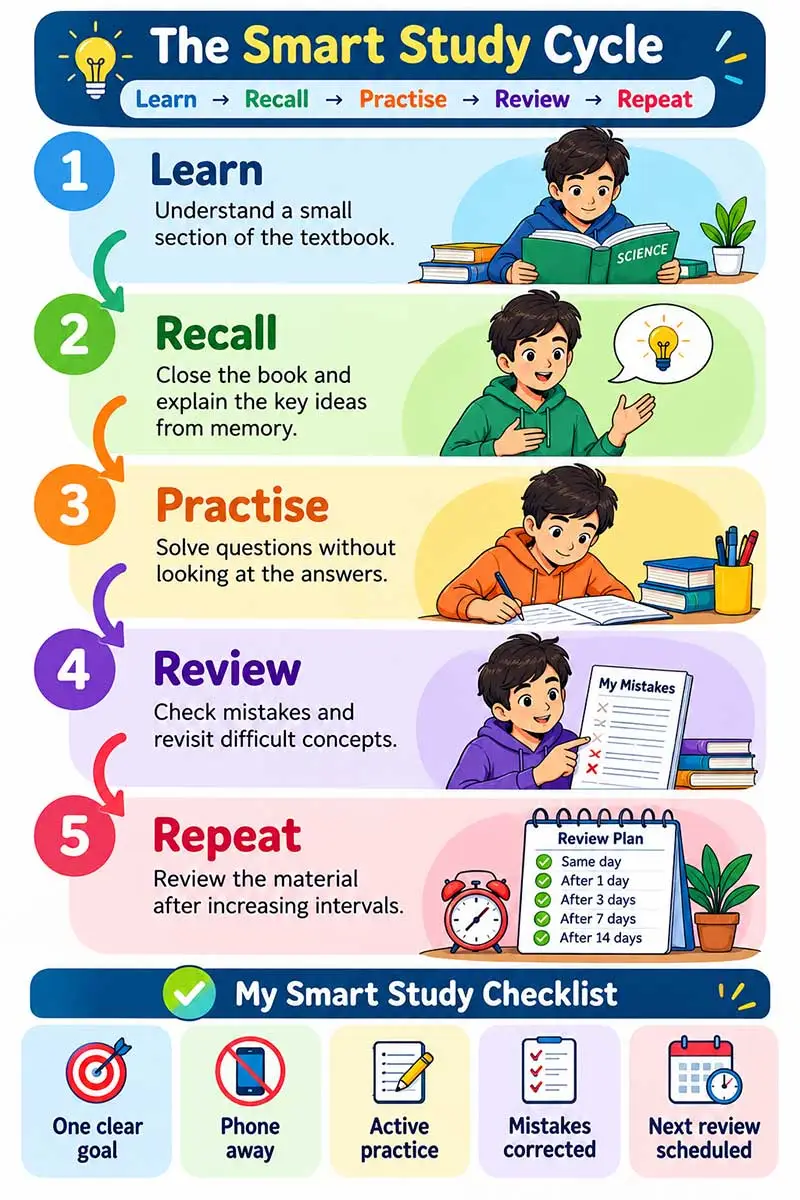
- Student B reads it once, closes the book, writes down the main ideas, solves five questions, checks the mistakes, and revisits the tricky bits the next day.
Both work hard, but only Student B is finding out what they don’t know yet, while there’s time to fix it. Smart studying isn’t about doing less. It’s about aiming your effort well.
Why Long Study Hours Don’t Always Work
Plenty of students reread a familiar page for an hour and then realise they can’t explain it without peeking. A few habits quietly waste your effort:
- Passive reading: seeing the same words again feels like knowing them, but it isn’t.
- Cramming: learning everything the night before leaves no room for spaced revision.
- Short sleep: late nights hit attention and memory the next day.
So instead of asking “How many hours did I study?”, try “What can I explain, remember or solve without looking at my notes?” That’s the number worth tracking.
10 Practical Ways to Study Smarter
These work from primary classes to Class 12, for school tests, CBSE boards or entrance exams.
1. Use Active Recall Instead of Rereading
Active recall means trying to remember something without looking. It turns revision into a mini test of what you really know.
- Read a small section carefully.
- Close the book.
- Write down the main ideas or explain them aloud.
- Reopen the book and check what you missed.
After the digestive system in Class 10 Biology, try drawing the whole tract from memory and naming what each organ does. Headings work too: see “Causes of the Revolt of 1857” and list the causes before you check.
Download the free Active Recall Practice Worksheet (PDF)
2. Space Out Your Revision
Spaced repetition means coming back to a topic after gaps instead of cramming it in one sitting. Each return makes your brain work to retrieve the idea, and that effort helps it stick. A simple schedule for a new topic:
| Review | When | What to do |
| First | Same day | Recall the key ideas |
| Second | After 1 day | Answer questions without notes |
| Third | After 3 days | Solve practice questions |
| Fourth | After 7 days | Take a short self-test |
| Fifth | After 14 days | Check what has stayed with you |
Treat these gaps as a starting point, not a scientific law. If you struggled to remember something, revisit it sooner; if it came easily, stretch the gap. Revising NCERT chapters this way through the year means no last-minute relearning.
Download the free Spaced Repetition Revision Planner (PDF)
3. Break Big Topics into Small Tasks
A chapter feels less scary once it’s cut into specific jobs. Instead of writing “Study Maths” in your timetable, write “Understand three examples from quadratic equations”, “Solve ten questions without peeking at the solutions” or “Go over yesterday’s mistakes.” Small tasks are easier to start and satisfying to tick off.
4. Try the Pomodoro Technique
Pomodoro splits study time into short, focused bursts with small breaks, which helps if your attention tends to wander. A two-hour plan could be four 25-minute sessions: learn a new concept, practise questions on it, work on a weak area, then test yourself and review your mistakes. Take five minutes between sessions to stretch or drink water, and a longer rest at the end.
Twenty-five minutes is the classic length, but adjust it: younger children may prefer 15–20 minutes, older students 40–50. The point is to protect your focus, not to obey a timer.
5. Practise the Feynman Technique
Pick one concept and explain it aloud in plain language, as if you’re teaching a friend who has never heard of it. Notice where you get vague or tangled, go back to the textbook for those parts, then explain it again with a simpler example.
A Class 8 student studying friction might compare pushing a toy car across a smooth floor and a rough one. If you can’t say why it moves differently, that’s your cue to review.
Download the free Feynman Technique Worksheet (PDF)
6. Start Practising Questions Before You Feel Ready
Lots of students keep reading until they feel “done” and then run out of time for practice. Don’t wait. Once you’ve got the basics, start on questions from your NCERT textbooks, school worksheets, sample papers and previous papers. If you want a method for sample papers, try this three-round approach to solving CBSE sample papers. Our list of the best free educational resources for CBSE students has more options.
Then follow three steps: attempt the question on your own, check it against the solution or marking scheme, and correct it by working out why you went wrong and solving it again. Keep a mistake notebook with the question type, your error, the right approach and a date to retry. It’s especially useful in Maths and Physics, where knowing a formula isn’t the same as using it correctly.
Download the free Mistake Notebook Tracker (PDF)
7. Draw Mind Maps
A mind map puts a topic in the centre and branches out to related ideas. For “Natural Resources”, the branches might be water, forests, minerals, soil, conservation and sustainable use. Stick to short keywords, arrows and small diagrams rather than copied paragraphs. If yours turns into another page to memorise, it’s too long.
8. Use Mnemonics for Things You Just Have to Memorise
Acronyms, rhymes and silly phrases can help with sequences and lists, like the order of the planets. Decide exactly what you need to remember, build a short association, and test yourself without looking at it. But a mnemonic only helps you recall a fact. It can’t replace understanding, and remembering a formula is no use if you don’t know when to apply it.
9. Set Up a Study Spot That Helps You Focus
You don’t need an expensive desk or a separate room. Keep only what you need for the task on the table, put your phone away or switch on focus mode, keep water and rough paper within reach, and pick a reasonably quiet, well-lit place. Tell your family when you’re studying.
Living in a busy home? Choose a time when interruptions are fewer, or find a quiet corner. Parents who want to help can start with our guide on how to support your child during board exam preparation.
10. Review Your Progress Every Week
At the end of each week, ask yourself: Which chapters can I explain without notes? Which question types still trip me up? Did I finish my planned practice? Then adjust your plan. If you score well on a chemical reactions test but keep slipping on balancing equations, spend the next session on balancing equations instead of rereading the whole chapter. Small gaps are easy to fix this week and painful to fix the night before.
Download the free Weekly Progress Review Worksheet (PDF)
How to Build a Study Timetable You’ll Actually Follow
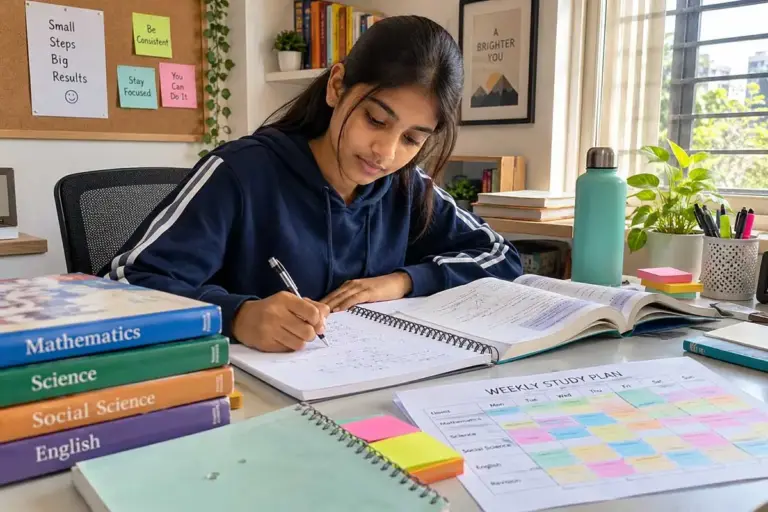
A good timetable balances school, homework, revision, practice, rest and the rest of your life. It should match your real routine, not an ideal one you’ll abandon by Wednesday. For a step-by-step walkthrough, read our guide to creating a study schedule that actually works. Here’s a sample for a student who is at school during the day; adjust it for tuition, travel and family commitments.
| Time | Activity |
| 6:00–7:00 am | Wake up, get ready, quick revision of earlier topics |
| 7:00 am–3:00 pm | School, travel and lunch |
| 3:00–5:00 pm | Rest and snack, then Mathematics practice with a short break |
| 5:00–5:45 pm | Science or another demanding subject |
| 5:45–7:15 pm | Outdoor play or exercise, then homework |
| 7:15–8:00 pm | Dinner and family time |
| 8:00–9:00 pm | English, social science or language revision, then plan tomorrow |
| 9:00–9:30 pm | Wind down for sleep |
Download the free Weekly Study Timetable Template (PDF)
It’s only a sample, not a rulebook. Younger students need shorter sessions, older ones may need more time for exam practice, and nobody should trade sleep for a timetable.
Not every subject needs equal time every day. Put difficult topics, upcoming tests and repeat mistakes first, give topics you understand but need to practise a medium slot, and review the ones you’re confident in now and then. A Class 10 student might split Maths, Science and Social Science across the week, with short daily reviews in between. Preparing for boards? Our CBSE exam preparation tips cover what to focus on as exams get closer.
Take Notes You’ll Actually Use
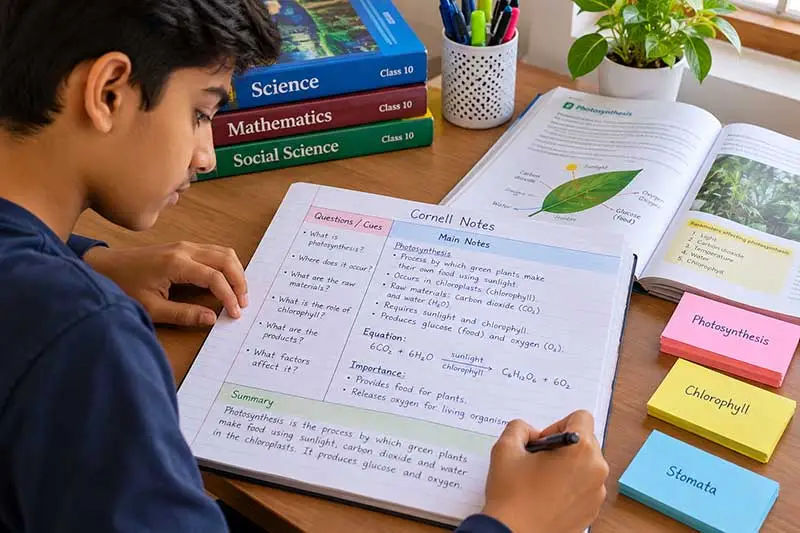
Good notes make revision faster because they hold the important stuff without copying the whole textbook. A popular option is the Cornell method: divide the page into main notes (concepts, examples, formulas), a cue column (questions and keywords) and a short summary in your own words at the bottom. For photosynthesis, the cue column might ask, “What does chlorophyll do?” When you revise, cover the main notes and answer the cues. Flashcards, mind maps and a mistake notebook work well alongside it.
Don’t burn hours decorating notes. They’re good when they help you recall and apply ideas.
Staying Focused While You Study
Focus isn’t just willpower. Distractions, tiredness and your surroundings all play a part.
Keep your phone from running the show
Keep it out of arm’s reach during sessions, turn off non-essential notifications, and decide in advance when you’ll check messages. Our online learning tips for school students go deeper on this.
Look after your body
Sleeping less to make up for poor planning backfires. Keep a regular sleep routine, eat proper meals, drink water and move around daily. Teenagers generally need around 8–10 hours of sleep, and younger children need more. For more, browse our student wellness articles.
When you just don’t feel like it
When a task feels huge, shrink the first step. Instead of “I must finish the whole History chapter”, try “I’ll read two pages and answer three questions.” Starting is usually the hardest part. If you’re still exhausted, take a proper break first.
Smart Study Strategies by Subject
Different subjects need different kinds of practice, so match the technique to what you’re trying to learn.
| Subject | Smart study strategy |
| Mathematics | Solve problems independently and analyse your errors |
| Science | Link concepts to diagrams, experiments and applications |
| Social Science | Use timelines, maps and cause-and-effect charts |
| English | Practise reading, writing and grammar, then edit your own answers |
| Hindi and other languages | Use vocabulary cards and regular written practice |
| Computer Science | Write, trace and debug code; predict the output first |
In Maths, don’t just read worked solutions; attempt the question first. For languages, regular writing and speaking beat memorising long lists of rules. In Science and Social Science, keep asking why something happened and how a process works. That fits the growing focus on conceptual understanding and competency-based learning in Indian schools.
Common Study Mistakes (and Better Alternatives)
| Common mistake | Better alternative |
| Rereading the same chapter | Close the book and recall the main points |
| Highlighting almost every line | Highlight the essentials, then test yourself |
| Memorising without understanding | Learn the idea and practise explaining it |
| Dodging difficult questions | Attempt them, find the gap, try again |
| Revising only before exams | Schedule short reviews through the term |
One more trap is assuming you’ve mastered a question because the solution looks familiar. Real mastery means solving it alone and handling a slightly different version.
Download Printable File ⬇️
A Printable Daily Study Checklist
Tick this off at the end of each day. It tracks learning, not hours.
My Daily Smart Study Checklist
- I set a clear goal before each study session.
- I studied without unnecessary distractions.
- I solved practice questions and corrected my mistakes.
- I planned tomorrow’s priorities.
- I left enough time for rest and sleep.
Use it as a guide, not a verdict on your worth.
Download the free Daily Smart Study Checklist (PDF)
Key Takeaways
- Measure learning, not hours: judge progress by what you can explain and solve alone.
- Test yourself: active recall beats rereading.
- Practise early and often: exercises, worksheets and sample papers.
- Plan realistically: protect your focus, rest and sleep.
The best study strategy is the one you’ll stick to. Pick two techniques, say active recall and spaced repetition, and try them for a week. Notice what you remember and which topics need more attention, then add others slowly. For more ideas, browse the study tips section on CBSE Guide.
Frequently Asked Questions (FAQs)
1. How can I study smarter, not harder?
Set clear goals, break chapters into small tasks, practise active recall, revise at spaced intervals and solve questions independently.
2. How many hours should a student study every day?
There’s no magic number. It depends on your age, class and exam schedule. Focused sessions with real practice beat long, distracted ones, and sleep, meals and play still matter.
3. What is the best study technique for memory?
Active recall and spaced repetition. One makes you retrieve information without notes, the other makes you do it again over time. Together they beat rereading.
4. How can I concentrate without getting distracted?
Set one clear goal per session, keep your phone away, and work in short bursts with breaks. If focus is still a struggle, check for tiredness or stress.
5. Is studying at night better than in the morning?
Neither wins for everyone. Pick the time when you’re most alert and can be consistent, without cutting into your sleep.
6. How can I study effectively one day before an exam?
Prioritise key concepts, skim concise notes and practise representative questions. Don’t learn everything from scratch, and get a proper night’s sleep.
7. How can CBSE students prepare for board exams?
Know the syllabus, study the NCERT textbooks, practise sample papers and review your mistakes. Check the official CBSE website for current exam information and guidelines.
8. Are handwritten notes better than digital notes?
Both work. Handwriting nudges you to summarise in your own words; digital notes are easier to search. What matters is how you use them.
9. How can I stop forgetting what I studied?
Review soon after learning, test yourself without the textbook, and revisit difficult ideas over several days. Enough sleep helps too.
10. Can students with average marks improve by studying smarter?
Yes. Find your learning gaps, practise regularly and analyse your mistakes. Progress takes time, so set achievable goals.

Student Success Desk focuses on practical learning strategies, study techniques, and academic improvement tips for school students.