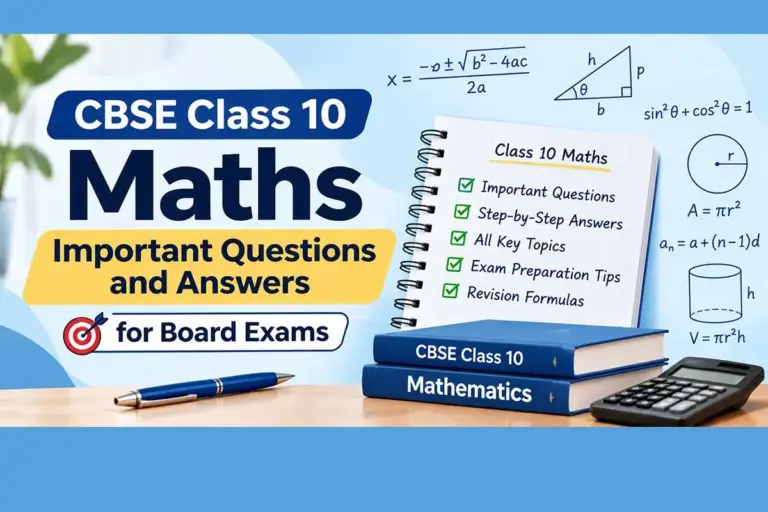
Let’s be honest: Maths can make or break your Class 10 board result. And scoring well takes more than memorising formulas. You need to understand why a method works, practise different types of problems, and learn to write your answers the way examiners like to see them.
With the board exams getting closer, the smartest use of your time is simple. Focus on the topics that matter most, work through previous-year papers, and practise model questions based on the latest exam pattern.
To make that easier, we’ve put together 30 important CBSE Class 10 Maths questions and answers that cover all seven units of the syllabus: algebra, geometry, trigonometry, mensuration, statistics, probability and more.
Whether you’re preparing for Mathematics Basic (241) or Mathematics Standard (041), this question bank will help you revise the essentials and build your problem-solving confidence. And if you’re still putting your overall plan together, our CBSE exam preparation tips for students are a good place to start.
CBSE Class 10 Maths Exam Pattern 2026–27
Before you dive into the questions, it helps to know what the paper actually looks like. Here’s the structure at a glance.
As per the CBSE Mathematics syllabus for the 2026–27 session, the theory paper carries 80 marks and internal assessment carries 20 marks.
Unit-Wise Marks Distribution
| Unit | Topics | Marks |
| I | Number Systems | 6 |
| II | Algebra | 20 |
| III | Coordinate Geometry | 6 |
| IV | Geometry | 15 |
| V | Trigonometry | 12 |
| VI | Mensuration | 10 |
| VII | Statistics and Probability | 11 |
| Total | 80 |
Algebra clearly leads the way, with Geometry and Trigonometry close behind. Give these three units a little extra attention, but don’t skip the rest, because every unit adds to your total.
Mathematics Board Exam Question Paper Structure
Here’s how the official CBSE Mathematics Standard sample question paper for 2026–27 is structured:
| Section | Question Type | Marks |
| A | 18 MCQs and 2 Assertion-Reason questions | 20 |
| B | 5 Very Short Answer questions | 10 |
| C | 6 Short Answer questions | 18 |
| D | 4 Long Answer questions | 20 |
| E | 3 Case Study-Based questions | 12 |
| Total | 38 Questions | 80 |
The paper runs for three hours. So along with the usual questions, make sure you also practise application-based, reasoning-based and case study-based ones.
CBSE Class 10 Maths Important Questions and Answers
The questions below follow the seven units of the Class 10 Mathematics syllabus. A small tip: try each question on your own first, and only then check the answer. That’s where the real learning happens.
Unit 1: Number Systems
Question 1. Find the HCF of 96 and 404 using Euclid’s Division Algorithm.
Answer:
According to Euclid’s Division Algorithm:
a = bq + r
Step 1: Divide 404 by 96.
404 = 96 × 4 + 20
Step 2: Divide 96 by 20.
96 = 20 × 4 + 16
Step 3: Divide 20 by 16.
20 = 16 × 1 + 4
Step 4: Divide 16 by 4.
16 = 4 × 4 + 0
Since the remainder is zero, the last non-zero remainder is 4.
Final Answer: HCF = 4.
Question 2. Prove that √5 is an irrational number.
Answer:
Let us assume that √5 is rational.
Therefore, it can be expressed as:
√5 = a/b
where a and b are coprime integers and b ≠ 0.
Squaring both sides:
5 = a²/b²
a² = 5b²
This means that a² is divisible by 5. Therefore, a is also divisible by 5.
Let a = 5k.
Substituting:
25k² = 5b²
b² = 5k²
Therefore, b is also divisible by 5.
This means that both a and b have 5 as a common factor, which contradicts our assumption that they are coprime.
Hence, √5 cannot be expressed as a ratio of two integers.
Therefore, √5 is irrational.
Unit 2: Algebra
Question 3. Find the zeroes of the polynomial x² − 5x + 6 and verify the relationship between the zeroes and coefficients.
Answer:
Given polynomial:
p(x) = x² − 5x + 6
Factorising:
x² − 5x + 6 = 0
x² − 2x − 3x + 6 = 0
x(x − 2) − 3(x − 2) = 0
(x − 2)(x − 3) = 0
Therefore:
x = 2 or x = 3.
The zeroes are 2 and 3.
Verification:
For a quadratic polynomial ax² + bx + c:
Sum of zeroes = −b/a
Product of zeroes = c/a
Here, a = 1, b = −5 and c = 6.
Sum of zeroes:
2 + 3 = 5
−(−5)/1 = 5
Product of zeroes:
2 × 3 = 6
6/1 = 6
Both relationships are verified.
Question 4. Solve the following pair of linear equations using the elimination method:
2x + 3y = 13
x − y = 1
Answer:
Given equations:
2x + 3y = 13 …(1)
x − y = 1 …(2)
Multiplying equation (2) by 2:
2x − 2y = 2 …(3)
Subtract equation (3) from equation (1):
(2x + 3y) − (2x − 2y) = 13 − 2
2x + 3y − 2x + 2y = 11
5y = 11
y = 11/5
Substituting y = 11/5 in equation (2):
x − 11/5 = 1
x = 1 + 11/5 = 16/5
Check: 2(16/5) + 3(11/5) = 32/5 + 33/5 = 13 ✓
Final Answer: x = 16/5 and y = 11/5.
Question 5. Find the nature of the roots of the quadratic equation 2x² − 4x + 5 = 0.
Answer:
Given equation:
2x² − 4x + 5 = 0
Comparing with ax² + bx + c = 0:
a = 2, b = −4 and c = 5.
The discriminant is:
D = b² − 4ac
Substituting the values:
D = (−4)² − 4 × 2 × 5
D = 16 − 40
D = −24
Since the discriminant is negative, the equation has no real roots.
Final Answer: The quadratic equation has no real roots.
Question 6. The product of two consecutive positive integers is 306. Find the integers.
Answer:
Let the first integer be x.
The next consecutive integer is x + 1.
According to the question:
x(x + 1) = 306
x² + x − 306 = 0
Factorising:
x² + 18x − 17x − 306 = 0
x(x + 18) − 17(x + 18) = 0
(x − 17)(x + 18) = 0
Therefore:
x = 17 or x = −18.
Since the integers are positive, x = 17.
The next integer is 18.
Final Answer: The two integers are 17 and 18.
Question 7. Find the 20th term of the arithmetic progression 5, 9, 13, 17, …
Answer:
Given:
First term (a) = 5
Common difference (d) = 9 − 5 = 4
Number of terms (n) = 20
The nth term of an AP is:
aₙ = a + (n − 1)d
Substituting:
a₂₀ = 5 + (20 − 1) × 4
= 5 + 19 × 4
= 5 + 76
= 81
Final Answer: The 20th term is 81.
Question 8. Find the sum of the first 15 terms of the arithmetic progression 2, 5, 8, 11, …
Answer:
Given:
a = 2
d = 5 − 2 = 3
n = 15
The sum of the first n terms of an AP is:
Sₙ = n/2 [2a + (n − 1)d]
Substituting:
S₁₅ = 15/2 [2 × 2 + (15 − 1) × 3]
= 15/2 [4 + 42]
= 15/2 × 46
= 15 × 23
= 345
Final Answer: The sum of the first 15 terms is 345.
Download 8 more practice questions on Number Systems and Algebra (PDF)
Unit 3: Coordinate Geometry
Question 9. Find the distance between the points A(2, 3) and B(8, 11).
Answer:
The distance formula is:
AB = √[(x₂ − x₁)² + (y₂ − y₁)²]
Given:
A(2, 3) and B(8, 11)
Substituting:
AB = √[(8 − 2)² + (11 − 3)²]
= √[6² + 8²]
= √[36 + 64]
= √100
= 10
Final Answer: The distance between the points is 10 units.
Question 10. Find the coordinates of the point that divides the line segment joining A(1, 2) and B(7, 8) internally in the ratio 1:2.
Answer:
Using the section formula:
P = [(mx₂ + nx₁)/(m + n), (my₂ + ny₁)/(m + n)]
Given:
A(1, 2), B(7, 8)
m = 1 and n = 2
Substituting:
x-coordinate = (1 × 7 + 2 × 1)/(1 + 2)
= (7 + 2)/3
= 3
y-coordinate = (1 × 8 + 2 × 2)/(1 + 2)
= (8 + 4)/3
= 4
Final Answer: The required coordinates are (3, 4).
Unit 4: Geometry
Question 11. State and prove the Basic Proportionality Theorem.
Answer:
Statement:
If a line is drawn parallel to one side of a triangle to intersect the other two sides at distinct points, then it divides those two sides in the same ratio.
Proof:
Consider triangle ABC, where D and E are points on AB and AC respectively, such that DE is parallel to BC.
We need to prove:
AD/DB = AE/EC
Join BE and CD.
Since triangles ADE and BDE have the same altitude from E to AB:
Area (ADE)/Area (BDE) = AD/DB …(1)
Similarly, triangles ADE and CDE have the same altitude from D to AC:
Area (ADE)/Area (CDE) = AE/EC …(2)
Since DE ∥ BC, triangles BDE and CDE have the same base DE and lie between the same parallels.
Therefore:
Area (BDE) = Area (CDE)
Using equations (1) and (2):
AD/DB = AE/EC
Hence, the Basic Proportionality Theorem is proved.
Question 12. In triangle ABC, DE is parallel to BC. If AD = 3 cm, DB = 2 cm and AE = 4 cm, find EC.
Answer:
Given:
AD = 3 cm
DB = 2 cm
AE = 4 cm
DE ∥ BC
According to the Basic Proportionality Theorem:
AD/DB = AE/EC
Substituting:
3/2 = 4/EC
Cross-multiplying:
3 × EC = 8
EC = 8/3
Final Answer: EC = 8/3 cm or approximately 2.67 cm.
Question 13. The corresponding sides of two similar triangles are in the ratio 3:5. If the area of the smaller triangle is 36 cm², find the area of the larger triangle.
Answer:
The ratio of the areas of two similar triangles is equal to the square of the ratio of their corresponding sides.
Area ratio = 3² : 5²
= 9 : 25
Let the area of the larger triangle be x.
36/x = 9/25
9x = 36 × 25
x = 36 × 25/9
x = 100
Final Answer: The area of the larger triangle is 100 cm².
Question 14. Prove that the lengths of tangents drawn from an external point to a circle are equal.
Answer:
Let P be an external point, and PA and PB be two tangents drawn to a circle with centre O, touching the circle at A and B respectively.
Join OA, OB and OP.
We know that the radius is perpendicular to the tangent at the point of contact.
Therefore:
OA ⟂ PA and OB ⟂ PB.
In right-angled triangles OAP and OBP:
OA = OB (radii of the same circle)
OP = OP (common side)
∠OAP = ∠OBP = 90°
Therefore, by the RHS congruence criterion:
△OAP ≅ △OBP
Hence, corresponding sides are equal.
PA = PB
Thus, the lengths of tangents drawn from an external point to a circle are equal.
Question 15. From an external point P, two tangents PA and PB are drawn to a circle. If PA = 7 cm, find PB.
Answer:
According to the tangent theorem:
PA = PB
Given:
PA = 7 cm
Therefore:
PB = 7 cm
Final Answer: PB = 7 cm.
Download Coordinate Geometry and Geometry practice questions with answers (PDF)
Unit 5: Trigonometry
Question 16. If sin θ = 3/5, find cos θ and tan θ, where θ is an acute angle.
Answer:
Given:
sin θ = 3/5
We know:
sin θ = Perpendicular/Hypotenuse
Let the perpendicular be 3 units and the hypotenuse be 5 units.
Using Pythagoras’ theorem:
Base² = Hypotenuse² − Perpendicular²
= 5² − 3²
= 25 − 9
= 16
Base = 4
Now:
cos θ = Base/Hypotenuse
= 4/5
tan θ = Perpendicular/Base
= 3/4
Final Answer:
cos θ = 4/5
tan θ = 3/4
Question 17. Evaluate the expression (1 − tan² 45°)/(1 + tan² 45°).
Answer:
We know:
tan 45° = 1
Substituting:
(1 − 1²)/(1 + 1²)
= (1 − 1)/(1 + 1)
= 0/2
= 0
Final Answer: 0.
Question 18. Prove the identity: (1 − cos² θ)/sin² θ = 1.
Answer:
We know the fundamental trigonometric identity:
sin² θ + cos² θ = 1
Rearranging:
1 − cos² θ = sin² θ
Substituting in the given expression:
(1 − cos² θ)/sin² θ
= sin² θ/sin² θ
= 1
Hence proved.
Question 19. A vertical pole casts a shadow of length 20√3 metres. If the angle of elevation of the sun is 30°, find the height of the pole.
Answer:
Let the height of the pole be h.
Given:
Shadow length = 20√3 m
Angle of elevation = 30°
Using:
tan θ = Height/Shadow
tan 30° = h/(20√3)
1/√3 = h/(20√3)
h = 20√3/√3
h = 20
Final Answer: The height of the pole is 20 metres.
Unit 6: Mensuration
Question 20. Find the area of a sector of a circle with radius 14 cm and central angle 90°. Use π = 22/7.
Answer:
The formula for the area of a sector is:
Area = (θ/360°) × πr²
Given:
r = 14 cm
θ = 90°
Substituting:
Area = (90/360) × 22/7 × 14 × 14
= 1/4 × 22/7 × 196
= 1/4 × 616
= 154
Final Answer: The area of the sector is 154 cm².
Question 21. Find the volume of a cylinder with radius 3 cm and height 7 cm.
Answer:
The volume of a cylinder is:
V = πr²h
Given:
r = 3 cm
h = 7 cm
Substituting:
V = π × 3² × 7
= 63π
Using π = 22/7:
V = 63 × 22/7
= 9 × 22
= 198
Final Answer: The volume of the cylinder is 198 cm³.
Question 22. Find the total surface area of a sphere with radius 3 cm.
Answer:
The total surface area of a sphere is:
TSA = 4πr²
Given:
r = 3 cm
Substituting:
TSA = 4 × π × 3²
= 4 × π × 9
= 36π
Final Answer: The total surface area is 36π cm², approximately 113.14 cm² (taking π = 22/7).
Download Trigonometry and Mensuration practice questions with answers (PDF)
Unit 7: Statistics and Probability
Question 23. Find the mean of the following frequency distribution.
| Value (x) | Frequency (f) |
| 10 | 2 |
| 20 | 3 |
| 30 | 5 |
Answer:
The formula for the mean is:
Mean = Σfx/Σf
Calculating fx:
| x | f | fx |
| 10 | 2 | 20 |
| 20 | 3 | 60 |
| 30 | 5 | 150 |
| Total | 10 | 230 |
Therefore:
Mean = 230/10
= 23
Final Answer: Mean = 23.
Question 24. Find the median of the following grouped frequency distribution.
| Class Interval | Frequency |
| 0–10 | 5 |
| 10–20 | 9 |
| 20–30 | 6 |
Answer:
First, calculate the cumulative frequencies.
| Class Interval | Frequency (f) | Cumulative Frequency (cf) |
| 0–10 | 5 | 5 |
| 10–20 | 9 | 14 |
| 20–30 | 6 | 20 |
Total frequency:
N = 20
N/2 = 10
The median class is 10–20 because its cumulative frequency is the first to exceed 10.
Using the median formula:
Median = l + [(N/2 − cf)/f] × h
Where:
l = 10
N = 20
cf = 5
f = 9
h = 10
Substituting:
Median = 10 + [(10 − 5)/9] × 10
= 10 + 50/9
= 10 + 5.56
= 15.56 (approximately)
Final Answer: Median ≈ 15.56.
Question 25. A die is thrown once. Find the probability of getting a prime number.
Answer:
The possible outcomes when a die is thrown are:
S = {1, 2, 3, 4, 5, 6}
Total number of outcomes = 6
Prime numbers among these outcomes are:
{2, 3, 5}
Number of favourable outcomes = 3
Probability = Favourable outcomes/Total outcomes
P(E) = 3/6
= 1/2
Final Answer: The probability of getting a prime number is 1/2.
Question 26. A box contains cards numbered from 1 to 20. One card is selected at random. Find the probability that the selected card has a number that is a multiple of 3 or 5.
Answer:
Total number of cards = 20
Multiples of 3:
{3, 6, 9, 12, 15, 18}
There are 6 multiples of 3.
Multiples of 5:
{5, 10, 15, 20}
There are 4 multiples of 5.
The number 15 is common to both sets.
Therefore, the total number of favourable outcomes is:
6 + 4 − 1 = 9
Probability = 9/20
Final Answer: The required probability is 9/20.
Competency-Based and Case Study Questions
CBSE is putting more and more emphasis on applying maths to real-life situations. Case study questions ask you to read some information, work out what’s being asked, and pick the right formula.
Here are four case studies for extra practice.
Question 27. Case Study: Arithmetic Progression
A school auditorium has 15 rows of seats. The first row contains 20 seats, and each successive row contains 2 more seats than the previous row.
Answer the following questions:
(a) How many seats are there in the 10th row?
Answer:
Given:
a = 20, d = 2, n = 10
aₙ = a + (n − 1)d
a₁₀ = 20 + 9 × 2
= 38
Answer: 38 seats.
(b) How many seats are there in the last row?
Answer:
a₁₅ = 20 + (15 − 1) × 2
= 20 + 28
= 48
Answer: 48 seats.
(c) Find the total number of seats in the auditorium.
Answer:
Sₙ = n/2 [2a + (n − 1)d]
S₁₅ = 15/2 [40 + 14 × 2]
= 15/2 × 68
= 510
Answer: 510 seats.
Question 28. Case Study: Coordinate Geometry
A student marks three points on a coordinate plane:
A(0, 0), B(6, 0) and C(6, 8).
Answer the following questions:
(a) Find the distance between A and B.
Answer:
AB = √[(6 − 0)² + (0 − 0)²]
= √36
= 6 units.
(b) Find the distance between B and C.
Answer:
BC = √[(6 − 6)² + (8 − 0)²]
= √64
= 8 units.
(c) Find the length of AC.
Answer:
AC = √[(6 − 0)² + (8 − 0)²]
= √(36 + 64)
= √100
= 10 units.
Question 29. Case Study: Mensuration
A cylindrical water tank has a radius of 7 metres and a height of 10 metres. Use π = 22/7.
Answer the following questions:
(a) Find the area of its circular base.
Answer:
Area = πr²
= 22/7 × 7 × 7
= 154 m²
(b) Find the volume of the tank.
Answer:
Volume = πr²h
= 22/7 × 7 × 7 × 10
= 1540 m³
(c) Express the capacity of the tank in litres.
Answer:
1 m³ = 1000 litres
Capacity = 1540 × 1000
= 15,40,000 litres
Answer: 15,40,000 litres.
Question 30. Case Study: Probability
A school organises a mathematics competition in which 50 students participate. Among them, 20 students are from Class 10A, 15 are from Class 10B, and the remaining students are from Class 10C. One student is selected randomly.
Answer the following questions:
(a) Find the probability that a student from Class 10A is selected.
Answer:
P(10A) = 20/50 = 2/5
(b) Find the probability that a student from Class 10B is selected.
Answer:
P(10B) = 15/50 = 3/10
(c) Find the probability that a student from Class 10C is selected.
Answer:
Number of students from Class 10C:
50 − 20 − 15 = 15
P(10C) = 15/50 = 3/10
Download Statistics, Probability and Case Study practice questions (PDF)
Important Mathematics Formulas for CBSE Class 10 Board Exams
Formulas are your fastest tools in the exam, and the more often you revise them, the quicker and more accurate you’ll become.
Here’s a quick revision list, chapter by chapter.
1. Real Numbers
- Euclid’s Division Lemma: a = bq + r, where 0 ≤ r < b.
- For two positive integers: HCF × LCM = Product of the two numbers.
2. Polynomials
For a quadratic polynomial ax² + bx + c:
- Sum of zeroes = −b/a
- Product of zeroes = c/a
3. Quadratic Equations
For ax² + bx + c = 0:
- Quadratic formula: x = [−b ± √(b² − 4ac)]/2a
- Discriminant: D = b² − 4ac
4. Arithmetic Progressions
- nth term: aₙ = a + (n − 1)d
- Sum of n terms: Sₙ = n/2 [2a + (n − 1)d]
5. Coordinate Geometry
- Distance formula: d = √[(x₂ − x₁)² + (y₂ − y₁)²]
- Midpoint formula: [(x₁ + x₂)/2, (y₁ + y₂)/2]
- Section formula for internal division in ratio m:n: [(mx₂ + nx₁)/(m + n), (my₂ + ny₁)/(m + n)]
6. Trigonometry
- sin θ = Perpendicular/Hypotenuse
- cos θ = Base/Hypotenuse
- tan θ = Perpendicular/Base
- sin² θ + cos² θ = 1
- 1 + tan² θ = sec² θ
- 1 + cot² θ = cosec² θ
7. Mensuration
- Area of a circle = πr²
- Circumference = 2πr
- Area of a sector = (θ/360°) × πr²
- Volume of a cylinder = πr²h
- Volume of a cone = (1/3)πr²h
- Volume of a sphere = (4/3)πr³
- Surface area of a sphere = 4πr²
- Volume of a hemisphere = (2/3)πr³
8. Statistics and Probability
- Mean = Σfx/Σf
- Median = l + [(N/2 − cf)/f] × h
- Mode = l + [(f₁ − f₀)/(2f₁ − f₀ − f₂)] × h
- Probability of an event = Number of favourable outcomes/Total number of equally likely outcomes
How to Score 95+ Marks in CBSE Class 10 Maths
Scoring 95 or more takes steady practice, regular revision and smart time management. Studying randomly rarely gets you there, but a clear plan does.
Here are seven practical tips to help you get there.
1. Understand Every Concept Clearly
Don’t just memorise formulas or solutions. Take a moment to understand where each formula comes from and how it applies to different kinds of problems.
Give Algebra, Geometry and Trigonometry a little extra time, since they carry the most marks.
2. Practise NCERT Textbook Questions
Your NCERT Mathematics textbook is the foundation of your board exam preparation.
Work through every exercise, solved example and activity, and keep going until you can solve problems on your own without peeking at the solutions. Our guide to free educational resources for CBSE students also points you to other reliable places for NCERT material and official sample papers.
3. Practise Previous-Year Question Papers
Previous-year CBSE papers show you the exam pattern, the types of questions asked and the level of difficulty to expect.
Aim to solve at least five to ten previous-year or official sample papers under timed conditions.
4. Solve Case Study-Based Questions
Don’t skip case study questions. Read the information slowly, work out which concepts and formulas apply, and then tackle each sub-question one at a time.
Practise real-life applications of arithmetic progressions, geometry, statistics, probability and mensuration.
5. Maintain a Formula Revision Notebook
Keep a separate notebook for important formulas, identities, theorems and shortcuts.
Flip through it often, especially in the last few weeks before the exam. Our tips on studying smarter, not harder explain how short notes and spaced revision make this even more effective.
6. Show All Calculation Steps
In Maths, how you present your solution matters almost as much as the final answer.
- Write the relevant formula before substituting values.
- Show the intermediate calculation steps.
- Mention the appropriate units in mensuration problems.
- Draw neat diagrams wherever necessary.
- Avoid skipping important steps in long-answer questions.
7. Take Timed Mock Tests
Practise writing the full question paper within three hours.
After every test, go back to the questions you got wrong and work out why. Was it a gap in the concept, a calculation slip or a time problem?
Do this regularly and you’ll notice your speed, accuracy and confidence improving. A realistic study schedule with regular test slots makes it much easier to stay consistent.
Frequently Asked Questions (FAQs)
1. Which chapters are most important for CBSE Class 10 Maths Board Exams?
Algebra carries the most weight at 20 marks, followed by Geometry (15 marks) and Trigonometry (12 marks). That said, prepare all seven units, because questions can come from any of them.
2. Is NCERT Mathematics sufficient for CBSE Class 10 Board Exams?
NCERT Mathematics is the main textbook prescribed by CBSE, so practise its examples and exercises thoroughly. Then add official CBSE sample papers, previous-year papers and extra competency-based questions to round off your preparation.
3. How many questions should I practise daily for Class 10 Maths?
Aim for around 15–20 questions a day, depending on where you stand in your preparation and how much time you have. Mix easy, moderate and challenging questions from different chapters. If you’re building a routine around this, our guide to a daily study routine for students can help.
4. How can I score full marks in CBSE Class 10 Mathematics?
To aim for full marks, master the NCERT syllabus, practise different question formats, revise formulas regularly, solve sample papers under timed conditions and watch out for careless calculation errors.
5. Are Mathematics Basic and Mathematics Standard question papers the same?
No. CBSE conducts separate exams for Mathematics Basic (241) and Mathematics Standard (041). Both have an 80-mark theory paper and 20 marks of internal assessment, but the question-paper designs differ. Standard includes a larger share of application-based and higher-order thinking questions.
6. Where can I download the official CBSE Class 10 Maths sample question paper?
You can download the latest Mathematics Basic and Mathematics Standard sample question papers and marking schemes for 2026–27 from the official CBSE Academic website.
Official resource: https://cbseacademic.nic.in/sqp_classx_2026-27.html
Final Words
Preparing for the CBSE Class 10 Maths board exam gets a lot easier when you follow a clear plan and practise different types of questions regularly.
The 30 questions and answers in this article cover the essential concepts from all seven units. Use them for revision alongside your NCERT textbook, classroom notes, previous-year papers and official CBSE sample papers.
There’s no shortcut to a high score in Maths, but there is a reliable route: regular practice, clear concepts, accuracy and good time management. Stay consistent, and you’ll feel the difference.
Best wishes to all Class 10 students for their CBSE Board Examinations!

Student Success Desk focuses on practical learning strategies, study techniques, and academic improvement tips for school students.