

There’s a particular kind of frustration that comes from studying for hours and still feeling unprepared. You read the chapter. You highlighted the important parts. You even read it again. And yet, sitting down to answer a question on it, the information feels just out of reach — familiar, but not quite usable.
This isn’t a sign that a student isn’t trying hard enough. More often, it’s a sign that the method of studying isn’t doing what it feels like it’s doing. Smart study techniques aren’t about studying for longer — they’re about studying in ways that actually move information from “I’ve seen this before” to “I can use this right now.”
Here are ten techniques that consistently make a difference — not because they’re complicated, but because they work with how learning actually happens.
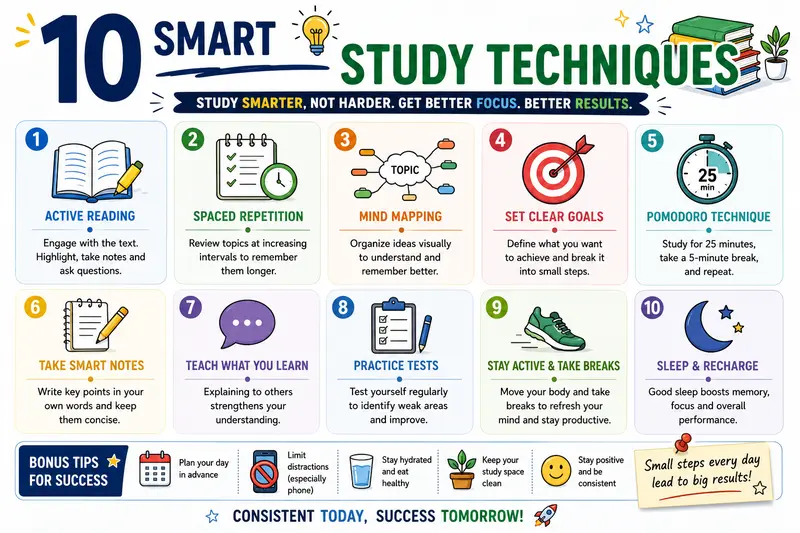
1. Active Recall — Testing Yourself Before You Feel Ready
Most students revise by reading something until it feels familiar. Active recall flips that: instead of reading and re-reading, you close the book and try to remember what you just read — before you feel confident enough to do it.
This feels harder, and that’s the point. Reading a chapter five times creates familiarity. Trying to recall it from memory — even imperfectly — creates retention.
A simple way to start: after reading a section, close it and write down everything you remember. Then check what you missed. That gap tells you exactly what to revisit.
2. Spaced Repetition — Coming Back Before You Forget
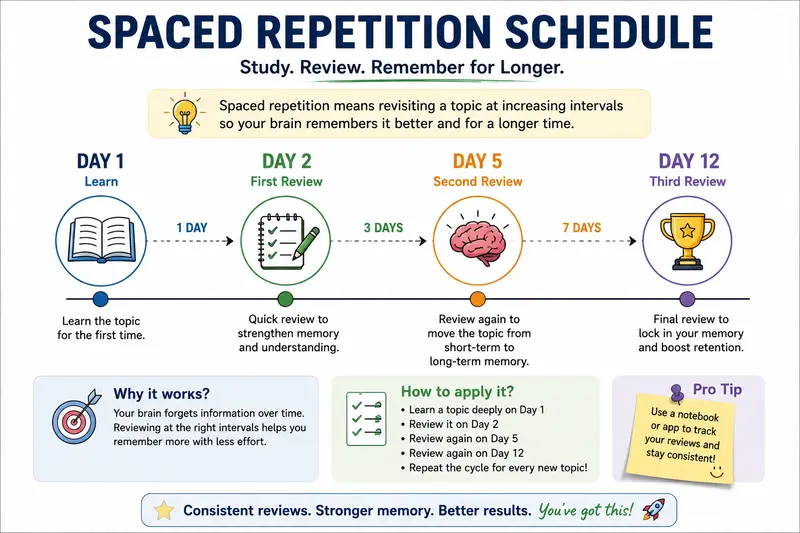
Most students revise a topic once, move on, and don’t return to it until just before the exam. By then, a lot of it has faded — and re-learning forgotten material takes almost as long as learning it the first time.
Spaced repetition means deliberately revisiting a topic at increasing intervals — a day later, then a few days later, then a week later. Each retrieval makes the memory more durable.
This doesn’t require an app, though apps can help. A simple system: review new material the next day, then again after three days, then after a week. Topics that keep getting revisited stay accessible. Topics revised once and abandoned tend not to.
3. The Feynman Technique — Explaining It Simply
Named after physicist Richard Feynman, this technique is based on a simple idea: if you can’t explain something simply, you don’t understand it well enough yet.
Pick a concept — say, Newton’s Third Law, or the structure of a cell. Explain it out loud, in plain language, as if teaching someone with no background in the subject. No jargon, no textbook phrasing — just plain words.
Wherever you get stuck, struggle to find the right words, or catch yourself using a term without really knowing what it means — that’s exactly where your understanding has a gap. Go back to that point, fill it in, and try explaining again.
This technique is uncomfortable because it exposes gaps quickly. That discomfort is useful — it’s better to discover a gap while studying than during an exam.
4. Chunking — Breaking Big Topics Into Smaller Pieces
A chapter on the French Revolution, or a unit on organic chemistry reactions, can feel overwhelming as a single block of information. Chunking means breaking it into smaller, connected pieces that are easier to hold in mind individually.
Instead of “the French Revolution,” think in terms of causes, key events, major figures, and consequences — four smaller chunks instead of one large one. Instead of memorising twenty organic reactions as a list, group them by reaction type — substitution, addition, elimination — so each group shares a common pattern.
This isn’t about reducing the content. It’s about organising it in a way that’s easier for the brain to hold and retrieve, because related pieces of information support each other.
5. The Pomodoro Technique — Working In Focused Bursts
This technique involves studying in short, focused intervals — typically 25 minutes — followed by a 5-minute break. After four such intervals, a longer break of 15 to 20 minutes follows.
The value here isn’t really about the exact timing. It’s about creating a clear boundary around focused work. Twenty-five minutes feels manageable in a way that “study until you’re done” doesn’t — especially for subjects that feel boring or hard to start.
For students who often find themselves staring at a book without engaging with it, this technique helps by making the commitment small enough to actually begin. Many find that once they start, they continue past the timer naturally — the hardest part was starting.
6. Interleaving — Mixing Subjects And Topics
Most students study one subject for a long stretch before moving to the next — an hour of Maths, then an hour of Chemistry. Interleaving means mixing related topics or subjects within a single session, rather than studying them in long isolated blocks.
For example, instead of solving twenty integration problems in a row, mix in some differentiation problems and some application-based questions. This forces your brain to recognise which type of problem it’s looking at before solving it — which is exactly the skill an exam tests, since exam questions don’t come neatly sorted by topic.
This technique feels less smooth than focused, single-topic practice. That’s expected — the slight difficulty of switching between types is what builds the flexible understanding exams require.
7. Mind Mapping — Seeing How Ideas Connect
Some subjects — History, Biology, Economics — involve a lot of interconnected ideas, where understanding the relationships between concepts matters as much as knowing the concepts themselves.
A mind map starts with a central topic and branches into related ideas, with lines showing how they connect. For “Causes of World War I,” a mind map might branch into political alliances, nationalism, economic competition, and triggering events — with lines showing how these factors influenced each other.
Creating the map is itself useful, because it requires thinking about relationships, not just facts. A finished mind map also makes for quick visual revision — much faster to scan than re-reading paragraphs.
8. Practice Under Exam Conditions
There’s a meaningful difference between knowing something and being able to produce it under time pressure, in the exact format an exam requires. Practising under realistic conditions — a set time limit, no notes, handwritten answers — closes that gap.
This means occasionally setting a timer, sitting with just a pen and paper, and attempting a full set of questions exactly as you would in the exam. Afterwards, check your answers against the marking scheme, not just whether the final answer was correct — many marks in board exams come from the structure and steps of an answer, not just the result.
Students who only ever study in relaxed conditions — open notes, no time limit, typing rather than writing — sometimes find the actual exam surprisingly different from their practice. Closing that gap before the real exam matters.
9. Teaching Someone Else
This is related to the Feynman Technique but works slightly differently — it involves an actual audience, even if that audience is a younger sibling, a parent, or a study group.
Explaining a topic to someone else requires structuring your knowledge in a way that makes sense to another person — a more demanding version of recalling it for yourself. Questions from the other person, even simple ones, often reveal gaps that wouldn’t surface during solo revision.
Study groups can work well if structured properly — each person prepares a topic and explains it to the others. The explaining is often more valuable than the listening, so make sure everyone gets a turn.
10. Reviewing Mistakes, Not Just Scores
After a test or practice paper, it’s tempting to look at the score, feel a reaction — good or bad — and move on. The more useful step happens after that: going through every wrong answer and understanding why it was wrong.
Was it a concept you didn’t know? A careless mistake under time pressure? A misread question? Each has a different fix. A concept gap needs more study. A careless mistake needs more careful practice. A misread question needs slower, more deliberate reading during exams.
Students who review mistakes systematically tend to stop making the same kind of mistake repeatedly — because they’ve identified the pattern, not just the individual error.
How To Choose Which Techniques to Use
Ten techniques can feel like a lot to take on at once, and trying all of them simultaneously usually doesn’t work. A more realistic approach: pick two or three that feel most relevant to your current challenges, and build them into your existing study sessions gradually.
If you find yourself forgetting material you studied weeks ago, spaced repetition addresses that directly. If you struggle to start studying at all, the Pomodoro technique can help with that specific barrier. If exams feel harder than your practice sessions suggest they should, practising under exam conditions closes that gap.
These techniques also work best alongside a study environment that supports concentration in the first place. If focus itself is a struggle — not just which technique to use, but staying engaged at all — it’s worth looking at the broader habits that improve concentration while studying, since sleep, breaks, and environment affect how well any technique works.
Common Mistakes When Adopting New Study Techniques
Switching everything at once. New techniques take some adjustment, and changing your entire approach overnight often feels disorienting rather than helpful. Introduce one or two at a time.
Giving up too quickly. Techniques like active recall and interleaving feel harder than familiar methods — that’s expected, and it’s part of why they work. A few uncomfortable sessions don’t mean the technique isn’t working; they often mean it is.
Using techniques without addressing the basics. No technique compensates for skipping sleep, studying in a noisy environment, or constant phone interruptions. Techniques work best as part of a broader routine, not as a replacement for the fundamentals.
Studying under pressure that makes experimentation feel risky. Trying new techniques requires a bit of room to adjust and occasionally feel less efficient at first. A home environment that supports studying without unnecessary pressure gives students that room — both to try new methods and to talk honestly about what is and isn’t working.
Final Takeaway
Smart study techniques aren’t about working harder in the way that “more hours, more highlighting, more re-reading” suggests. They’re about working in ways that match how memory and understanding actually form — testing yourself, spacing out revision, explaining ideas simply, and practising under real conditions.
Pick a couple of these to try this week. Not all ten at once — just enough to notice the difference. For more structured approaches to studying, browse the study tips and online learning resources available for students preparing across subjects and grade levels.
Frequently Asked Questions (FAQs)
Q1. What are the most effective study techniques for board exam preparation?
Active recall, spaced repetition, and practising under exam conditions tend to have the most direct impact on board exam performance, because they build the specific skills exams test — recalling information without prompts, retaining material over weeks, and producing answers under time pressure. The Feynman Technique is also valuable for subjects requiring conceptual explanation, like Physics derivations or History analysis.
Q2. How can I make studying less boring using smart study techniques?
Techniques like the Pomodoro Technique and interleaving can make studying feel less monotonous by breaking it into shorter, more varied segments. Teaching a concept to someone else or creating a mind map also adds variety compared to reading the same material repeatedly. The goal isn’t to make studying “fun” in an artificial sense, but to make it feel less like a long, undifferentiated stretch of the same activity.
Q3. How long does it take to see results from new study techniques?
Some techniques, like the Pomodoro Technique, can show immediate effects on focus within the first session. Others, like spaced repetition, show their value over weeks — the difference becomes clear when you find you remember material from a month ago without needing to relearn it. Most students notice a meaningful difference within two to three weeks of consistent use, particularly with active recall and spaced repetition.
Q4. Can these study techniques work for all subjects, including Maths and languages?
Yes, though some techniques suit certain subjects more naturally. Active recall and spaced repetition work well across all subjects. Interleaving is particularly useful for Maths, where mixing problem types builds the flexibility exams require. Mind mapping suits subjects with interconnected concepts, like History or Biology. The Feynman Technique works well for any subject requiring explanation — Physics derivations, Economics concepts, or grammar rules in languages.
Q5. Is it necessary to use all 10 techniques to study effectively?
No. Using all ten at once is neither necessary nor practical. Most students benefit from choosing two or three techniques that address their specific challenges — for example, spaced repetition for retention issues, or practising under exam conditions for time management. Building a small number of techniques into a consistent routine works better than trying everything briefly and dropping all of it.

The CBSE Guide Editorial Team creates helpful educational content for students, parents, and learners across various academic and personal development topics.