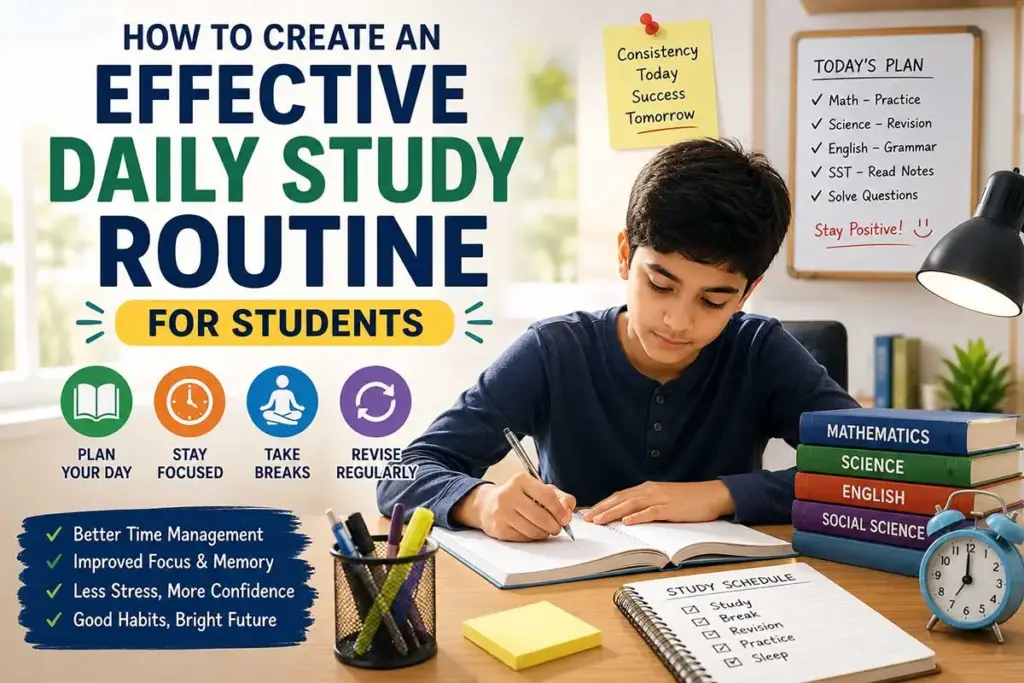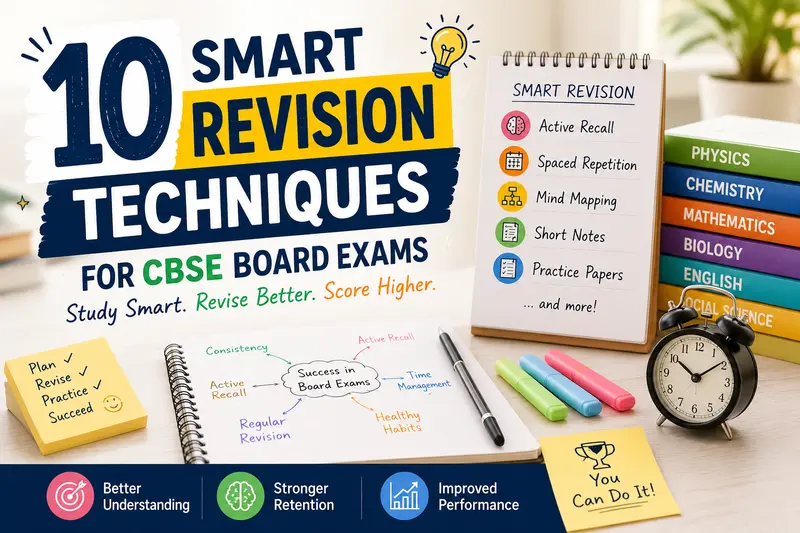
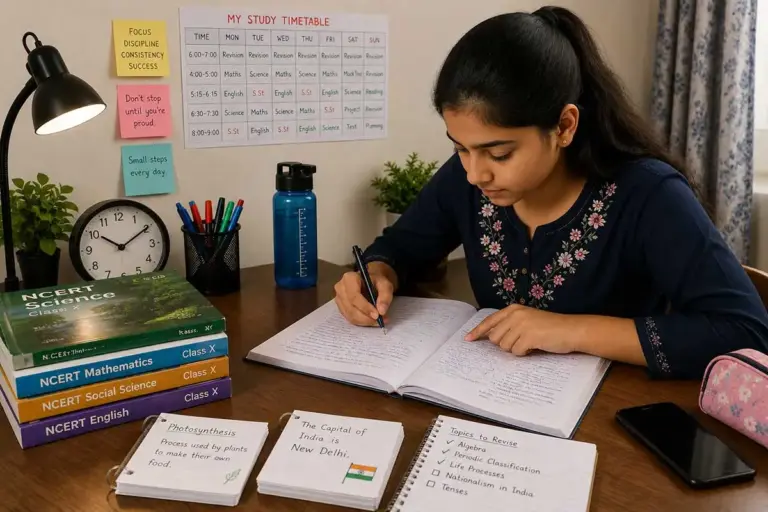
The Short Answer
If you only remember one thing from this article, make it this: active recall, spaced revision, practice testing, focused study sessions, tidy note-making, and a schedule you can realistically stick to beat marathon reading sessions every time. Instead of reading the same chapter for the fifth time, students learn faster when they actively pull information out of their own memory, test themselves, revisit the tricky bits on a schedule, and follow a routine that leaves room for sleep, breaks, and a bit of a life outside textbooks.
Why Do Some Students Study for Hours but Remember So Little?
Here’s an uncomfortable truth: the number of hours you put in doesn’t automatically translate into what you actually remember.
Picture two students. One spends three hours reading a Science chapter and still can’t explain it the next morning. The other studies for a focused 60–90 minutes, quizzes themselves, goes back over the parts that didn’t stick, and walks away remembering far more.
The difference usually comes down to how a student studies, not how long they sit at the desk.
A few habits quietly sabotage good intentions:
- Reading the same chapter over and over without ever testing yourself on it
- Highlighting almost every line (which defeats the point of highlighting)
- Copying whole textbook paragraphs into a notebook word for word
- Studying with the phone buzzing every few minutes
- Building timetables that look great on paper but are impossible to actually follow
- Pushing all revision to the week before the exam
- Quietly avoiding the subjects that feel hardest
- Sitting for hours without a real break
- Memorising answers without actually understanding the concept behind them
For CBSE students specifically, it helps to start from the prescribed curriculum and the right textbooks. CBSE’s current academic direction leans heavily on competency-based education — in other words, understanding and applying what you learn, not just reciting it.
The official NCERT textbooks portal is a solid, reliable starting point if you want to study straight from the source.
So What Actually Works? A Quick-Look Table
There’s no single technique that works for every student and every subject. But combining active learning, retrieval practice, spaced revision, focused sessions, and regular question practice will take you a lot further than passive reading ever will.
| Technique | Best For | How to Use It |
| Active recall | Memory & understanding | Close the book and recall what you just learned |
| Spaced revision | Long-term memory | Revisit material at gradually increasing intervals |
| Practice testing | Exam prep | Solve questions without peeking at the answers |
| Feynman technique | Difficult concepts | Explain the idea in plain, simple language |
| Mind maps | Connecting ideas | Lay out concepts visually, branch by branch |
| Flashcards | Definitions & facts | Question on one side, answer on the other |
| Pomodoro-style sessions | Concentration | Study in short focused bursts with real breaks |
| Error log | Fixing weak spots | Write down mistakes and come back to them later |
If you’d like a more structured starting point, this guide to 10 Smart Study Techniques Every Student Should Know is worth a look too.
1. Swap Passive Reading for Active Recall
Active recall simply means forcing yourself to pull information out of memory rather than just re-reading it off a page.
Say you’ve just studied the causes of the Revolt of 1857. Close the book and ask yourself:
“What were the major causes of the Revolt of 1857?”
Write or say the answer without peeking. Then check it against your notes or textbook.
It’s a small shift, but it turns revision from a passive scroll through familiar words into an actual mental workout.
2. Make Practice Testing Part of Everyday Learning
Practice questions aren’t just something you dust off the night before an exam — they work best woven into everyday study.
After a Maths topic, try the problems without glancing at the worked examples first. After Biology, answer a few questions purely from memory. After a History chapter, jot short answers to the questions you think might come up.
The point isn’t to score yourself. It’s to find out exactly what you can’t pull out of memory on your own — that’s where your revision time should actually go.
3. Try Teaching It: The Feynman Technique
Pick a concept and explain it out loud as if you were teaching it to a younger student.
“Photosynthesis is the process by which green plants make food using light energy, carbon dioxide, and water.”
If you stumble or reach for jargon to cover a gap, that’s exactly where to go back to the textbook. This works especially well for Science, Maths concepts, Economics, and anything else that needs real understanding rather than memorisation.
How Does Active Recall Actually Improve Learning?
Active recall forces your brain to retrieve information rather than simply nod along at familiar-looking words.
Compare two approaches:
Method A: Read the chapter three times.
Method B: Read it once, close the book, write down what you remember, check your mistakes, and come back to it again later.
Method B feels harder — and that’s exactly why it works. The struggle is what exposes the gaps.
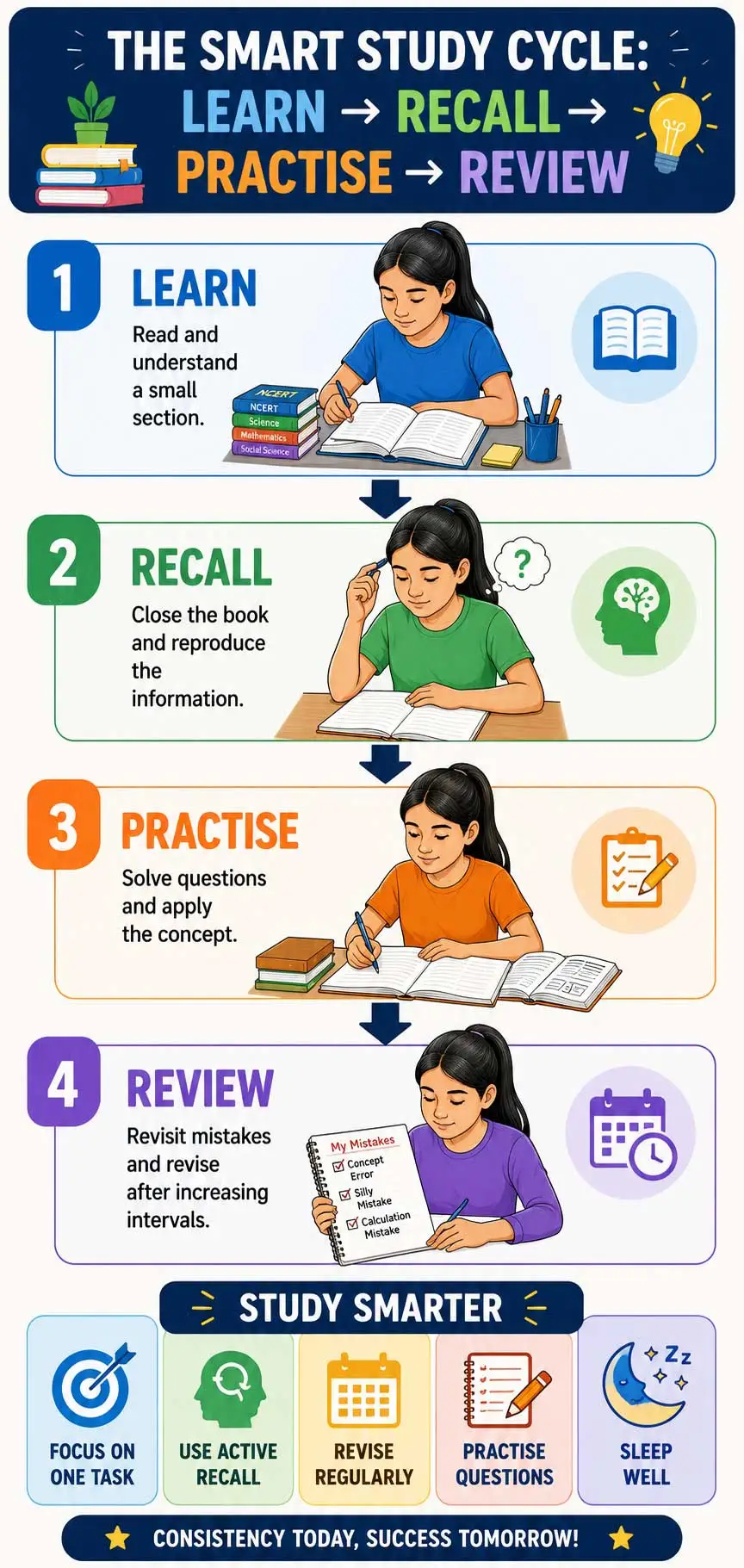
A simple active-recall routine looks like this:
- Read a small section.
- Close the textbook.
- Write down three to five points from memory.
- Check them against the original material.
- Correct whatever was missing or wrong.
- Test yourself again a little later.
For younger children, parents can turn this into a chat instead of a test. For example:
Parent: “Why does rain happen?”
Child: “Water evaporates, rises, cools, and turns into clouds. When the droplets get heavy enough, they fall as rain.”
That short answer is already retrieval practice — no flashcards required.
How Can Spaced Revision Strengthen Memory?
Cramming can make information feel familiar for a day or two, but it fades fast. Spreading revision out over several days is far better for anything you actually want to remember long-term.
A Simple Spaced Revision Pattern
Say you learn a chapter on Monday. It could look something like this:
- Monday: Learn the concept
- Tuesday: 10-minute recall
- Thursday: Practice questions
- Sunday: Quick revision
- Two weeks later: Self-test
- Before the exam: Final review
The exact intervals don’t need to be perfect. What matters is coming back to important material again and again, instead of trying to cram it all into a single sitting.
This works especially well for Science definitions, Social Science facts, English vocabulary, formulae, dates and events, key terminology, and diagrams or processes.
How Should Students Make Better Notes?
Good notes are not a shrunk-down copy of the textbook — they should help you understand, remember, and revise quickly.
The 4-Part Note Method
For each topic, jot down:
- Main idea — what’s this topic actually about?
- Key points — the three to seven most important ideas
- Examples — something that makes the concept click
- Questions — what might actually show up in an exam
Notes on “The Water Cycle”, for instance, might look like this:
Main idea: Water keeps moving between Earth’s surface and the atmosphere.
Key points: Evaporation, condensation, precipitation, collection.
Example: Wet clothes dry because the water evaporates.
Questions: What is evaporation? Explain condensation. Describe the water cycle.
Pair this with How to Create a Good Daily Study Plan for Students to keep your learning and revision organised.
When Should Students Reach for Mind Maps?
Mind maps shine when several ideas are connected and you need to see how they fit together.
A Social Science chapter, for example, could have the main topic in the centre with branches for causes, important people, events, effects, dates, and examples.
Just don’t turn every single page into a colourful diagram — save mind maps for the chapters where the relationships between ideas genuinely matter.
How Can Students Actually Improve Concentration?
Concentration isn’t just about “trying harder.” Your environment does a lot of the heavy lifting.
Set Up a Distraction-Free Study Zone
Before you sit down:
- Keep the books you need within reach.
- Put the phone away, or switch on Do Not Disturb.
- Have water nearby so you’re not up and down.
- Clear the clutter off the desk.
- Decide exactly what you’re going to finish.
- If you’re on a computer, close every tab that isn’t relevant.
A goal like “Study Science” is vague enough that you’ll waste ten minutes just deciding where to start. A better goal is something like:
“Complete pages 42–48, write five recall questions, and solve the exercise.”
Specific tasks cut out the decision-making that eats into your actual study time.
Use Focused Study Blocks
Try experimenting with:
- 25 minutes of study + a 5-minute break
- 40 minutes of study + a 10-minute break
Older students prepping for board exams may find longer focused stretches work better for them. The right duration really comes down to age, subject, energy levels, and experience.
During breaks, be careful — “just 10 minutes” of social media has a way of quietly becoming 45. Stretching, a short walk, a glass of water, or simply resting your eyes make for a much better break.
What Does a Practical Study Schedule Look Like for CBSE Students?
A timetable only works if it actually fits your life — school hours, tuition, travel, homework, family time, sports, and sleep all need a seat at the table. A schedule that looks impressive on paper but can’t be followed isn’t really a schedule at all.
A Sample Weekday Schedule
| Time | Activity |
| 6:00–6:30 AM | Wake up and get ready |
| 6:30–7:00 AM | Quick revision or reading |
| School hours | Classes and schoolwork |
| 4:00–4:45 PM | Snack, rest, and relaxation |
| 4:45–5:45 PM | Homework |
| 5:45–6:15 PM | Outdoor activity / break |
| 6:15–7:00 PM | Difficult subject |
| 7:00–7:30 PM | Dinner / break |
| 7:30–8:15 PM | Practice questions / revision |
| 8:15–8:30 PM | Plan tomorrow |
| Night | Relax and sleep on time |
Treat this as a template, not a rulebook — adjust it around your own school and tuition timings. For a deeper dive, see How to Create a Perfect Study Timetable for CBSE Students.
The 3-Task Rule
Instead of writing a list of 15 things you’ll never finish, pick three priorities. For example:
- Complete the Mathematics exercise
- Revise one Biology chapter
- Prepare the English assignment
Finish those early, and you can always add more. This keeps students from feeling like they’ve “failed” just because an unrealistic 15-item list wasn’t fully ticked off.
How Should Students Approach Different Subjects?
Every subject rewards a slightly different approach.
Mathematics
Focus on understanding the concept, working through examples, solving problems on your own, keeping track of mistakes, and re-attempting tricky questions a few days later.
An error notebook is genuinely one of the most useful tools here. Write down:
Question → Mistake → Correct method → Why I made the mistake
Flip back through it before every test.
Science
Blend understanding with retrieval. A sequence that works well:
Read → Explain → Draw → Recall → Practise
After studying the human digestive system, for instance, try drawing the pathway from memory and labelling the organs without peeking at the book.
Social Science
Timelines, cause-and-effect charts, maps, keywords, and short recall questions all pull their weight here. Rather than memorising a long paragraph, break it down into:
Cause → Event → Result → Significance
English
Frequent, regular practice beats the occasional marathon session. Work on reading comprehension, vocabulary, grammar, writing formats, literature themes, and how you present your answers. Read actively — ask what the author is really getting at, how a character changes, or what evidence backs up a particular interpretation.
Languages
Short, frequent practice wins here too. Revise vocabulary, grammar rules, writing formats, and literature in separate sittings rather than trying to cram it all in at once.
How Can Students Manage Time During Exam Prep?
As exams get closer, preparation should gradually shift from learning new material to retrieving and applying what you already know. A useful three-stage approach:
Stage 1 – Build: Understand each chapter and put together concise notes.
Stage 2 – Practise: Work through textbook exercises, sample questions, and previous exam papers.
Stage 3 – Test: Attempt timed papers without referring back to your notes.
After each test, sort your mistakes into categories so you know exactly what to fix:
| Mistake Type | What to Do |
| Didn’t know the concept | Relearn it |
| Forgot the information | Use spaced recall |
| Misread the question | Practise reading carefully |
| Calculation error | Slow down and double-check |
| Ran out of time | Practise timed papers |
| Knew the answer but wrote it poorly | Work on answer structure |
The study planner for better time management is a handy tool for breaking big goals down into manageable pieces.
Study Mistakes Worth Avoiding
1. Only Studying the Subjects You Like
Easy subjects feel productive, but the ones you’re avoiding are exactly the ones that need planned, deliberate attention.
2. Building a Timetable and Never Looking at It Again
A timetable needs to flex as school schedules, tests, and other commitments shift — it’s a living document, not a stone tablet.
3. Studying With the Phone Right Next to You
Even if you don’t touch it, every notification and every urge to “just check” chips away at your concentration.
4. Highlighting Absolutely Everything
If everything is highlighted, nothing actually stands out.
5. Memorising Without Understanding
Ask yourself: “Can I explain this in my own words?” If the answer is no, you need more understanding, not more repetition.
6. Ignoring Mistakes
Mistakes are some of the most useful study material you’ll ever get. Write down the ones that keep repeating and deliberately practise them.
7. Pulling All-Nighters
A last-minute all-night push can feel productive in the moment, but it usually leaves you exhausted right when you need concentration and recall the most.
8. Comparing Study Hours With Classmates
One student might need two hours to master a topic that takes another student one. Track what you’ve actually learned, not just how long you sat at the desk.
Printable Study Checklist
Print this out, or copy it into a notebook.
Before Studying
- Decide exactly what I’m going to study.
- Keep textbooks and stationery ready.
- Clear away unnecessary distractions.
- Put my phone away or switch on Do Not Disturb.
- Set a realistic target for the session.
During Study
- Focus on one topic at a time.
- Explain the important ideas in my own words.
- Use active recall.
- Solve questions without peeking at the answers.
- Mark tricky topics for a later review.
- Take short, meaningful breaks.
After Study
- Test myself on what I just learned.
- Correct my mistakes.
- Write down any lingering doubts.
- Schedule the next revision session.
- Plan tomorrow’s top three tasks.
Key Takeaways
- Study smarter, not just longer.
- Active recall beats re-reading the same material over and over.
- Space your revision across days and weeks instead of cramming at the last minute.
- Make notes that summarise and organise ideas, rather than copying the textbook.
- Use practice questions to find the gaps in what you actually know.
- Save difficult subjects for when your concentration is at its best.
- Build a realistic schedule that leaves room for school, homework, breaks, and downtime.
- Keep an error log for Maths, Science, and other problem-solving subjects.
- Lean on official CBSE and NCERT resources — CBSE’s 2026–27 curriculum continues to emphasise competency-based, experiential learning.
- Remember that sleep, movement, and breaks are part of effective learning, not obstacles to it.
Frequently Asked Questions
1. What’s the best study method for CBSE students?
There isn’t one single best method. A strong combination is active recall, spaced revision, practice questions, focused study sessions, and regularly reviewing mistakes — adjusted to fit the subject and the student.
2. How many hours should a student study every day?
It depends on age, grade, school workload, and how close the exams are. Rather than chasing a random number of hours, set specific learning goals and work through them with focused attention.
3. Is studying early in the morning better than studying at night?
Not necessarily. Some students think more clearly in the morning; others do their best work at night. What matters more is concentration, consistency, enough sleep, and picking the right time for your hardest subjects.
4. How can I remember what I study for longer?
Lean on active recall and spaced revision. After learning something, close the book and explain it from memory. Revisit it after a day, then a few days, then again later. Practice questions strengthen recall even further.
5. How can I concentrate while studying at home?
Start with a specific goal, keep your study area tidy, turn off notifications, and put your phone out of reach. Study in focused blocks with short breaks instead of trying to grind through hours in one sitting.
6. Should students make handwritten notes?
Handwritten notes are useful when they force you to process and summarise information in your own words. Copying textbook paragraphs verbatim, though, usually isn’t worth the time. Aim for key ideas, relationships, examples, questions, and the bits you find difficult.
7. How can I prepare for CBSE board examinations?
Start with the prescribed syllabus and textbooks, build a real understanding of the concepts, revise regularly, practise exam-style questions, and attempt timed papers. After every practice test, review what went wrong instead of just checking the score.
8. Is it better to study one subject all day or several subjects?
For most students, mixing two or three subjects makes for a more balanced day — say, Maths practice, a Science revision session, and some English work. What suits you best depends on your workload and how your concentration holds up.
9. How can parents help children develop better study habits?
Provide a calm space to study, help set realistic routines, encourage proper breaks and sleep, and ask about what they learned rather than only asking about marks. A simple “what did you learn today?” is a great, low-key way to prompt active recall.
Authoritative Resources
- CBSE Official Website — Curriculum, examination information, sample papers, and official academic resources.
- NCERT Official Textbooks — Official NCERT textbooks for Classes I–XII.
- NCERT Official Website — Curriculum frameworks, educational resources, and academic publications.

Student Success Desk focuses on practical learning strategies, study techniques, and academic improvement tips for school students.