

So you’ve just finished Class 12, and everyone around you seems to have an opinion about what you should do next. Your relatives swear by engineering. Your neighbour’s daughter is doing CA and “earning so well.” Your friend is prepping for NEET because that’s just what science students do, right?
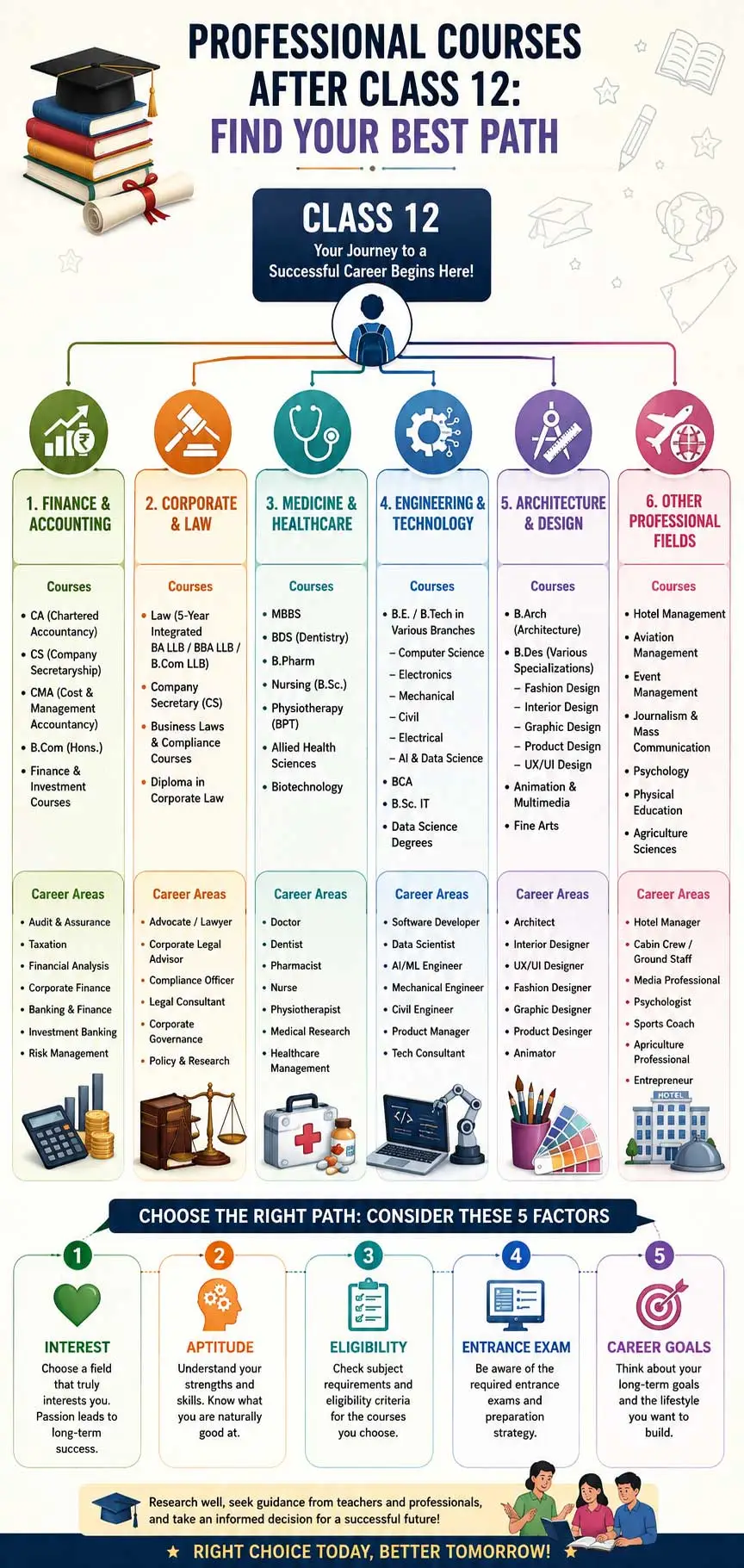
Here’s the honest truth: there’s no single “best” professional course. The best one is the one that actually fits you — your interests, your strengths, your eligibility, and the kind of work you can picture yourself doing every day for years. This guide walks through the major professional pathways available after Class 12 — CA, CS, CMA, Law, Medicine, Engineering, Architecture, Design, and a few others worth knowing about — so you can figure out where you actually belong.
If you’re still exploring broad career options in general, the Career Options After Class 12 guide is a good place to start before diving into specifics.
What Exactly Is a “Professional Course”?
Not every degree after Class 12 works the same way. A professional course trains you for a specific occupation through a structured mix of academic study, exams, internships, and practical training. Think Chartered Accountancy, Company Secretary, Cost and Management Accountancy, Law, Medicine, Dentistry, Engineering, Architecture, Pharmacy, Nursing, and Design.
The pathway matters as much as the qualification itself. A CA student follows a route laid out by the Institute of Chartered Accountants of India (ICAI), while an MBBS aspirant goes through NEET-UG and the medical admission system. So don’t just pick a course because it sounds impressive — dig into what the entire journey actually looks like first.
So, Which Course Is Right for You?
Ask yourself five honest questions:
- Interest — Do you actually enjoy this subject, or just tolerate it?
- Aptitude — Does your natural strength line up with what the profession demands?
- Eligibility — Do your Class 11–12 subjects even qualify you?
- Commitment — Can you handle the years and exams this route requires?
- Career fit — Would you enjoy the actual, day-to-day work?
A Commerce student who loves numbers might thrive in CA or CMA. Someone drawn to corporate law might prefer CS or Law. A Biology student fascinated by the human body might lean toward medicine. A creative mind might feel more at home in design. The goal isn’t chasing the most “prestigious” tag — it’s finding real overlap between your abilities and the profession’s demands.
Chartered Accountancy (CA)
CA is one of India’s most respected qualifications in accounting, auditing, taxation, and financial management, run by the Institute of Chartered Accountants of India (ICAI).
CAs work across accounting, auditing, taxation, financial reporting, corporate finance, risk management, and business advisory — in firms, companies, or independent practice.
The path: Class 12 → CA Foundation → CA Intermediate → Practical Training (two years, under the current scheme) → CA Final → Membership.
It suits students who enjoy numbers, structured problem-solving, and rigorous exams. Commerce students consider it first, but other streams should check ICAI’s current eligibility rules too — CA isn’t exclusively a Commerce path.
Company Secretary (CS)
A Company Secretary sits at the intersection of business, law, and corporate governance — handling compliance, board processes, legal documentation, and corporate restructuring. The qualification is run by the Institute of Company Secretaries of India (ICSI).
The path: Class 12 → CSEET (Company Secretary Executive Entrance Test) → CS Executive → CS Professional → training requirements → Membership. Note that ICSI restructured CSEET starting the June 2026 session, with more focus on business communication, legal aptitude, and reasoning — so check the latest notifications before applying.
CS appeals to students who like Commerce but are more drawn to law and governance than pure accounting.
Cost and Management Accountancy (CMA)
CMA focuses on cost accounting, budgeting, financial planning, and helping businesses make smarter decisions — not just recording numbers, but using them. It’s run by the Institute of Cost Accountants of India (ICMAI).
The path: Class 12 → CMA Foundation → CMA Intermediate → CMA Final → practical training → Membership.
If you enjoy business mathematics, cost analysis, and strategy, this could be your fit.
CA vs CS vs CMA — the quick version
| Qualification | Main Focus | Suits | Career Areas |
| CA | Accounting, audit, taxation, finance | Numbers & analysis | Audit, tax, finance |
| CS | Corporate law & governance | Law, business, compliance | Corporate governance, legal affairs |
| CMA | Cost & management accounting | Cost analysis, decisions | Cost management, FP&A |
Simply put: CA is about financial reporting and audit, CS is about corporate law and compliance, and CMA is about cost management and business decisions. There’s overlap, and careers often cross these lines.
Law
Law might be the most versatile pathway on this list. Students typically enrol in a five-year integrated programme like BA LLB, BBA LLB, or BCom LLB.
Career options range far beyond courtroom litigation — corporate law, IP law, tax law, banking law, legal research, compliance, public policy, and dispute resolution all count. Students aiming for National Law Universities usually take CLAT; other institutions run their own admissions.
A common myth: you need to be a natural public speaker to study law. Not true — what matters more at the start is careful reading, analysis, and the ability to build a logical argument. Communication skills develop along the way.
Medicine and Healthcare
For Science students with Biology, medicine remains one of the most sought-after paths. The MBBS (Bachelor of Medicine and Bachelor of Surgery) is the primary route to becoming a doctor in India, and NEET-UG is the national entrance exam for undergraduate medical education (it also covers some Indian System of Medicine and homoeopathy programmes).
But MBBS isn’t the only door into healthcare. Dentistry, Pharmacy, Nursing, Physiotherapy, Occupational Therapy, Medical Lab Sciences, Radiology, Biotechnology, and Public Health are all real professions with their own training and career paths — not “backup options” to settle for.
Engineering and Technology
Engineering remains the natural home for students strong in Maths and Physics, with options spanning Computer Science, AI/ML, Electronics, Electrical, Mechanical, Civil, Chemical, Aerospace, Biotech, and Environmental Engineering. JEE Main and JEE Advanced dominate the admissions landscape for top government institutions.
But engineering today stretches well beyond traditional branches — into software development, data science, cybersecurity, cloud computing, robotics, and semiconductor tech. For more on exploring these options, check the career guidance resources on CBSEGuide.co.in.
Architecture
Architecture blends Maths, design, drawing, and spatial reasoning with an understanding of buildings and urban environments. It’s not interior decoration — it involves technical knowledge, planning, building systems, and regulatory understanding. Check current eligibility requirements before finalising your Class 11–12 subjects.
Design and Creative Professions
Design has grown into a serious profession — product design, UX/UI, fashion, animation, game design, and interaction design all offer real career tracks, usually through entrance exams, portfolios, or interviews. Talent helps, but research, communication, and problem-solving matter just as much as raw creativity.
Other Options Worth Knowing
- Pharmacy — chemistry, biology, and healthcare combined.
- Nursing — hospitals, community health, and education.
- Hotel Management — hospitality, tourism, customer experience.
- Aviation — beyond piloting: operations, management, maintenance.
- Teaching and Education — for those who enjoy working with children.
- Emerging fields — data analytics, cybersecurity, AI/ML, sustainability, fintech, and healthcare tech. Explore more via CBSEGuide’s career resources.
What Fits Your Class 12 Stream?
| Stream | Courses to Explore |
| Science PCM | Engineering, Architecture, Design, Defence, Technology |
| Science PCB | Medicine, Dentistry, Pharmacy, Nursing, Biotechnology |
| Commerce | CA, CS, CMA, Finance, Management, Economics, Law |
| Humanities/Arts | Law, Design, Media, Psychology, Education, Public Policy |
Always double-check current eligibility with the specific institution — a course open to multiple streams may still have subject-level conditions.
How to Actually Choose

1. Start with the work, not the title. Instead of asking “Is CA a good career?”, ask “Would I enjoy what a CA actually does every day?”
2. Understand the entrance exam — syllabus, competition, number of attempts, deadlines, eligibility. If you’re juggling board prep alongside this, the CBSE Study Planner can help you organise both.
3. Look at the full timeline, not just the first qualification: Class 12 → Entrance/Professional Stage → Degree → Training → Advanced Qualification → Career. That’s the realistic picture.
4. Talk to someone actually in the field. Ask what a normal day looks like, what’s hard about it, and what they wish they’d known earlier. Brochures never tell you this.
5. Be honest about cost — tuition, coaching, hostel, books, exam fees, and training. Also look into scholarships before assuming something’s out of reach.
Common Mistakes to Avoid
- Chasing “high paying” without checking if you’d enjoy the work.
- Following your friends’ choices instead of your own strengths.
- Treating one exam (JEE, NEET, etc.) as the only route to success.
- Ignoring eligibility and subject requirements.
- Confusing popularity with fit.
- Looking only at starting salary, ignoring growth and satisfaction.
- Skipping the fine print on practical training and internships.
Key Takeaways
- Professional courses offer structured routes into specialised careers, but none is universally “the best.”
- CA, CS, and CMA suit students drawn to accounting, corporate affairs, and finance — each with a different focus.
- Law is genuinely versatile, spanning litigation, corporate work, policy, and research.
- Healthcare offers many paths beyond MBBS.
- Engineering now includes AI, data, and cybersecurity, not just the traditional branches.
- Your Class 12 stream shapes your options but doesn’t define your whole career.
- Rules and exams change — always verify with official sources.
- The right course matches your interest, aptitude, eligibility, commitment, and goals — in that order.
Frequently Asked Questions
Which is the best professional course after Class 12?
There isn’t one universal answer. CA, CS, CMA, Law, Medicine, Engineering, Architecture, Design, and Pharmacy can all lead to rewarding careers — it depends on your interests and eligibility.
Which courses suit Commerce students best?
CA, CS, CMA, B.Com with specialisation, finance, economics, management, and law are the common picks.
Can Science students take up CA, CS, or CMA?
Yes, in most cases — these aren’t restricted to Commerce students. Always check the current ICAI, ICSI, or ICMAI eligibility rules before registering.
Is CA better than CS or CMA?
No — they serve different purposes. CA leans into accounting and audit, CS into corporate law and governance, and CMA into cost and management accounting.
Is MBBS the only healthcare option?
Not at all. Dentistry, pharmacy, nursing, physiotherapy, and medical lab sciences are all solid, separate career paths.
What can Humanities students pursue?
Law, design, media, psychology, education, management, and various multidisciplinary programmes — always check specific eligibility.
Should I pick a professional course or a regular degree?
Neither is automatically superior. Professional courses offer a structured route into a specific field; regular degrees offer more flexibility for later study. It depends on your goals.
When should I start preparing for entrance exams?
Start understanding the syllabus and eligibility from Class 11 onward. Intensive prep should follow the latest official syllabus for your specific exam.
Authoritative References
- Institute of Chartered Accountants of India (ICAI) — New Scheme of Education and Training and current student guidance.
- Institute of Company Secretaries of India (ICSI) — current CSEET structure and eligibility.
- Institute of Cost Accountants of India (ICMAI) — course eligibility and pathway.
- National Testing Agency (NTA) — NEET-UG and CUET-UG information.

The Career Awareness Desk publishes informative articles to help students explore career paths, future opportunities, and skill development.