

Choosing a career after Class 12 can feel like a huge decision, and in some ways it is. But here’s some reassurance: you don’t have to figure out your whole future right now. The best path depends on what you enjoy, what you’re good at, your stream, your family’s finances and where you’d like to be in a few years. Plenty of students head into engineering, medicine, commerce, law, design, management or teaching, while newer fields like artificial intelligence and data science are drawing more and more interest.
How to Choose the Right Career After Class 12
Marks, what your friends are choosing and the size of a starting salary all matter, but they shouldn’t be the only things guiding you. A good career fit brings together what you like, what you’re good at, what the course requires, the jobs it leads to and what your family can realistically afford.
Before you settle on a course, ask yourself these five questions:
- Interest: Which subjects and activities do you genuinely enjoy, even when nobody is grading you?
- Aptitude: Where do you shine: solving problems, communicating, creating, analysing or working with people?
- Eligibility: Does your Class 12 stream meet the course’s subject requirements?
- Cost and duration: Can you comfortably manage the tuition fees, living expenses and years of study?
- Future opportunities: What further qualifications, internships or practical skills will you need along the way?
Say you love biology but can’t picture yourself as a doctor. That’s perfectly fine. Biotechnology, microbiology, nutrition and life sciences are all worth a look. In the same way, a commerce student who is curious about technology can explore business analytics, fintech or information systems, as long as they meet the course eligibility.
Put the five factors into practice: download our Know Yourself First worksheet.
Ideally, career exploration starts around Class 10, when you choose your stream. But if you’re in Class 12 and feel a little behind, don’t panic. You can still compare courses, take aptitude assessments, talk to people working in fields that interest you and look into alternative pathways before you decide.
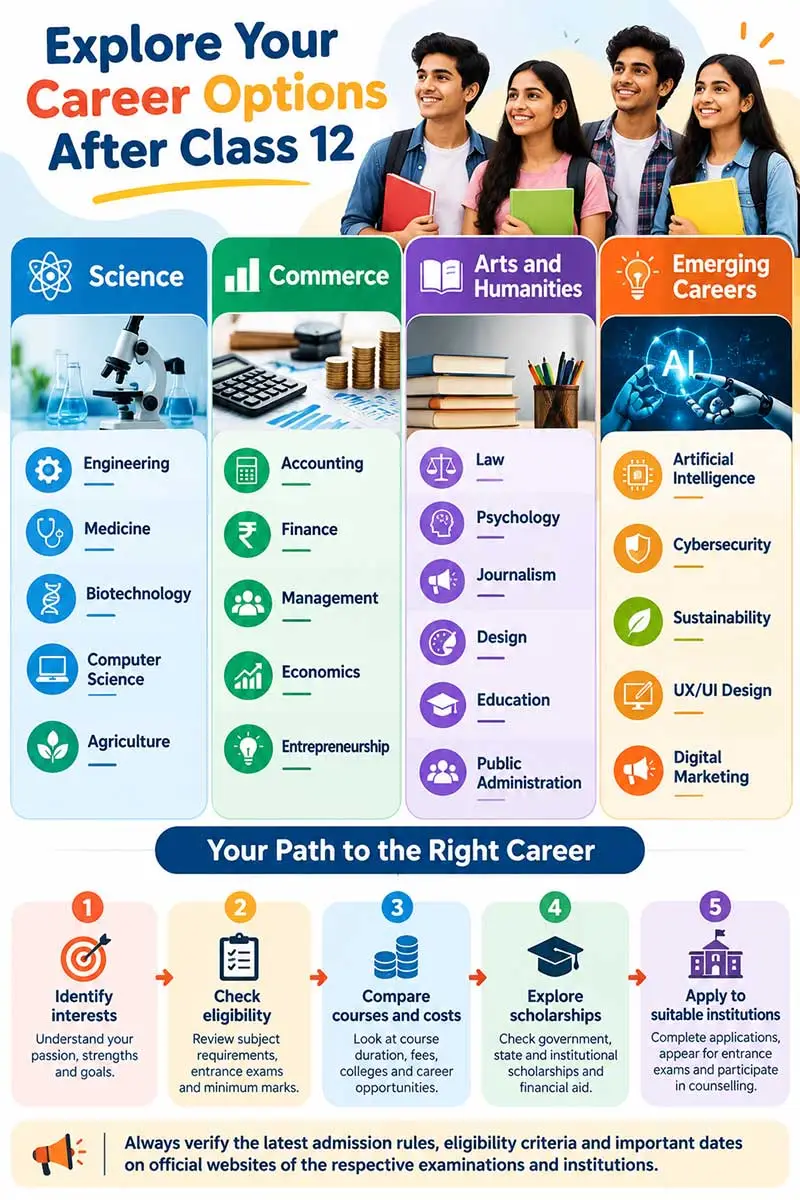
Download Printable File of Career Paths After Class 12 ⬇️
Best Career Options After Class 12 Science
Science opens doors to healthcare, engineering, computing, research, environmental studies and much more. Your subject combination (Mathematics, Biology or both) affects which courses you’re eligible for, but it doesn’t decide your entire future.
| Career option | Typical course | Suitable for students interested in |
| Engineering | B.E./B.Tech | Technology, mathematics, problem-solving |
| Medicine | MBBS | Patient care and clinical science |
| Dental science | BDS | Oral healthcare and clinical practice |
| Nursing | B.Sc. Nursing | Healthcare and patient support |
| Pharmacy | B.Pharm | Medicines and pharmaceutical science |
| Computer science | B.Tech, BCA or relevant degrees | Software, computing and technology |
| Biotechnology | B.Sc./B.Tech Biotechnology | Biology, laboratory work and research |
| Agriculture | B.Sc. Agriculture | Farming, food production and sustainability |
| Architecture | B.Arch | Building design and spatial planning |
| Environmental science | B.Sc. or related degrees | Ecology, conservation and climate issues |
Which science career should you choose?
If you studied Physics, Chemistry and Mathematics (PCM), you can look at engineering, architecture, computer science and the physical sciences. If you took Physics, Chemistry and Biology (PCB), medicine, nursing, pharmacy, biotechnology and life sciences are open to you. And if you studied both Mathematics and Biology, you may have even more options, depending on admission requirements.
Not every science career means becoming a doctor or an engineer. If computers fascinate you, for instance, you could move towards software development, cybersecurity or data analytics through several different undergraduate routes.
Before you apply, read each institution’s eligibility rules carefully. Some courses ask for particular Class 12 subjects, minimum marks, entrance examinations or extra aptitude tests.
Best Career Options After Class 12 Commerce
Commerce students can build careers in accounting, finance, banking, business, economics, taxation, marketing and management. If you studied Mathematics, some quantitative courses may be easier to get into, though requirements differ from one institution to another.
| Career option | Typical course or qualification | Potential career paths |
| Chartered accountancy | CA qualification through ICAI | Audit, taxation, accounting |
| Company secretary | CS qualification through ICSI | Corporate compliance and governance |
| Finance and accounting | B.Com, B.Com (Hons.) | Financial analysis, accounting |
| Business management | BBA or BMS | Marketing, operations, management |
| Economics | B.A./B.Sc. Economics | Research, policy, economic analysis |
| Banking and finance | B.Com or specialised degree | Banking, financial services |
| Law | Five-year integrated law degree | Legal practice, corporate law |
| Digital marketing | Relevant degree or recognised training | SEO, content marketing, campaign management |
| Business analytics | BBA, B.Com or relevant quantitative degree | Business intelligence and analysis |
| Entrepreneurship | BBA or another suitable degree | Start-ups and family businesses |
Is CA the only good career option for commerce students?
Not at all. Chartered accountancy is a respected path, but it’s far from the only route to a successful career. If you’re drawn to business strategy, management might suit you better. If you love working with numbers, finance, economics or analytics could be a great fit.
CA and CS are professional qualifications with their own registration, examination and training requirements. Before you enrol, check the latest rules directly with the respective professional institutes.
One practical way to think about it is to compare a general undergraduate degree with a professional qualification. A B.Com, for example, gives you a broad academic base while you work out whether accounting, taxation or financial services is really for you.
If you’d like extra academic support while you research programmes and career requirements, take a look at these CBSE study resources.
Best Career Options After Class 12 Arts and Humanities
Arts and humanities lead to law, psychology, education, public administration, communication, the social sciences and creative industries. These paths often suit people who love reading and writing, enjoy understanding others, think about how society works or like expressing ideas visually.
| Career option | Typical course | Possible career opportunities |
| Law | BA LLB or another eligible integrated law degree | Legal practice, legal research |
| Psychology | BA/B.Sc. Psychology | Research, human resources, further professional study |
| Journalism | BA Journalism or mass communication | Reporting, digital media |
| Design | B.Des or relevant design degree | Graphic, product or communication design |
| Teaching | Relevant bachelor’s degree followed by required teacher education | School teaching |
| Social work | BSW | Community development, social services |
| Civil services | Any eligible bachelor’s degree followed by competitive examinations | Administrative and public services |
| Hotel management | Relevant hospitality degree | Hotels, tourism and events |
| Languages | BA in a language or literature | Translation, editing, teaching |
| Political science | BA Political Science | Policy research, public affairs |

Can arts students pursue high-paying careers?
Yes, they can, although earnings depend on your qualifications, experience, skills, location and employer. Humanities graduates move into corporate communications, UX writing, user research, advertising, human resources, policy analysis and other specialised fields.
Imagine a student who enjoys both psychology and technology. After building research, analytical and communication skills, they could explore user research. Or someone who loves writing might pair a language degree with digital publishing, editing or content strategy.
Keep in mind that some careers need postgraduate study, professional training, competitive examinations or supervised practice. Clinical roles in psychology, for example, come with specific qualification and regulatory requirements, so verify the current rules before choosing a course.
Narrowed it down? Compare up to three courses side by side.
Emerging Career Options for Students
Technology, sustainability and changing business needs are creating exciting new opportunities. You can explore these fields through the right degrees, internships and recognised skill-development programmes.
Artificial intelligence and data science
A good match if you enjoy mathematics, computing, statistics and solving analytical puzzles. Routes include computer science, statistics, mathematics and specialised undergraduate programmes.
Cybersecurity and cloud computing
Roles include security analysis, cloud support and systems administration. It helps to build strong basics in networking, operating systems and programming.
Renewable energy and sustainability
Careers here range from solar energy and environmental consulting to energy engineering and sustainability reporting. The qualifications you need depend on the specific role.
UX/UI design and digital product development
Ideal if you like mixing creativity with technology and an interest in how people use products. A portfolio, solid design fundamentals and hands-on projects will help you stand out.
Other areas worth exploring include robotics, health informatics, digital marketing, animation, game development, logistics and specialised financial technology.
Important: A new field isn’t automatically well paid or secure. Before you pay for any course, read real job descriptions, check the course’s accreditation, look for evidence of placements and find out which practical skills employers actually expect.
Popular Entrance Exams After Class 12
Many professional courses and universities ask for an entrance exam. Which one you need depends on the programme and the institution.
| Examination | Main purpose |
| JEE Main | Admission pathways for participating engineering institutions; also used for other specified technical admissions |
| NEET UG | Undergraduate medical admissions covered by the examination |
| CUET UG | Undergraduate admissions at participating universities |
| CLAT | Admission to participating National Law Universities |
| NCHM JEE | Admission to participating hospitality and hotel administration programmes |
| NATA or relevant institutional tests | Architecture admissions, depending on applicable rules |
| Design entrance tests | Admission to participating design programmes |
For official details on exams like JEE Main, NEET UG and CUET UG, visit the National Testing Agency’s official website.
National Testing Agency
Keep in mind that sitting an exam doesn’t guarantee admission. Eligibility, your rank, counselling, seat availability and each institution’s own requirements all play a part.
How should students prepare for entrance exams?
- Pin down the exact course and colleges you want to apply to.
- Check eligibility, syllabus, exam dates and application deadlines.
- Download the latest official information bulletin.
- Build a realistic study schedule that fits alongside your Class 12 preparation.
- Practise with previous years’ papers and timed mock tests.
- Keep track of application forms, admit cards, results and counselling notices.
Please don’t rely only on social media posts or coaching advertisements for important admission information. Always confirm dates and rules on official examination and university websites.
Keep every exam date in one place.
Scholarships and Affordable Education
Higher education can be expensive, but please don’t rule out a course you love before looking into financial help. Government scholarships, state schemes, institutional merit awards and need-based assistance can make a real difference for eligible students.
Here are some good places to start:
- National scholarships: Take a look at the Ministry of Education’s scholarship information.
- State government schemes: Check your state’s official scholarship portal for income-based, merit-based and category-specific support.
- College scholarships: Ask the admission office about fee concessions, merit awards, financial aid and instalment plans.
- Education loans: Compare interest rates, repayment terms, eligible expenses and the total cost of borrowing before you commit.
- Affordable institutions: Consider government colleges and public universities alongside private ones.
Eligibility rules, income limits, application dates and renewal requirements differ from scheme to scheme. Rely on official notifications and apply before the deadlines.
Work out what each course really costs and where the money could come from.
A Step-by-Step Career Planning Checklist
Use this checklist to compare your options before you make your final decision.
My career planning checklist
- List three subjects or activities I enjoy.
- Identify my strengths, skills and areas for improvement.
- Shortlist three to five suitable career options.
- Check Class 12 subject and minimum-mark requirements.
- Compare courses, colleges, fees and course duration.
- Check entrance examinations and application deadlines.
- Research scholarships and financial assistance.
- Speak with a teacher, career counsellor or professional.
- Review internships, practical training and employment pathways.
- Discuss the final shortlist with my family and make an informed choice.
Print the checklist, tick it off, and take it to your family discussion.
Key Takeaways
- The best career after Class 12 depends on your interests, aptitude, eligibility, budget and long-term goals.
- Science students can explore technical, medical, research and environmental careers.
- Commerce students can head into finance, accounting, management, economics and business.
- Arts and humanities students have openings in law, psychology, media, design, education and public services.
- Emerging careers call for a solid academic foundation, practical skills and a willingness to keep learning.
- Always check entrance exams, scholarships and admission requirements on official websites.
- A well-researched decision beats picking a course just because it’s popular.
Frequently Asked Questions
1. Which is the best career option after Class 12?
There’s no single best career for everyone. Engineering, medicine, finance, law, design, management, teaching and technology can all be great choices, depending on your interests, abilities and goals.
2. Which career is best after Class 12 for a high salary?
Some specialised careers in technology, finance, medicine and management do offer strong earning potential. But salaries vary widely with skills, qualifications, experience, location and employer, so think about long-term fit rather than salary alone.
3. Can I change my career direction after Class 12?
Yes, you can. There are alternative degrees, diplomas, professional qualifications and skill-based courses to explore. Just remember that some programmes need specific Class 12 subjects or entrance exams, so check eligibility before you apply.
4. Which courses can students pursue after Class 12 without an entrance exam?
Yes, some colleges admit students based on Class 12 marks or their own criteria. Selected B.A., B.Com., B.Sc. and BBA programmes are examples. Admission rules change by college and year, so confirm the current requirements.
5. What are the best career options after Class 12 without Mathematics?
It depends on your subjects and eligibility, but you could look at law, psychology, journalism, nursing, life sciences, design, social work, commerce-related programmes and hospitality. A few of these courses still ask for Mathematics or other specific subjects.
6. Can I get a scholarship after Class 12?
Yes. Eligible students can apply for government, state, institutional and private scholarships. Selection may depend on academic performance, family income, category, the course and other conditions.
7. Is a degree necessary for a successful career?
Not always. Some fields offer diploma, vocational, apprenticeship or skill-based routes in. That said, regulated professions and many specialised jobs need recognised qualifications, so check what your chosen career requires.
8. When should I start planning my career after Class 12?
Ideally, start exploring in Class 10 or 11. If you’re already in Class 12, begin right away: shortlist courses, check eligibility, review entrance exams and keep an eye on application deadlines.

The Career Awareness Desk publishes informative articles to help students explore career paths, future opportunities, and skill development.