
Quick answer:
A good CBSE study planner does one simple thing well: it turns a pile of schoolwork, homework, revision and practice into study blocks a student can actually get through. The trick isn’t cramming more into the week — it’s keeping the plan realistic. Set a handful of weekly goals, put the hardest subjects first, build in time for revision and practice, leave room for things to run long, and take ten minutes at the end of the week to see what worked.
What Is a CBSE Study Planner, Really?
Think of it as a tool that answers three questions for a student: what to study, when to study it, and how to know whether it’s actually getting done.
A timetable and a planner sound like the same thing, but they’re not quite. A timetable mostly hands out time — “Maths, one hour.” A planner ties that hour to something specific. So instead of “Maths – 1 hour,” it looks more like this:
5:00–6:00 PM: Complete NCERT Maths Exercise 7.2 and correct mistakes from yesterday’s practice.
That one small change matters more than it sounds like it should — it gives the session an actual finish line, instead of just an hour to sit at the desk.
A planner can live anywhere: a notebook, a printed sheet taped above the desk, or a spreadsheet. Younger students usually need a parent’s help putting one together; older students should be nudged toward building and running their own, even if the first few attempts are rough.
It’s also worth remembering that CBSE regularly updates its own academic resources — curriculum notes, support material, enrichment content — and the framework for the 2026–27 session already reflects some of those changes. So whatever planner a student builds, it should be checked against the syllabus and resources for their actual class, not last year’s notes.
Why Bother With a Study Planner in the First Place?
CBSE students are rarely dealing with just one thing. There’s schoolwork, projects, practicals, tuition, sport or music, and exams — often all in the same week.
Left unplanned, that mix tends to sort itself out badly: a student gravitates toward the subject they’re already good at, and the chapter they’re avoiding just keeps getting pushed back.
A planner that’s actually built with some thought can help a student:
- Break a big syllabus down into pieces small enough to start
- Put extra time where it’s genuinely needed
- Get homework done before the deadline is looming
- Make revision a habit, not an afterthought
- Leave room for practice questions, not just reading
- Keep a visible record of what’s actually been covered
- Prepare properly for tests and exams
- Cut down on last-minute cramming
- Build habits that hold up over months, not just one good week
- Still leave room for sleep, exercise and downtime
One thing worth saying clearly: a planner shouldn’t become one more thing to feel guilty about. Its whole job is to take some of the constant “what should I do next?” decision-making off a student’s plate — not add pressure on top of it.
If building a realistic day-to-day routine feels like the harder part, this daily study routine for students walks through how school hours, homework, revision, breaks and everything else can actually fit together.
Building a CBSE Study Planner, Step by Step
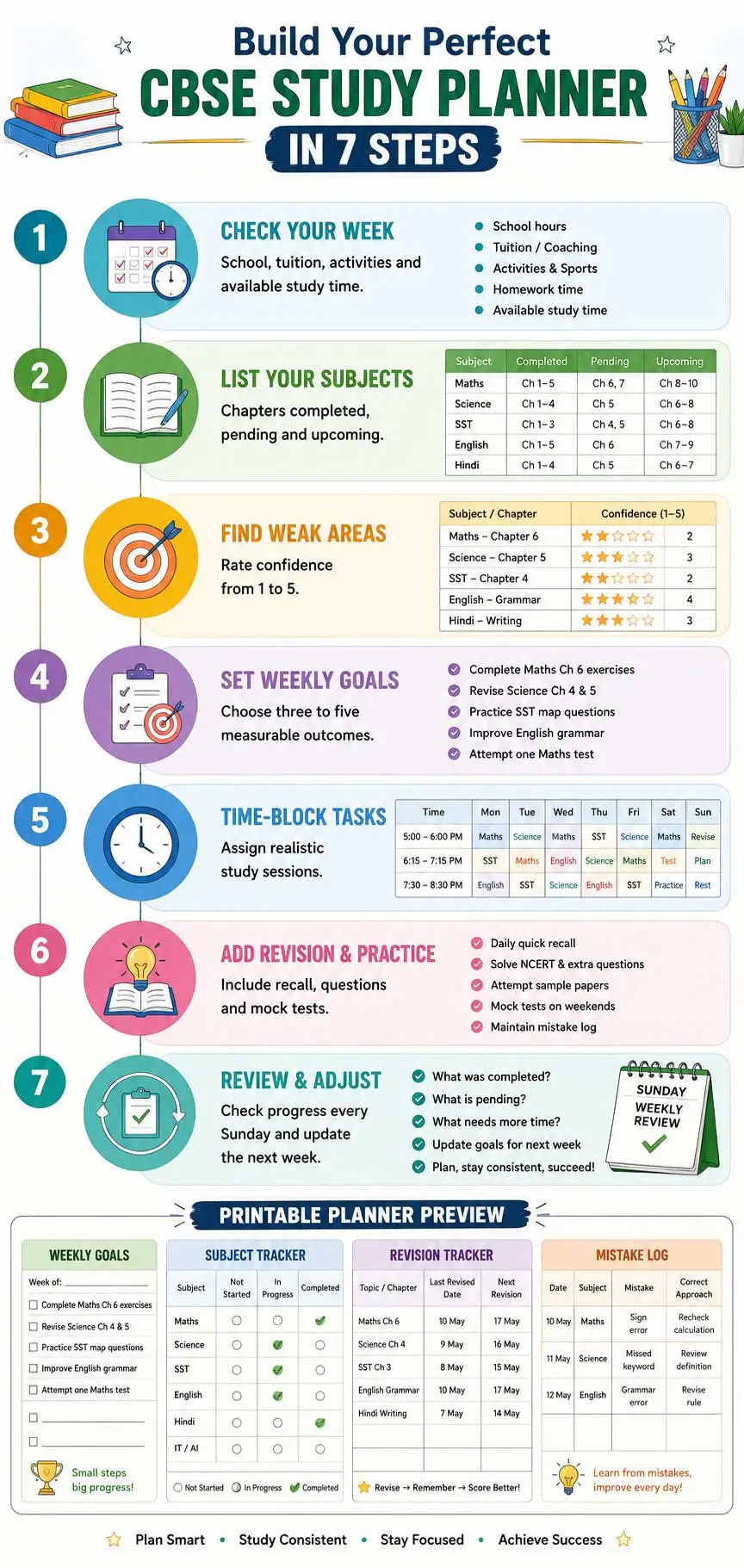
Step 1: Write Down What Can’t Move
Start with the parts of the day that are already fixed — school hours, tuition or coaching, travel, sport, family commitments, meals, sleep.
Say a student gets home at 4:00 PM and genuinely needs half an hour to unwind and eat something. The first study block shouldn’t start at 4:00 PM sharp just because the plan says so.
A planner that fights the student’s real day never survives the first busy week. Work with the day that actually exists.
Step 2: Get Every Subject and Every Pending Task on One List
List out the subjects, and against each one, note where things stand:
| Subject | Current Status | Priority | Next Task |
| Mathematics | 2 chapters pending | High | Complete Exercise |
| Science | Concepts revised | Medium | Solve questions |
| English | On track | Low | Grammar practice |
| Social Science | One chapter pending | High | Read + make notes |
| Hindi | On track | Medium | Writing practice |
Nothing complicated here — it just gives a student (or a parent glancing over their shoulder) an honest, at-a-glance picture of where attention needs to go.
Step 3: Be Honest About Strong and Weak Areas
Ask a student to rate their confidence in each chapter, not their marks. A simple 1-to-5 scale does the job:
- 5 – Very confident
- 4 – Confident
- 3 – Needs revision
- 2 – Weak
- 1 – Need help
Marks and understanding aren’t always the same thing. A student can score decently in a chapter and still fumble the moment they’re asked to explain the idea out loud.
When exam prep starts, the chapters that deserve first attention are the ones sitting at the intersection of low confidence and high importance — not just whatever feels urgent that day.
Step 4: Set Goals for the Week — Not Vague Ones
A weekly plan should open with somewhere between two and five specific goals. Skip anything like:
- Study more.
- Finish Science.
- Revise Maths.
Try this instead:
- Complete Mathematics Chapter 6 exercises.
- Revise two Science chapters.
- Attempt one Social Science practice paper.
- Learn and practise ten English grammar questions.
- Correct mistakes from the previous test.
The more specific the goal, the easier it is to look back on Friday and know honestly whether it happened.
Step 5: Turn Those Goals Into Actual Time Slots
Now the goals need a place on the clock. For example:
Monday
- 5:00–5:50 PM – Mathematics: Exercise 6.1
- 6:10–6:50 PM – Science: Revise Chapter 4
- 8:00–8:30 PM – English: Grammar practice
What matters here is that every block ends with something a student can point to and say “done.”
This guide on using a study planner effectively for better time management makes a similar point: plan for outcomes, not just hours logged against a subject’s name.
Step 6: Don’t Let the Whole Week Be New Material
It’s tempting to fill every slot with fresh lessons, but a balanced week needs a mix:
- New learning
- Homework
- Revision
- Question practice
- Self-testing
- Mistake correction
So after a Science chapter is taught, a short recall session the next day and a longer practice round later in the week does more for retention than moving straight on to the next topic.
For students prepping for exams, 10 essential revision techniques for CBSE exams covers ideas like active recall, spaced revision and answer-writing practice worth building into the week.
Step 7: Always Leave Some Room to Breathe
This might be the single most useful habit in the whole planner. Take a schedule like this:
- 5:00–6:00 Maths
- 6:00–7:00 Science
- 7:00–8:00 Social Science
There’s no slack anywhere — if homework runs fifteen minutes over, the rest of the evening falls apart. A sturdier version looks more like:
- 5:00–5:50 Maths
- 5:50–6:10 Break
- 6:10–7:00 Science
- 7:00–7:30 Buffer/homework
- 8:00–8:40 Social Science
One late or missed session shouldn’t be able to take down the entire day.
What Actually Belongs in a Weekly CBSE Study Planner
A printable planner tends to work best with a handful of sections:
1. Weekly Goals
Three to five outcomes for the week — nothing more.
2. Subject-Wise Schedule
Actual study blocks assigned to actual subjects.
3. Homework Tracker
Assignments and their deadlines, in one place.
4. Chapter Completion Tracker
A quick status against each chapter:
- Not Started
- In Progress
- Completed
- Revised
- Practised
- Needs Help
5. Revision Tracker
A record of when each topic was last revisited.
6. Practice Tracker
Covering:
- NCERT questions
- Worksheets
- Sample questions
- Previous-year questions
- Mock tests
7. Mistake Log
A simple log turns errors into something useful instead of just a lost mark:
| Date | Subject | Mistake | Correct Approach |
| Monday | Maths | Sign error | Recheck calculation |
| Tuesday | Science | Missed keyword | Review definition |
| Wednesday | English | Grammar error | Revise rule |
A Sample Weekly Study Planner for CBSE Students
Here’s a working example, aimed roughly at a Class 9 or 10 student:
| Day | Main Study Block | Second Block | Revision/Practice |
| Monday | Mathematics | Science | English grammar |
| Tuesday | Social Science | Mathematics | Science recall |
| Wednesday | Science | English | Maths practice |
| Thursday | Mathematics | Social Science | Language revision |
| Friday | Science | Mathematics | Weekly recap |
| Saturday | Difficult topics | Practice paper | Mistake correction |
| Sunday | Weekly revision | Pending work | Plan next week |
Treat this as a starting framework, not something to copy exactly. It needs to be reshaped around a student’s actual school schedule, tuition timings, activities and — honestly — how much energy they have left by evening.
For a subject-by-subject breakdown, the CBSE subject-wise revision plan for mid-term exams goes into more detail.
What a Typical Day Might Look Like
| Time | Activity |
| 6:30–7:00 AM | Quick revision |
| School hours | School learning |
| 4:00–4:45 PM | Travel, snack and rest |
| 4:45–5:30 PM | Homework |
| 5:30–5:45 PM | Break |
| 5:45–6:35 PM | Difficult subject |
| 6:35–7:15 PM | Outdoor activity/rest |
| 7:15–8:00 PM | Second subject |
| 8:00–8:30 PM | Dinner |
| 8:30–9:00 PM | Light revision |
| 9:00–9:10 PM | Plan tomorrow |
The exact timings will shift depending on a family’s routine and a student’s school hours — that’s expected, and fine.
Planning Different Subjects — They’re Not All the Same
Mathematics
Give priority to:
- Concept review
- Worked examples
- NCERT exercises
- Additional problems
- Error correction
- Timed practice
Maths responds much better to short, regular sessions than to one long marathon once a week.
Science
Split time across:
- Concept understanding
- Diagrams
- Definitions
- Numericals
- NCERT questions
- Self-testing
For Physics and Chemistry in particular, problem-solving needs to be part of the routine — reading alone rarely builds the skill an exam actually tests.
Social Science
A mix works best:
- Reading
- Short notes
- Timelines
- Maps where applicable
- Active recall
- Structured answer writing
Avoid the trap of rereading the same chapter three times and calling it revision.
Languages
Give separate time to:
- Grammar
- Reading comprehension
- Writing practice
- Literature
- Vocabulary
- Answer presentation
Information Technology or Skill Subjects
- Concept review
- Practical exercises
- Terminology
- Application-based questions
- Sample questions
Study Planner vs Study Timetable — What’s the Actual Difference?
People tend to use these two words interchangeably, but they’re not really doing the same job.
| Study Timetable | Study Planner |
| Focuses mainly on time | Combines time with tasks |
| Usually repeats weekly | Can change every week |
| Says when to study | Says what to accomplish |
| Useful for routine | Useful for goals and tracking |
| Often subject-based | Subject, chapter and task-based |
| Less flexible | More adaptable |
A timetable says “5:00 PM – Maths.” A planner says “5:00–5:50 PM – Complete Exercise 8.3 and review errors.” The second version leaves a lot less room for a student to quietly do nothing for fifty minutes.
A Printable CBSE Study Planner Checklist
Worth printing and filling in every Sunday.
Weekly Planning Checklist
- Write down school and tuition commitments.
- List upcoming tests and assignment deadlines.
- Identify unfinished chapters.
- Rate confidence in difficult topics.
- Choose three to five weekly goals.
- Allocate study blocks.
- Schedule revision sessions.
- Schedule question practice.
- Include at least one buffer period.
- Plan breaks and physical activity.
- Check that the workload is realistic.
- Prepare books and materials.
- Review progress at the end of the week.
- Move unfinished tasks to the following week.
Daily Completion Checklist
- Completed today’s main study goal.
- Finished homework.
- Revised an earlier topic.
- Practised questions.
- Corrected mistakes.
- Recorded doubts.
- Prepared materials for tomorrow.
- Planned the next day’s priority.
Common Study Planning Mistakes Worth Avoiding
1. Planning Too Many Hours
A schedule packed with six to eight hours of self-study looks impressive on paper, but keeping it up alongside a full school day is another matter entirely. The goal is a plan that survives the week, not one that wins points for ambition.
2. Giving Every Subject the Same Amount of Time
Equal time isn’t the same as fair time. A weak subject might genuinely need three sessions a week, while a strong one gets by fine on a single revision pass.
3. Writing Tasks That Are Too Vague
“Study Science” doesn’t tell anyone how it went. “Revise Chapter 3 and answer ten questions” does.
4. Leaving Homework Out of the Plan
Homework should have its own place in the schedule, not show up as a surprise that derails the evening.
5. Skipping Revision Slots
Finishing a chapter isn’t the same as having learned it. Revision needs to keep showing up throughout the planner, not just once before a test.
6. Copying a Topper’s Timetable
A schedule that works brilliantly for one student can fall apart for another. School timing, commute, tuition, activities, and how each student concentrates are all different.
7. Treating the Planner Like a Punishment
If a session gets missed, doubling up the next day isn’t the fix. Shift the task into a buffer slot and carry on.
8. Ignoring Sleep and Breaks
A study plan that skips sleep, meals and movement isn’t sustainable, no matter how well the subjects are balanced.
For more on this, healthy habits that improve concentration while studying is worth a look.
How Parents Can Help — Without Taking Over
Parents can make a real difference here without managing every minute of a child’s evening.
Encourage, Don’t Micromanage
Instead of repeating “did you study?”, try asking:
- What is your main goal today?
- Which topic is difficult?
- Do you need help with anything?
- What needs to move to tomorrow?
Review the Planner Once a Week
Ten minutes on a Sunday is usually enough. Look at:
- Completed work
- Unfinished tasks
- Upcoming tests
- Difficult subjects
- Workload
- Sleep and breaks
Help Set Up a Study Space That Works
A quiet, reasonably tidy corner cuts down on distractions. Keeping textbooks, notebooks and stationery within reach saves a surprising number of small interruptions.
Keep the Focus on Progress, Not Perfection
The point was never to build the perfect planner. It’s to help a student get a little better, week over week, at planning and studying on their own.
For students heading into board exams, the CBSE board exam preparation guide has more on planning, revision, practice papers and staying reasonably sane through the process.
Using NCERT and Official CBSE Resources Alongside the Planner
A planner is only as good as the syllabus it’s built on, so it needs to line up with the resources relevant to a student’s class and academic session.
NCERT publishes official textbook PDFs for Classes I through XII, which makes them a solid reference point when mapping out chapter-wise study and revision.
CBSE’s own Academic Curriculum and Resources section carries curriculum information and academic material directly from the board, and currently lists the detailed curriculum for the 2026–27 session along with related updates.
The NCERT Textbooks PDF Portal is the place to confirm the applicable textbook and chapter structure.
For the wider policy picture, the Ministry of Education’s National Education Policy 2020 page has the official reference.
It’s worth double-checking curriculum changes, prescribed textbooks and exam requirements against current official sources rather than leaning on an older schedule or a study plan found online.
Key Takeaways
- A CBSE study planner should organise tasks, not just hours.
- Start with fixed commitments such as school, tuition and activities.
- Set three to five measurable goals each week.
- Give extra study time to difficult and high-priority topics.
- Combine new learning with revision and question practice.
- Use buffer time so one missed session doesn’t derail the whole schedule.
- Track mistakes, not just completed chapters.
- Adapt the planner to the student’s real routine instead of copying someone else’s.
- Include sleep, breaks, physical activity and personal time.
- Review the planner every week and adjust as needed.
Frequently Asked Questions
1. What is the best study planner for CBSE students?
Honestly, the best one is whichever a student will actually keep using. It should cover weekly goals, daily tasks, homework, revision, practice, upcoming tests and some way to track progress. A plain printed planner, updated regularly, works just as well as any app.
2. How many hours should a CBSE student study every day?
There’s no magic number that fits every student — it depends on class level, school workload, exams and how each student learns. Focused, realistic sessions matter far more than chasing a specific hour count.
3. Should I make a study planner every day or every week?
Weekly tends to work better in practice. Build the main plan once a week, then make small daily tweaks as homework and school activities shift. A quick end-of-day check keeps things on track without redoing the whole plan constantly.
4. Should CBSE students study every subject every day?
Not really — trying to touch every subject daily usually just spreads attention too thin. Rotating subjects, with extra sessions for the weaker or practice-heavy ones, tends to work better.
5. How can I plan revision in a CBSE study timetable?
Don’t leave it for exam week. Add short revision sessions right after learning a topic, then come back to important chapters at growing intervals. Self-testing and mistake correction matter more here than just rereading notes.
6. What should I do if I fall behind my study plan?
Resist the urge to catch up on everything at once. Pick out what matters most, use buffer time to fit it in, and push lower-priority tasks to another day. If the plan keeps failing, that’s usually a sign to make it lighter, not to push harder.
7. Is a paper study planner better than a digital planner?
Neither wins outright. Paper is simple and hard to get distracted by; digital is easier to edit and can send reminders. The right choice is whichever one a student will actually stick with.
8. Can parents make a study planner for their children?
Parents can absolutely help younger students put one together, but older students should gradually take that on themselves. Parents are better placed reviewing goals and offering support than controlling every session.
9. Should a study planner include breaks?
Yes, without question. Breaks, meals, movement and sleep aren’t extras — they’re what makes a study schedule sustainable in the first place.
10. Where can students find official CBSE and NCERT learning resources?
The official CBSE Academic portal has the current curriculum and academic information, and the NCERT textbook portal covers prescribed textbooks. Both are worth checking against the current academic session before building a chapter-wise plan.

Learning Support Team shares guidance on safe online learning, educational technology, and effective digital study practices.