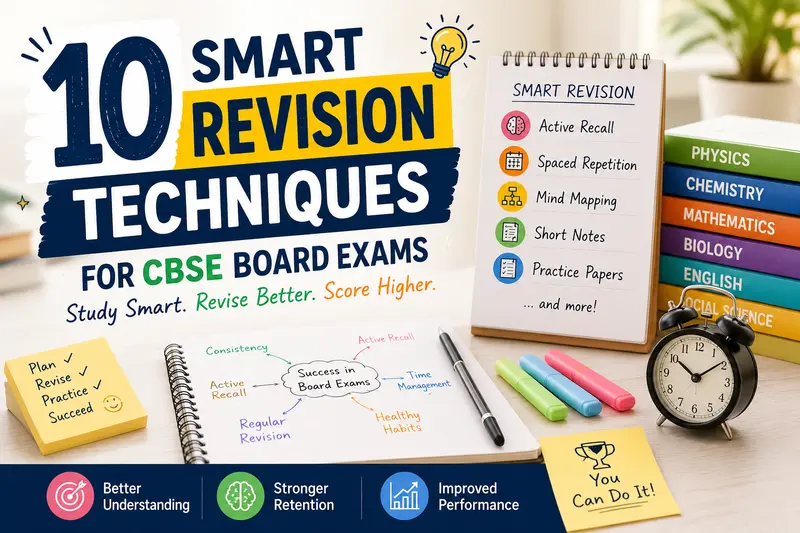

Let’s be honest — the words “board exams” are enough to make most students break into a cold sweat. Whether you’re gearing up for CBSE Class 10, Class 12, or any other board exam, the pressure can feel enormous. And it makes sense — these exams feel like they carry the weight of your entire future on them.
But here’s something worth remembering: feeling a little nervous is perfectly okay. In fact, it shows you care. The problem starts when that nervousness snowballs into anxiety that keeps you from sleeping, eating, or thinking clearly.
The truth is, board exam preparation doesn’t have to be this exhausting, stressful marathon. With a solid plan, smart study habits, and a bit of self-compassion, you can walk into your exam hall feeling genuinely prepared — not just surviving on caffeine and panic.
This article is your friendly guide through all of it: how to study better, manage your time, stay healthy, and keep your stress in check so you can actually perform at your best.
Why Do Students Feel So Stressed During Board Exams?
Before you can tackle stress, it helps to understand where it’s coming from. Here are some of the most common culprits:
- Fear of getting poor marks
- Pressure from parents, relatives, or even friends
- Staring at a massive syllabus and wondering where to even begin
- Feeling under-prepared or behind schedule
- Constantly comparing yourself to classmates
- Not knowing exactly what to expect in the exam
- Poor time management leading to last-minute panic
- Sacrificing sleep to cram more content
Once you recognize these triggers, you’re already one step ahead. Awareness is the first step toward doing something about it.
Create a Study Plan That Actually Works for You
One of the biggest reasons students feel overwhelmed is that they try to think about the entire syllabus at once — and that’s genuinely terrifying. The fix? Break it down into something you can actually manage. Creating a structured study schedule can make a huge difference, and this guide on effective study planners for better time management can help you get started.
Divide and Conquer the Syllabus
Instead of staring at the whole mountain, focus on one small climb at a time. Break your syllabus into:
- Individual chapters
- Specific topics and subtopics
- Practice sessions
- Revision blocks
Completing small chunks gives you a sense of accomplishment that keeps you motivated. It’s the difference between feeling like you’re making progress and feeling like you’re running in place.
A Sample Daily Schedule
Here’s a schedule you can adapt to your own routine:
| Time | Activity |
| 6:30 AM – 7:00 AM | Morning walk or light exercise |
| 7:00 AM – 8:00 AM | Science revision |
| 8:00 AM – 9:00 AM | Breakfast and getting ready for school |
| School Hours | Classroom learning — pay attention! |
| 5:00 PM – 6:00 PM | Mathematics practice |
| 6:00 PM – 6:30 PM | A proper break — you’ve earned it |
| 6:30 PM – 7:30 PM | Language subject |
| 7:30 PM – 8:00 PM | Dinner with your family |
| 8:00 PM – 9:00 PM | Social Science revision |
| 9:00 PM – 9:30 PM | Quick review and planning for tomorrow |
| 10:00 PM | Lights out — sleep is non-negotiable |
If you’re struggling to create a routine that fits your academic goals, check out this daily study routine for students for additional practical ideas.
Having a written schedule takes so much mental energy out of the equation. You don’t have to decide what to study next — you already know.
Understand It, Don’t Just Memorize It
Here’s something a lot of students figure out too late: trying to memorize everything without understanding it is not only exhausting — it doesn’t really work.
When you actually understand why a physics formula works, or how a historical event unfolded, you can answer questions with confidence — even if they’re worded differently than you expected. Understanding gives you flexibility; memorization makes you rigid.
A Simple Example
Instead of staring at a formula until you’ve memorized it by sheer force of will, try this:
- Ask yourself what the formula is actually describing.
- Think about where and why it’s used in real life.
- Solve a variety of problems using it so your brain connects the concept to different situations.
This way, you’re not just cramming information — you’re building genuine knowledge. And that stays with you far longer.
Study Smarter, Not Longer
Clocking in seven hours at your desk without much to show for it is a common trap. The goal isn’t to study more — it’s to study better.
The Pomodoro Technique
This method is simple but surprisingly effective:
- Study with full focus for 25 minutes.
- Take a 5-minute break (stretch, get water, step outside).
- After four rounds, take a longer 15–20 minute break.
Short, focused bursts of study are far more productive than long, distracted sessions. Give it a week and you’ll notice the difference.
Active Recall
Instead of passively rereading your notes (which feels productive but often isn’t), try this:
- Close the book.
- Ask yourself a question about what you just read.
- Write down or say aloud what you remember.
It’s uncomfortable at first because your brain has to actually work — but that’s exactly the point. Struggling to recall something is how memories get stronger.
Spaced Repetition
Don’t just revise a topic once and move on. Space it out:
- Review it the next day.
- Review it again after a week.
- One final review after a month.
This method is backed by decades of research on how human memory works. It takes more planning but dramatically improves what you actually retain.
Many high-performing students use evidence-based learning methods. These scientifically proven study techniques can help improve retention and reduce exam stress.
Practice Previous Years’ Papers — Seriously, Do This
If there’s one study habit that consistently separates prepared students from anxious ones, it’s solving past question papers. And yet so many students skip this step!
Here’s what practicing past papers actually does for you:
- You get familiar with how questions are phrased — no surprises.
- You spot which topics come up most often.
- You practice working within the actual time limits.
- You build real confidence, not just the illusion of it.
A Simple Month-by-Month Practice Plan
| Week | What to Focus On |
| Week 1 | Topic-wise questions from individual chapters |
| Week 2 | Chapter tests covering broader sections |
| Week 3 | Half-length mock tests to build stamina |
| Week 4 onwards | Full-length papers under exam conditions |
Students who sit down and actually simulate the exam experience tend to feel noticeably calmer on the day itself. Because they’ve already done it before.
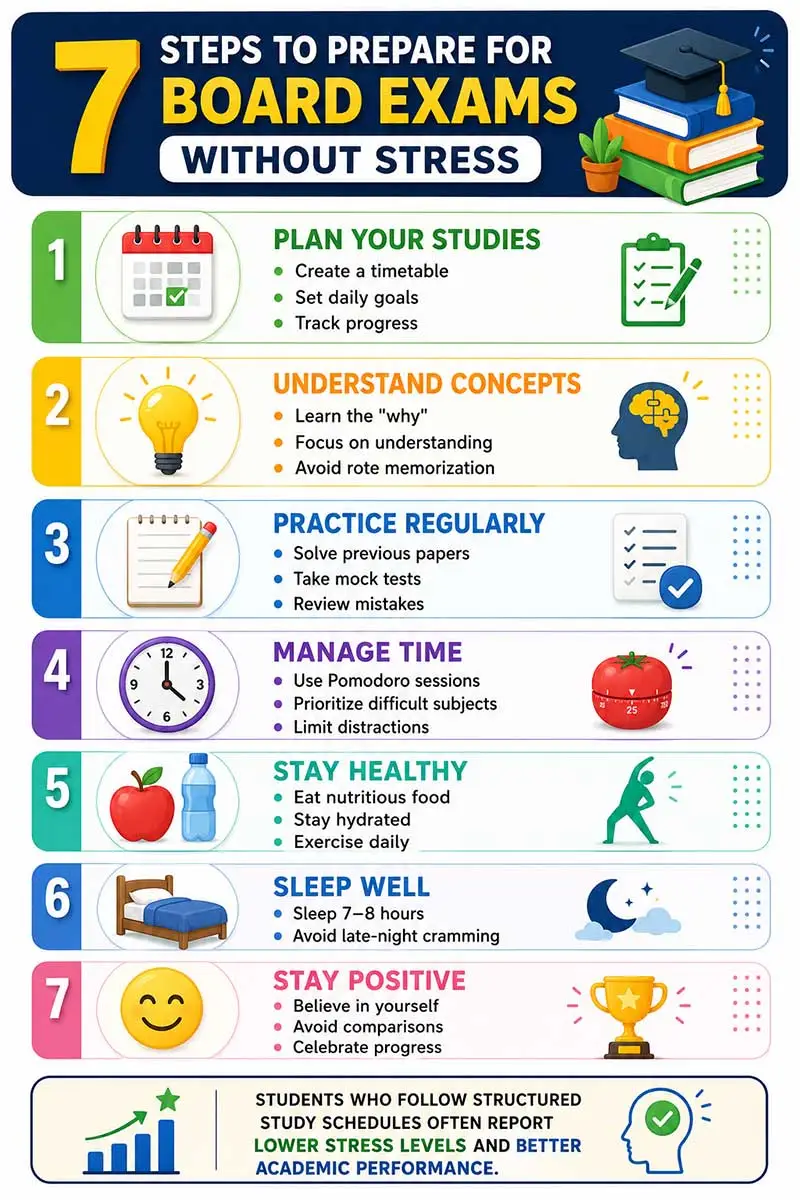
Time Management: Your Secret Weapon
Managing your time well isn’t just about fitting everything in — it’s about making sure the right things get your attention at the right time.
Know Which Subjects Need You Most
| Priority | What It Means |
| High | Subjects that challenge you and need extra attention |
| Medium | Subjects where you’re doing okay but could improve |
| Low | Subjects where you’re strong — just maintain with regular revision |
Be honest with yourself about where you stand. Spending all your time on subjects you already know, while avoiding the hard ones, is a very human tendency — but it’ll cost you.
One Thing at a Time
Research is pretty clear on this: multitasking doesn’t make you more productive. It makes you less effective at everything. During study sessions, try to:
- Keep your phone in another room (or at least face down and on silent).
- Turn off social media notifications.
- Give one subject your complete attention before moving to the next.
Take Care of Your Body — It Matters More Than You Think
Your brain is part of your body. And no amount of studying will compensate for running on no sleep and junk food.
Eat Well
You don’t need a complicated diet. Just make sure you’re eating real food regularly:
- Fruits, vegetables, and whole grains give your brain sustained energy.
- Nuts, eggs, and milk are excellent for focus and memory.
- Cut back on junk food, sugary snacks, and energy drinks — the crash isn’t worth it.
Stay Hydrated
This sounds almost too simple, but mild dehydration genuinely affects concentration. Keep a water bottle at your study table and use it.
Move Your Body
You don’t need to run a marathon. Even 20–30 minutes of movement — a walk, some yoga, cycling, or just stretching — can dramatically reduce stress hormones and sharpen your focus for hours afterward.
Please, Get Enough Sleep
This deserves its own emphasis because so many students treat sleep like an optional extra during exam season. It’s not. Here’s what actually happens when you sleep:
- Your brain consolidates everything you studied that day.
- Your memory strengthens.
- Stress hormones drop.
- You wake up able to actually think clearly.
Aim for 7–9 hours every night. Studying until 2 AM and waking up exhausted the next day is a net loss, not a gain.
According to the Centers for Disease Control and Prevention (CDC), adequate sleep is essential for attention, learning, and academic performance among students.
Dealing with Exam Anxiety (It’s More Common Than You Think)
Even the most prepared students get nervous. The goal isn’t to eliminate anxiety entirely — it’s to stop it from running the show.
Try Deep Breathing
When your heart is racing and your thoughts are spiraling, this actually helps. It’s not just something people say:
- Breathe in slowly for 4 seconds.
- Hold for 4 seconds.
- Breathe out for 4 seconds.
- Repeat 4–5 times.
It activates your body’s calming system. It genuinely works.
Change How You Talk to Yourself
The voice inside your head during stressful moments matters a lot. Instead of:
❌ “I’m going to fail. I haven’t studied enough. I’m terrible at this.”
Try:
✅ “I’ve been preparing and I’m improving. I can handle this.”
It’s not about being blindly optimistic. It’s about replacing catastrophic thinking with something more grounded and truthful.
Focus on Progress, Not Perfection
Every chapter you complete, every practice question you answer, every week you stick to your schedule — that’s progress. Celebrate it. Don’t only notice what you haven’t done yet.

A Note to Parents: Your Role Matters
If you’re a parent reading this, your child needs you right now — but maybe not in the way you think.
What Genuinely Helps
- Telling them you believe in them (and meaning it).
- Noticing effort, not just marks.
- Keeping the home calm and supportive during this period.
- Making sure they eat, sleep, and take breaks.
What Tends to Backfire
- Comparing them to siblings, neighbors, or classmates.
- Frequently asking about marks or rank.
- Setting expectations so high that they feel they can’t win no matter what they do.
- Criticizing their study habits in the middle of exam season.
Supportive, low-pressure parenting genuinely improves student confidence and performance. You have more influence than you might realize.
How Teachers Can Make a Real Difference
Students trust their teachers, often more than they show. Teachers who create a supportive environment can dramatically reduce classroom anxiety.
Some of the most effective things teachers can do include:
- Running focused revision sessions that address common weak spots.
- Sharing exam strategy alongside subject content.
- Giving feedback that tells students what they can improve, not just what they got wrong.
- Creating a classroom culture where asking questions is encouraged, not embarrassing.
- Organizing mock exams so students practice under real conditions.
Mistakes to Avoid (That Almost Everyone Makes)
Knowing what not to do is just as valuable as knowing what to do.
Last-Minute Cramming
Trying to absorb three months of content in three days doesn’t work. It just guarantees you’ll be exhausted and scattered when you need to be sharp.
Ignoring Your Weak Subjects
It’s natural to gravitate toward subjects you enjoy. But the subjects you find hard are exactly the ones that need your attention most. Face them early.
Studying Without Any Breaks
Your brain isn’t built for marathon uninterrupted sessions. Breaks aren’t laziness — they’re essential for retaining what you’ve just studied.
Comparing Yourself to Others
Your classmate who claims to have read everything twice may be exaggerating. And even if they haven’t — your preparation journey is your own. Comparison rarely helps and often hurts.
Neglecting Your Health
A tired, hungry, stressed body produces a tired, struggling mind. Your health isn’t separate from your exam performance — it’s central to it.
Download Printable PDF Resources
1. Board Exam Study Planner
Purpose
Help students organize daily and weekly preparation.
Sections Included
- Monthly goals
- Weekly targets
- Daily timetable
- Subject tracker
- Revision schedule
- Mock test records
2. Board Exam Readiness Checklist
Purpose
Help students evaluate exam preparedness.
Sections Included
- Syllabus completion
- Revision status
- Sample paper practice
- Health and sleep habits
- Confidence assessment
- Final-week preparation
Key Takeaways
- Consistent preparation over months beats last-minute cramming every time.
- A realistic study timetable removes the daily anxiety of “what should I study?”
- Understanding concepts beats memorization for long-term retention.
- Past papers are one of the most effective preparation tools available to you.
- Sleep, nutrition, and exercise aren’t luxuries — they directly affect your performance.
- Stress management is a skill worth practicing, not an afterthought.
- Encouragement from parents and teachers makes a measurable difference.
- Confidence comes from preparation — start early and build it deliberately.
Frequently Asked Questions
1. How many hours should I study each day?
Quality beats quantity every time. Most students do well with 4–6 focused hours of study outside school. More than that, and you hit diminishing returns — especially if you’re exhausted.
2. When should I start preparing?
Ideally, from the beginning of the academic year. Even light, consistent revision early on means you’re not drowning in content later. The final months should be for intensive revision, not learning everything from scratch.
3. Is it normal to feel nervous?
Completely. A little nervousness actually sharpens your focus. The goal is to keep it manageable, not eliminate it entirely.
4. How can I concentrate better?
Minimize distractions (yes, that means your phone), use techniques like the Pomodoro method, and make sure you’re rested. You can’t concentrate well when you’re sleep-deprived or hungry.
5. Should I study late at night?
Generally, no. A well-rested brain at 9 PM will absorb far more than an exhausted brain at 1 AM. Protect your sleep schedule.
6. How important are sample papers, really?
Extremely. They help you understand the question format, identify patterns, and practice under timed conditions. Students who regularly solve past papers tend to go into exams far more confident.
7. What should parents do when their child is stressed?
Listen first. Then encourage, avoid comparisons, and help establish a balanced routine. Sometimes what a stressed student needs most is to feel seen and supported, not advised.
8. Can stress actually hurt my exam performance?
Yes, significantly. High stress impairs memory recall, narrows your thinking, and reduces your ability to problem-solve under pressure — which is exactly what exams require. Managing stress isn’t soft or secondary. It’s essential.
Final Thoughts
Board exams matter. But they are not the only thing that matters, and they are not the end of the road either way. They’re one chapter in what will be a long, interesting life.
The students who do best aren’t always the ones who studied the hardest or slept the least. They’re the ones who prepared consistently, took care of themselves, and showed up to the exam with a clear head and genuine confidence.
You can be that student. It starts with a plan, continues with daily effort, and is supported by the people around you. Trust the process, be kind to yourself along the way, and remember — one focused day at a time is all it takes.
You’ve got this.

Student Success Desk focuses on practical learning strategies, study techniques, and academic improvement tips for school students.