

Mid-terms have a way of sneaking up. One week it’s early September and the syllabus feels manageable; the next, your school announces dates and you realise six weeks of scattered chapters, notes, and half-finished homework are now supposed to fit into a revision plan you haven’t actually built yet.
We’ve already covered the techniques themselves in 10 Smart Revision Techniques for CBSE Board Exams. This post is about the step most students skip before they even get to use those techniques: turning a pile of subjects into an actual subject-wise plan, with real days, real priorities, and a schedule you can follow without re-deciding what to study every single morning.
Why “I’ll Revise Everything” Isn’t a Plan
Ask most students what their mid-term revision plan is, and the honest answer is some version of “I’ll go through everything.” That’s not a plan — it’s a hope. Without a structure behind it, revision time quietly flows toward the subject you enjoy most or the chapter you covered most recently, while the subject you’ve been avoiding since July stays avoided right up until the night before the paper.
A subject-wise plan fixes this by forcing three decisions up front: which subjects need the most time, which days those subjects get, and what “revising” actually means for each one — instead of leaving all three to be decided in a panic later.
Step 1: Take Stock of Every Subject Honestly
Before you can prioritise anything, you need an honest map of where you actually stand. Grab a page and, for every subject on your mid-term timetable, note:
- How much of the syllabus for this exam is actually covered in class so far
- A confidence rating from 1 to 5 for each chapter or unit — not what you scored last time, what you’d score if the test were tomorrow
- Whether this subject typically needs more practice-based revision (Maths, Science numericals) or more reading and recall (History, Civics, Languages)
This step feels slow, but it’s the difference between a plan built on facts and one built on assumptions about yourself that are usually a few months out of date.
Step 2: Rank Subjects by Urgency, Not Preference
Once you know where you stand, sort subjects into a simple grid: how much this subject counts (weightage, number of papers, or how much it affects your overall average) against how confident you actually are in it right now.
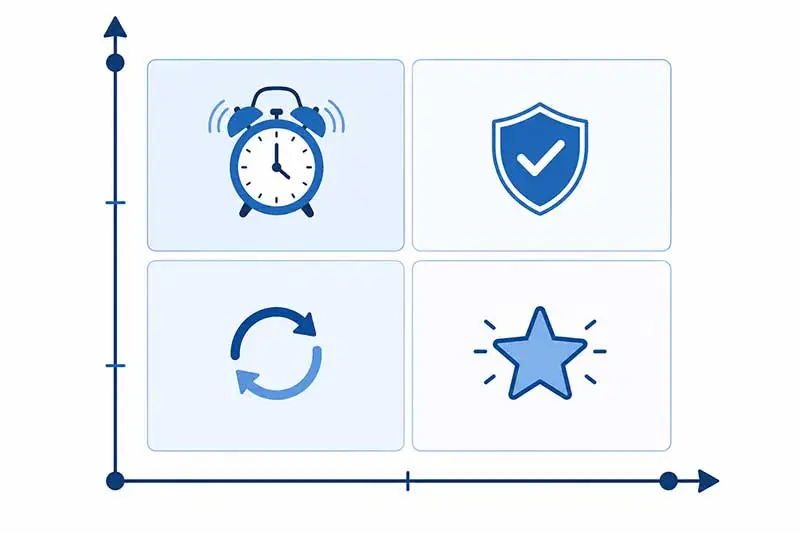
- High weightage, low confidence — Urgent. These get first pick of your best study hours and the most days on your schedule.
- High weightage, high confidence — Maintain. Don’t ignore these, but short, regular check-ins are enough. Don’t let a subject you’re already strong in eat time an urgent one needs.
- Low weightage, low confidence — Steady practice. Give these consistent but shorter sessions rather than long, rare ones.
- Low weightage, high confidence — Quick wins. A light once-a-week pass is usually enough to keep these solid.
Most students instinctively do the opposite of this — they revise what’s comfortable first and hope there’s time left for the rest. Ranking by urgency, not preference, is what actually protects your weak subjects.
Step 3: Time-Block Your Revision Days
With your priority list ready, the next step is putting it on an actual calendar. If you don’t already have a study timetable you’re using day to day, mid-term season is a good time to start one — because a revision plan without fixed time slots tends to quietly dissolve into whatever feels easiest each evening.
A few principles that make time-blocking work for revision specifically:
- Give “Urgent” subjects two to three dedicated slots a week, not one long cram session
- Study your hardest subject in your most alert time of day, not last, when energy is already gone
- Keep sessions to 45–50 minute blocks with real breaks — revision fatigue sets in faster than regular study fatigue
- Leave one buffer slot every few days for whatever fell behind, because something always does
Step 4: Build In Practice, Not Just Reading
Rereading notes and textbooks feels productive, but research on retrieval practice consistently shows that actively recalling information — through self-testing, practice questions, or explaining a topic out loud — builds far stronger, longer-lasting memory than passive review does. Reading a chapter twice is not the same as being able to answer a question about it with the book closed.
If you’re using the Cornell-style note-taking approach, this is where it pays off — cover your notes, work from the cue column, and treat every revision session as a small test rather than a read-through. Build in previous years’ questions and sample papers for every subject, not just the ones you find interesting.
A Sample Two-Week Subject-Wise Revision Schedule

This is a starting structure, not a rule — adjust it to your own subject list and school timetable.
- Week 1, Days 1–3: Urgent subjects only. First full read-through plus a short self-test on each chapter covered.
- Week 1, Days 4–6: Continue Urgent subjects, add one Steady-practice subject per day in a shorter slot.
- Week 1, Day 7: Light review day — Quick-wins subjects, plus re-rating your confidence levels from Step 1.
- Week 2, Days 1–4: Practice-heavy days — past papers and timed questions across all Urgent and Steady-practice subjects.
- Week 2, Days 5–6: Final pass on weak spots identified during Week 2 practice, plus a short Maintain-subject check-in.
- Week 2, Day 7: Rest, sleep, and a light skim of summary notes only. No new content this close to the exam.
Common Mistakes That Derail a Revision Plan
- Treating every subject equally. Equal time isn’t fair time — your weakest, highest-weightage subject needs more of it than your strongest.
- Planning by chapter order instead of priority. Working straight through the textbook ignores the fact that some chapters matter far more than others right now.
- Skipping the confidence check-in. A plan built in Week 1 and never revisited stops reflecting reality by Week 2.
- No buffer time. One missed day without a buffer often turns into a collapsed schedule, not just a one-day delay.
- All reading, no testing. If a session doesn’t include recalling or answering something, it’s not really revision yet.
How Mid-Term Marks Fit Into Your Overall Score
It’s worth remembering that periodic tests aren’t just practice — they typically feed directly into your internal assessment marks for the year, alongside your portfolio and subject enrichment activities. That’s one more reason a scattered, last-minute approach to mid-terms costs more than just the test itself.
If exam-season nerves are part of what’s making it hard to plan calmly, it’s worth reading How to Prepare for Board Exams Without Stress alongside this guide — a plan only helps if you’re calm enough to follow it.
Quick Reference: Subject-Wise Revision Plan at a Glance
| Step | What to Do |
| Take stock | List every subject, rate confidence 1–5, note how much syllabus is covered |
| Rank by urgency | Sort subjects into Urgent, Maintain, Steady Practice, and Quick Wins |
| Time-block | Assign fixed days and 45–50 minute slots per subject based on rank |
| Add practice | Bring in past papers and self-testing for every subject, not just reading |
| Review weekly | Re-rate confidence and shift time toward whatever is still weak |
Frequently Asked Questions
How many subjects should I revise in one day?
Two to three is usually realistic — one Urgent subject as the main focus, plus a shorter session on a Steady-practice or Maintain subject. Trying to touch every subject daily usually means doing none of them properly.
What if my mid-terms cover only part of the syllabus?
Even better — a smaller syllabus window is exactly when a subject-wise plan pays off most, since you can go deep on fewer chapters instead of spreading thin across the whole year’s content.
Should I make a new plan for every mid-term, or reuse the same one?
Reuse the structure, not the content. The steps (take stock, rank, time-block, add practice) stay the same every time — only your confidence ratings and subject priorities change as the year goes on.
What if I fall behind halfway through the two weeks?
Use your buffer slots first. If you’re still behind after that, drop a Quick-wins subject down to a single light review rather than cutting time from an Urgent one.
Is it okay to revise the same subject on consecutive days?
For Urgent subjects, yes — but mix in some interleaving with a second subject where possible. Pure back-to-back single-subject days tend to feel productive but limit how much you’re actively recalling versus just continuing to read.
Final Takeaway
A subject-wise revision plan isn’t about finding extra hours you don’t have — it’s about spending the hours you do have on the subjects that actually need them, in a structure you don’t have to rebuild from scratch every morning. Take an honest look at where you stand, rank instead of guessing, block real time on a real calendar, and build in practice from day one. That’s the difference between hoping mid-terms go well and actually being ready for them.
If you’d like a subject-wise revision plan built around your own timetable and mid-term dates, the Student Success Assistant can help you put one together in a few minutes.

Student Success Desk focuses on practical learning strategies, study techniques, and academic improvement tips for school students.