
Direct Answer: Effective discipline means teaching, not punishing. It works best when parents stay calm, set clear and consistent rules, explain the “why” behind them, and respond to mistakes with natural consequences instead of anger. Praise for effort, predictable routines, and open communication build self-discipline far more reliably than shouting, shaming, or physical punishment ever can.
Why Discipline Isn’t the Same as Punishment
Be honest — how many times have you scolded your child for the exact same thing, three days in a row, and wondered why nothing’s sinking in? You’re not doing anything wrong as a parent. You’ve just been handed the wrong tool for the job.
Here’s a fun fact that changed how I think about this: the word “discipline” comes from the Latin disciplina, which simply means “instruction” or “teaching.” Not punishment. Not consequences delivered through gritted teeth. Teaching. Somewhere between our own strict, no-questions-asked childhoods and our kids’ very different ones, the two got completely tangled up.
Think about the difference for a second. Punishment is really just asking, “How do I make my child feel bad enough, right now, that they stop?” Discipline asks something much bigger: “How do I help my child actually understand what to do instead — so they don’t need me standing over them next time?” One is a reaction. The other is a life skill you’re quietly building, one ordinary evening at a time.
And no, this doesn’t mean going soft or letting rules slide. If anything, real discipline asks more of you as a parent, not less — because it means following through calmly every single time, not just on the days you have the patience for it.
What Does Research Say About Punishment vs. Positive Discipline?
You don’t have to just take my word for this — child development researchers have been studying it for decades, and honestly, the pattern is almost boringly consistent. Harsh or physical discipline tends to be linked with more aggression, more anxiety, and more behavioural trouble down the line. Meanwhile, a warm-but-firm parenting style — the kind where love and boundaries sit side by side — tends to raise kids who handle their emotions better and often do better academically too.
The National Council of Educational Research and Training (NCERT) has, through its curriculum and teacher training materials, consistently pushed for child-centred, non-punitive classroom management — and honestly, whatever works in a classroom of thirty children usually works even better with one or two at home. The Ministry of Education’s guidelines under the National Education Policy 2020 lean the same way, emphasising nurturing environments over fear-based compliance as the foundation for a child’s holistic development.
So no, this isn’t about rules not mattering. It’s just that how you hold the rule matters every bit as much as the rule itself.

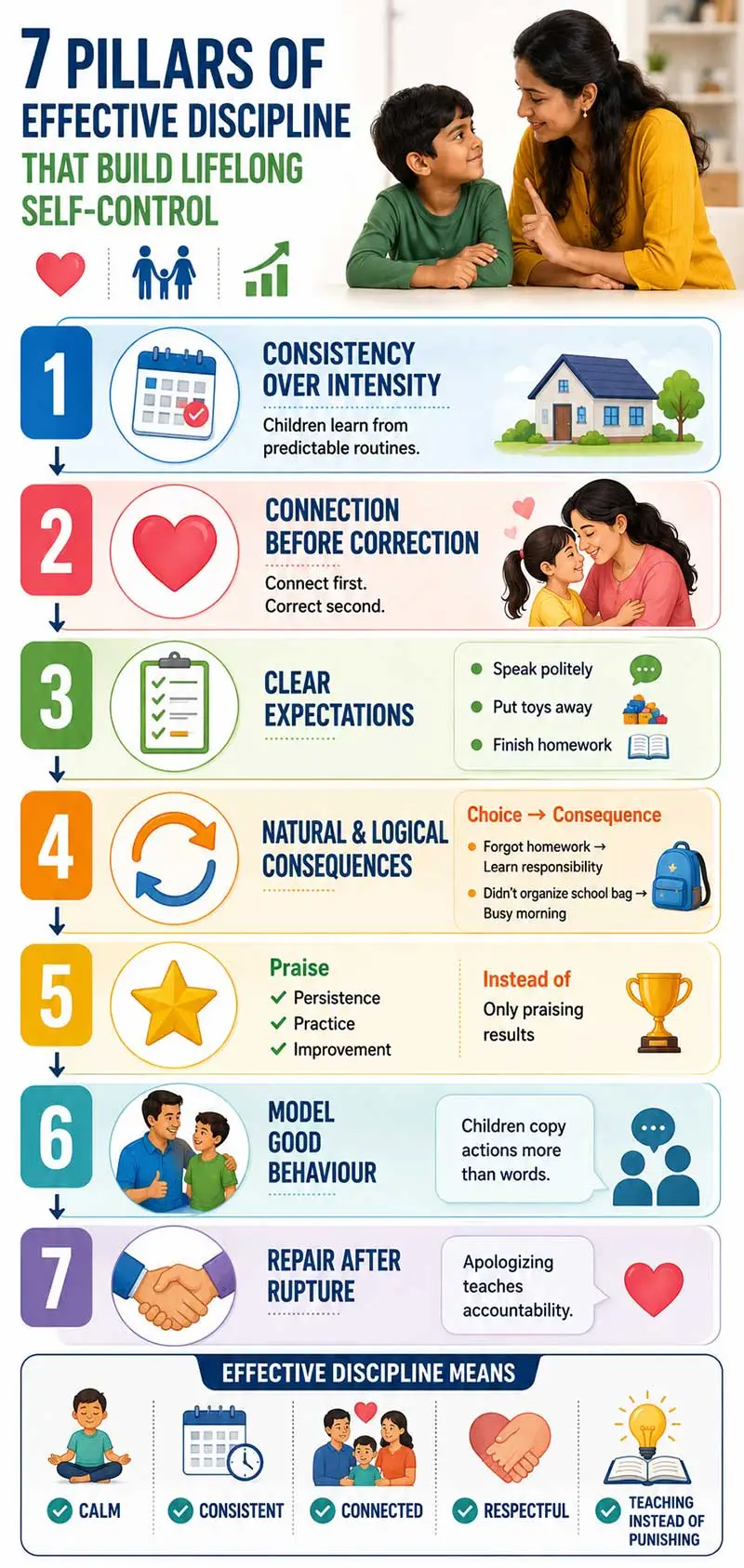
The 7 Pillars of Effective Discipline at Home
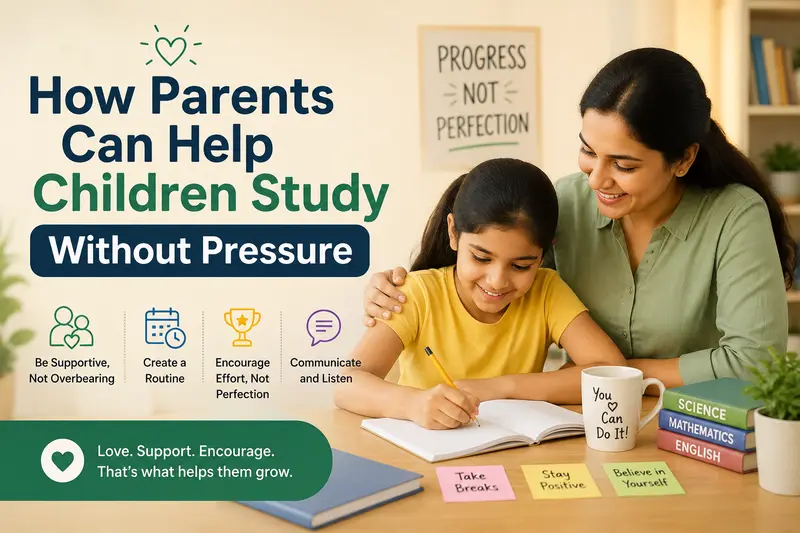
One of the biggest challenges for families is balancing discipline with academic expectations. If your child is preparing for tests, these strategies work even better when combined with approaches that reduce stress rather than increase it, as explained in “How Parents Can Help Children Study Without Pressure“.
1. Consistency Over Intensity
A calm rule that holds up every single time will always beat a strict rule that only shows up when you’re in the mood. Kids are frighteningly good at spotting patterns — way better than they are at following instructions, if we’re honest. If screen time rules quietly bend on an exhausting Tuesday, guess which day they’ll test you on next week?
2. Connection Before Correction
Before you jump in to correct anything, give it ten seconds. A hand on the shoulder. Actual eye contact. Their name said gently, not barked. A child who feels safe listens faster than one who feels attacked — every time, no exceptions.
3. Clear, Age-Appropriate Expectations
“Behave properly” means precisely nothing to a six-year-old — think about it, what does that even look like to a child? But “Keep your voice at inside-level when we’re at Nani’s house” gives them something they can actually picture and act on.
4. Natural and Logical Consequences
If your child won’t pack their school bag the night before, the natural consequence is a rushed, stressful morning scrambling for their geometry box — not losing their favourite toy for a week. When the consequence actually connects to the choice, kids learn cause and effect. When it doesn’t, they just learn that you’re upset.
5. Praise the Effort, Not Just the Outcome
Try this instead of “good job”: “You tried that fraction problem three times before asking for help — that’s real persistence.” It sounds small, but it builds resilience. Constantly saying “you’re so smart,” on the other hand, can quietly make kids more afraid of failing — because if being smart is the whole identity, a wrong answer threatens it.
6. Model What You Expect
Kids copy what we do, not what we say — almost annoyingly so. A parent yelling “Stop shouting!” is, whether they mean to or not, teaching shouting.
7. Repair After Rupture
You will lose your temper sometimes. Every parent does — that’s not a confession, it’s just true. What matters is going back afterward and saying so: “I got too loud earlier. I was frustrated, but that wasn’t fair to you.” This one habit, more than almost anything else on this list, teaches emotional accountability.
How Should Discipline Change With Your Child’s Age?
What works beautifully for a toddler will make a teenager roll their eyes so hard it hurts. And fair enough — every stage genuinely needs its own approach. (For more on this, our guide on age-appropriate learning goals for children digs deeper into how development shifts stage by stage.)
Ages 3–6: Keep it short, immediate, and visual. This is the redirect-don’t-lecture stage — long explanations just wash right over them. A simple routine chart on the fridge does more than any speech ever will.
Ages 7–10: Now the “why” behind a rule actually starts to land. This is also a great age to bring them into setting a few house rules themselves — kids are far more likely to keep a rule they helped write.
Ages 11–14: Their need for independence is growing fast, and it deserves respect. Shift from “rules I hand down” to “agreements we work out together.” Clamp down too hard here and don’t be surprised if things just move underground instead.
Ages 15+: Lean on natural consequences and, more than anything, trust. Teenagers respond so much better to being treated like capable young adults than to being managed like they’re still ten.

Common Discipline Mistakes Indian Parents Make
- Comparing siblings or classmates (“Why can’t you be like your didi?”) — it stings for years and rarely changes a single behaviour.
- Empty threats (“No birthday party if you do that again!”) — kids figure out fast which threats you’ll actually follow through on and which are just noise.
- Public shaming in front of relatives or guests — it might look like it “works” in the moment, but it chips away at a child’s sense of safety in ways that show up much later.
- Bribery disguised as motivation — constantly rewarding basic, expected behaviour can end up dulling a child’s own internal drive to do the right thing.
- Inconsistent rules between parents — Mummy says no phone after 9 pm, Papa lets it slide “just this once,” and just like that, kids learn exactly which parent to ask.
Discipline Strategies Comparison Table
| Approach | What It Looks Like | Short-Term Effect | Long-Term Effect |
| Punishment (shouting, physical) | Immediate reaction to stop behaviour | Quick compliance out of fear | Increased anxiety, resentment, hidden behaviour |
| Permissive (no consequences) | Letting things slide to avoid conflict | Peaceful in the moment | Poor boundary awareness, entitlement |
| Positive Discipline | Calm, consistent, consequence-based | Slower initial change | Stronger self-control, trust, and communication |
| Bribery/Reward-only | Rewards for every expected behaviour | Fast compliance | Reduced internal motivation over time |
A Practical Weekly Discipline Checklist for Parents
- Did I set clear expectations before the situation, not just after?
- Did I stay calm, or did I react from frustration?
- Did I follow through on the consequence I stated?
- Did I praise at least one effort (not just outcome) today?
- Did I apologise if I overreacted?
- Are both parents/caregivers aligned on the same rules this week?
- Did I connect with my child before correcting them?
Go ahead, print this out and stick it on the fridge or above the study table. During exam months, pairing consistent routines with healthy sleep, nutrition, and exercise can further improve learning. See our guide on “Healthy Habits That Improve Concentration While Studying“. Nobody nails all seven every single day (I certainly don’t), but the small, repeated checks matter far more than one big dramatic overhaul ever will.
⬇️ Download Printable PDF Worksheet: Positive Discipline Weekly Reflection Checklist
How to Handle Specific Situations
When your child throws a tantrum in public: Lower your voice instead of raising it — it feels counterintuitive, but it works. Step away from the crowd with them rather than trying to negotiate loudly in front of an audience.
When your child lies about homework: Separate the lie from the missed homework. Lump them into one big punishment and the actual lesson — that honesty matters — gets completely lost in the noise.
When siblings fight constantly: Resist the urge to play judge and decide who’s “right.” Instead, ask each child what they actually need in that moment, then guide them toward figuring out a solution together.
When your child keeps ignoring the same instruction: Before assuming they’re being difficult, ask yourself — was the instruction actually clear? And did you follow through last time, or did it fizzle out? More often than not, that’s the real story.
For more on the sibling side of things, our piece on building strong sibling relationships at home goes into more depth. And if exam pressure seems to be fuelling the behaviour, it’s also helpful to read “How Parents Can Support Children During Exam Season” for practical ways to reduce stress while maintaining healthy routines. To keep children engaged and confident throughout the academic year, explore “Student Motivation: Boost Exam Performance“.
When Should You Seek Professional Help?
A bit of defiance, some mood swings, testing boundaries here and there — that’s just childhood, not a red flag. But it’s worth reaching out to a professional if you start noticing:
- Persistent aggression toward themselves or others
- A sudden pulling away from things they used to genuinely enjoy
- Behavioural shifts that stick around for weeks with no clear trigger
- Fear or anxiety that feels bigger than the situation calls for
Many CBSE schools now have in-house counsellors as part of their wellness push — reaching out to your child’s school counsellor is often the easiest first step, and honestly, far more normal today than it was even ten years ago. Our directory of student mental health resources is a good place to explore further options too.
⬇️ Download Printable PDF Worksheet: Positive Discipline Practice Scenarios
Key Takeaways
- Discipline means teaching, not punishing — the goal is a skill your child keeps for life, not just quiet compliance today.
- Consistency matters more than strictness; kids respond to patterns they can predict.
- Logical consequences teach cause-and-effect far better than shouting or unrelated punishments ever will.
- Praise the effort and persistence, not just the result — that’s what builds resilience.
- Your approach needs to grow up alongside your child, from toddlerhood right through the teenage years.
- Repairing things after you lose your temper teaches accountability — and honestly, it models exactly the behaviour you’re hoping to see.
- If something feels off for weeks, don’t wait it out alone — loop in a school counsellor or child psychologist early.
Frequently Asked Questions
1. What is the difference between discipline and punishment?
Discipline teaches a child what to do and why, building long-term self-control. Punishment is more about making a child feel bad enough to stop a behaviour right now, without necessarily teaching them a better way forward.
2. Is it ever okay to scold my child?
Firm, calm correction? Absolutely, and often necessary. The real concern is scolding that comes from your own frustration in the moment, rather than what your child actually needs to learn.
3. How do I discipline a child without shouting?
Try lowering your voice instead of raising it, get down to their eye level, state exactly what you expect, and follow through calmly on a consequence you’d already decided on — rather than reacting in the heat of the moment.
4. What are natural consequences in parenting?
These are outcomes that happen naturally from a child’s own choice — feeling cold because they refused to wear a sweater, for instance — rather than an unrelated punishment a parent hands out separately.
5. How can both parents stay consistent with discipline?
Sit down and agree on 3–5 core household rules ahead of time, work through disagreements privately rather than in front of your child, and try not to overrule each other in the moment — it undoes both of you.
6. Does positive discipline work for teenagers too?
Yes, though it looks different at this stage — teens tend to respond much better to negotiated agreements and natural consequences than to strict, one-sided rules handed down from above.
7. How do I stop comparing my child to siblings or classmates?
Keep your feedback focused on their own progress — “You solved two more problems than yesterday” — rather than stacking them up against someone else. Comparisons rarely change behaviour; they just chip away at confidence.
8. What should I do if I lose my temper with my child?
Once you’ve cooled down, go back and name it: explain what happened, apologise if it’s warranted, and briefly share what you’ll try differently next time. That’s not weakness — it’s exactly the kind of accountability you want them to learn too.
9. At what age should discipline strategies change?
Roughly at each developmental stage — early childhood (3–6), middle childhood (7–10), early adolescence (11–14), and the teenage years (15+) — each one asks for a shift, moving gradually from simple redirection to real negotiation and trust.
10. When should I involve a school counsellor for behavioural issues?
If a behavioural or emotional change sticks around for several weeks, feels extreme, or involves aggression or withdrawal, a school counsellor or child psychologist can help get to the bottom of it early — before it becomes a bigger pattern.

Parent Guidance Corner provides supportive resources for parents helping children with education, learning habits, and academic wellbeing.