Most of us have watched a child (or been the child) open a laptop to “study math,” play a 20-minute video, glance at a notification, open another tab, reply to a message, and somehow lose an hour without being able to explain what was just learned. That gap — between being online and actually learning online — is what this article is about.
The good news is that the fix isn’t more apps or faster internet. It’s a handful of habits: a clear goal before each session, shorter lessons, real practice, honest feedback, smart use of AI, safe digital habits, and a study space that isn’t fighting for attention with a phone. Combine that with good teacher guidance and a bit of structure at home, and online learning stops being something students sit through and starts being something they actually do.
Why Online Learning Feels Harder Than It Should
Flexibility is the whole appeal of online learning — and also its biggest trap. Without structure, “I’ll study whenever” quietly becomes “I never quite start.”
Some familiar culprits:
- Watching passively instead of participating
- Phones and social media pulling attention away
- Long, uninterrupted video lessons
- No one there to answer a question in the moment
- Too many apps, not enough follow-through
- Patchy internet or a shared family device
- Screen fatigue and general burnout
These issues hit differently across India, where access to devices, internet, and quiet study space varies a lot from home to home. India’s National Education Policy (NEP) 2020 acknowledges this directly — it backs technology-supported learning but insists on blended approaches, teacher training, and closing the digital divide, not just handing everyone a tablet and calling it done.
If your own study habits could use a reset, CBSE Guide’s study tips is a decent place to start.
What Actually Makes Online Learning Work
A fast laptop and a library of videos won’t get anyone very far on their own. What matters is how the technology gets used. A recent peer-reviewed study in Frontiers in Education on active learning strategies for online teaching makes the case plainly: online classes work best when they’re built around participation, not broadcast.
The elements that tend to separate learning that sticks from learning that doesn’t:
| Element | What it looks like |
| Clear goal | Student knows exactly what “done” looks like |
| Short lessons | Content broken into digestible chunks |
| Active participation | Answering, explaining, creating, discussing |
| Immediate practice | Using the concept right after learning it |
| Feedback | Mistakes get caught and corrected quickly |
| Interaction | Real back-and-forth with teachers or peers |
| Revision | Old material gets revisited, not just filed away |
| Personalisation | More time for hard topics, less for easy ones |
| Safe habits | Privacy and passwords aren’t an afterthought |
| Progress tracking | Students can see what’s done and what isn’t |
The Ministry of Education’s PRAGYATA guidelines make an important distinction between synchronous learning (live classes) and asynchronous learning (recorded content), and they’re clear that online education shouldn’t just try to recreate a physical classroom on a screen. Good online learning plays to the strengths of the medium instead of imitating a whiteboard.
What Students Can Do Differently
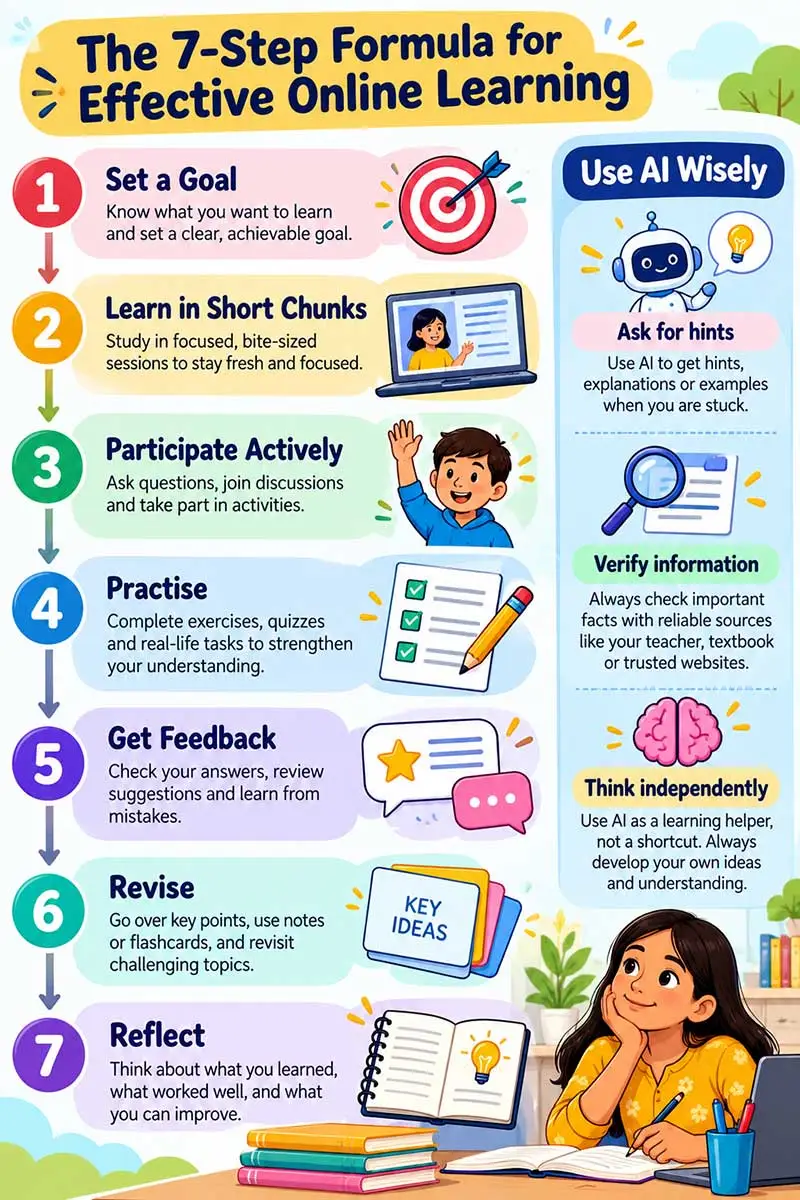
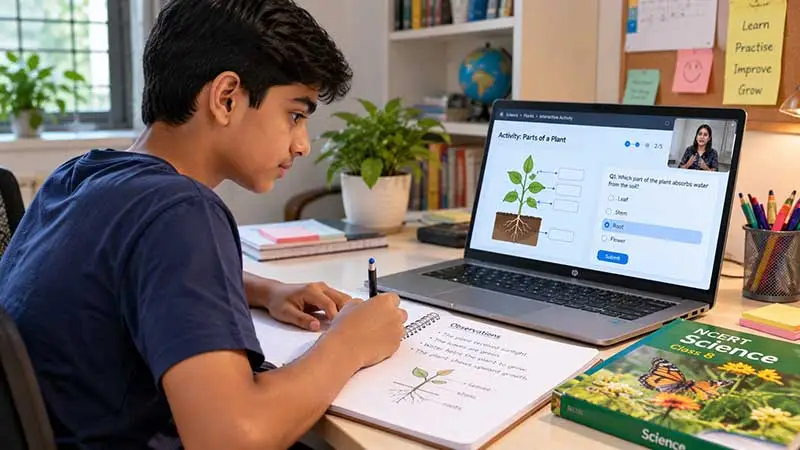
Set a real goal first. “By the end of this, I can explain photosynthesis in my own words” beats “study science” every time — it gives you something to check yourself against afterward.
Get distractions out of the room, not just out of sight. Turn off notifications, put the phone somewhere else entirely, and try full-screen mode or a website blocker if self-control alone isn’t cutting it. Keep a notebook nearby for stray questions so they don’t turn into tab-opening excuses.
Take notes that mean something. Don’t transcribe the teacher word for word — capture key ideas, definitions, examples, and anything confusing. Afterward, close the notes and try explaining the concept out loud. That one habit does more to convert watching into learning than almost anything else. For more on this, 10 Smart Study Techniques Every Student Should Know is worth a read.
Use the pause button deliberately. Recorded lessons let you slow down, replay, or stop before an answer is revealed — but rewatching a video five times isn’t the same as mastering it. Follow up every playback with an attempt to solve something unaided.
Ask questions before the exam does. Jot down anything unclear in the moment: why does this happen, what’s the difference between these two ideas, where exactly did I go wrong? Waiting until test week to notice confusion is the expensive way to find out.
What Teachers Can Do to Keep Students Engaged
A 45-minute class doesn’t have to be a 45-minute monologue. Breaking it up — warm-up question, short explanation, a bit of interaction, a guided activity, a quick quiz, a review — keeps attention from drifting the way one long stretch of talking never can.
A few things worth doing more often:
- Ask sharper questions. “Does everyone understand?” tells you nothing. “What would happen if the temperature increased?” tells you everything.
- Quiz in small doses. Short checks after each concept — polls, flashcards, exit tickets — reveal gaps while they’re still easy to fix, without needing to feel like a graded test.
- Build in group work. Solving a problem together, debating an issue, or explaining a concept to a classmate does double duty: it reinforces the material and builds communication skills that a solo video never will.
Using AI as a Learning Assistant, Not a Shortcut
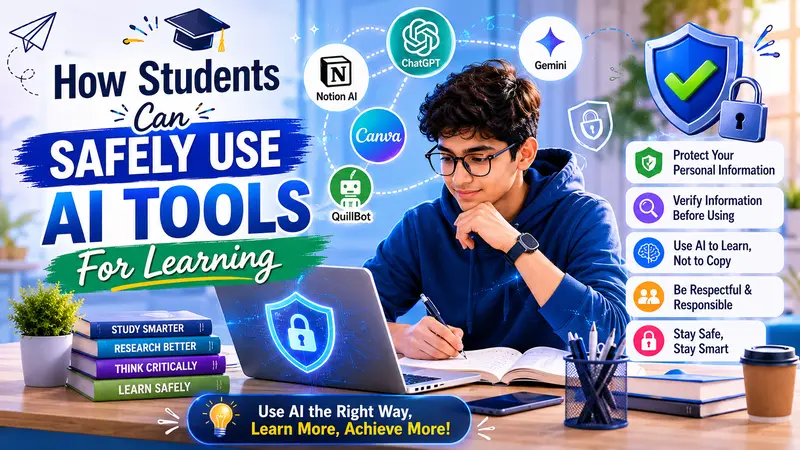
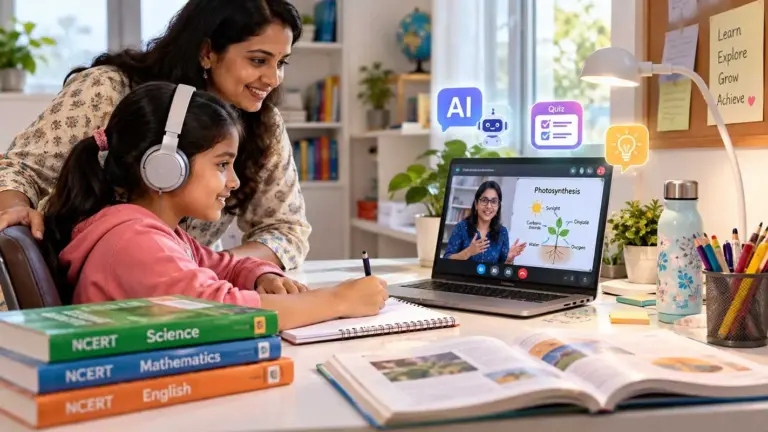
AI can make online learning genuinely more personal — generating practice questions, simplifying a tricky explanation, building flashcards, or spotting gaps in understanding. But it works best as a support system, not a replacement for actually thinking.
The difference shows up in how a question gets asked. “Give me the answer” produces a shortcut. “Give me one hint at a time so I can solve it myself” produces a student who’s still doing the reasoning. A useful pattern to build into any study session: Try, Ask, Check, Explain. Attempt the problem alone first, ask AI for a hint if genuinely stuck, verify the answer against a textbook or teacher, then explain the final answer in your own words. AI-generated answers can be wrong, outdated, or subtly off — which is exactly why that verification step matters, especially with exams on the line. Cogniks’ piece on how AI tutors help students learn from mistakes digs further into what this looks like in practice for Class 10 and 12 students.
Choosing Learning Apps Without Losing the Plot
More apps rarely means better learning — it usually just means more tabs. Before installing yet another one, it’s worth asking whether it actually matches your learning goal, whether it gives real feedback (not just marks), whether it’s safe and age-appropriate, and whether it’ll even run on your internet connection.
Government-backed resources are easy to overlook but genuinely solid: NCERT’s ePathshala gives free access to textbooks and study content, and SWAYAM offers full interactive courses with video, reading material, and self-assessment built in. They’re worth using alongside — not instead of — regular school material.
Learning at Your Own Pace
Self-paced learning is arguably digital education’s biggest advantage, and it’s wasted if everyone still moves in lockstep. A student who’s already comfortable with fractions shouldn’t have to sit through the same amount of practice as one who’s still getting the hang of it.
A simple weekly rhythm: learn a new concept, solve basic problems, try mixed problems, review the mistakes, then take a short self-test. Keeping a small Learning Gap Notebook — topic, what you already know, what still needs practice — turns “I should study more” into something you can actually act on.
Supporting Online Learning at Home
Parents don’t need to become teachers; they mostly need to set the conditions for learning to happen. That means a study space with decent lighting, minimal distractions, and the right materials within reach — nothing fancy required. It also means a routine the child can predict: when class starts, when breaks happen, when the screen gets put away for the day. A useful rule of thumb: structure the day, but don’t turn every minute into study time.
Constant “are you studying?” check-ins tend to create friction without improving anything. Questions like what did you learn today, what was hard, what do you want to practise tomorrow open up a real conversation instead. Parents looking for more ideas can check out Creating a Positive Learning Environment at Home.
Staying Safe Online
Digital safety belongs in the curriculum, not on the sidelines. The basics still matter most: strong, unique passwords that never get shared, caution before clicking unfamiliar links or downloading unknown files, sensible privacy settings, and telling a trusted adult about cyberbullying or anything uncomfortable rather than sitting on it. CBSE’s Cyber Safety handbook covers this in more depth for schools and families. And when a child does come forward with a concern, responding calmly — rather than with immediate punishment — makes it far more likely they’ll speak up again next time.
Online vs. Traditional Learning: Neither Wins Outright
Online learning offers flexibility, self-paced progress, and often better access to recorded revision material. Traditional classrooms tend to win on immediate teacher interaction, natural peer connection, and hands-on activities that are hard to replicate through a screen. NEP 2020 leans into blended learning for exactly this reason — practical and experiential learning still have real limits in a purely online setup. The most useful answer usually isn’t picking a side; it’s using each format for what it does best.
A Simple Daily Routine Worth Trying
Before (5 min): Check the goal for today, get materials ready, silence notifications, open only what’s needed.
During (25–40 min): Listen actively, take brief notes, answer questions, pause when something’s unclear.
Practice (15–20 min): Attempt questions without peeking at answers, take a short quiz, explain the concept out loud.
Review (5 min): What did I learn? What can I explain without help? What needs revisiting tomorrow?
That last five minutes of reflection is small, but it’s often what separates a session that actually sticks from one that quietly evaporates by the next morning.
Key Takeaways
- Active participation beats passive watching, every time.
- Every session goes better with a clear goal set in advance.
- Short lessons plus real practice outperform long lectures.
- AI is most useful as a hint-giver, not an answer machine — always verify what it tells you.
- Choose apps based on fit and safety, not just popularity.
- Track what you know and what you don’t; vague effort is hard to improve on.
- Parents help most by providing structure, not surveillance.
- Blended learning — mixing online flexibility with classroom interaction — tends to outperform either extreme.
Frequently Asked Questions
How can I make online learning more effective? Set a clear goal before each session, study in short focused stretches, participate actively, take notes, practise right away, and review mistakes. Keep notifications off while you work.
How can online classes be made more engaging? Short lessons, frequent and specific questions, low-stakes quizzes, discussions, and group work all help. Students learn more when they’re creating and responding, not just watching.
Are online classes better than the classroom? Neither is automatically better. Online learning offers flexibility and access; classrooms offer direct interaction and easier hands-on work. A blended approach usually beats picking one.
How can AI help students learn? It can generate practice questions, simplify explanations, build revision plans, and give feedback — best used as a study partner, not a source of ready-made answers.
Is it safe for children to use AI tools for schoolwork? It depends on the tool, the student’s age, and how it’s used. Avoid sharing personal information, stick to age-appropriate platforms, and loop in a parent or teacher when it’s unclear.
How long should a study session last? There’s no universal number — younger students generally need shorter sessions, older students can sustain longer focused blocks. Regular breaks matter more than exact timing.
What should a student do with unreliable internet? Download materials for offline use where possible, rely on lower-bandwidth resources, keep printed notes for key topics, and tell teachers about missed live sessions.
What’s the single most important habit for online learning? Active participation. After learning something, try to recall it, explain it, or apply it without looking. If you can only recognise the right answer on screen, the learning isn’t finished yet.

Learning Support Team shares guidance on safe online learning, educational technology, and effective digital study practices.