

Most parents don’t set out to pressurise their children. They ask about homework because they care. They check marks because they want to know their child is doing okay. They push harder during board exam season because they understand what’s at stake. The intention is support — but somewhere between the intention and the conversation, it can start to feel like pressure to the child sitting across the table.
This gap between what parents mean and what children experience is one of the most common dynamics in Indian households during exam time. And it’s worth understanding — not because parents are doing something wrong, but because small shifts in approach can make a significant difference in how a child actually studies.
Knowing how to help children study effectively isn’t about stepping back entirely. It’s about stepping in the right way.
Understand What Your Child Is Actually Feeling
Before offering strategies, tips, or timetables, it helps to know what’s already going on inside your child’s head.
A Class 10 or 12 student preparing for board exams is carrying a lot. There’s the academic load itself. Then there’s peer pressure — comparisons with classmates who seem more prepared. There’s uncertainty about the future: Which college? Which stream? What if I don’t score well enough? And underneath all of that, there’s often the worry of letting their parents down.
When a child comes home from school quiet or seems unmotivated at their desk, it’s rarely laziness. It’s usually some version of being overwhelmed. The parent who responds with “Have you finished your revision?” may not be wrong to ask — but the child may need a different conversation first.
Try asking open questions rather than progress-check questions. “How was today?” or “Is there anything feeling difficult right now?” opens a door. “Did you study?” closes it.
Create A Home Environment That Makes Studying Easier
Parents often focus on motivating their children to study when the more practical thing to address is the environment around them.
A child who shares a room with a younger sibling, has no dedicated desk, and studies with a television on in the next room is working against real obstacles. These aren’t excuses — they’re genuine barriers to concentration.
Think through the basics:
- A consistent study space. It doesn’t have to be a separate room. A corner of the dining table used at the same time each day works. What matters is that the space is associated with focused work, not distraction.
- Reasonable quiet during study hours. This often requires coordination from the whole family — keeping noise down, limiting loud conversations near the study area, reducing TV volume during the two hours a child has set aside for work.
- Devices managed, not banned. Banning phones entirely often creates conflict without solving the problem. A more practical approach: agree on when the phone goes in another room, and keep that boundary consistent rather than arbitrary.
Small environmental changes often produce more improvement in study habits than any amount of motivational conversation.
How To Help Children Study Effectively Without Taking Over
There’s a version of parental help that crosses into doing the work for the child. Notes rewritten by a parent. Problems solved while the child watches. Projects completed with more parent than student involvement.
This kind of help feels supportive in the moment but leaves the child underprepared for what actually happens in the exam — where they’re on their own.
The more useful kind of support looks like this:
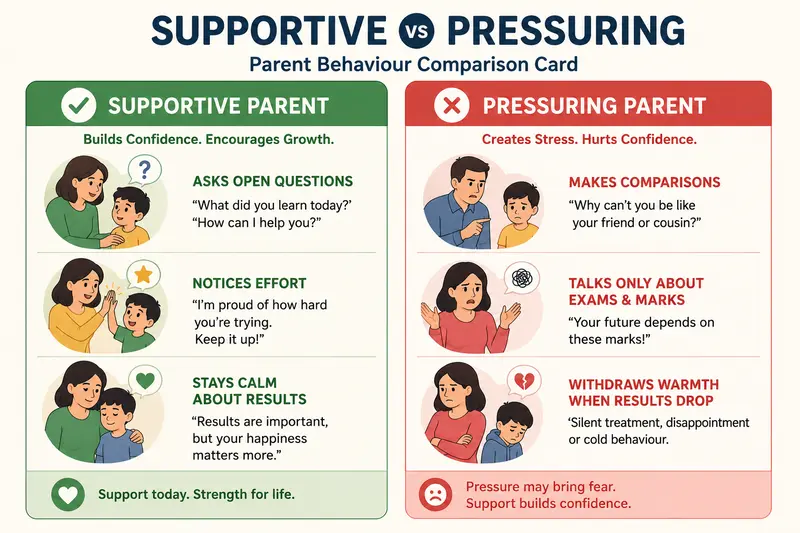
Ask them to explain what they’ve learned. If your child has spent an hour on a History chapter, ask them to tell you about it at dinner — in their own words, casually. You don’t need to know the subject to listen. The act of explaining it consolidates their understanding in a way that re-reading the chapter doesn’t.
Help them plan rather than execute. Sit with your child for fifteen minutes at the start of the week and help them map out what they want to cover and when. Then step back. The plan belongs to them. Following through on it also needs to be their responsibility — otherwise the habit never forms.
Be available but not hovering. Checking in once at the start of a study session and once at the end is enough. Sitting beside them while they study, asking questions every twenty minutes, or supervising their every revision choice signals that you don’t trust them to manage it — and children often meet that expectation.
Manage Comparisons — They Do More Damage Than Most Parents Realise
“Riya from your class scored 95. Why can’t you focus like her?”
This kind of comment is so common in Indian households that many parents say it almost automatically. It comes from a place of wanting to motivate. What it actually does is different.
Children who are constantly compared to peers begin to study for the wrong reason — not to learn or improve, but to avoid the shame of falling short. That motivation is fragile. It creates anxiety rather than effort, and it makes the child associate studying with stress rather than achievement.
Every child has a different starting point, a different pace, and a different set of strengths. A child who moves from 60% to 72% has worked hard and improved significantly — and that deserves acknowledgment, not a comparison to someone who scored higher with an easier starting point.
Notice improvement over time, not just the absolute score. Comment on effort you observe — the extra hour spent on a difficult chapter, the practice problems attempted before bed — not just outcomes. This kind of attention shapes a child’s relationship with studying in a lasting way.
Talk About Exams Honestly — Not Dramatically
Parents sometimes speak about board exams in ways that inadvertently amplify a child’s fear.
“Everything depends on these marks.” “This is the most important year of your life.” “If you don’t do well in Class 12, doors will close.”
These statements may reflect real concerns, but they put enormous psychological weight on an already pressured child. A student who believes that one exam determines their entire future doesn’t study better — they study in a state of fear. And fear is not a productive study environment.
It’s more helpful to acknowledge that board exams matter without catastrophising them. Something like: “These exams are important, and I know you’re working hard. Whatever the result, we’ll figure out the next step together.” That kind of message reduces anxiety without being dishonest about the stakes.
Students who believe their parents have their back regardless of results are generally more resilient, more willing to attempt difficult problems, and more honest about where they’re struggling — which makes it easier to actually help them.
Parenting Tips For Education: The Role of Routine
One of the most effective things a parent can do has nothing to do with study content at all: it’s supporting a consistent daily routine.
Children who sleep and wake at roughly the same time, eat properly, and have predictable study hours develop better concentration than those whose schedules vary wildly from day to day. The brain works better with regularity.
This means parents need to model it too. If study hours in the household are treated seriously — meals happen on time, noise is managed, distractions are reduced — children take their own study time more seriously. When a parent is scrolling on their phone in the same room they’ve asked their child to study in, the message is mixed.
Some practical anchors worth establishing:
- A fixed study start time that doesn’t shift based on mood or circumstances
- A proper dinner break rather than eating while studying
- Lights-off time that gives the child adequate sleep — especially in the months before board exams
These aren’t dramatic interventions. They’re consistent habits, and consistency is what makes them work.
What Not To Do: Mistakes That Undermine Student Motivation
Even well-meaning parents fall into patterns that quietly work against their child’s motivation.
Over-scheduling extra tuitions. A child who attends school, three tuition classes, and an online course every week has no time to think, process, or rest. More input doesn’t produce more learning past a certain point. It produces exhaustion. Review the load honestly and ask whether all of it is genuinely necessary.
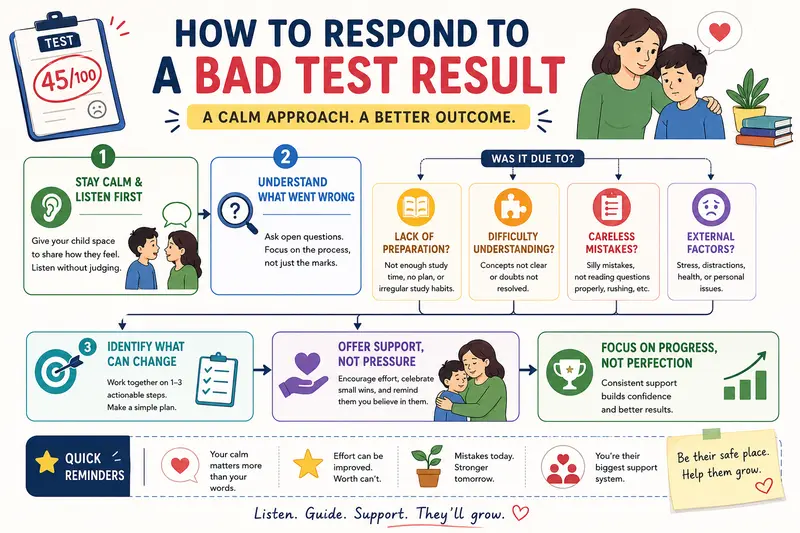
Reacting strongly to poor test results. How a parent responds to a bad result shapes whether a child tells the truth next time. A child who knows a low mark will lead to a heated conversation learns to hide results, delay showing them, or feel ashamed rather than motivated to improve. A calmer response — “okay, let’s see what went wrong and what to do differently” — keeps the conversation open.
Withdrawing affection or warmth when marks are disappointing. Children notice when a parent’s mood is tied to their academic performance. It teaches them that they are valued for their results, not for who they are. This is one of the most damaging patterns in education, and most parents who do it don’t realise they’re doing it.
Final Takeaway
The goal of supportive parenting isn’t to guarantee top marks. It’s to raise a child who can manage difficulty, persist through setbacks, and find their own motivation to learn. Those qualities matter far longer than any single board exam result.
Parents who help children study effectively aren’t the ones with the most elaborate revision plans or the strictest study timetables. They’re the ones who create a calm, consistent environment, acknowledge effort honestly, and stay curious about their child’s experience rather than fixated only on their performance.
That kind of support doesn’t replace the child’s own work. It makes the child’s own work more possible.
Frequently Asked Questions (FAQs)
Q1. How can parents support children during board exam preparation without adding to their stress?
The most effective thing is to focus on environment and encouragement rather than constant progress checks. Make sure the home environment supports concentration, keep comparisons with other children out of the conversation, and acknowledge effort alongside results. Being a calm presence — someone your child can talk to when they’re struggling — is often more valuable than any specific academic strategy.
Q2. My child seems unmotivated to study. What should I do?
Lack of motivation usually has a reason behind it — difficulty with certain subjects, social stress, fear of failure, or simply feeling overwhelmed by the volume of work. Rather than responding with pressure, try a direct conversation: “Is there something that’s making it hard to get started?” Understanding the cause is the first step. Motivation often returns when a student feels heard and when the workload starts to feel manageable rather than impossible.
Q3. How much should parents be involved in their child’s revision?
Involvement is most useful at the planning stage — helping your child map out what needs to be covered and when. After that, stepping back is important. Hovering over study sessions, checking every answer, or redoing work the child has done sends the message that you don’t trust their effort. Be available when they need help, but let the studying itself be their responsibility.
Q4. Should parents hire tutors or enroll children in coaching classes?
It depends on the child’s needs and the subject in question. Tutoring is genuinely useful when a child is struggling with a specific topic or needs more practice than school provides. It becomes counterproductive when a child is enrolled in multiple coaching programmes and has no time to rest or process what they’re learning. More input doesn’t automatically mean better results — and the child’s own study time is often more valuable than another class.
Q5. How do I talk to my child about exam results without causing more stress?
Start by acknowledging that exams are important without saying they determine everything. When results come — good or bad — respond to the effort and process first, not just the number. For a disappointing result, a calm “let’s understand what happened and what we can do differently” is far more useful than a strong emotional reaction. Children who feel safe bringing their parents difficult news are in a much better position to get the help they actually need.

The CBSE Guide Editorial Team creates helpful educational content for students, parents, and learners across various academic and personal development topics.