Quick answer: Start with the official syllabus and your NCERT textbooks, break the syllabus into weekly targets instead of vague monthly goals, revise actively rather than just re-reading, practise previous years’ papers and timed mock tests, go back and understand every mistake, and protect your sleep. None of this is glamorous, but it’s what actually works — far more than a last-minute cramming session ever will.
Start by Understanding What You’re Actually Preparing For
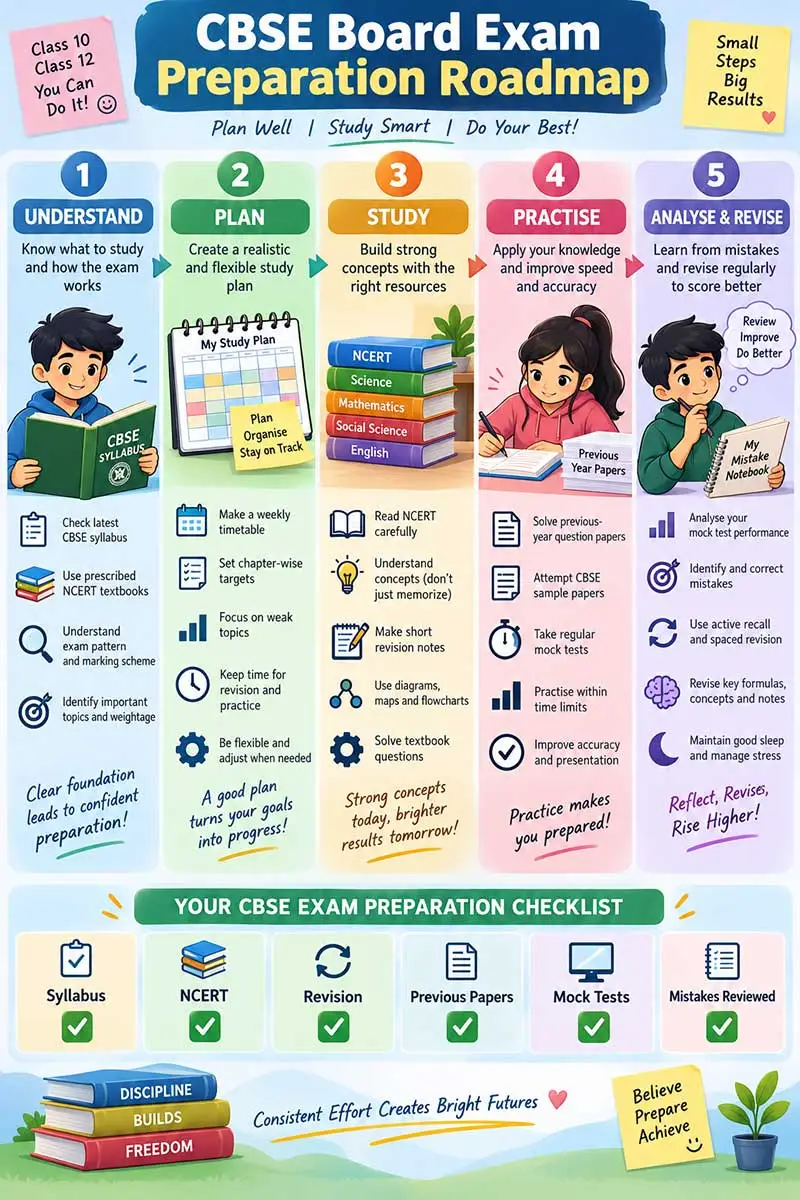
It sounds obvious, but a surprising number of students build a timetable before they’ve even looked at what they’re supposed to cover. Before you plan a single study hour, gather:
- The latest CBSE syllabus for each subject
- Your prescribed NCERT textbooks
- Subject-wise sample papers and marking schemes
- Previous years’ question papers
- Any school revision material or practical/project requirements
- The official exam dates and notices
You can find all of this directly on CBSE’s official academic website, which hosts the syllabus, sample papers, marking schemes and model answers for every subject. If you’re looking for chapter-wise NCERT help alongside your textbook, Cogniks’ NCERT solutions are a handy companion for working through tricky exercises.
One honest piece of advice: don’t build your strategy around WhatsApp forwards claiming to know “the questions that will come.” Stick to the syllabus, your textbooks, official sample papers, and what your teacher tells you.
Build a Study Plan You’ll Actually Follow
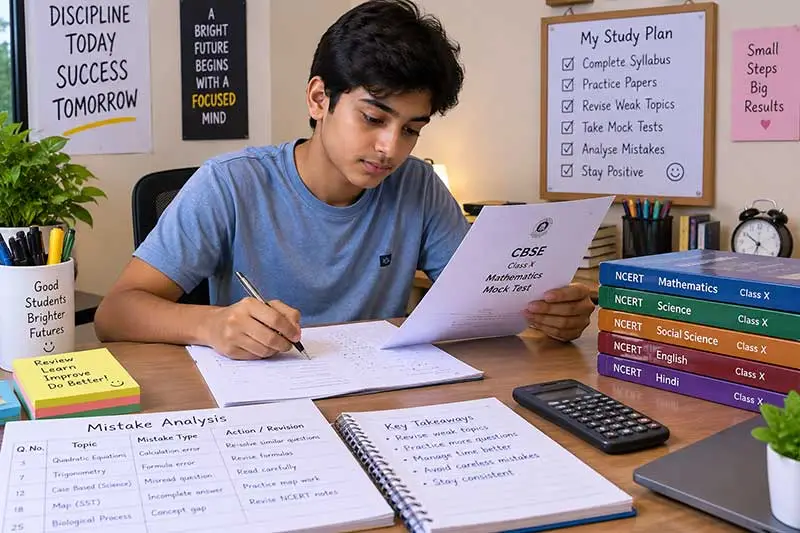
A good plan answers three simple questions — what will I study, when will I study it, and how will I know I’ve actually learned it? “Study Science for three hours” isn’t a plan; it’s a hope. Instead, try something measurable: Science — Chemical Reactions: read the chapter, revise the key concepts, solve the textbook questions, attempt 15 practice questions, then take a short self-test. Now you have something you can actually tick off.
Map your syllabus first. For every subject, list the chapters and mark each one red (don’t understand it yet), yellow (understand it but need practice), or green (confident). Give your red and yellow topics the extra time.
Then plan week by week, not month by month. A long-range plan sounds impressive but rarely survives contact with a school test, a cold, or a family event. A weekly plan is flexible enough to bend without breaking — something like Maths and 20 problems on Monday, Science numericals on Tuesday, and a full mock paper plus mistake analysis on Sunday.
Move Through Three Phases, Not All at Once
Phase 1 — build understanding. Finish the syllabus, read your NCERT carefully, make concise notes, and flag the topics that confuse you so you can ask your teacher. Don’t rush a chapter just to tick it off.
Phase 2 — practise until it sticks. Once most of the syllabus is covered, shift from reading to actually doing: textbook exercises, previous years’ questions, sample papers, case-based and application questions. This lines up with what the assessment reforms from the Ministry of Education have been pushing for years — understanding and application matter more than rote memorisation.
Phase 3 — simulate the real exam. Attempt full papers under a strict time limit, without your notes, using proper answer-sheet presentation. Then mark yourself against the actual marking scheme. A mock test isn’t about the score you get; it’s about finding out what still needs work before the exam does that for you.
Revise Actively, Not Just Repeatedly
Re-reading a chapter five times feels productive, but it mostly builds familiarity, not memory. A few things that genuinely work:
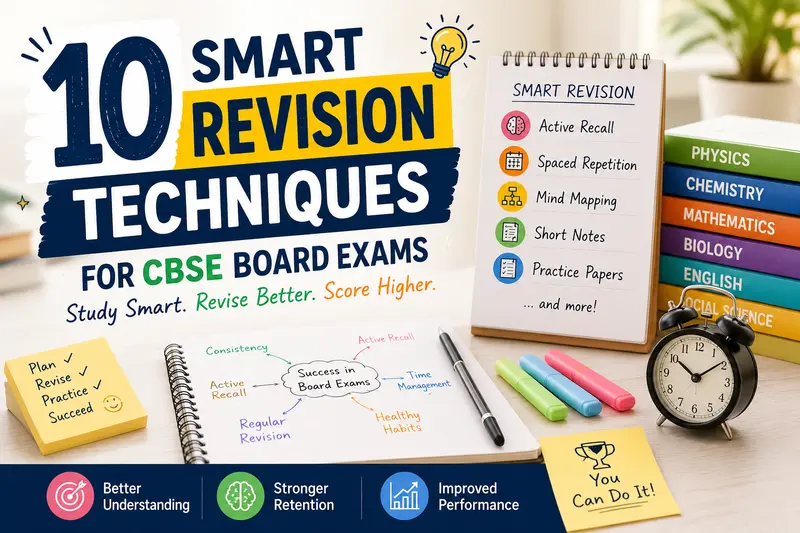
Close the book and recall. After studying a topic, shut it and write down everything you remember. Then check it against your notes — the gaps tell you exactly what to revisit.
Keep one-page revision sheets — definitions, formulas, dates, diagrams, and the mistakes you keep making — short enough that you’ll actually reread them the night before an exam.
Space out your revision instead of doing it once. Coming back to a topic on day 1, day 3, day 7 and day 14 keeps it from fading, and it’s a far better use of your time than cramming everything into one long session.
Keep a mistake notebook. For every question you get wrong, note the mistake, the correct approach, and why it happened — a concept gap, a careless calculation, misreading the question, or running out of time. In the days before the exam, this notebook is worth more than rereading the whole syllabus again.
Use Previous Years’ Papers and Mock Tests Properly
Previous years’ papers aren’t a crystal ball for “questions that will repeat” — they’re a way to understand the format, spot the concepts that show up again and again, and see exactly where you’re weak. Our guide on how to solve previous years’ question papers effectively walks through a simple three-step method: attempt the paper without looking at the answers, mark it strictly against the official scheme, then go back and fix the chapter behind every mistake.
Mock tests matter for a similar reason — you might understand a chapter perfectly and still run out of time in a three-hour paper. After each one, ask yourself honestly: did I know the concepts, did I make avoidable mistakes, did I finish on time, was my presentation clear, and which chapters need another look? Five mock papers you’ve properly analysed will take you further than fifteen you rushed through and forgot.
A Quick Word on Each Subject
You don’t need to study every subject the same way.
- Mathematics rewards regular problem-solving over passive reading — work through NCERT examples, rework the questions you got wrong, and practise under time pressure.
- Science needs a mix of concepts and application: read carefully, practise diagrams and numericals, and try explaining tricky ideas out loud in your own words.
- Social Science gets easier once you organise it — timelines for History, maps for Geography, and a simple cause → development → consequence structure for long chapters.
- English and languages are about applying skills, not memorising model answers — practise comprehension, writing formats, and building an answer around textual evidence rather than reciting one.
Write Answers the Evaluator Can Actually Follow
Knowing the answer and communicating it clearly are two different skills. For short answers, get to the point instead of padding with an introduction. For long answers, follow a simple structure — opening point, explanation, supporting example, conclusion — and use headings, numbered points or diagrams where they genuinely help.
Just as important: write for someone else to read. Avoid tiny handwriting, heavy overwriting, and long unbroken paragraphs. Underline keywords sparingly, and always follow whatever instructions your actual question paper and school give you.
Manage Stress by Making the Problem Smaller
“I have so much to study” is an anxious, shapeless thought. “What’s my next 45-minute task?” is something you can actually do. Try a 45–50 minute focused study block followed by a 5–10 minute break — stand up, stretch, drink water — rather than turning every break into a long scroll session.
Don’t sacrifice sleep for a few extra hours of studying; it tends to cost you more in concentration and memory than it gives back. And try to resist comparing your hours or scores to a friend’s — track your own chapters completed, mistakes corrected, and mock-test progress instead. If exam anxiety ever starts feeling like more than you can manage alone, talk to a parent, teacher or counsellor — that’s a completely normal and sensible thing to do. Our piece on protecting your sleep, nutrition and exercise during exams goes into this in more detail.
If you want a fuller picture of what a serious, well-organised strategy for scoring 95%+ in your board exams looks like from here, it’s worth reading through as well.
A Realistic Daily Schedule
You don’t need 12–14 hours a day — consistency matters more than volume. A workable day might look like a short revision session before school, focused study for your main subject in the evening, a practice session, and a second subject or revision slot after dinner, with a proper wind-down before bed. Adjust it around your own school hours, commute and energy levels — the schedule only works if you can actually stick to it.
Quick Checklist Before the Exam
- Latest syllabus and NCERT textbooks in hand
- Chapter-wise tracker with weak topics flagged
- Concise revision notes ready
- Previous years’ papers and sample papers attempted and reviewed
- Timed mock tests completed and analysed
- Mistake notebook up to date
- Formulas and key concepts revised
- Answer presentation and writing speed checked
- Sleep, breaks and exam stationery sorted
Key Takeaways
Start with the official syllabus and NCERT. Break it into weekly, measurable targets. Revise actively with recall and spaced repetition rather than rereading. Use previous years’ papers and timed mocks to find your gaps, then actually fix them. Build subject-specific habits instead of studying everything the same way. And protect your sleep and routine — a tired brain forgets faster than it learns.
Frequently Asked Questions
When should I start preparing for CBSE Board Exams?
Ideally, all year — gradually shifting from learning concepts to revision, practice papers and mocks as the exam gets closer.
Is NCERT enough on its own?
It’s essential where it’s prescribed, but pair it with the current syllabus, sample papers, marking schemes and previous years’ papers for the full picture.
How many hours should I study each day?
There’s no magic number. A consistent, focused routine with proper revision and enough sleep beats counting hours.
How many mock tests should I take?
Fewer papers that you genuinely analyse are worth more than many you rush through without reviewing.
What if I haven’t finished the syllabus yet?
List what’s left, prioritise by importance and your current understanding, and keep short revision sessions going for what you’ve already covered.
How do I stop forgetting what I’ve studied?
Active recall, spaced revision, self-testing and short notes — revisiting material at intervals works better than rereading it once in one long sitting.

Student Success Desk focuses on practical learning strategies, study techniques, and academic improvement tips for school students.