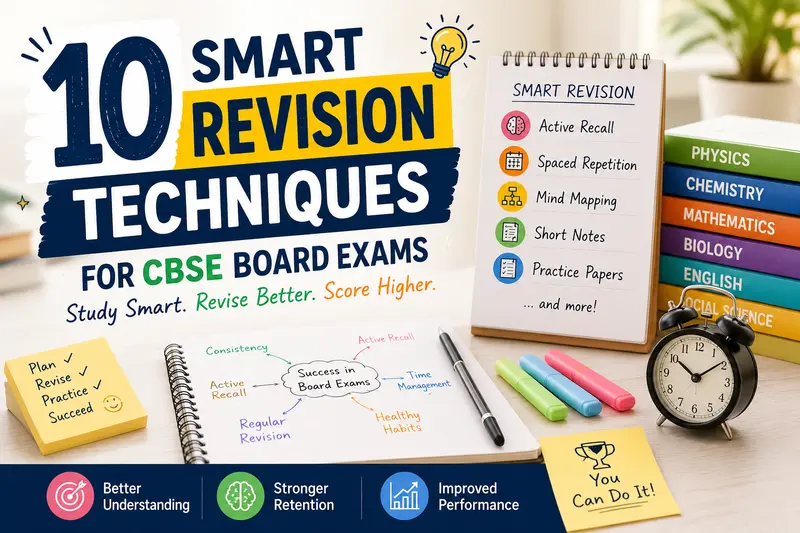
| Quick Answer Scoring 95%+ isn’t about studying the longest hours — it’s a process: know the syllabus and marking scheme, build NCERT into your daily routine, solve and analyse previous-year papers, take realistic mock tests, keep an error notebook, and revise using active recall and spaced repetition instead of rereading. Protect your sleep along the way, and treat the final month as revision time, not new-material time. |
Every year, thousands of CBSE students set the same ambitious target: 95% or above. Some get there. Many don’t — not because they didn’t work hard, but because hard work alone was never really the missing piece. What separates a 95%+ scorer from an equally hardworking student who lands at 78% usually comes down to strategy: how the syllabus is broken down, how mistakes are tracked, how revision is spaced out, and how calm the final week actually is.
This guide walks through that strategy step by step — the kind of process-driven approach that turns “I studied a lot” into “I know exactly where I stand in every subject.”
What Does It Actually Take to Score 95%+?
Treat a 95%+ target as a process goal, not a single number you’re chasing. You need a strong grip on the syllabus, accurate recall, genuine conceptual understanding, plenty of question practice, and calm time management on the day itself.
Start with the basics that actually matter: the official syllabus, prescribed NCERT textbooks, sample papers, marking schemes, and previous years’ question papers. CBSE’s own examination resources on the official CBSE academic website give you previous-year papers, sample papers, marking schemes, and model answers — all in one place, and all reliable.
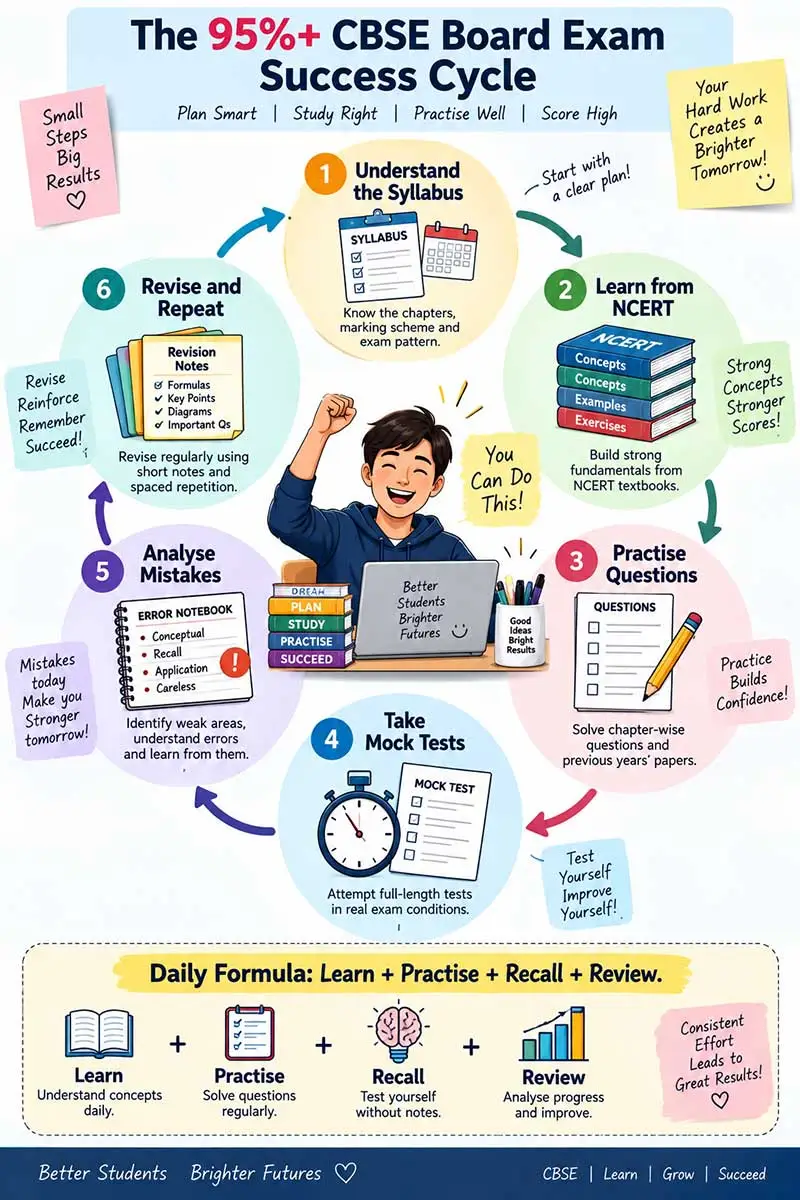
The cycle worth memorising is simple: Learn → Practise → Test → Analyse → Revise → Repeat. Follow it consistently, and your preparation becomes something you can measure, instead of something that depends on motivation showing up every day.
Step 1: Get Clear on the Syllabus and Marking Scheme
Before you touch a timetable, figure out exactly what you’re studying for. Download the latest syllabus and note the chapters and units, prescribed textbooks, any practical or project components, question types, marks distribution, internal assessment weightage, competency-based questions, and any fresh instructions CBSE has issued.
Skip the coaching-centre “important chapters” lists as your primary reference, and use CBSE’s own material instead. A simple syllabus tracker helps here, and it doesn’t need to be fancy:
| Chapter | First Study | Practice | Revision 1 | Revision 2 | Test Score |
| Chapter 1 | ✓ | ✓ | ✓ | — | 88% |
| Chapter 2 | ✓ | ✓ | — | — | 72% |
| Chapter 3 | ✓ | — | — | — | — |
Once you can see this laid out, it’s obvious where your preparation actually needs attention — not where you feel like it does. For textbook support, NCERT’s own repository covers Classes I–XII and is worth bookmarking.
Step 2: Build a Study Plan You’ll Actually Follow
A good timetable tells you what to do, not just how long to sit at your desk. “Study Mathematics for three hours” isn’t a plan — “Complete Applications of Derivatives examples, solve 20 questions, review mistakes” is.
Try splitting each study day into three parts: learning new or difficult material, practice — solving questions without peeking at solutions, and revision — recalling what you studied earlier. A sample layout:
| Time | Activity |
| 6:30–7:15 AM | Formula/definition revision |
| 4:00–5:30 PM | New concept/chapter |
| 5:45–7:00 PM | Question practice |
| 8:00–9:00 PM | Second subject |
| 9:00–9:30 PM | Active recall + error review |
Fit this around your own school, tuition, and sleep schedule rather than copying someone else’s routine. As a general rule, aim for the 60–30–10 split: 60% learning and revising concepts, 30% solving questions and papers, 10% analysing mistakes. As exam day gets closer, shift more of that time toward practice and testing.
Step 3: Make NCERT Your Actual Foundation
For most CBSE subjects, NCERT isn’t a book you skim once before the exam — it’s the foundation everything else sits on. For every chapter: read the concept, highlight only what’s essential, work through the examples and diagrams, solve the exercises without checking answers first, make short revision notes, and test yourself once you’re done.
One habit worth building: don’t let your notes grow longer than the chapter itself. If a 20-page chapter turns into 15 pages of notes, they’re not doing their job. Instead, aim for one-page formula sheets, short definition lists, key diagrams, dates, concept maps, common mistakes, and the handful of questions you keep getting wrong. Your revision material should get shorter, not longer, every time you revise.
Step 4: Use Previous-Year Papers the Right Way
Previous-year papers matter because they train you to apply what you know under real exam pressure — but only if you analyse them afterward instead of just ticking off “papers solved.” After every paper, sort your mistakes into one of four types:
| Error Type | Example | Fix |
| Conceptual | Did not understand a topic | Relearn the concept |
| Recall | Forgot a formula or date | Spaced revision |
| Application | Could not apply the concept | More practice |
| Careless | Calculation or sign mistake | Slow down and check |
Keep an error notebook and revisit it every few days. A few real examples might read like: lost marks in Maths from a sign error, forgot a unit conversion in Physics, gave weak evidence in an English long answer, missed a key point in a Social Science five-marker. None of these are really “I don’t know the topic” mistakes — they’re fixable habits once you notice the pattern.
For a deeper breakdown of exactly how to structure this process, our guide on solving previous-year question papers effectively walks through the full rehearsal-style approach — worth reading before your next practice paper.
Step 5: Treat Mock Tests Like the Real Thing
A mock test only tells you something useful if you take it seriously — no phone checks, no peeking at notes, no unlimited breaks. Reproduce exam conditions as closely as you can.
After each one, calculate your accuracy (correct answers ÷ total attempted × 100) and note your total score, time taken, unanswered questions, silly mistakes, and which sections ate up too much time. CBSE’s competency-based resources increasingly reward application and higher-order thinking over rote recall, so don’t limit your practice to memorisation-heavy questions.
Preparing Subject by Subject
A 95%+ strategy has to flex by subject.
Mathematics — focus on understanding concepts, learning formulas properly, working through NCERT problems, practising different question types under time pressure, and revisiting previous-year papers. Keep a running formula notebook. When a problem stumps you, resist jumping straight to the solution — give yourself a few minutes to identify the relevant concept first.
Science — follow the sequence Concept → Formula/Definition → Diagram → Application → Questions. Physics needs regular numerical practice; Chemistry rewards attention to reactions, equations, and applications; Biology comes down to terminology, diagrams, and clear explanations.
Social Science — this is where organised recall matters as much as understanding. Build chapter summaries, timelines, comparison tables, maps, and cause-and-effect chains. For long answers, practise writing structured responses rather than memorising whole paragraphs.
English — don’t prepare by reading model answers alone. Practise reading comprehension, grammar, writing formats, literature-based questions, and evidence-based answers. A strong answer directly addresses the question and uses relevant textual detail.
Hindi and other languages — regular attention to literature, grammar, comprehension, writing formats, spelling, and vocabulary pays off; these subjects become genuinely high-scoring with frequent writing practice.
Writing Answers That Actually Score
Knowing an answer and presenting it well are two different skills. Use the question itself as your guide — if it asks for three reasons, give three clearly identifiable points; if it asks for a comparison, actually compare rather than writing two disconnected paragraphs.
A reliable structure for long answers is Introduction → Main points → Explanation/example → Conclusion. For point-wise answers: Point → Explanation → Example/evidence.
Before submitting anything, run through a quick presentation check: Did I answer exactly what was asked? Are all parts of the question covered? Are key terms visible? Are calculations shown and diagrams labelled? Is my handwriting readable, and did I check units? The goal isn’t decorative handwriting — clarity and accuracy matter far more than how pretty the page looks.
Revising Without Actually Forgetting
Reading the same chapter five times doesn’t mean you remember it — it just means you’ve read it five times. Active recall works better: close the book and ask yourself what the five main concepts are, whether you can explain the topic without notes, which formulas you actually remember, and whether you can solve a representative question cold.
Pair this with spaced revision — something like Day 1 → Day 3 → Day 7 → Day 15 → Day 30 — rather than rereading the full chapter every time. Later revisions should lean more on questions, flashcards, formulas, diagrams, and your error notebook, which makes each pass faster as the exam gets closer.
Managing Stress Before the Exam
Scoring highly shouldn’t cost you sleep, food, movement, or your emotional balance — and honestly, it doesn’t need to. A tired brain concentrates, recalls, and problem-solves worse, not better, so protect your sleep rather than turning every night into a study marathon. Take short breaks after focused study blocks — stand up, stretch, drink water. Try to avoid comparing your hours or scores to anyone else’s; track your own progress instead.
Sleep, nutrition, and regular movement do more for exam performance than most students expect — our piece on protecting all three during exam season covers the specifics in more depth.
When you feel overwhelmed, a simple reset helps: stop for a few minutes, breathe slowly, write down what’s left to do, pick the next small task, and start there. Swap “I have the whole syllabus left” for “I’ll finish this chapter and solve 15 questions.” Small completed tasks build momentum faster than big ambitious ones.

The Final 30 Days
If your syllabus is largely done, the last month should be about revision, testing, and correction rather than new material.
Days 30–21: strengthen weak chapters, finish anything incomplete, build formula sheets, review old mistakes.
Days 20–11: solve previous-year papers, take timed subject tests, analyse every mistake, revisit weak concepts, practise answer writing.
Days 10–5: full-length mock exams, following Test → Check → Analyse → Correct → Re-test. Track how many mistakes you’re eliminating, not just your score.
Days 4–2: rapid revision of formulas, definitions, diagrams, maps, dates, and your error notebook — avoid starting large chunks of new material unless it’s genuinely unavoidable.
Day 1: stay calm. Pack your admit card, stationery, and exam-centre details the night before, and keep the final evening for light revision rather than an all-nighter.
Common Mistakes That Quietly Cost Marks
A few patterns show up again and again: spending hours on favourite subjects while avoiding weak ones, relying on memorisation when CBSE increasingly tests application and competency, solving papers without ever analysing them, collecting five guidebooks instead of mastering one syllabus, ignoring presentation even when the content is right, leaving revision for the final week, and sacrificing sleep in the belief that more hours automatically means more marks.
None of these are dramatic failures — they’re just habits worth catching early, ideally while there’s still time to fix them.
Printable Resources Worth Making
A simple Board Exam Preparation Pack goes a long way: a syllabus checklist, monthly calendar, weekly timetable, chapter tracker, mock-test score sheet, error log, formula sheet, revision tracker, and exam-day checklist. A useful mock-test tracker could look like this:
| Test | Score | Time | Main Weakness | Action |
| Mathematics 1 | 86% | 3h 10m | Calculations | Practise 20 problems |
| Science 1 | 91% | 2h 55m | Biology recall | Revise diagrams |
| English 1 | 94% | 2h 40m | Long answers | Practise 3 answers |
Once you’re tracking scores this way, preparation stops feeling vague and starts looking like a measurable improvement system.
Key Takeaways
Start with the official CBSE syllabus and examination resources, and use NCERT as your foundation. Split study time across learning, practice, and revision instead of just logging hours. Solve previous-year papers and mock tests, but always analyse the mistakes afterward. Keep an error notebook and revisit it regularly. Use active recall and spaced revision instead of rereading passively. Protect sleep, breaks, and physical wellbeing — they’re part of the strategy, not a distraction from it. Aim for steady improvement rather than obsessing over one percentage.
A 95%+ result rarely comes from one extraordinary week. It’s usually the outcome of months of consistent preparation, deliberate practice, careful revision, and calm execution on the day.
FAQs
Is it really possible to score 95%+ in CBSE boards? Yes — through systematic preparation, though no strategy can guarantee an exact percentage. Consistent syllabus completion, regular practice, and honest mock-test analysis meaningfully improve your odds.
How many hours should I study each day? There’s no universal number. Focused, quality study time matters more than the hour count — build a schedule that fits around school, sleep, and revision.
Is NCERT enough on its own? It’s the right foundation for most CBSE subjects, but pair it with the question formats and competencies reflected in official CBSE sample papers and marking schemes, and for chapter-wise clarity, Cogniks’ NCERT solutions are a useful companion.
How many previous-year papers should I solve? There’s no fixed number — a handful of carefully analysed papers beats dozens solved without review.
When should I start full mock tests? Once you’ve covered enough syllabus to make the test meaningful, then increase frequency as the exam nears.
How do I stop making silly mistakes? Practise under timed conditions, write calculations clearly, check units and signs, read questions carefully, and save time at the end to review your answers.
Should I study new chapters in the final days? Prioritise revision and practice instead. If something important is genuinely incomplete, study it strategically, but don’t let it replace most of your revision time.
What’s the single most important habit for scoring high? Reviewing mistakes. Every wrong answer teaches you something — whether it’s a gap in understanding, recall, application, timing, or just carelessness.

Student Success Desk focuses on practical learning strategies, study techniques, and academic improvement tips for school students.