
Most students don’t fail because they didn’t put in the hours. They fail because the hours went into the wrong kind of work.
If you’ve ever reread the same chapter three times the night before a test and still blanked on half the answers, you already know this feeling. It’s not a motivation problem. It’s a method problem.
Over the past few decades, cognitive psychologists and education researchers have spent a lot of time figuring out which study habits actually stick, and which ones just feel productive in the moment. The findings are fairly consistent: a handful of techniques outperform almost everything else when it comes to memory, understanding, and exam performance — and most students have never been taught any of them.
This article walks through ten of those techniques: what they are, how to actually use them, where students tend to go wrong, and how to fit them into a realistic weekly routine. Whether you’re a CBSE student gearing up for boards, a parent trying to help without nagging, or a teacher looking for strategies that hold up beyond a single semester, these methods are worth knowing.
Why Traditional Studying Often Fails
Ask most students how they study and you’ll hear some version of the same answer: read the chapter again, highlight the important-looking bits, then cram the week before the exam.
The trouble is, none of that actually tests whether you know the material. Rereading creates a sense of familiarity — this looks familiar, so I must know it — without ever checking whether you can recall it under pressure. Highlighting feels productive but mostly just marks what to reread later. And cramming can get you through tomorrow’s test while practically guaranteeing you’ll have forgotten most of it by next month.
Real learning needs a bit of friction. It needs you to retrieve information instead of just recognizing it, to space your review out instead of binging it, and to test yourself honestly instead of reviewing passively. That’s exactly what the ten techniques below are built around.
Students can also explore our collection of CBSE Study Tips for practical strategies to improve daily learning habits.
1. Active Recall: Probably the Single Best Thing You Can Do
If there’s one technique worth adopting before any other, it’s this one. Active recall simply means testing yourself on material instead of rereading it. It sounds almost too simple, but the research behind it is some of the strongest in all of learning science. Research on retrieval practice shows that actively recalling information significantly improves long-term retention.
Here’s how it plays out in practice. Say you’ve got a Science chapter to revise. Instead of reading it a third time, close the book and write down everything you remember, unprompted. Then check what you got right, what you missed, and go back to patch the gaps. That’s the whole technique.
It works because of how memory actually forms. Every time you force your brain to retrieve information rather than just recognize it, you strengthen the pathway that stores it — a bit like a path through tall grass that gets clearer the more it’s walked. Rereading doesn’t do that. It lets the brain coast.
You can build active recall into almost any subject — flashcards, sample questions, self-quizzes, or simply explaining a topic out loud without peeking at your notes. Students who lean on it tend to remember more, understand concepts more deeply, and walk into exams with less panic, mostly because they’ve already tested themselves under conditions that resemble the real thing.
2. Spaced Repetition: Studying on a Schedule Your Brain Actually Likes
Forgetting isn’t a sign you didn’t study hard enough. It’s just how memory works — left alone, the brain quietly discards information it doesn’t think it needs again. Spaced repetition works with that tendency instead of fighting it, reviewing material right before it’s about to fade, then stretching the gap a little further each time.
Instead of studying a chapter once and hoping it sticks, you’d revisit it after a day, then three days, then a week, then two weeks, then a month. Each review costs less time than the one before it, but locks the material in more firmly. A simple schedule might look like this:
| Day | Activity |
| Day 1 | Learn new topic |
| Day 2 | First revision |
| Day 4 | Second revision |
| Day 8 | Third revision |
| Day 15 | Fourth revision |
| Day 30 | Final review |
Timing the review for right before forgetting kicks in does more for long-term memory than the same number of hours spent cramming in one sitting. Students who build this habit walk into exams remembering material from weeks, sometimes months, earlier — instead of relying on a last-minute refresh the night before.
3. Practice Testing: Stop Studying for the Exam, Start Taking It
There’s a strange gap between feeling ready for an exam and actually being ready for one. Practice testing closes it.
The idea is simple: answer questions under conditions that resemble the real exam — previous years’ papers, mock tests, timed quizzes, sample papers — instead of just reviewing your notes one more time. It’s uncomfortable in a useful way. You find out exactly what you don’t know while there’s still time to fix it, rather than finding out mid-exam.
One thing worth saying clearly: a practice test isn’t a report card. A bad score is useful data, not a verdict on how the real exam will go. The point isn’t to prove what you already know — it’s to find the gaps before the actual exam does.
4. Interleaving: Why Mixing Subjects Beats Marathon Sessions
Most students study one subject for hours at a stretch, on the theory that more focused time on one topic equals more mastery. Interleaving suggests otherwise — switching between related topics or subjects in shorter blocks often teaches the brain more than grinding through one subject for the same total time.
Instead of three straight hours of Mathematics, try forty-five minutes of Math, then forty-five of Science, then forty-five of English. It feels less efficient in the moment; you never quite settle into a groove. That’s actually the point. Constantly having to distinguish between topics forces your brain to recognize which method or concept applies where — a skill that straight repetition never really builds.
Students who interleave tend to do better on the kind of problems that require choosing the right approach rather than just applying a memorized one, which, conveniently, is most of what exams actually test.
5. The Feynman Technique: If You Can’t Explain It Simply, You Don’t Know It Yet
Named after physicist Richard Feynman, who was famous for making impossibly complex ideas sound obvious, this technique is built on a simple test: can you explain a concept in plain language to someone who’s never heard of it?
Pick a topic. Explain it out loud as if you’re teaching it to a younger student — no jargon, no textbook phrasing, just plain words. The moment you stumble, or reach for a term you can’t actually define, you’ve found a gap in your own understanding. Go back, fill it in, and try explaining it again, a little simpler this time.
Try it with something like photosynthesis: skip the textbook definition and explain it the way you’d explain it to a younger sibling. You’ll notice almost immediately whether you actually understand it or just remember the vocabulary around it.
It works because teaching is a far harder test of understanding than reading ever is. You can fake recognition. You can’t really fake an explanation.
At a Glance: All Ten Techniques
Before getting into the remaining five, here’s a quick-reference version of all ten — useful as a checklist:
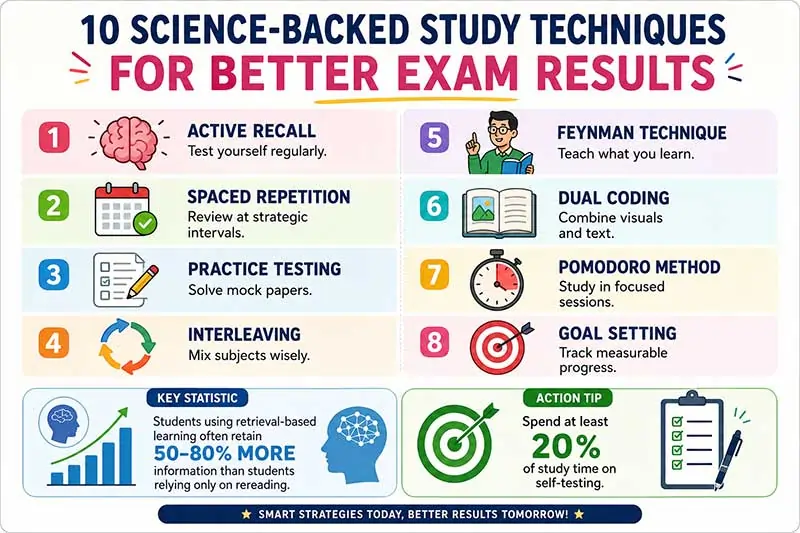
One number worth remembering: students who build regular self-testing into their routine tend to retain noticeably more than students who rely mainly on rereading. Even a modest shift — putting roughly a fifth of total study time toward testing yourself instead of reviewing notes — tends to show up in exam results.
6. Dual Coding: Give Information Two Ways Into Your Brain
Dual coding just means pairing words with pictures — turning a written explanation into a diagram, mind map, flowchart, concept map, or infographic alongside the text version.
The logic behind it is fairly intuitive once you hear it. The brain doesn’t store information through a single channel; it processes verbal and visual information differently, so giving it both creates more ways to retrieve the same idea later. A timeline you’ve drawn yourself is often easier to recall under exam pressure than a paragraph you’ve read.
Different subjects lend themselves to different visual formats:
| Subject | Visual Method |
| Science | Diagrams and flowcharts |
| Geography | Maps |
| History | Timelines |
| Mathematics | Visual problem-solving models |
| Biology | Labelled illustrations |
You don’t need artistic talent for this to work. A rough flowchart scribbled in the margin of your notebook does the job just as well as a polished diagram.
7. The Pomodoro Technique: Permission to Take Breaks
The Pomodoro Technique is less about studying harder and more about studying in chunks the brain can actually sustain. Work in a focused twenty-five-minute burst, take a five-minute break, repeat that cycle four times, then take a longer break.
It sounds almost too basic to count as a “technique,” but there’s something useful in it: attention naturally dips after extended stretches, and pretending otherwise just leads to staring at a page while your mind wanders. Short, clearly bounded sessions keep you actually present for the time you’re sitting down to study, rather than physically present and mentally elsewhere.
Students who use it tend to procrastinate less, since starting a twenty-five-minute block feels far less daunting than starting a three-hour one, and they generally report sharper concentration during each session.
8. Elaborative Interrogation: The Power of Asking “Why”
Elaborative interrogation is a long name for a simple habit: asking yourself why something is true while you’re learning it, instead of just memorizing that it is.
Take a fact like “plants need sunlight.” Most students would just memorize that line. Elaborative interrogation pushes further: why do plants need sunlight? What does the sunlight actually do once the plant has it? Answering those questions ties the fact to a chain of reasoning, which is a much stickier kind of memory than a standalone sentence.
This technique tends to pay off most in subjects built on cause and effect — Science, Social Science, Economics, Environmental Studies — where understanding why something happens does most of the work of remembering that it happens.

9. Goal-Oriented Study Planning
Vague intentions rarely survive contact with a busy week. “I’ll study more Physics” is the kind of goal that quietly disappears by Wednesday. Specific goals tend to actually get done, mostly because they’re easy to check off and hard to talk yourself out of.
The SMART framework is a useful way to make goals specific enough to stick:
| Goal Component | Example |
| Specific | Complete Chapter 5 Physics |
| Measurable | Solve 20 numerical problems |
| Achievable | Finish within 2 days |
| Relevant | Prepare for upcoming test |
| Time-bound | Complete by Friday |
A goal like this does more than organize your time. It gives you something concrete to feel good about finishing, which — over a long exam season — matters more than people expect. A structured study planner can help students stay consistent with revision and goal tracking.
10. Sleep and Memory Consolidation
Of everything on this list, sleep is probably the technique students are most likely to skip — and the one the research is most consistent about. Memory consolidation, the process where the brain files away what you learned that day, happens largely during sleep. Skip the sleep, and you’re studying material your brain never gets the chance to properly store.
The common mistake here is obvious: staying up late the night before an exam, treating sleep as the thing to sacrifice when time runs short. It tends to backfire. A better approach is studying earlier in the day, doing a brief, light revision before bed rather than a heavy one, and protecting seven to nine hours of actual sleep.
Students who do this consistently report better concentration the next day, sharper recall during the exam itself, and noticeably less of the pre-exam anxiety that comes from feeling unprepared.
How the Techniques Compare
For a quick sense of how these methods stack up against each other, here’s a simple retention comparison:
Illustrative values for educational comparison purposes.
These numbers are illustrative rather than drawn from a single definitive study, but they reflect a pattern that shows up consistently in the research: retrieval-based methods like active recall and spaced repetition outperform passive ones like rereading and highlighting by a wide margin.
Putting It Together: A Weekly Study Plan
Knowing ten techniques doesn’t help much without a structure to actually use them in. Here’s a simple weekly rhythm that incorporates most of what’s covered above:
| Day | Primary Activity |
| Monday | Learn new concepts |
| Tuesday | Active recall practice |
| Wednesday | Practice questions |
| Thursday | Spaced revision |
| Friday | Mock test |
| Saturday | Weak-topic improvement |
| Sunday | Comprehensive review |
It doesn’t need to be followed exactly. The underlying idea — learn, test yourself, revise with spacing, and check progress with a mock test — matters more than the specific day assignments.
Common Study Mistakes to Avoid
Last-minute cramming produces a convincing short-term memory and a near-total loss of that information within days. Great for tomorrow’s quiz, not much else.
Multitasking between a phone and a textbook doesn’t actually save time — it just makes both tasks take longer and stick worse, since attention gets divided rather than doubled.
Studying without testing leaves you with material that feels familiar, which isn’t the same as material you can actually retrieve under exam conditions. The gap between the two only shows up when it’s too late to fix.
Ignoring sleep to study more usually means studying material your brain doesn’t get the chance to properly consolidate — a net loss disguised as extra effort.
Skipping a revision plan lets even well-learned material fade. Spaced repetition exists precisely to prevent this.
Explore more Exam Preparation Resources to strengthen your study routine throughout the academic year.
Two Printable Resources Worth Using
Weekly Study Planner
A simple printable for organizing study sessions around the techniques above. It typically includes a weekly timetable, subject priorities, daily goals, a revision tracker, a practice test log, and space for weekly reflection.
Exam Readiness Checklist
A short self-assessment for the weeks before an exam: syllabus completion, revision status, mock test performance, a list of weak topics, a sleep and wellness check, and a simple confidence rating.
Key Takeaways
- Active recall — testing yourself — beats rereading by a wide margin.
- Spaced repetition keeps information from fading by reviewing it just before you’d otherwise forget it.
- Practice tests reveal gaps while there’s still time to close them.
- Interleaving subjects builds the skill of choosing the right approach, not just applying one.
- Dual coding gives your brain a second route back to the same information.
- The Pomodoro Technique keeps focus from draining over long sessions.
- Asking “why” turns a memorized fact into something you actually understand.
- Specific goals get finished; vague ones get postponed.
- Sleep isn’t optional — it’s when memory actually gets stored.
- No single technique is magic. Combining a few of them is what produces real results.
Where to Start
- Pick one chapter and try active recall on it today.
- Build a simple spaced-revision calendar for your toughest subject.
- Take one practice test this week, treated as information rather than a verdict.
- Add one visual — a diagram, timeline, or mind map — to your next study session.
- Protect seven to nine hours of sleep, especially in exam weeks.
Frequently Asked Questions
1. Which study technique works best for CBSE exams?
There isn’t one single winner, but active recall paired with spaced repetition tends to outperform other combinations for most students preparing for board exams.
2. How many hours should students study each day?
Less than most people assume. Two to five focused hours, depending on grade level and goals, usually beats six unfocused ones. Quality of attention matters more than total time logged.
3. Is highlighting a waste of time?
Not entirely — it can help flag what’s important on a first pass. The mistake is stopping there. Pair it with active recall and practice testing, or the highlighted material rarely gets revisited in a way that builds memory.
4. How often should topics actually be revised?
A reasonable rhythm is one day, three days, one week, then progressively longer gaps — the core idea behind spaced repetition.
5. Can parents actually help with this, or is it mostly on the student?
Parents can help quite a bit, even without knowing the subject material — helping build a schedule, running a quick quiz from the textbook, or just keeping an eye on whether revision is happening on a reasonable timeline.
6. Do practice tests genuinely move the score, or is that overstated?
They genuinely help. Beyond the content review, they get students used to the format and pacing of the real exam, which removes one source of anxiety on exam day.
7. Is the occasional late night before an exam actually harmful?
One late night here and there is unlikely to do much damage. The real cost comes from consistent sleep deprivation over weeks, which is where memory and concentration take the bigger hit.
8. Do these techniques help students who are struggling, or mainly the ones already doing fine?
If anything, they tend to help struggling students more, since these methods replace guesswork about “studying enough” with a concrete, repeatable process.
Conclusion
Doing well on exams isn’t really about studying harder. It’s about studying in a way that matches how memory actually works.
The techniques covered here — active recall, spaced repetition, practice testing, interleaving, dual coding, and consistent sleep, among others — aren’t shortcuts. They take some getting used to, and a few of them, like testing yourself or mixing subjects, feel less comfortable than just rereading a chapter one more time. But that discomfort is doing real work: it’s the friction that turns information you’ve seen into information you actually know.
You don’t need all ten at once. Pick one or two this week — active recall is usually the easiest place to start — and build from there. Parents and teachers can help too, mostly by nudging toward these habits instead of toward longer hours. Small changes in method, given enough time, tend to outperform large increases in effort.

Student Success Desk focuses on practical learning strategies, study techniques, and academic improvement tips for school students.