
Practical Tips for Students, Parents & Educators
Introduction
If you’ve ever felt your heart race as you flipped open an exam paper, you’re not alone. Nervousness before a test is one of the most universal experiences in student life — whether you’re sitting a school assessment, a CBSE board exam, a competitive entrance test, or a semester paper.
Here’s the thing: a little bit of that nervous energy is actually helpful. It sharpens your focus and gives you the push you need to perform. But when anxiety takes over — when the worry becomes so loud it drowns everything else out — it stops being useful and starts getting in the way.
That’s what this article is about. We’ll walk through what exam anxiety really is, why it happens, what it feels like, and — most importantly — what you can actually do about it. Whether you’re a student trying to get through exam season, a parent watching your child struggle, or a teacher looking for ways to help, there’s something here for you.
What Is Exam Anxiety?
Exam anxiety isn’t just “feeling nervous before a test.” It’s a persistent pattern of excessive worry, fear, or dread that’s specifically tied to exams — and it can show up well before the exam room, sometimes weeks in advance.
What makes it tricky is that even students who have prepared thoroughly can experience it. You could know your material inside out and still find yourself freezing up, forgetting things you definitely knew, or feeling overwhelmed for no clear reason. That’s anxiety at work.
Recognising the Signs
Exam anxiety doesn’t look the same for everyone. It tends to show up in three broad ways — physically, emotionally, and mentally. Here’s a quick overview:
| Physical Symptoms | Emotional Symptoms | Mental Symptoms |
| Racing heartbeat | Fear and dread | Difficulty concentrating |
| Sweating | Irritability | Forgetfulness |
| Headaches | Panic | Negative self-talk |
| Stomach discomfort | Mood swings | Going blank during exams |
| Poor or broken sleep | Low confidence | Constant “what if” thinking |
Recognising these symptoms early matters. The sooner you notice what’s happening, the sooner you can start doing something about it.
Why Does Exam Anxiety Happen?
There’s rarely one single cause. More often, it’s a combination of pressures that build up over time. Some of the most common ones include:
1. Fear of Failure
Worrying that disappointing results will let your parents down, close off opportunities, or define your future can create enormous pressure — especially when exams feel like they carry a lot of weight.
2. Leaving Revision Too Late
When you’ve left most of your studying to the final few days, the anxiety that follows isn’t surprising. There’s simply not enough time to feel confident, and panic fills the gap.
Students can reduce this by following a structured timetable like the one discussed in Perfect Study Timetable for CBSE Students.
3. Chasing Perfection
Trying to score full marks in every subject, or feeling like anything less than perfect isn’t good enough, sets up a cycle of stress that’s almost impossible to escape.
4. Comparing Yourself to Others
Listening to a classmate talk about how much they’ve studied, or watching someone breeze through a mock test, can make you feel like you’re already behind — even when you’re not.
5. Not Getting Enough Sleep
Sleep and anxiety have a complicated relationship. Poor sleep makes anxiety worse, and anxiety makes it harder to sleep. When this cycle sets in during exam season, it can be hard to break.
When Stress Crosses a Line
Some stress before exams is completely normal — it’s your brain’s way of saying “this matters.” But there’s a difference between healthy stress and anxiety that’s become overwhelming.
Watch out for these warning signs:
- Worrying about exams almost constantly, even when you’re not studying
- Avoiding revision altogether because thinking about it feels too overwhelming
- Frequent crying, frustration, or emotional outbursts around exam time
- Panic attacks before or during exams
- Several nights of poor sleep in a row
- Loss of appetite or feeling physically unwell without a clear cause
- Feeling hopeless even after preparing well
If any of these have been going on for a few weeks, or if they’re starting to affect daily life, it’s worth talking to someone — a trusted adult, a school counsellor, or a mental health professional. Asking for help is not weakness. It’s a smart decision.
What Actually Helps: 10 Practical Strategies
1. Start Early — Don’t Wait Until the Last Minute
The single most effective thing you can do to reduce exam anxiety is give yourself enough time. When you’ve been revising steadily for weeks, you walk into the exam room with a quiet confidence that cramming simply can’t produce.
A few things that make early preparation easier:
- Break your syllabus into manageable chunks — chapter by chapter, week by week
- Set yourself small, achievable daily goals rather than vague targets like “study a lot”
- Build in weekly revision so material stays fresh
- Take practice tests regularly — they help you spot gaps and build confidence
Students can also explore Scientifically Proven Study Techniques for evidence-based learning methods.
2. Build a Study Schedule You’ll Actually Use
A schedule only works if it’s realistic. Here’s a simple daily structure that many students find helpful:
| Time | Activity |
| 6:30–7:00 AM | Morning revision (review yesterday’s notes) |
| School Hours | Attend classes — active participation matters |
| 5:00–6:00 PM | Homework and assignments |
| 6:15–7:15 PM | Subject 1 — focused study |
| 7:30–8:15 PM | Subject 2 — focused study |
| 8:30–9:00 PM | Light revision — no new material |
| Before Bed | Wind down — no screens, no cramming |
The key is to keep it flexible enough that one bad day doesn’t throw everything off.
Students who struggle with planning can also read:
How to Use a Study Planner Effectively for Better Time Management
3. Revise Smarter, Not Harder
Reading your textbook from cover to cover for the fifth time isn’t revision — it just feels like it is. Effective revision is active, not passive. Try these instead:
- Flashcards for key facts, definitions, and formulas
- Past papers — the single best way to understand what examiners actually want
- Teaching a concept to a friend or explaining it out loud to yourself
- Mind maps to see how ideas connect
- Practice tests under timed conditions
For more ideas, check 10 Smart Revision Techniques for CBSE Board Exams.
4. Aim for Progress, Not Perfection
Perfection is a trap. It sets a standard that’s impossible to reach and then punishes you for not reaching it.
Instead of asking: “Can I score 100%?”
Try asking: “Do I understand this better than I did yesterday?”
Celebrating small improvements — a concept that finally clicked, a topic you feel more confident about — builds genuine momentum. That momentum is what carries you through exam season.
5. Take Care of Your Body
Your brain doesn’t work in isolation. How you sleep, what you eat, how much you move — all of it affects how well you think and how anxious you feel. During exam season, healthy habits matter more, not less.
- Aim for 7–9 hours of sleep — memory consolidation happens while you sleep
- Stay hydrated — even mild dehydration affects concentration
- Eat regular, balanced meals — your brain needs fuel
- Get some physical activity each day, even a short walk
- Go easy on coffee and energy drinks — the crash isn’t worth it
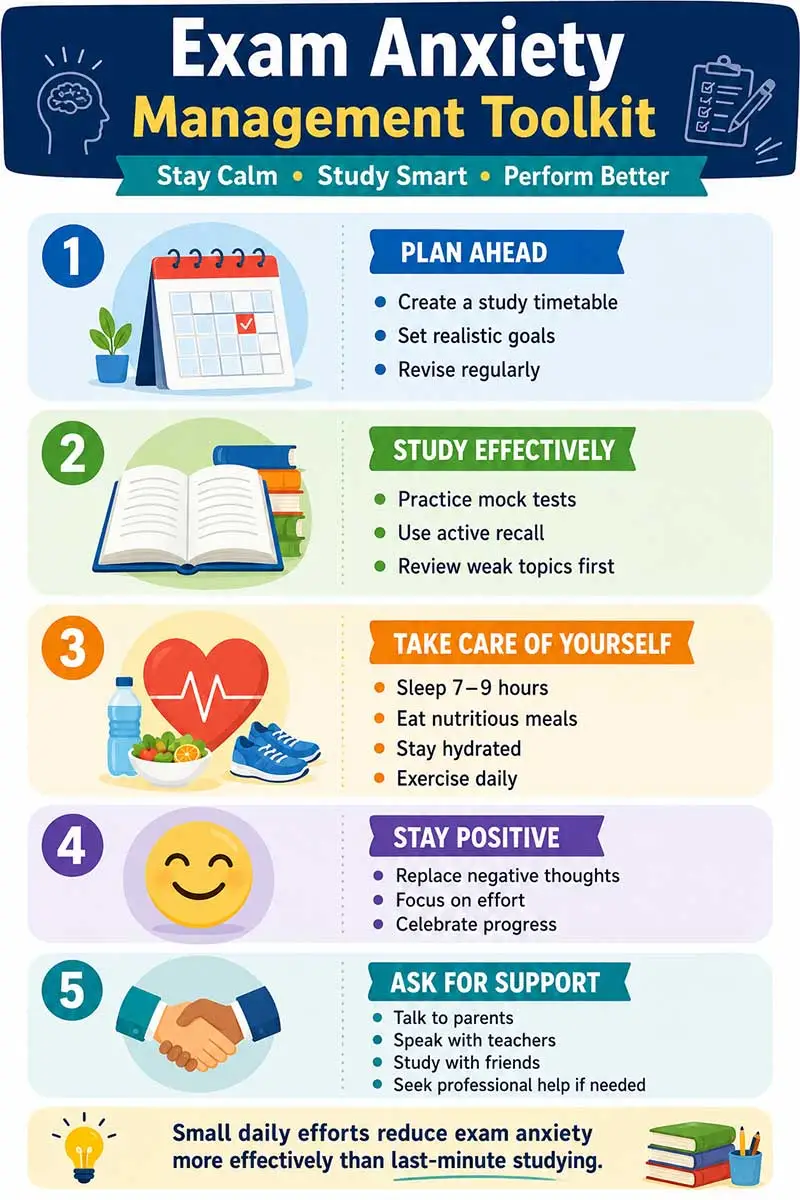
💡 Small daily habits reduce exam anxiety more effectively than last-minute studying.
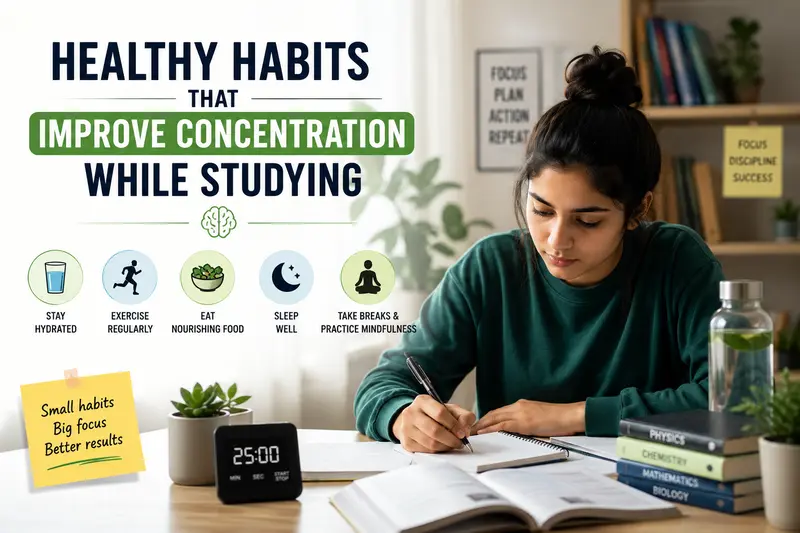
Healthy lifestyle habits that support concentration are discussed in Healthy Habits That Improve Concentration While Studying.
Infographic: Exam Anxiety Management Toolkit
6. Learn to Calm Your Nervous System
When anxiety spikes — before or during an exam — your body goes into a kind of mild panic response. The good news is you can interrupt that response with a few simple techniques.
Deep Breathing: The 4-4-4 Method
This takes less than two minutes and genuinely works:
- Breathe in slowly through your nose for 4 seconds
- Hold for 4 seconds
- Breathe out gently through your mouth for 4 seconds
- Repeat 4–5 times
Slow, controlled breathing signals to your nervous system that you’re safe. It slows your heart rate and clears some of the mental fog that panic creates.
Mindfulness
You don’t need an app or a meditation cushion for this. Just spend 5–10 minutes each day doing one thing at a time — walking, eating, breathing — without letting your mind drift to tomorrow’s exam. Over time, this trains your brain to stay present rather than spiralling into worry.
According to the World Health Organization (WHO), maintaining good mental well-being is essential for learning and overall health.
7. Talk Back to Negative Thoughts
Anxiety has a way of filling your head with a very convincing running commentary: “I’m going to fail,” “I can’t remember anything,” “Everyone else is better prepared than me.”
The trick isn’t to force yourself to feel positive — it’s to challenge the thoughts with something more accurate:
| Instead of thinking… | Try telling yourself… |
| “I’m going to fail.” | “I’ve prepared. I’ll give it my best.” |
| “Everyone is smarter than me.” | “I’m working at my own pace and that’s okay.” |
| “I can’t remember anything.” | “One difficult question doesn’t define my performance.” |
| “I’m not good enough.” | “I can stay calm and think clearly.” |
This won’t magically boost your marks, but it will reduce the mental noise — and that makes a real difference.
8. Stop Comparing Yourself to Others
Different students need different amounts of time to prepare. Some absorb material quickly; others need more repetition. Neither is better — they’re just different ways of learning.
Comparing your study hours or mock test scores with classmates almost always increases anxiety without improving your performance. A more useful approach:
- Track your own progress week by week
- Identify where you’re improving and where you need more work
- Set personal goals based on your starting point, not someone else’s
9. Take Breaks on Purpose
Studying for hours without stopping doesn’t make you more prepared — it makes you more exhausted. Your brain needs rest to consolidate what you’ve learned.
A simple approach that works well is the 50–10 Rule: study with full focus for 50 minutes, then take a genuine 10-minute break. Stretch, walk around, drink some water, rest your eyes. Then come back.
Short, intentional breaks improve concentration and help prevent the mental fatigue that makes anxiety worse.
10. Use Technology Thoughtfully
Educational apps, online quizzes, video explanations — these can all make studying more effective. But the same devices that help you learn can also become a significant source of distraction.
Some boundaries worth setting:
- Turn off social media notifications during study sessions
- Put your phone in another room if it’s pulling your attention
- Use screen time to learn, not to scroll
- Set clear end times for study so you don’t feel like you should always be doing more
You can also read How Students Can Safely Use AI Tools for Learning.
A Word for Parents
Parents have more influence over exam anxiety than they might realise — for better or worse. The pressure students feel at home can either compound what they’re already experiencing at school, or provide a genuine buffer against it.
Some of the most helpful things parents can do:
- Focus on effort, not marks — “I’m proud of how hard you’ve worked” lands very differently from “what did you score?”
- Avoid comparing your child to siblings, cousins, or classmates
- Make sure they’re getting enough sleep and eating properly — these aren’t luxuries during exams
- Create space for them to talk about how they’re feeling without jumping straight to advice
- Celebrate progress, not just outcomes
Sometimes the most powerful thing a parent can say before an exam is simply: “I love you no matter how it goes.”
Parents may also find these tips useful:
How Parents Can Help Children Study Without Pressure
A Word for Teachers
The classroom environment has a huge impact on how students experience exam pressure. Teachers who create a culture of psychological safety — where it’s okay to ask questions, make mistakes, and not know everything yet — produce students who are less anxious and more resilient.
Practical ways to support students:
- Be clear about exam formats and expectations — uncertainty breeds anxiety
- Run regular, low-stakes practice tests so the real thing feels familiar
- Give feedback that identifies what’s working, not just what isn’t
- Acknowledge effort and improvement, not just results
- Create space to talk about stress management — even briefly — before major exams
Students perform better when they feel supported rather than judged. That’s not a soft observation — it’s backed by a substantial body of educational research.

Common Mistakes That Make Anxiety Worse
| Common Mistake | A Better Approach |
| Cramming the night before | Build a steady revision routine over weeks |
| Staying up late to study | Protect your sleep — it’s not optional |
| Skipping meals | Eat regular, balanced food during exam season |
| Comparing marks with classmates | Track your own progress instead |
| Avoiding difficult topics | Tackle weak areas early, while there’s still time |
| Studying for hours without breaks | Use planned breaks to maintain focus |
| Negative self-talk | Challenge anxious thoughts with accurate ones |
Printable PDF Resources
Printable PDF 1: Weekly Exam Preparation Planner
Purpose
Help students organize their study schedule while maintaining a healthy balance between learning and relaxation.
Sections Included
- Weekly goals
- Subject-wise timetable
- Daily revision tracker
- Practice test record
- Water intake tracker
- Sleep tracker
- Exercise checklist
- Notes and reminders
Printable PDF 2: Exam Anxiety Self-Assessment & Readiness Checklist
Purpose
Enable students to monitor their preparation, confidence, and emotional well-being before examinations.
Sections Included
- Revision completed
- Practice papers attempted
- Sleep quality
- Stress level (1–5)
- Confidence rating
- Healthy habits checklist
- Positive affirmations
- Final exam-day checklist
Key Takeaways
- Exam anxiety is common — you’re not struggling because something is wrong with you
- Consistent preparation is more effective than last-minute cramming
- Sleep, nutrition, and exercise directly affect how anxious you feel
- Challenging negative thoughts and setting realistic expectations genuinely helps
- Parents and teachers can reduce anxiety significantly by offering encouragement instead of pressure
- Asking for help — from a friend, a teacher, or a professional — is a sign of strength
Frequently Asked Questions
Is exam anxiety normal?
Yes — mild nervousness before an exam is a completely normal human response. It becomes a concern when it’s persistent, severe, or starts interfering with daily life, sleep, or the ability to study at all.
How can I calm down before an exam?
Prepare as early as you can, protect your sleep, and practise deep breathing in the days leading up to the exam. Avoid last-minute cramming — it tends to increase anxiety rather than reduce it.
Does poor sleep make exam anxiety worse?
Significantly, yes. Sleep affects memory, concentration, emotional regulation, and your overall ability to manage stress. Prioritising sleep during exam season isn’t laziness — it’s strategy.
Should parents talk about marks every day during exams?
This is generally not helpful. Frequent mark-focused conversations tend to increase pressure. Encouraging consistent effort and checking in on how your child is feeling emotionally tends to produce better outcomes.
How often should I take breaks while studying?
A break of about 10 minutes after every 50–60 minutes of focused studying is a widely recommended approach. The key is that the break should be genuine rest — not scrolling through social media.
Can exercise actually help with exam stress?
Yes. Physical activity releases endorphins, improves mood, reduces cortisol (the stress hormone), and enhances concentration. Even a 20-minute walk makes a measurable difference.
When should a student seek professional help?
If anxiety is causing persistent panic attacks, severe sleep problems, avoidance of school, or significantly affecting everyday life for several weeks, it’s worth speaking with a qualified mental health professional. This is not a last resort — it’s a sensible step.
Final Thoughts
Exam anxiety is real, it’s common, and it can feel genuinely overwhelming. But it doesn’t have to control how you perform or how you feel about yourself as a student.
With the right habits, realistic expectations, and the support of the people around you, exams become something you can face — not something you have to dread.
And here’s something worth holding on to: exams measure your understanding at one particular moment in time. They don’t measure your intelligence, your potential, or your worth as a person. They never have.
Prepare well. Rest properly. Be kind to yourself. And trust that you’ve done enough.

Wellness & Balance Team shares educational content focused on healthy routines, study-life balance, and student wellbeing.