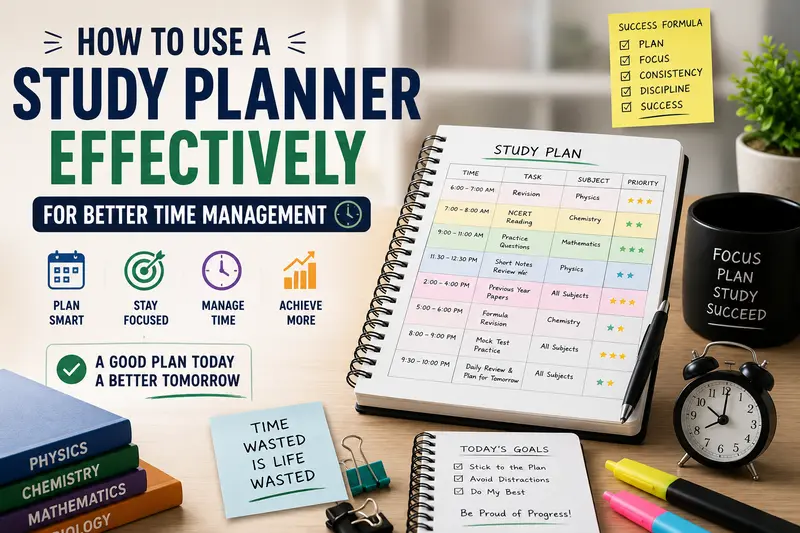

A practical guide to books, worksheets, planners and learning tools
Quick answer:
The most useful CBSE study resources are NCERT textbooks, the latest syllabus, official sample papers and marking schemes, previous years’ papers, chapter-wise worksheets, revision notes, flashcards, formula sheets and printable planners. Pair them with free official platforms and you have everything you need to understand concepts, practise, track progress and walk into exams with confidence.
1. Why the Right Resources Matter
Most students know the feeling: you sit down to study, and twenty minutes later you are still hunting for the right notes. Between guidebooks, random PDFs and endless videos, it is easy to spend more time searching than learning.
The fix is a small, dependable collection where each item has a clear job. A Class 10 student in Mathematics might use the NCERT textbook for concepts, a worksheet for practice, a formula sheet for quick revision and an official sample paper to check exam readiness.
A well-organised study system helps you to:
- Understand concepts instead of memorising answers
- Spot difficult chapters and practise them steadily
- Revise without rereading whole textbooks
- Get comfortable with exam formats
- Learn from your mistakes
The goal is never to collect everything. It is to pick the right tool for each task.
2. Official CBSE Resources to Start With
Official material should be the foundation of your collection. It keeps you aligned with the prescribed curriculum and away from outdated or inaccurate content.
| Resource | What it is for | When to use it |
| Latest CBSE syllabus | Knowing exactly what to study | Start of session and before exams |
| NCERT textbooks | Learning concepts and examples | Daily study |
| NCERT Exemplar Problems | Extra conceptual practice, where available | After finishing a chapter |
| CBSE sample papers | Understanding the exam format | Revision and mock tests |
| Official marking schemes | Seeing how answers are marked | After practice papers |
| Previous years’ papers | Exam-style practice | Throughout preparation |
| Printable checklists | Tracking chapters and topics | Weekly and before exams |
Always check that any material matches your class, subject, session and syllabus, especially older guidebooks and downloaded PDFs. Here are three links worth bookmarking:
- CBSE Academic: curriculum details, academic resources and exam materials.
- NCERT Textbooks: digital textbooks for Classes 1 to 12.
- NCERT Exemplar Problems: extra practice problems and answers where available.
A good habit: check official sources before buying another guidebook. You may already have what you need.
3. Making the Most of NCERT Textbooks
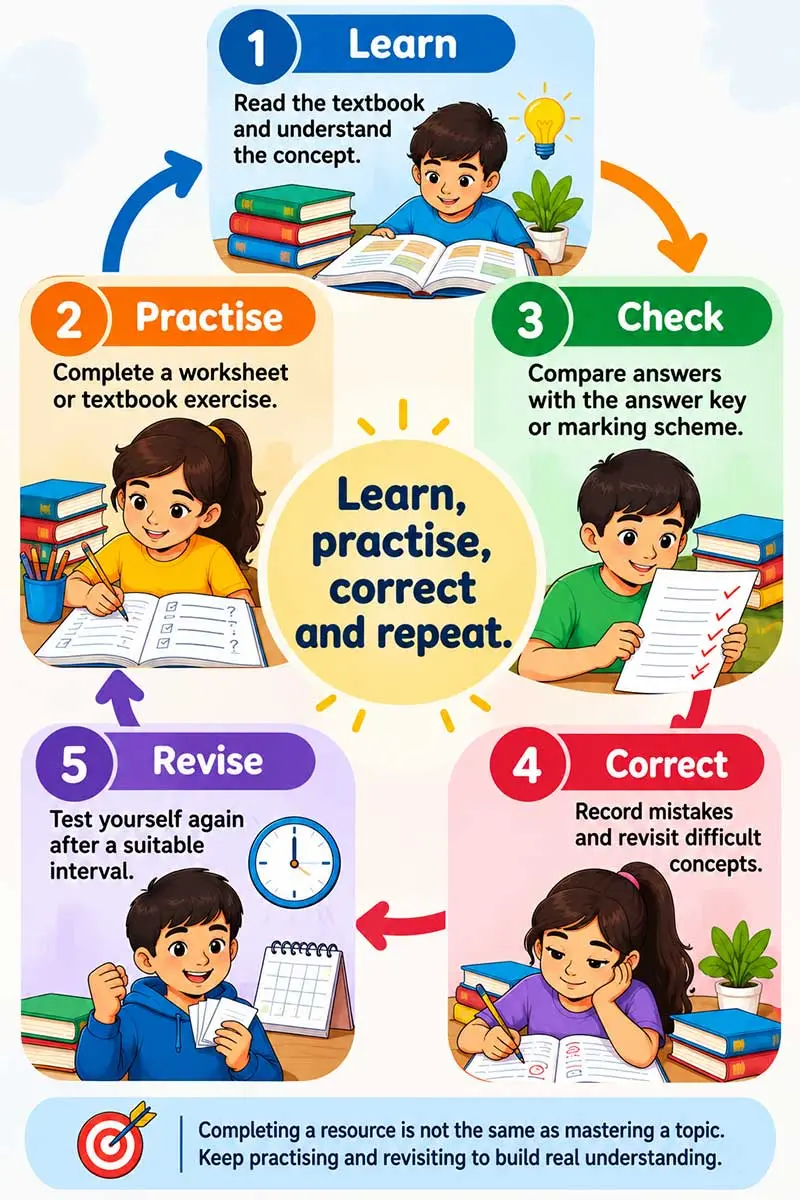
NCERT textbooks are the natural starting point, especially for Classes 10 and 12. They carry the prescribed content, explanations, examples and exercises. But reading a chapter once is only the beginning. Try this five-step routine:
- Preview the headings, objectives, diagrams and key terms.
- Understand the explanations and worked examples before trying to memorise anything.
- Practise the exercises on your own before peeking at solutions.
- Note down confusing ideas, wrong answers and doubts.
- Revisit the tricky questions after a few days and solve them again without help.
In Mathematics, write out every step. In Science, understand the reasoning behind processes. In Social Science, connect facts with causes, maps and dates.
What about Exemplar Problems? They offer deeper practice in selected subjects. If you are still shaky on a chapter’s basics, go back to the textbook first. Exemplar questions pay off once the fundamentals feel solid.
Printable idea: a chapter tracker. Make one sheet per subject with columns for Chapter, Textbook studied, Exercises completed and Difficult questions revised, each with a tick box. Tick only when you have truly understood and practised, not just read.
4. Sample Papers, Previous Years’ Papers and Marking Schemes
Knowing the content is one thing. Using it under exam conditions is another. Sample papers and past papers teach you the question formats, help with time management and show you where to focus your revision.
| Sample papers | Previous years’ papers | |
| Purpose | Practise the current exam pattern | See what was asked in earlier exams |
| Best use | Timed practice and mock exams | Getting familiar with question styles |
| Check | Current syllabus and paper design | Year and syllabus relevance |
A sample paper does not predict your actual questions. Use it to understand the structure and practise applying what you know. To get real value from a practice session:
- Pick a paper that matches your class and current syllabus.
- Solve it within the time limit, without notes or answers.
- Mark yourself using the marking scheme.
- Work out why you lost marks, then revisit that textbook section and try similar questions.
Printable idea: a mock test analysis sheet. After each paper, note your marks, the questions you got wrong, topics to revise, questions skipped for lack of time, and three actions before the next test. The aim is improvement, not collecting scores.
5. Chapter-Wise Worksheets
Worksheets help you move from understanding an idea to using it on your own. A good one starts with simple questions and builds toward harder ones, with a mix of multiple-choice, short and long answers, numericals, diagrams, case-based questions and an answer key.
Try the worksheet first, then check your answers, correct mistakes in a different colour and note why each one happened. For digital files, clear names such as Class-8-Maths-Chapter-4-Worksheet.pdf save a lot of searching later.
CBSEGuide readers can also explore effective study techniques for students for ideas on combining practice with active recall and regular revision.
6. Revision Notes, Flashcards and Formula Sheets
Quick-revision tools work best when you make them while learning, not in the last week before exams.
Revision notes should be short and in your own words: definitions, key ideas, examples, diagrams, dates, formulas and links between topics. A simple chapter template covers the main concept, important terms, key facts, one or two examples, difficult areas and five self-test questions. Avoid copying whole paragraphs.
Flashcards suit vocabulary, formulas, scientific terms, dates and short questions. Write the question on one side and the answer on the other, and keep one pile for cards you know and another to revisit. Paper cards work just as well as apps.
Formula sheets and concept maps help too. Group Maths formulas by chapter with a small example, and use concept maps in Biology, Geography, History and Economics to show how ideas connect.
One caution: revision notes support the textbook but never replace it. Check your summaries against the chapter and current syllabus. For more help, see this guide to subject-wise revision planning for mid-term exams.
7. Study Planners, Timetables and Checklists
A planner decides what to study, a timetable decides when, and a checklist shows what is done. Together they stop homework, revision and tests from colliding at the last minute.
| Tool | What it tracks | How often |
| Weekly study planner | Goals and study sessions | Update every weekend |
| Daily task checklist | Homework and priorities | Each evening |
| Assignment tracker | Projects, worksheets, due dates | When tasks are set |
| Chapter tracker | Topics studied, practised, revised | Weekly |
| Mistake log | Repeated errors and fixes | After tests |
You do not need seven separate documents. One notebook or spreadsheet can do the job. CBSEGuide has a CBSE study planner with a weekly timetable and printable checklist and a printable assignment tracker to help you get started.
A simple weekly template. Copy this into a notebook or spreadsheet and adapt it freely:
| Day | Main target | Practice or revision | Done |
| Monday | Mathematics chapter | Solve five to ten questions | ☐ |
| Tuesday | Science chapter | Revise concepts and diagrams | ☐ |
| Wednesday | English or a language | Grammar and writing practice | ☐ |
| Thursday | Social Science | Recall key points, practise answers | ☐ |
| Friday | Difficult topics | Correct the week’s errors | ☐ |
| Saturday | Two priority subjects | Short practice test | ☐ |
| Sunday | Weekly review | Update trackers, plan next week | ☐ |
This is only a framework. Fit it around your school hours, tuition, hobbies and upcoming assessments. For a more detailed schedule, read how to create a study timetable for CBSE students.
8. Free Online Learning Resources
Digital resources are wonderful when you need to revisit a lesson at home or tackle a tough concept alone. Just pick reliable platforms and go in with a purpose rather than browsing aimlessly.
NCERT ePathshala offers digital textbooks, audio, video, interactive material and other learning aids on computers, tablets and phones. Some NCERT textbook QR codes link straight to chapter resources.
The NCERT portals give you the NCERT textbook portal for prescribed content and the Exemplar Problems portal for extra practice.
The CBSE Academic website is the place for curriculum details and official exam preparation material.
Videos and interactive aids can make abstract ideas click, such as a visual demonstration of a science process that is hard to picture from text. Keep it active: pick a specific doubt, watch a lesson on it, then close the video, explain the idea in your own words and solve a related question.
Spotting unreliable resources. Before downloading a PDF or following an explanation, check the publisher, date, class level and syllabus. Be wary of sites promising guaranteed board questions.
9. Subject-Wise Resources for Classes 6 to 12
Different subjects call for different kinds of practice, so choose resources based on the skill you want to build.
| Subject | Useful resources | How to use them |
| Mathematics | NCERT exercises, worksheets, formula sheets, mistake logs | Solve independently, fix calculation errors |
| Science | Textbooks, diagrams, concept maps, sample papers | Understand processes, label diagrams |
| English | Grammar worksheets, reading passages, vocabulary cards | Practise comprehension and structured writing |
| Hindi and other languages | Grammar exercises, writing prompts, literature notes | Build accuracy and clear answers |
| Social Science | Summaries, timelines, maps, source-based questions | Connect causes and consequences, practise maps |
| Computer Science / IP | Textbooks, coding exercises, practicals | Learn by doing, not memorising code |
Classes 6 to 8 are about strong foundations and regular habits, so visual aids, short worksheets and simple checklists work well. Classes 9 and 10 call for chapter tracking, written-answer practice and exam-style questions. Classes 11 and 12 need more subject-specific material, such as detailed numericals, case-based questions and timed mocks. For entrance exams, also follow the official syllabus from the relevant exam authority.
10. Choosing the Right Resources
More material does not mean better results. Before adding anything new, ask yourself:
- Does it match my class, subject and current syllabus?
- Is it accurate and from a reliable source?
- Can I attempt questions on my own, with answers available?
- Does it address a specific weakness?
- If it is paid, is it genuinely worth the cost?
Also remember the difference between learning and assessment tools. A video can explain a hard idea but cannot replace practice, and a mock test reveals weaknesses but cannot fix them. The strongest collection mixes explanation, practice, assessment and revision.
11. A Realistic Weekly Resource Plan
Here is a gentle way to put everything into action without overloading a busy week.

| Day | Focus |
| Monday: Learn and organise | Check the timetable and assignment tracker, pick the week’s key chapters, read the textbook sections and set three realistic goals. |
| Tuesday and Wednesday: Practise | Do worksheets and textbook exercises without solutions, make brief revision notes and log difficult questions. |
| Thursday: Revise | Use flashcards and formula sheets, recall answers from memory and revisit the week’s tricky concepts. |
| Friday: Check understanding | Take a short subject test, mark it with solutions or marking guidance and note topics needing more work. |
| Saturday: Strengthen | Revisit difficult chapters, try extra questions and ask a teacher or parent about unresolved doubts. |
| Sunday: Review and plan | Update the chapter tracker, check upcoming tests, review the week’s mistakes and plan the next week. |
Adjust it around your school commitments and exam dates. For more guidance, read how to prepare for CBSE board exams.
12. Common Mistakes to Avoid
- Collecting too many guidebooks. Switching between materials causes confusion. Start with the textbook and add extras only when needed.
- Memorising without understanding. You also need to explain ideas and solve unfamiliar problems.
- Ignoring mistakes. A wrong answer shows you a gap. Find the cause and try a similar question again.
- Using outdated material. Old books and papers may not match the current syllabus or pattern.
- Treating ticked boxes as mastery. Mark a chapter mastered only when you can explain it and answer questions independently.
Key Takeaways
- Begin with the latest CBSE syllabus and NCERT textbooks.
- Use official sample papers, marking schemes and past papers for exam practice.
- Reinforce learning with worksheets, concise notes, flashcards and formula sheets.
- Organise your work with printable planners and trackers.
- Review mistakes after every practice session.
- Aim for understanding and steady improvement, not a bigger pile of materials.
Frequently Asked Questions
1. What are the most important study resources for CBSE students?
The current syllabus, prescribed textbooks, worksheets, revision notes, sample papers and marking schemes, plus planners and mistake logs to keep it all organised.
2. Are NCERT textbooks enough for board exams?
They are an essential foundation, especially for Classes 10 and 12. Understand the content and finish the exercises first, then add sample papers and check the current syllabus and official guidance.
3. Where can I download free CBSE study materials?
Start with the CBSE Academic website, the NCERT textbook portal, NCERT Exemplar Problems and NCERT ePathshala. What is available varies by class, subject and session.
4. Which printable resources are useful?
Weekly planners, daily checklists, assignment trackers, chapter sheets, formula sheets, mock-test analysis forms and mistake logs.
5. How can I organise study materials at home?
Make a folder for each subject, label files by class, chapter and type, and mirror the same structure digitally.
6. Are online resources better than printed ones?
Neither is automatically better. Digital tools offer videos and interactive lessons, while printed worksheets make focused practice and tracking easier. Choose what helps you learn consistently.
7. How often should I revise my notes?
Soon after learning, again over the next few days, and then in weekly revision. Difficult topics need more frequent practice, so adjust for your understanding and exam dates.
8. How can parents help?
Help organise books, plan realistic timetables and track deadlines. Encourage independent problem-solving, talk through difficulties without comparing children with others, and check in supportively rather than monitoring every session.
9. Should I buy expensive guidebooks and online courses?
Not necessarily. Use textbooks and free official resources first. A paid option may be worth it if it fills a specific need, but overlapping purchases are rarely necessary.

Student Success Desk focuses on practical learning strategies, study techniques, and academic improvement tips for school students.