
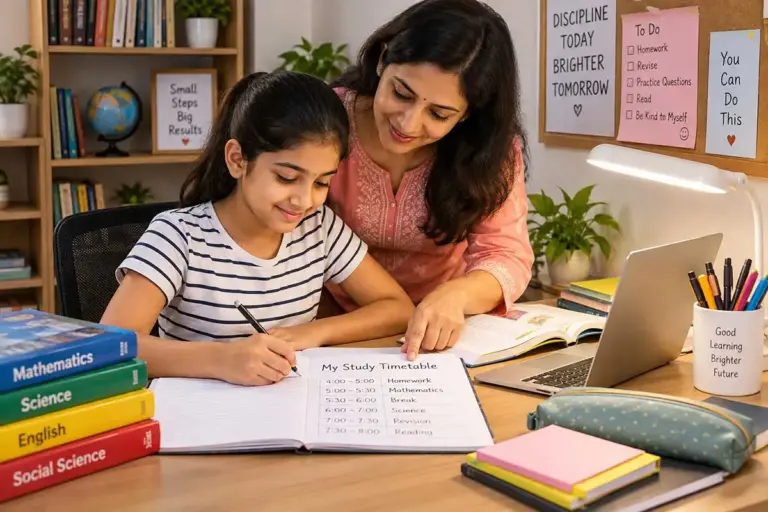
| The Short Answer Parents can help children build good study habits by keeping a steady routine, setting up a calm place to work, breaking big goals into small ones, encouraging active learning, keeping screen distractions in check, and praising effort instead of only marks. The real aim is to help your child slowly become organised, motivated and independent, without piling on academic pressure. |
Why Are Good Study Habits Important for Children?
Good study habits aren’t really about sitting with a textbook for more hours. They’re about learning how to manage time, concentrate, finish what you start, revise regularly, bounce back from mistakes and, little by little, take charge of your own education.
Think about a typical day for a school student in India: school, homework, tuition or coaching, activities, family responsibilities and plenty of tempting screens. Without some kind of routine, studying quietly turns into something that only happens the night before a test.
A good study habit changes that. It makes learning an ordinary, everyday part of life.
The National Council of Educational Research and Training (NCERT) talks about helping children build learning habits so they can take part actively in school, and it recognises that children learn in many ways: by listening, reading, interacting and doing. NCERT
The good news is that you don’t have to become your child’s teacher at home. Your more important job is to create the conditions in which learning can happen.
What Role Should Parents Play in Developing Study Habits?
The most helpful parent isn’t always the one sitting next to the child through every homework session. Over the years, your role can shift through three stages:
| Stage | What you do | What your child does |
| Early stage | Give structure and plenty of guidance | Follows the routine |
| Developing stage | Remind, encourage and check in now and then | Plans and completes tasks |
| Independent stage | Step in when needed | Manages time, learning and revision |
The goal is support that slowly leads to independence.
A Class 3 child may still need help packing the school bag and checking homework. By Class 8, many students can handle a weekly study plan on their own. And a Class 10 or 12 student usually needs a chat about priorities now and then, not constant supervision.
So here’s a question worth asking yourself:
“What can I help my child learn to do on their own?”
It’s usually far more useful than “How do I make my child study?”
How Can Parents Create a Good Study Routine?
A routine gives children something to lean on. They don’t have to decide from scratch every single day when and where to study.
A good routine makes room for:
- School and tuition
- Homework
- Revision
- Breaks
- Meals
- Physical activity
- Family time
- Relaxation
- Enough sleep
Try not to build a timetable that squeezes academics into every minute of the day. Children need breathing room, and a plan that’s too tight usually falls apart within a week.
Start With a Simple Daily Plan
“Study Maths for two hours” sounds clear, but it doesn’t tell a child what to actually do. Help them name a specific task instead.
Less helpful: “Study Science.”
More helpful: “Revise the chapter on nutrition and answer 10 practice questions.”
Specific goals make progress easy to see, and seeing progress is motivating.
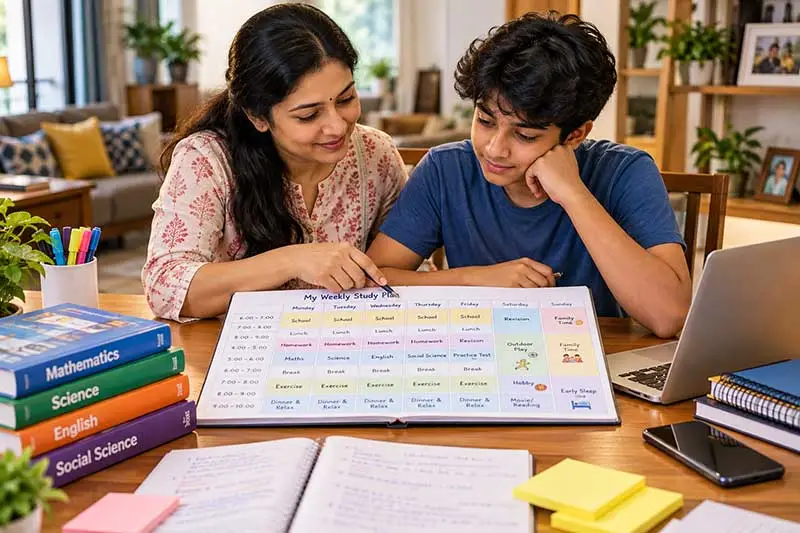
Older students often do well with a weekly plan. Sit down together (or let them do it alone) and list:
- Chapters that still need to be completed
- Topics that need revision
- Assignments with deadlines coming up
- Difficult subjects that need extra practice
- Time for play, hobbies and rest
If you’d like more ideas, have a look at our guide on how to create a daily study routine for students.
Should Children Study at the Same Time Every Day?
Consistency helps, but there’s no need to be rigid about it.
Some children are sharp as soon as they get home from school. Others need a snack, some rest and a bit of outdoor play before they can sit down with books. Watch your child for a week or two and notice when they’re naturally most alert. That’s the best time for the harder subjects.
What matters most is regularity, not a perfect timetable.
How Can Parents Create a Positive Study Environment at Home?
Your child doesn’t need an expensive study room to build good habits. A suitable space is ideally:
- Well lit
- Comfortable
- Reasonably quiet
- Free from unnecessary interruptions
- Stocked with the books and stationery they need
- Tidy enough that things are easy to find
Short on space? A dining table or a shared family corner works perfectly well. The family can simply agree on a study time when everyone keeps interruptions to a minimum.
What Should Parents Keep Away From the Study Area?
Depending on your child, the usual suspects are:
- Television
- Phone notifications
- Gaming devices
- Chit-chat and side conversations
- Social media
- Snacks that are always within reach
- Extra browser tabs
The aim isn’t a perfectly silent house. It’s to cut down the interruptions that keep breaking your child’s concentration.
A positive learning environment at home comes more from family habits and emotional support than from fancy furniture or equipment.
How Can Parents Teach Children to Set Study Goals?
“Finish your studies” has no finish line, so it’s no surprise children find it hard to follow. The fix is to help them cut big tasks into smaller goals.
Instead of: “Prepare for the Maths test.”
Try:
- Revise fractions.
- Solve 10 problems.
- Check the mistakes.
- Practise two difficult questions again.
- Look over the formula sheet tomorrow.
Small steps also make achievement visible, and ticking something off feels good.
Try the “Three Priorities” Method
At the start of a study session, ask your child to pick just three important tasks.
| Today’s priorities ☐ Complete English assignment ☐ Revise one Science topic ☐ Practise 10 Maths questions |
Once those are done, your child can decide whether anything else needs doing. This avoids a familiar trap: writing a huge to-do list and feeling like a failure even after finishing several tasks.
How Can Parents Encourage Better Learning Techniques?
Encourage your child to learn actively instead of simply spending time with the book open. After reading a chapter, for instance, ask them to close the book and tell you what they remember.
Here are a few techniques worth introducing:
Active Recall
Ask questions like these:
- “What were the three main points?”
- “Can you explain this without looking at the book?”
- “What did you find difficult?”
Practice Questions
Solving questions shows whether your child can really use the concept, not just recognise it on the page.
Spaced Revision
Rather than revising a chapter only the night before an exam, come back to it several times over days and weeks.
Teaching Someone Else
Ask your child to explain an idea to you in simple words. If they struggle to explain it clearly, that topic probably needs another look.
Error Review
Suggest a small “mistake notebook” for errors that keep coming back in Maths, Science and languages.
Our detailed guide to effective study techniques for students has more strategies you can introduce one at a time.
Do Parents Need to Teach Every Subject?
Not at all.
You can ask questions, encourage practice and help your child find good resources without pretending to know every concept. Compare these two things a parent might say:
“Show me where you got stuck.”
“Why don’t you understand this?”
The first invites problem-solving. The second can leave a child feeling judged.
How Should Parents Handle Phones, Gaming and Social Media?
Technology is now part of education. A phone, tablet or laptop may be needed for online classes, research, videos, assignments and learning apps. So the goal shouldn’t be a blunt “no screens.”
It helps to separate the different kinds of screen time:
| Type of screen use | Example | Parent approach |
| Essential learning | Online class, digital textbook | Support it |
| Useful learning | Educational video, practice app | Encourage, with sensible boundaries |
| Social use | Messaging, social media | Agree on limits together |
| Entertainment | Gaming, streaming | Schedule it at suitable times |
Some ground rules many families find useful:
- Phones stay away during focused study time.
- Notifications are switched off while studying.
- Leisure screen time comes after important responsibilities.
- No secret device use late at night.
- Educational screen use is treated differently from entertainment.
Talk the rules over with your children instead of just announcing them. A family screen-time agreement can make expectations clearer, especially with teenagers.
And remember to set an example. If adults are glued to their phones during family conversations, children can fairly ask why the same behaviour is not okay for them.
How Can Parents Motivate Children Without Pressure?
Motivation is one of the most important pieces of healthy study habits, and it’s easy to get wrong. Lines like these are common:
- “You must get 95%.”
- “Look at your cousin’s marks.”
- “You are wasting your future.”
- “If you studied properly, you would always score higher.”
However well meant, they tend to raise anxiety, not improve learning. Try noticing effort, strategy, persistence and improvement instead.
Compare the Child With Their Own Past Performance
Rather than saying:
“Your friend scored 90 and you scored 75.”
try:
“You scored 68 last time and 75 this time. What helped you improve?”
This moves the focus from competition to progress.
Praise Specific Behaviours
Instead of only saying:
“You are very intelligent.”
try:
“You kept working on that difficult problem instead of giving up.”
The second sentence points to something your child did and can do again.
What If Marks Suddenly Fall?
Please don’t jump to the conclusion that your child has become lazy. Gently explore a few questions first:
- Is the subject getting harder?
- Is the workload too heavy?
- Is my child sleeping enough?
- Are there problems at school?
- Is tuition adding too much pressure?
- Is technology pulling their attention away?
- Are the basics clear?
A drop in marks is a signal to look into, not a reason to punish.
For more guidance, read how parents can help children study without pressure.
How Can Parents Teach Discipline and Responsibility?
Discipline works best when children know what is expected and what follows. A simple system can look like this:
Expectation → Routine → Reminder → Responsibility → Review
Here’s how it might play out at home:
Expectation: Homework is finished before gaming.
Routine: Homework starts at 6:00 p.m.
Reminder: You give one reminder.
Responsibility: Your child manages the work on their own.
Review: At the weekend, you talk about what worked.
Try not to turn every missed assignment into a big argument. Children also need to feel natural consequences now and then. If your child keeps putting off homework, losing some free time can teach more than a lecture ever will.
Discipline should teach responsibility, not create fear.
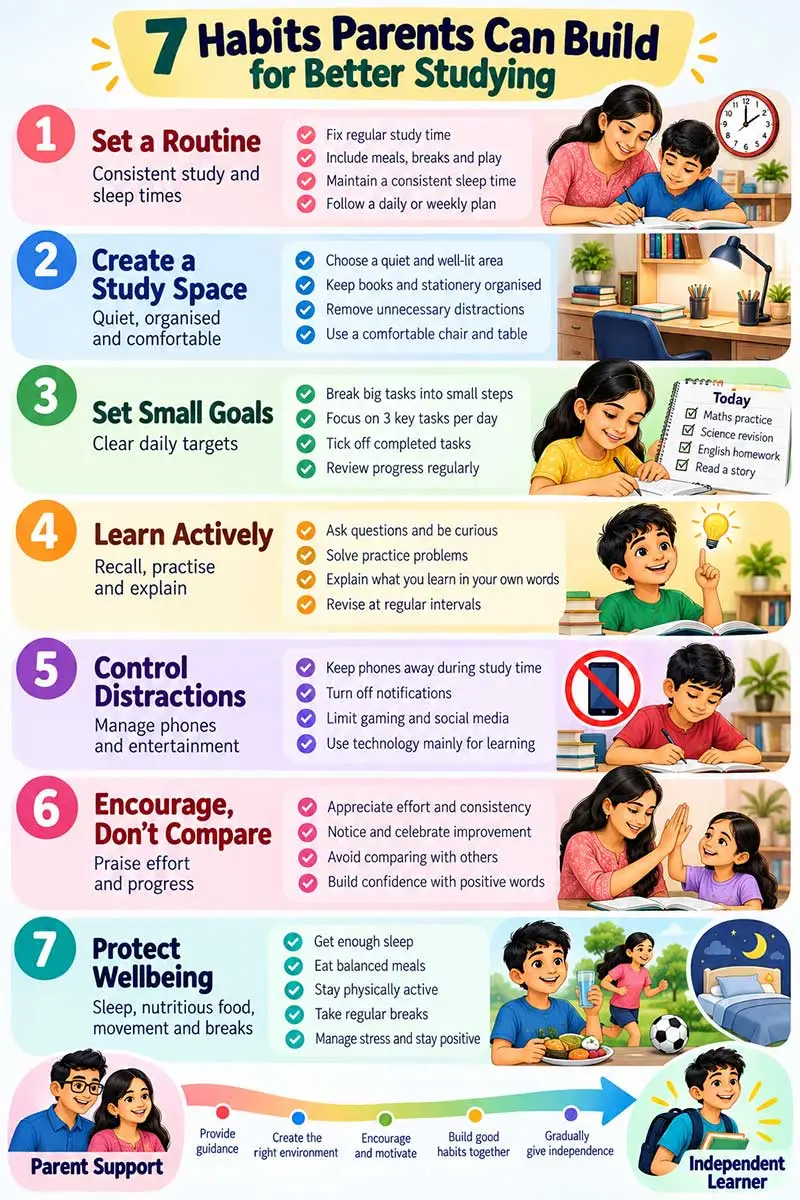
Why Do Sleep, Food and Physical Activity Matter?
Study habits can’t be separated from general wellbeing. A tired, hungry or inactive child will find it much harder to concentrate. So please protect these three things:
Sleep
Late-night studying shouldn’t become the family’s default plan.
Nutritious Meals
Children don’t need costly “brain foods” or unverified supplements. Regular, balanced Indian meals give them the energy and nutrients for growth and daily activity.
Physical Activity
Walking, cycling, outdoor games, yoga or any age-appropriate activity gives the body and mind a welcome break from sitting.
The importance of sleep, nutrition and exercise during exams becomes especially clear when children are dealing with heavy academic workloads.
A Simple Rule for Parents
Please don’t treat sleep, meals, play and relaxation as rewards children earn after they finish all their studies. They’re part of a learning routine that can actually last.
How Can Parents Work With Teachers?
Parents and teachers do best as partners, not as rival authorities.
The Central Board of Secondary Education (CBSE) stresses the value of family–school partnership for children’s learning and emotional wellbeing in its positive parenting guidance. CBSE
Parent-teacher meetings are a great chance to ask specific questions:
- Does my child take part in class?
- Which concepts are proving difficult?
- Does my child finish work independently?
- Is concentration a concern?
- How does my child get along with classmates?
- What can we practise at home?
- Are there resources you would recommend?
Try not to let every conversation with a teacher become a discussion about marks. Teachers often notice learning difficulties, confidence issues or classroom behaviour that never show up at home.
You may also like our guide on how parents can talk to teachers about their child’s progress.
A Practical Parent Checklist
Use this once a week instead of monitoring every minute of every study session. It’s a gentle way to see what’s going well and what could use a little attention.
| Question | Yes | Needs attention |
| Does my child have a reasonably consistent study routine? | ☐ | ☐ |
| Is the study area reasonably free from distractions? | ☐ | ☐ |
| Does my child have realistic daily goals? | ☐ | ☐ |
| Does my child revise regularly? | ☐ | ☐ |
| Does my child practise questions rather than only read? | ☐ | ☐ |
| Is leisure screen time under reasonable control? | ☐ | ☐ |
| Is my child getting adequate sleep? | ☐ | ☐ |
| Does my child have time for physical activity? | ☐ | ☐ |
| Do I praise effort and improvement? | ☐ | ☐ |
| Do I avoid comparing my child with other children? | ☐ | ☐ |
| Does my child know when and how to ask for help? | ☐ | ☐ |
| Am I gradually encouraging independence? | ☐ | ☐ |
A Printable “What Did You Learn Today?” Routine
Spend five relaxed minutes with your child after school or in the evening and let them fill in (or simply answer aloud):
Today I learned: _______________________
Something I understood well: _______________________
Something I found difficult: _______________________
One question I still have: _______________________
Tomorrow I will practise: _______________________
This little exercise encourages reflection without making every parent-child conversation feel like an exam.
What Should Parents Avoid?
Even loving, well-intentioned parents can make study habits harder to build without realising it. Try to avoid:
- Checking every few minutes whether your child is studying.
- Comparing marks with siblings, friends or relatives.
- Using fear as the main source of motivation.
- Expecting different children to follow identical routines.
- Treating every poor mark as a character flaw.
- Letting studying regularly replace sleep.
- Handing over too many resources at once.
- Solving every tough homework question for them.
- Using technology bans as punishment for every academic problem.
- Focusing only on marks.
A child who learns to manage time, recover from mistakes and ask for help is picking up skills that matter long after the next exam is over.
Key Takeaways
- Build routines, not rigid schedules. Consistency matters more than a perfect timetable.
- Create the right environment. A calm, organised study spot cuts down avoidable distractions.
- Use small goals. Specific tasks are easier to start and finish than vague instructions.
- Encourage active learning. Recall, practice questions, explaining and revising beat rereading.
- Manage technology thoughtfully. Treat learning screen time differently from leisure screen time.
- Praise effort and progress. Don’t let marks become the only measure of success.
- Teach responsibility gradually. As children grow, let them take more charge of their own learning.
- Protect wellbeing. Sleep, good food, movement and breaks keep learning sustainable.
- Work with teachers. Parents and schools support children in different, complementary ways.
- Aim for independence. The goal is a child who knows how to learn without constant supervision.
Frequently Asked Questions
1. How can I make my child study regularly?
Start with a simple, predictable routine instead of demanding long hours. Set one or two specific tasks, fix a regular study time, and slowly give your child more independence. Praise consistency and completion, not just the number of hours spent at the desk.
2. How many hours should a school child study at home?
There isn’t one number that suits every child. Age, class, school workload, tuition, learning needs and exam schedules all play a part. Aim for productive study, regular revision, proper breaks and enough sleep, rather than setting an unnecessarily high number of hours.
3. Should parents sit with children while they study?
Younger children often benefit from closer company, but it’s wise to step back as they grow more capable. For older students, occasional check-ins and support usually work better than sitting beside them for every session.
4. How can I motivate my child without putting pressure on them?
Praise effort, persistence, good strategies and improvement. Avoid comparing your child with classmates, cousins or siblings. Ask what they found interesting or tricky, and help them work out the next step instead of focusing only on marks.
5. What should I do if my child keeps using the phone while studying?
First find out whether the phone is being used for learning or for entertainment. Agree on clear rules, such as notifications off and the phone kept away during focused sessions. Younger children may need more supervision, while teenagers should help create the rules.
6. How can I help my child who is weak in Maths or Science?
Try to pin down the specific difficulty instead of labelling your child “weak.” Revisit the basics, practise a few questions regularly and look at the mistakes together. If the problem continues, talk to the teacher and consider whether extra academic support would help.
7. Is tuition necessary for developing good study habits?
Not necessarily. Tuition can give useful academic support to some students, but it doesn’t automatically create good study habits. Children still need to learn how to plan, practise, revise, manage distractions and work on their own.
8. How can parents help children during CBSE exam preparation?
Help your child understand the syllabus and schedule, build a realistic revision routine, provide good study conditions, encourage practice, and protect sleep and wellbeing. Try not to create needless fear around board exams.
9. What should parents do when a child refuses to study?
Resist the urge to turn it into a confrontation. Find out what’s behind the resistance. Your child may be tired, confused, overwhelmed, distracted or stuck on a particular subject. Deal with the underlying problem, then restart with a small, achievable task.
10. When should parents seek additional help?
If academic difficulties persist, or come with noticeable changes in mood, sleep, behaviour, attendance, motivation or everyday functioning, speak with your child’s teacher, a school counsellor or another qualified professional. Early support is usually more effective than waiting until things become severe.

Parent Guidance Corner provides supportive resources for parents helping children with education, learning habits, and academic wellbeing.