The Quick Answer
| A realistic study routine, enough sleep, balanced meals, regular movement, and less screen time all go a long way toward managing stress. So does letting go of constant comparison with classmates. And when academic pressure starts to feel like too much to carry alone, talking it through with a parent, teacher, friend, or school counsellor genuinely helps. |
Why Do CBSE Students Experience Stress?
School life in India asks a lot of students. On any given week, a CBSE student might be juggling regular classes, homework, tuition or coaching, projects, practical work, extracurriculars, family expectations, and exams — often all at once.
For Class 10 and Class 12 students, this pressure tends to spike during pre-board and board exam season. On top of that, there’s the quiet worry about marks, competitive exams, career choices, and how they measure up against classmates.
It’s worth saying: stress on its own isn’t the enemy. A bit of pressure can actually push a student to prepare and meet a deadline. The real trouble starts when that stress doesn’t let up — when it begins chipping away at sleep, concentration, mood, relationships, or everyday functioning.
CBSE has been placing more weight on student well-being alongside academics in recent years. Its Counseling Hub and Spoke School Model frames wellness broadly — mental health awareness, physical activity, nutrition, mindfulness, emotional growth, and safe digital habits all fall under that umbrella.
The Ministry of Education’s school wellness guidelines echo this, calling out socio-emotional skills, emotional well-being, resilience, and consistent support for academic and behavioural concerns.
What Are the Common Signs of Student Stress?
Stress doesn’t show up the same way in every student. One child might grow anxious and restless; another might go quiet and lose interest in things they used to enjoy.
A few signs worth watching for:
- Difficulty concentrating
- Constant worrying about examinations
- Irritability or frequent mood changes
- Feeling tired even after resting
- Headaches or stomach discomfort
- Difficulty falling asleep
- Sleeping much more or less than usual
- Avoiding schoolwork
- Losing interest in hobbies
- Feeling overwhelmed by ordinary tasks
- Constantly comparing marks with classmates
- Sudden decline in academic performance
CBSE’s guidance for teachers points out that repeated patterns like mood swings, slipping grades, absenteeism, anxiety, and stress can be a sign that a student would benefit from extra support or a referral to a counsellor.
One rough day doesn’t necessarily mean something is seriously wrong. But changes that persist or keep getting worse are worth paying attention to.
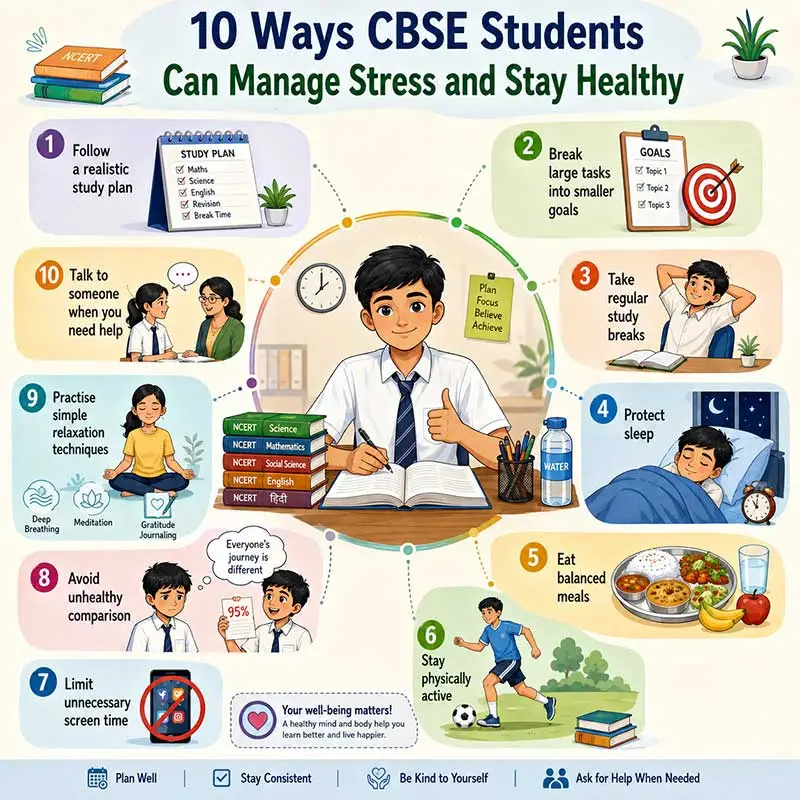
10 Practical Ways to Manage Stress and Stay Healthy
1. Create a Realistic Study Routine
One of the easiest ways to ease academic stress is simply knowing what needs to get done, and when.
Rather than drawing up a timetable that demands six or seven hours of intense self-study every single day, build a schedule around the student’s actual life.
Make room for:
| Activity | Why It Matters |
| School | Learning and classroom participation |
| Homework | Completing daily academic work |
| Focused study | Learning difficult topics |
| Revision | Strengthening previous learning |
| Exercise/play | Physical and mental refreshment |
| Meals | Energy and concentration |
| Family/personal time | Emotional balance |
| Sleep | Recovery and learning |
A good timetable should bend a little. If a student misses one study session because of a school activity or a family commitment, that doesn’t mean the whole week is a write-off.
For more planning ideas, take a look at this CBSE study planner for students and this daily study routine for students.
A Simple School-Day Example
- 6:00 AM: Wake up and get ready
- 6:30 AM: Breakfast and light revision if useful
- School hours: Classes and school activities
- After school: Lunch and rest
- 4:30 PM: Homework
- 5:30 PM: Outdoor play/walking
- 6:15 PM: Focused study
- 7:15 PM: Break
- 7:30 PM: Revision or practice questions
- 8:30 PM: Dinner and family time
- 9:15 PM: Prepare for the next day
- 9:30–10:00 PM: Wind down and sleep according to age and individual needs
The exact timings will naturally shift depending on the student’s school, commute, tuition, and family schedule — treat this as a starting template, not a rulebook.
2. Break Large Tasks Into Smaller Goals
“Finish the entire Science syllabus” can feel like standing at the bottom of a mountain.
“Revise one chapter and solve 15 questions” is something you can actually start on today.
Try the small-goal method:
- Choose one subject.
- Select one specific topic.
- Decide what you will complete.
- Study for a focused period.
- Take a short break.
- Check what you actually completed.
This turns an intimidating workload into a series of steps that actually feel doable.
Students can also lean on a CBSE study timetable to spread subjects across the week instead of trying to cover everything every single day.
3. Take Regular Breaks While Studying
Studying non-stop for hours on end doesn’t automatically mean better learning — often it means the opposite.
After a focused study stretch, step away for a bit. Stand up, stretch, drink some water, walk around the room, or just rest your eyes for a moment.
A good break should leave the student feeling refreshed, not pulled into another demanding activity.
Better Study Breaks
- Stretching
- Walking
- Deep breathing
- Drinking water
- Looking away from the screen
- Talking briefly with family
- Spending a few minutes outdoors
Breaks to Avoid
- Starting a long gaming session
- Scrolling social media endlessly
- Watching several videos
- Beginning a television episode
- Checking notifications every few minutes
The goal is to come back to studying feeling recharged — not to swap one demanding activity for another.
4. Protect Your Sleep
Sleep isn’t wasted study time — it’s part of the studying.
A tired student might spend more hours with a book open but actually retain far less. Poor sleep also chips away at concentration, mood, and the ability to handle everyday pressure.
So it’s worth avoiding the habit of pulling all-nighters as a regular exam strategy.
Create a Better Sleep Routine
- Keep a reasonably consistent bedtime.
- Avoid studying until the point of exhaustion.
- Reduce stimulating screen use close to bedtime.
- Keep the bedroom comfortable and quiet.
- Prepare school materials before going to bed.
- Avoid excessive caffeine, especially later in the day.
How much sleep a child or teenager actually needs varies by age and by the individual, so it’s better for parents to follow age-appropriate health guidance rather than chasing one fixed number.
5. Eat Regular, Balanced Meals
What a student eats has a direct effect on energy and concentration through the school day.
Indian students don’t need expensive “brain foods.” A balanced home meal already covers many of the nutrients growing bodies and busy minds need.
Some practical everyday options:
- Rice or roti with dal
- Vegetables
- Fruits
- Curd or other suitable dairy foods
- Eggs, where included in the family’s diet
- Nuts and seeds, where appropriate
- Beans and other pulses
- Adequate water
During Exam Preparation
Try not to let these replace proper meals:
- Excessive tea or coffee
- Sugary drinks
- Energy drinks
- Frequent packaged snacks
- Skipping meals to save study time
A student who’s hungry, dehydrated, or running on empty is unlikely to get much out of a long study session, no matter how motivated they are.
6. Include Physical Activity Every Day
Exercise shouldn’t be the first thing sacrificed the moment exams get close.
Walking, cycling, yoga, badminton, football, cricket, dancing, or just playing outdoors all offer a genuine break from academic work.
Staying active also helps students hold onto a healthier daily rhythm and gives them some time away from books and screens.
What matters most here is consistency, not competition. A student doesn’t need an intense workout to benefit — regular movement is enough.
7. Reduce Unnecessary Screen Time
Technology is woven into education now. Students use phones, tablets, and computers for online classes, educational videos, research, and digital learning every day.
The issue was never technology itself — it’s uncontrolled use.
A few simple rules to try:
Study time: Keep unnecessary notifications off.
Homework: Use only the websites or apps needed for the task.
Break time: Avoid automatically opening social media.
Before sleep: Give yourself a screen-free wind-down period when practical.
Parents can help most by setting clear household expectations around devices, rather than constantly checking in on what a child is doing minute to minute.
8. Stop Comparing Your Progress With Everyone Else
Comparison tends to peak during exam season.
One classmate says, “I completed five chapters.”
Another says, “I scored 95% in the test.”
None of that actually tells a student how they’re doing.
A more useful comparison is between where you are now and where you were before. Try asking:
- Did I understand this topic better than last week?
- Did I correct my previous mistakes?
- Did I complete today’s priority?
- Am I becoming more consistent?
- Do I know which topics need help?
Academic progress rarely moves in a straight line. One lower mark on one test doesn’t define a student’s ability or their future.
9. Use Simple Stress-Relief Techniques
When things start to feel like too much, a short reset can help more than forcing yourself to keep pushing through.
The 60-Second Reset
- Put the book down.
- Relax your shoulders.
- Breathe slowly and comfortably.
- Notice what you are feeling.
- Identify the next small task.
- Begin with that task rather than thinking about the entire syllabus.
Journaling, prayer or quiet reflection (whatever fits a student’s personal and family practices), gentle stretching, a short walk, or simply talking to someone they trust can all help too.
These are useful everyday tools, not a substitute for professional support when a student is dealing with significant or ongoing distress.
10. Ask for Help Before Stress Becomes Overwhelming
Some students believe asking for help means they’re weak.
They’re not. Not even close.
A student can turn to:
- A parent or guardian
- A trusted teacher
- School counsellor
- Wellness teacher
- School psychologist
- Another responsible adult
- A qualified mental-health professional when appropriate
CBSE’s school mental-health guidance stresses the importance of identifying students who need support, and the role counsellors play in addressing academic, emotional, behavioural, and social concerns.
Schools, too, have a real part to play in building an environment where asking for help feels normal rather than embarrassing.
How Can Students Build a Healthy Daily Routine?
A healthy student routine doesn’t have to be complicated.
Think of the day as five connected areas — Study, Sleep, Food, Movement, and Relationships. When one area gets consistently neglected, the rest tend to get harder to manage too.
The Student Wellness Formula
| Area | Healthy Habit |
| Study | Focused sessions with realistic goals |
| Sleep | Consistent, age-appropriate sleep routine |
| Food | Regular balanced meals |
| Movement | Daily physical activity |
| Mental well-being | Breaks, relaxation and social connection |
| Digital habits | Purposeful screen use |
| Relationships | Talk to trusted people |
| Recreation | Time for hobbies and enjoyment |
This lines up with the broader direction CBSE has been pushing for school wellness — one that connects mental health, physical activity, nutrition, mindfulness, emotional development, and safe digital behaviour.
What Should Students Eat During School and Exam Days?
The goal is regular, balanced meals — not hunting for some special “examination diet.”
Simple Indian Breakfast Ideas
- Idli with sambar
- Vegetable poha
- Upma with vegetables
- Dosa with sambar
- Paratha with curd and vegetables
- Eggs with whole-grain roti, where suitable
- Oats with fruit and nuts
School-Time Snacks
- Fruit
- Homemade sandwich
- Roasted chana
- Nuts
- Sprouts
- Curd
- Homemade snacks in reasonable portions
Hydration
Keep water within easy reach through the day. Students shouldn’t wait until they’re already very thirsty to drink.
During exams, sticking to familiar foods usually works better than experimenting with unusual diets or supplements.
When Should a Student Ask for Help?
Stress becomes more concerning when it sticks around, gets severe, or starts interfering with everyday life.
It’s worth talking to a trusted adult or qualified professional if a student experiences ongoing issues such as:
- Severe or persistent anxiety
- Major changes in sleep
- Persistent sadness or hopelessness
- Frequent unexplained physical complaints
- Significant withdrawal from friends or family
- Major changes in eating habits
- Inability to attend school or complete normal activities
- Serious difficulty concentrating
- Feeling unable to cope with everyday responsibilities
| If a student talks about self-harm, suicide, or not wanting to live, take it seriously and seek immediate help from a trusted adult and qualified emergency or mental-health services. Do not leave the student to handle the situation alone. |
Mental health concerns deserve exactly the same seriousness as physical health concerns — no more, no less.
Printable Student Wellness Checklist
Students can print this out or copy it into a notebook and go through it each evening.
Daily Wellness Check
Study
- I completed my main study goal.
- I revised something I learned earlier.
- I identified difficult topics.
- I took appropriate study breaks.
Health
- I ate regular meals.
- I drank enough water.
- I moved or exercised today.
- I followed a reasonable sleep routine.
Mental Well-being
- I took some time to relax.
- I spent time with family/friends or someone I trust.
- I avoided unnecessary comparison.
- I asked for help if I needed it.
Digital Habits
- I limited unnecessary scrolling.
- I kept distractions away during study time.
- I used technology mainly for useful purposes.
Weekly Reflection
At the end of the week, take a few minutes to answer:
- What went well?
- What caused the most stress?
- Which subject needs more attention?
- Did I get enough rest?
- What healthy habit should I improve next week?
Answering these turns wellness into a practical, weekly habit — not just another item on a student’s already long list of responsibilities.

Key Takeaways
- Student well-being is an important part of successful learning.
- Stress can be useful in small amounts but becomes problematic when persistent or overwhelming.
- A realistic study schedule is more sustainable than an extreme timetable.
- Sleep, nutrition and physical activity should not be sacrificed for extra study hours.
- Break large academic tasks into smaller, achievable goals.
- Reduce unnecessary screen distractions during study sessions.
- Avoid comparing your marks, study hours or progress with classmates.
- Talking to a parent, teacher or counsellor is a strength, not a weakness.
- Parents should support students without creating unnecessary pressure.
- Schools have an important role in creating safe and supportive environments.
Frequently Asked Questions
1. How can CBSE students reduce exam stress?
Consistent preparation, a realistic study schedule, regular practice questions, breaks, adequate sleep, regular meals, and avoiding last-minute cramming all help. Relaxation techniques and talking to a trusted adult make a real difference too.
2. How many hours should a CBSE student study every day?
There’s no single ideal number that works for every student. It depends on age, class, school schedule, academic goals, and individual needs. Focused, consistent study generally matters more than simply racking up hours.
3. Is it okay to take breaks while studying?
Yes. Short breaks help refresh attention and prevent prolonged mental fatigue. Ideally, breaks should involve movement, hydration, or relaxation rather than turning into long stretches of social media or gaming.
4. Does lack of sleep affect exam performance?
Yes. Poor sleep affects concentration, mood, memory, and daytime functioning. It’s best to avoid routinely sacrificing sleep to study late into the night.
5. What should students eat during exams?
Regular, balanced meals with familiar foods. Indian staples like dal, rice, roti, vegetables, fruits, curd, eggs, pulses, and nuts can all form part of a balanced diet.
6. How can parents reduce academic pressure?
By focusing on effort, progress, and healthy routines rather than repeatedly asking about marks. Helping children plan realistically, listening to their concerns, and allowing adequate sleep and recreation all create a healthier learning environment.
7. What should I do if I feel overwhelmed by studies?
Pause and identify the most immediate small task rather than thinking about the entire syllabus. Take a short break, sort out your priorities, and talk to a parent, teacher, school counsellor, or another trusted adult if the stress continues.
8. Is stress always bad for students?
No. Short-term stress can actually motivate a student to prepare for a test or finish an assignment. The real concern is persistent or excessive stress that starts interfering with sleep, health, learning, relationships, or everyday life.
9. When should a student see a counsellor?
When stress, anxiety, low mood, sleep problems, academic difficulties, or other concerns persist or start interfering with everyday life. Immediate professional help matters especially when there are concerns about self-harm or suicide.
Authoritative References
- CBSE: The Board’s recent Counseling Hub and Spoke School Model promotes a whole-school approach to wellness, including mental health awareness, physical activity, nutrition, mindfulness and emotional growth.
- CBSE: The CBSE Handbook for Teachers discusses early identification of emotional, behavioural and academic concerns and referral to counselling support where appropriate.
- Ministry of Education, Government of India: The General Guidelines for Happy and Healthy Schools emphasize socio-emotional development, emotional well-being and resilience among students.

Wellness & Balance Team shares educational content focused on healthy routines, study-life balance, and student wellbeing.