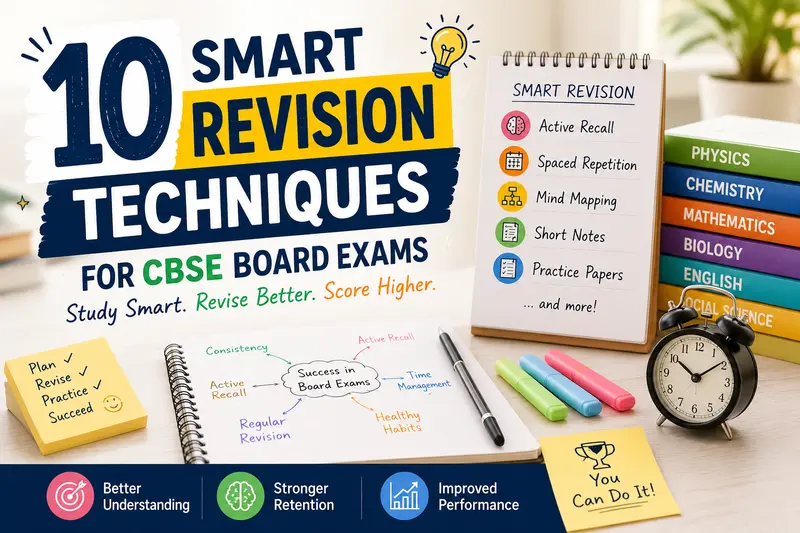
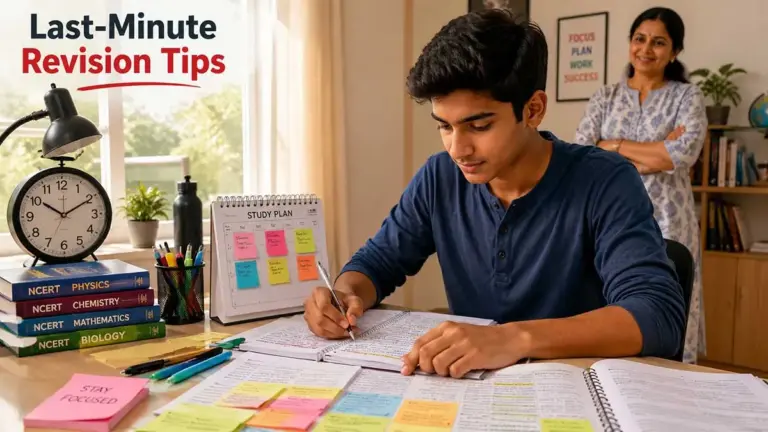
A parent’s guide to smart, stress-free exam revision
Okay, let’s be honest — the week before an exam has a very particular energy to it, doesn’t it? Half excitement, half low-grade panic. If you’ve got a child staring at a stack of textbooks right now, wondering out loud whether they’ve “done enough,” you already know exactly what I mean.
Here’s the thing I’ve learned, though, both as a parent and from talking to teachers who’ve seen thousands of students go through this exact moment: those last few days before an exam aren’t wasted time. They can genuinely move the needle — but only if they’re used the right way.
So many kids fall into the same trap. They try to cram in a brand-new chapter they never got to, or they sit and reread the textbook for the fifth time, hoping something sticks. And honestly? It rarely does. It just makes everyone more anxious for very little payoff. The students who actually walk into the exam hall calm and ready aren’t the ones who studied the hardest in those last days — they’re the ones who revised the smartest.
Whether your child is prepping for CBSE Boards, a school test, or a competitive entrance exam, the revision techniques in this piece can genuinely help — better recall, steadier nerves, and a lot less of that exam-week dread.
I’m going to walk you through the strategies that actually hold up, backed by how memory and learning really work — how to build a revision schedule that doesn’t collapse by day two, the mistakes worth dodging, and how to make every hour before the exam count.
Why Last-Minute Revision Actually Matters
Here’s something worth saying out loud: revision isn’t just “reading your notes again.” It’s the process that locks information into long-term memory, shows you exactly where the gaps are, and trains your brain to pull up answers quickly when it counts.
Done well, revision helps kids:
- Remember things better, for longer
- Walk in with more confidence
- Worry less
- Spot the gaps before the exam does
- Get comfortable answering within a time limit
- Make fewer careless mistakes
And here’s the mindset shift that matters most: revision isn’t about covering every single page equally. It’s about figuring out what actually deserves the time.
For more proven learning methods, take a look at Scientifically Proven Study Techniques.
Build a Revision Plan That Actually Makes Sense
If there’s one mistake I see over and over, it’s studying at random — just picking up whatever book is closest. A simple plan fixes this almost instantly, and it makes sure nothing important gets skipped by accident.
Step 1: Write Down Every Subject
Just list them all out. For most CBSE students, that’s something like:
- Mathematics
- Science
- English
- Social Science
- Hindi
- Computer Science
Then break each one down into its chapters.
Step 2: Sort Chapters by Priority
Not every chapter deserves equal time — and that’s actually good news. Sort them like this:
| Priority | What It Means | How Much Time to Give It |
| High | Frequently asked, tricky concepts | More time |
| Medium | Moderately important | A reasonable chunk |
| Low | Already feels solid | A quick pass |
This one step alone can save hours of wasted effort, because it points you straight at what will actually move the score.
If you’re after a more structured approach, Perfect Study Timetable for CBSE Students is worth a read too.
Active Recall Beats Rereading, Every Time
This is the one I wish more students believed sooner: actually trying to pull information out of your memory works far better than reading the same page five times over.
So instead of rereading a chapter yet again, close the book and ask:
- What are the key points here?
- Can I explain this without peeking?
- Can I actually solve a problem on this, unaided?
- Do I remember the formulas or definitions, or am I guessing?
What This Looks Like Subject by Subject
For Science — try drawing the diagram from memory, or explaining the process out loud like you’re teaching someone.
For Mathematics — solve a problem cold, without glancing at a worked example first.
For Social Science — try to recall the dates and events without any prompt.
For English — summarize a chapter in your own words, not the book’s.
It feels harder than rereading, and that’s exactly the point — that little bit of struggle is what makes the memory stick.
You might also like 10 Smart Study Techniques Every Student Should Know.
Practice Previous Years’ Papers
If your child only has time for one thing, honestly, make it this. Solving previous years’ papers is one of the fastest ways to get genuinely exam-ready.
It helps with:
- Understanding how questions are usually framed
- Getting a feel for timing
- Spotting which topics keep showing up
- Building real confidence
- Taking the edge off exam fear
How to Actually Practice, Not Just Skim
- Set a timer — a real one.
- Attempt the whole paper without stopping to check the book.
- Mark your own answers honestly (this part matters more than people think).
- Notice which mistakes keep repeating.
- Go straight back and fix those weak spots.
Even two or three full papers solved properly before the exam can shift the outcome more than another week of passive reading would.
More preparation ideas live in the Exam Preparation section.
The 80/20 Rule for Revision
You may have heard of the Pareto Principle — the idea that a relatively small slice of your effort tends to drive most of the results. It applies beautifully here too.
To be clear, this isn’t permission to skip chapters. It just means being deliberate about identifying:
- The concepts that come up again and again
- High-weightage chapters
- Key formulas
- Core definitions
- Diagrams
- Maps
- Case-based questions
Give these the lion’s share of your time, and let the topics you’ve already nailed get a lighter, quicker pass.
Build a Quick Revision Notebook
Rather than flipping between five textbooks the night before, it helps enormously to have one compact notebook that has everything condensed in one place.
Worth including:
- Important formulas
- Key definitions
- Dates
- Diagrams
- Chemical equations
- Grammar rules
- Vocabulary
- Maps
- Flowcharts
- The concepts you always seem to forget
Ask any topper and you’ll often hear the same thing — on the last day, this little notebook is basically all they touch.
Study in Short, Focused Bursts
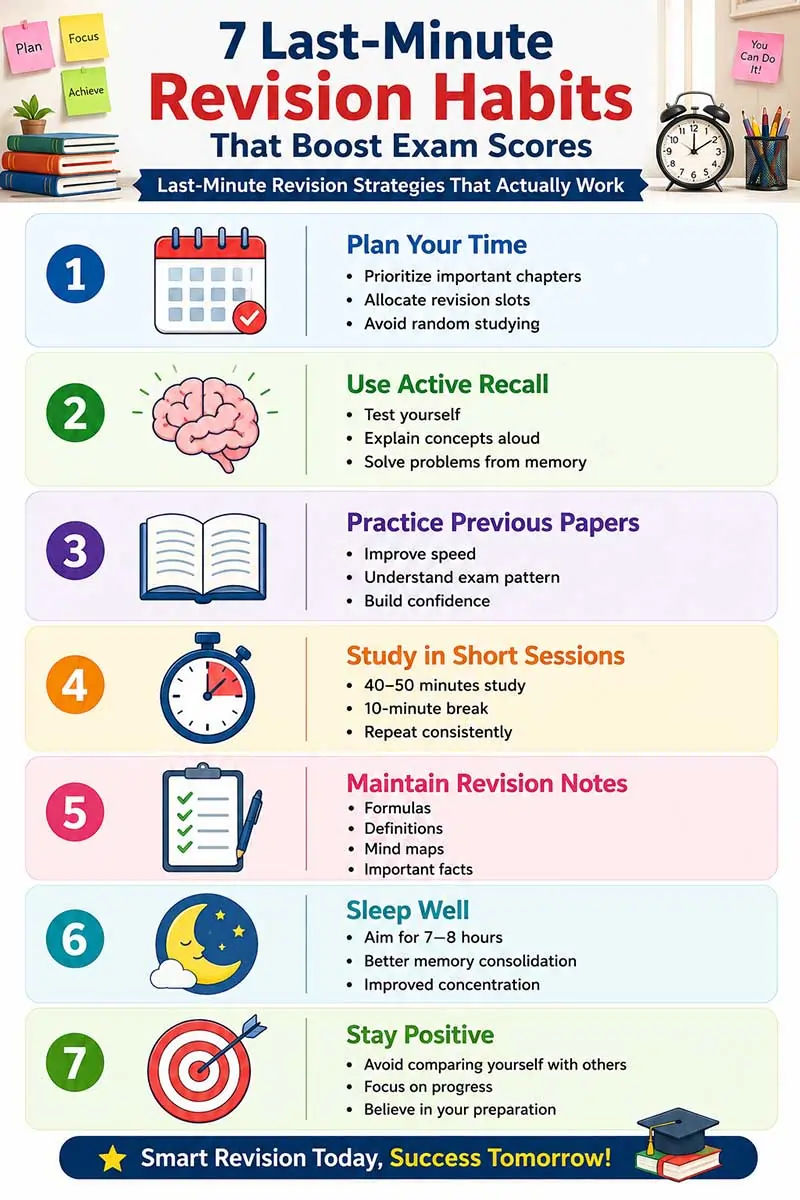
Marathon study sessions sound productive, but they’re usually where concentration quietly falls apart. Shorter, focused sessions almost always win out.
A simple rhythm that works for most students:
| Study Duration | Break |
| 45–50 minutes | 10 minutes |
| 90 minutes | 15–20 minutes |
And during those breaks, encourage your child to actually step away — stretch, drink some water, walk around, rest their eyes. The one thing to watch for? Endless scrolling. It feels like rest, but it rarely leaves the brain any more refreshed.
Curious about building this into a longer-term habit? Daily Study Routine for Students digs into that.
Give Weak Areas Attention Too — Not Just the Favorites
It’s completely natural to gravitate toward the subjects that feel comfortable and avoid the ones that don’t. But that comfort has a cost — it leaves real gaps sitting untouched right before the exam.
For the tougher areas
Difficult concepts, the mistakes that keep repeating, the lower-scoring chapters. These deserve real time.
For the strong areas
A quick revision pass, a formula check, maybe a few practice questions. No need to overdo it.
So if Algebra feels shaky but Geometry feels solid, that’s exactly where the extra hour should go — into Algebra, with just a light touch-up on Geometry.
It’s a small shift in mindset, but it makes preparation feel a lot more even across the board.
Don’t Skip the Basics: Sleep, Food, and Water
No revision strategy in the world makes up for a tired, under-fed brain. And this is the part parents can influence the most, honestly.
Sleep Matters More Than an Extra Hour of Studying
Aim for 7–8 hours of real sleep, especially in that final week. Sleep is when the brain actually files away everything it’s learned — it’s not wasted time, it’s part of the studying.
Staying up all night before the exam almost always backfires. A rested, alert mind will outperform a tired one that “covered more,” every single time.
Food That Actually Helps
Simple, steady-energy meals go a long way:
- Fresh fruit
- Dry fruits and nuts
- Whole grains
- Milk or yogurt
- Eggs or other protein-rich food
- Green leafy vegetables
Try to keep the sugary snacks and energy drinks to a minimum — they spike energy and then crash it right back down, which is the last thing you want mid-revision.
And water. Just… keep a bottle nearby and actually drink from it.
More on this here: Healthy Habits That Improve Concentration While Studying.
Let Technology Help — Without Letting It Take Over
Used well, technology can genuinely make revision faster and more effective. Educational apps, quick quizzes, digital flashcards, even AI tools — they all have a place here.
The key word is “support.” Not replace, not distract.
A few productive ways to use it:
- Short concept videos when something isn’t clicking
- Quick online quizzes to test recall
- Digital flashcards for quick review
- A timer app to keep sessions focused
- Reviewing digital notes on the go
If AI tools are part of the mix, it’s worth double-checking anything important against the textbook or a teacher — a good habit, not a suspicion.
Related read: How Students Can Safely Use AI Tools for Learning.
And don’t forget the NCERT website has genuinely useful free resources too: https://ncert.nic.in/
Common Mistakes Worth Avoiding
Even well-prepared students trip up sometimes, and usually it’s for one of these reasons:
| Mistake | What to Do Instead |
| Starting a brand-new chapter at the last minute | Stick to revising what’s already been studied |
| Studying non-stop with no breaks | Build in short, regular breaks |
| Avoiding the weak subjects | Give the tough topics more time, not less |
| Memorizing without understanding | Focus on concepts and active recall |
| Comparing progress with friends | Track your own progress instead |
| Pulling an all-nighter | Sleep properly before the exam |
| Too much phone time | Keep tech use purposeful and limited |
For Parents: Support Without the Pressure
This part is really for us, honestly. The days before an exam should feel encouraging, not tense — and the way we show up matters more than we sometimes realize.
A few things that genuinely help:
- A quiet space to study in
- Gently encouraging breaks, not just study time
- Healthy, simple meals
- Appreciating the effort, not just the marks
- Steering clear of comparisons with other kids
- Helping keep the routine calm and steady
More often than not, a little warmth and reassurance does more for a child’s confidence than another reminder to “study harder.”
If this is useful, there’s more here: How Parents Can Help Children Study Without Pressure
For Teachers: Small Shifts That Make Revision Count
Teachers have a real chance here too — not by introducing new material at the eleventh hour, but by helping students focus on what matters most.
Some approaches that tend to work well in the final days:
- Quick, rapid-fire quizzes
- Going over frequently asked questions
- Talking through common mistakes openly
- Doubt-clearing sessions
- Encouraging peer discussion
- Sharing short, focused revision notes
A calm, encouraging classroom in these last days can do wonders for how confident students feel walking in.
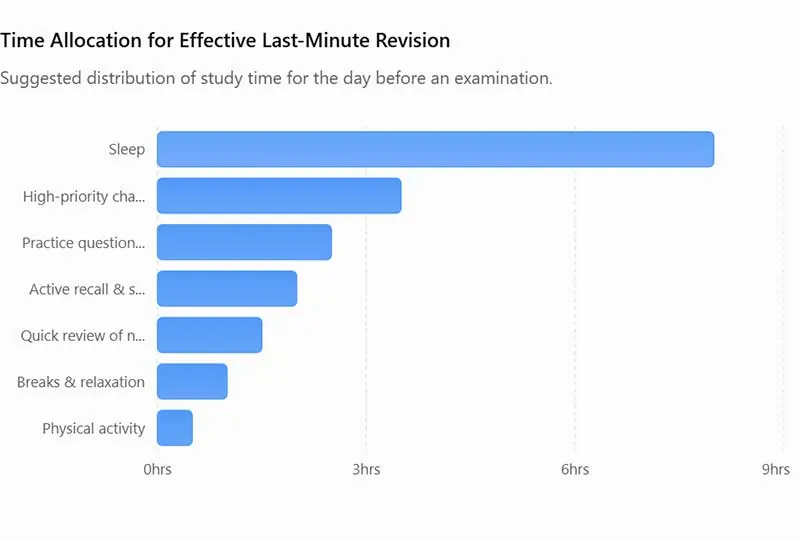
A Sample One-Day Revision Plan
The day before the exam should feel like steady revision — not last-minute panic.
| Time | Activity |
| 7:00–8:00 AM | Revise key formulas, definitions, and core concepts |
| 8:00–8:30 AM | Breakfast and a short break |
| 8:30–10:30 AM | Revise high-priority chapters |
| 10:30–11:00 AM | Break, maybe a short walk |
| 11:00 AM–1:00 PM | Solve important questions or a sample paper |
| 1:00–2:00 PM | Lunch and some downtime |
| 2:00–4:00 PM | Revise the weaker topics |
| 4:00–5:00 PM | A walk or some light activity |
| 5:00–7:00 PM | Go through the revision notebook |
| After Dinner | Relax, get the exam kit ready, and sleep early |
Printable PDF Resources
Last-Minute Revision Checklist
Purpose
To help students systematically complete their final revision before the examination.
Sections Included
- Subject-wise checklist
- Important chapters
- Formula review
- Diagrams completed
- Previous papers solved
- Doubts clarified
- Exam kit prepared
- Sleep tracker
- Water intake tracker
- Confidence rating
⬇️ Download Printable File: Last-Minute Revision Checklist
Exam Readiness Self-Assessment Worksheet
Purpose
To help students evaluate their preparedness one day before the examination.
Sections Included
- Topics revised
- Strong areas
- Weak areas
- Time management rating
- Confidence level
- Stress level
- Questions to revise
- Goals for exam day
⬇️ Download Printable File: Exam Readiness Self-Assessment Worksheet
Key Takeaways
- Build a realistic plan rather than studying randomly
- Give the tough, high-weightage chapters real priority
- Lean on active recall over passive rereading
- Solve previous years’ papers to sharpen speed and accuracy
- Keep a concise notebook for quick, final review
- Study in short bursts with proper breaks
- Sleep enough, eat well, stay hydrated
- Skip the comparisons — track your own progress instead
- Parents and teachers can make a real difference just by staying encouraging
- Steady, smart revision always beats last-minute cramming
A Few Questions Parents Often Ask
How many hours should my child study in the final week?
Honestly, it’s less about hours and more about how focused those hours are. Most students do well with 6–8 hours of genuinely focused revision, paired with proper breaks and sleep.
Should they start a new chapter the day before the exam?
Best avoided. That final day is really for revisiting what’s already been studied — new material this late tends to add confusion, not confidence.
What’s the single most effective revision technique?
Active recall, spaced revision, and solving past papers — these three consistently come out on top in the research.
How can formulas actually stick?
Keep them in a separate notebook, go over them daily, and — this is the key part — practice applying them to different problems rather than just memorizing them in isolation.
Is it worth revising late into the night?
Sleeping early and waking up refreshed almost always wins. Good sleep does more for memory and focus than those extra tired hours ever could.
Can parents actually help during this stretch?
Absolutely — mostly through emotional support, a calm home, healthy routines, and resisting the urge to add pressure.
Are online tools actually worth using?
Yes, when used sensibly. Quizzes, videos, and AI tools can complement textbook study nicely — they just shouldn’t replace it.
In Closing
Last-minute revision was never about relearning everything — it’s about revising with intention. A solid plan, active recall, a few practice papers, a tidy notebook, and some basic self-care can shift both confidence and performance more than most people expect.
And here’s the thing worth remembering: how well you revise matters just as much as how much you study. Focus on understanding, work on the weak spots, and hold onto a steady, positive mindset. Trust the preparation that’s already been done, and keep showing up for it, one session at a time.
Every bit of revision is one step closer to walking into that exam hall calm, ready, and quietly confident.

Learning Support Team shares guidance on safe online learning, educational technology, and effective digital study practices.