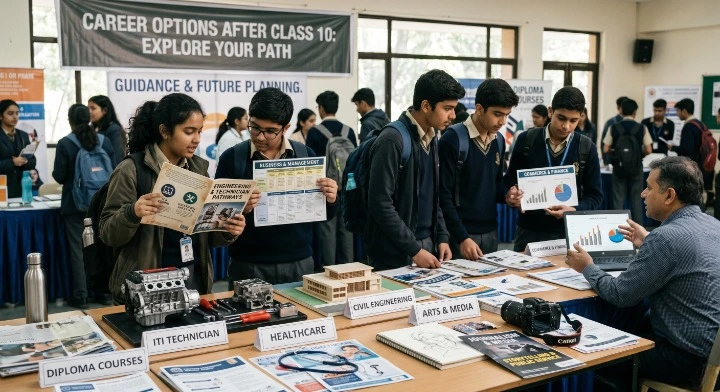

If you’ve just finished Class 10, or you’re the parent of someone who has, you already know the feeling — that slightly nervous, slightly exciting sense that a real decision is suddenly staring you in the face. What stream should I pick? What if I choose wrong? It can feel like the whole future hinges on this one choice.
Here’s the good news: it doesn’t. Not the way it might seem right now. Gone are the days when your only real options were science, commerce, or arts and nothing else. Today’s students can walk into diploma programs, skill certifications, vocational training, or even start building a business while they’re still teenagers. There are more doors open than ever before.
This guide is for anyone trying to make sense of it all — students weighing their options, parents wanting to help without hovering, or teachers looking for a way to explain the landscape clearly. We’ll walk through what’s out there, how to think about choosing a stream, where the newer, less obvious opportunities are, and some practical ways to approach the decision without the stress.
Why This Decision Matters (But Won’t Define You Forever)
Let’s be honest — what you choose after Class 10 does shape the next few years: which subjects you study, which doors open first, which exams become relevant. That part is real.
But it’s worth saying clearly: this is not a life sentence. Plenty of people you’d consider successful today took a winding path to get there — they switched streams, picked up a certification later, went back to studying something completely different after working for a few years. A decision made at fifteen or sixteen doesn’t have to be the final word.
What a good choice at this stage really does is simpler than it sounds. It helps you:
- Feel more confident about the road ahead
- Stay genuinely motivated instead of just going through the motions
- Study subjects you actually enjoy
- Prepare properly for competitive exams, if that’s the path
- Start shaping longer-term goals, even loosely
If you’d like to go deeper, our Career Guidance section has more resources worth a look.
Before You Choose: A Few Things Worth Sitting With
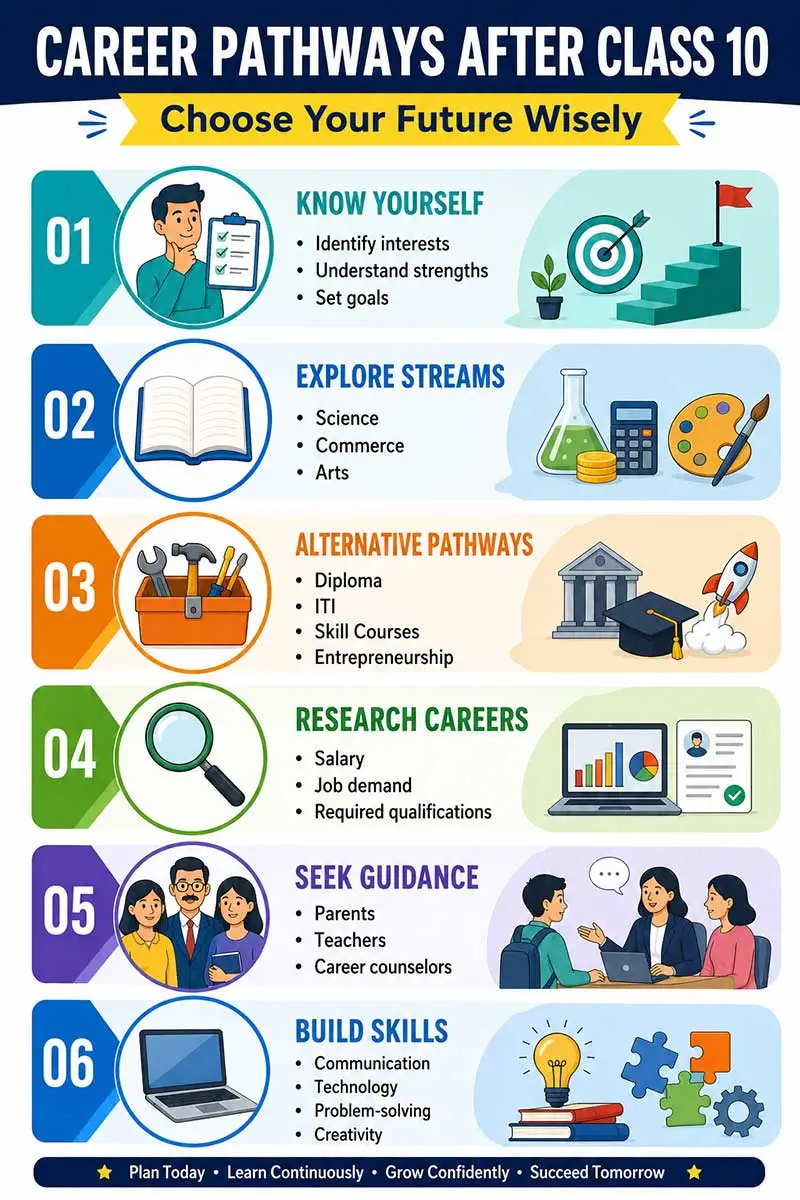
It’s tempting to just ask a friend what they’re doing and follow along. Don’t. Their strengths, interests, and family situation are different from yours. Instead, take a few quiet minutes and think through these five things.
1. What Actually Interests You
Not what sounds impressive — what genuinely pulls your attention. Ask yourself:
- Which subjects do I actually look forward to?
- What kind of activities make time disappear for me?
- Do I like solving problems, making things, helping people, or tinkering with technology?
2. What You’re Naturally Good At
Everyone has a mix of strengths. Try to be honest about where yours lie:
- Analytical thinking
- Creativity
- Communication
- Leadership
- Technical, hands-on ability
3. Where You See Yourself Down the Road
This one’s harder, especially at fifteen. But even a rough sense of where you’d like to be in ten or fifteen years can help narrow things down.
4. Your Personality
Different personalities tend to thrive in different kinds of careers. It’s not a strict rule, but it’s a useful starting point:
| Personality | Careers That Often Fit |
| Analytical | Engineer, Data Scientist |
| Creative | Designer, Writer, Animator |
| Social | Teacher, Lawyer, HR |
| Practical | Technician, Electrician |
| Entrepreneurial | Business Owner, Startup Founder |
5. Where the Future Is Heading
It’s worth spending a little time looking at which industries are expected to grow over the next decade — not to chase trends blindly, but so you’re not walking in blind either.
The National Career Service Portal is a genuinely useful place to start.
The Major Paths Open to You After Class 10
Option 1: Science Stream
Science tends to suit students who are curious about how things work — maths, biology, technology, research. It’s a broad stream, and it keeps a lot of doors open.
Common career paths include:
- Engineering
- Medicine
- Pharmacy
- Artificial Intelligence
- Robotics
- Biotechnology
- Data Science
- Architecture
What’s good about it
- Wide range of career opportunities
- Flexibility to pivot into other fields later
- Natural fit for competitive exams like JEE and NEET
What’s tough about it
- Demands strong analytical thinking
- The academic workload is genuinely heavier
Option 2: Commerce Stream
If business, money, and how the economy works genuinely interest you, commerce is worth serious consideration.
Career opportunities include:
- Chartered Accountant (CA)
- Company Secretary (CS)
- Banking
- Finance
- Business Management
- Entrepreneurship
- Digital Marketing
What’s good about it
- Strong earning potential
- Naturally business-oriented career paths
- Growing demand across financial sectors
Option 3: Arts (Humanities)
Arts used to get dismissed as the “easy” stream, but that reputation hasn’t kept up with reality. It’s actually become one of the fastest-growing paths out there.
Career options include:
- Civil Services
- Journalism
- Psychology
- Law
- Sociology
- Political Science
- Design
- Teaching
What’s good about it
- A genuinely diverse set of career options
- A natural home for creative, curious thinkers
- Solid foundation if UPSC is on your radar
Option 4: Diploma Courses
Not every student wants to sit through two more years of a traditional stream before specializing. Diploma programs let you jump straight into a technical field — mechanical, civil, computer, electrical engineering, fashion design, interior design, and more.
The appeal here is practical: diplomas focus on industry-ready skills and can get you into the workforce sooner than the traditional degree route.
Option 5: ITI (Industrial Training Institute)
ITI programs are built for one thing — getting you job-ready in a specific technical trade, fast. Think electrician, fitter, welder, plumber, mechanic, or computer operator.
These courses usually wrap up in one to two years, and they open real doors in both government and private-sector jobs.
Option 6: Skill Development Courses
More and more students are stacking a certification or two alongside their regular schooling or diploma — and it’s a smart move. Popular ones right now include graphic design, web development, coding, artificial intelligence, video editing, animation, digital marketing, and cybersecurity.
If AI tools are part of that picture for you, it’s worth reading this guide on using AI tools safely for learning first.
Option 7: Entrepreneurship
A growing number of young people aren’t waiting for a degree to start building something of their own — YouTube channels, apps, online tutoring, handmade product businesses, freelancing, e-commerce stores. It’s not an easy road, and it takes real discipline and a willingness to keep learning, but it’s a legitimate path in its own right.
How the Paths Compare
| Career Path | Duration | Higher Education Needed | Job Opportunities |
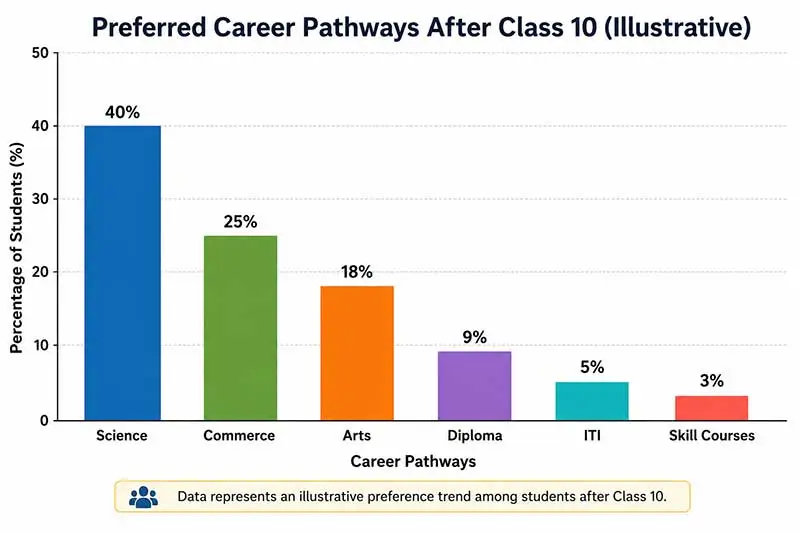
| Science | 2 Years + Degree | Yes | Very High |
| Commerce | 2 Years + Degree | Yes | High |
| Arts | 2 Years + Degree | Yes | High |
| Diploma | 3 Years | Optional | High |
| ITI | 1–2 Years | Optional | High |
| Skill Courses | Few Months | Optional | Growing |
| Entrepreneurship | Flexible | No | Unlimited |
How Parents Can Help — Without Adding Pressure
If you’re a parent reading this, your role matters more than you might think, and it’s simpler than it feels. Mostly, it comes down to being present without pushing.
- Listen without jumping to judgment.
- Encourage your child to explore, even if it takes a while.
- Resist comparing them to siblings, cousins, or the neighbor’s kid.
- Arrange a career counseling session if they seem stuck.
- Help them actually research professions, rather than just naming them.
A couple of related reads that might help:
Mistakes Worth Avoiding
- Picking a stream just because your friends did
- Giving in to social pressure instead of your own judgment
- Brushing aside what you’re actually interested in
- Buying into the myth that some streams are “good” and others “bad”
- Deciding without doing any real research
- Overlooking what skills the future will actually demand

A Simple Step-by-Step Way to Plan This Out
| Step | Action |
| 1 | Identify your interests |
| 2 | Evaluate your strengths |
| 3 | Explore the career options available |
| 4 | Research where future demand is heading |
| 5 | Talk it through with parents and teachers |
| 6 | Meet with a career counselor |
| 7 | Make your decision, and make it confidently |
A few more resources that pair well with this planning process:
- How to Create a Perfect Study Timetable for CBSE Students
- How to Use a Study Planner Effectively for Better Time Management
- Study Tips
Trusted Sources Worth Bookmarking
Printable Resource: Career Planning Worksheet
A simple worksheet to help students work through their thinking on paper — covering personal interests, favorite subjects, a strengths assessment, career research notes, long-term goals, and an action plan.
⬇️ Download Printable PDF – Career Planning Worksheet
Printable Resource: Career Decision Checklist
A companion checklist to help students actually finalize their post-Class 10 path — stream comparison, career goals, college research, entrance exams required, skill development goals, and questions worth asking a career counselor.
⬇️ Download Printable PDF – Career Decision Checklist
The Main Things to Remember
- Class 10 is the start of a journey, not the whole map.
- Choose a stream based on your interests, strengths, and goals — not someone else’s.
- Science, Commerce, Arts, Diploma, ITI, Skill Courses, and Entrepreneurship are all legitimate paths.
- Do the research before you decide, not after.
- Parents and teachers do best when they guide rather than pressure.
- Whatever path you take, keep building communication, digital, and problem-solving skills — they matter everywhere.
Frequently Asked Questions
Which stream offers the best career opportunities after Class 10?
There isn’t one “best” stream for everyone. It really depends on your interests, abilities, and where you want to end up. Science, Commerce, and Arts each open up excellent opportunities in their own way.
Can I change my career later if I choose the wrong stream?
Yes, absolutely. Plenty of students shift their academic or career direction later through higher education, certifications, or skill-based courses.
Is Commerce easier than Science?
Not really — they’re just different kinds of hard. Commerce asks for strong analytical and financial thinking, while Science leans on maths and scientific concepts.
Are diploma courses a good option after Class 10?
Yes. They offer practical, industry-focused training and can lead to early employment or a smoother path into further education.
What’s the difference between ITI and diploma courses?
ITI focuses on specific technical trades and usually takes one to two years. Diploma courses are broader and typically take three years, often leading into engineering degrees.
Should parents decide the stream for their child?
Parents should guide and support, not decide unilaterally based on their own preferences. Students tend to do better long-term when their own interests and strengths are part of the decision.
Are skill-based courses useful while studying?
Yes. Skills like coding, communication, digital marketing, and graphic design can genuinely boost employability alongside formal education.
Wrapping Up
Choosing a path after Class 10 is a big moment, but it doesn’t have to be a stressful one. A little honest self-reflection, some real research, and support from parents, teachers, and career counselors go a long way. And remember — learning doesn’t stop after you pick a stream. Staying curious, staying flexible, and continuing to build new skills matter just as much as whatever path you choose today. Make the most informed decision you can, and trust that it’s a strong foundation for what comes next.

The Career Awareness Desk publishes informative articles to help students explore career paths, future opportunities, and skill development.