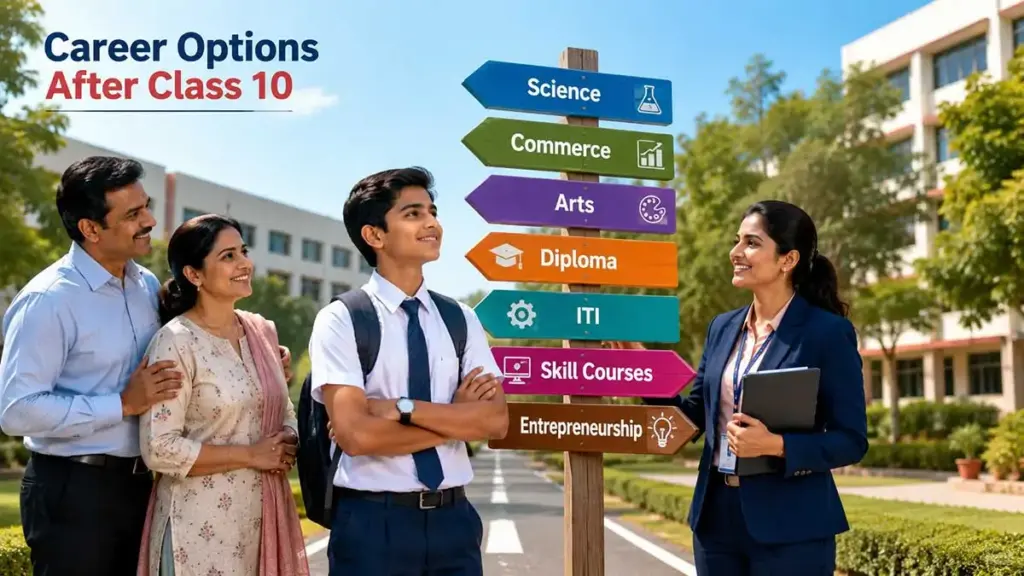
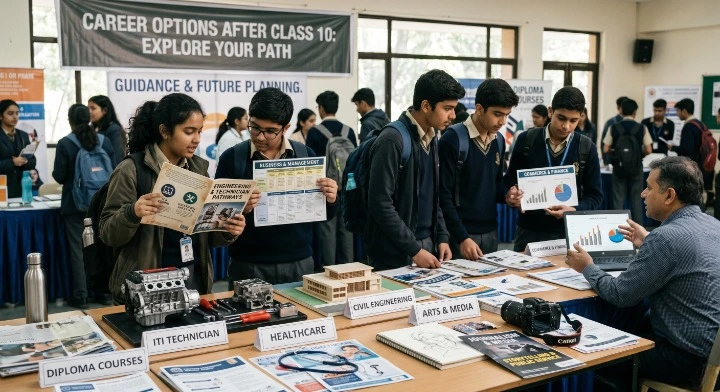
Finishing Class 10 is a major milestone – but it also opens up a flood of questions for most people. Which stream shall I take? What career should I choose? Is this the appropriate thing to do?
The good news is that there is no one “right” way. There are more professional alternatives post 10th than ever before and knowing them will allow students to make decisions they will feel confident about, not just those that sound impressive at family gatherings.
This guide is designed to do just that—walk you through the major paths accessible, what they lead to, and how to think about picking intelligently.
Why Class 10 Is a Crucial Turning Point
In India after class 10 children usually go to class 11 and choose a stream Science, Commerce or Humanities/Arts. But many kids don’t know this isn’t the only choice. For some students, Diploma courses, vocational training and skill-based programs are equally viable and a far better fit.
This is the decision that will determine the next few years of your schooling. It’s not a life sentence to a career. People change careers all the time. But it gives you a direction to go for now. So it is worth working through carefully.
Stream Selection: The Most Common Way
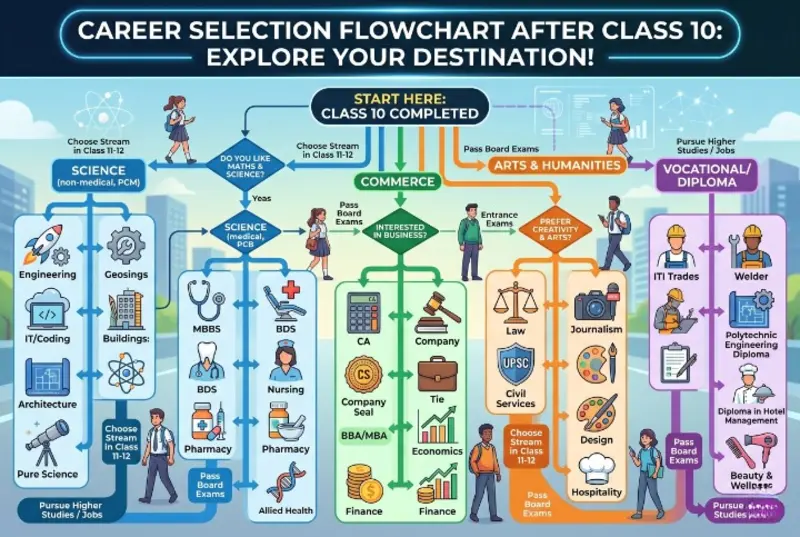
Science Stream (Physical Sciences)
Science is the most preferred subject for the students of class 10 and it leads to some of the most desired occupations in India.
Two primary combinations:
- PCM (Physics, Chemistry, Mathematics) – for engineering, architecture and technology streams.
- PCB (Physics, Chemistry, Biology) – for medical, pharmacy and life sciences
Where it could lead:
- Engineering (JEE – IIT, NIT, State Colleges)
- Medicine (MBBS, BDS, BAMS thru NEET)
- Architecture, Aerospace, Data Science · Research and academia
Science-who should choose? Students who genuinely enjoy problem-solving, are curious about how things work, and don’t mind rigorous study. Picking Science because of parental pressure — without real interest — often makes Class 11 and 12 unnecessarily stressful.
Commerce Stream
Commerce has played a very important role in the past ten years. India’s economy is rising and occupations in finance, business and management are at boom.
Main Subjects: Accountancy, Business Studies, Economics and sometimes Mathematics
Where it can take you:
- Chartered Accountancy (CA) – one of the most regarded professional credentials in India
- Company Secretary (CS) · MBA, Business Management
- Banking, Finance & Insurance
- Startup and Entrepreneurship
Commerce appeals to students interested in money, markets, business operations or economics and who seek a job that is practical and professionally structured.
Arts / Humanities Stream
Probably Humanities is the most underestimated stream in Indian schooling. It deals with a wide variety of disciplines – History, Geography, Political Science, Sociology, Psychology, Literature, Fine Arts and many more.
Where it can take you:
- Civil Services (IAS, IPS, IFS) – some of the most coveted occupations in India
- Law (LLB, BA LLB thru CLAT)
- Media Studies and Journalism
- Education & Teaching · Social Work, NGOs & Public Policy
- Design, Film, Literature & the Creative Arts
The concept of Humanities as a “backup” stream is antiquated. Arts is the background of many of India’s top government workers, attorneys, journalists and policy makers.
Vocational and Skill Based Career Options
Not all students thrive in a typical classroom atmosphere, and that’s just fine. India’s National Skills Qualification Framework (NSQF) and ITI programmes are good options.
Industrial Training Institutes (ITI)
ITIs provide practical trade training in the following areas:
- Electrician, Plumber, Welder, Mechanic Engineer
- Computer Hardware and Network
- Fashion Design and Textile Technology
Duration: 1-2 years. After completing an ITI course, students can get instantly placed in industries, apply for government technical employment or even go for a polytechnic diploma for higher studies.
Diploma Courses in Polytechnic
State polytechnic institutes offer three-year diploma programs in engineering fields including Civil, Mechanical, Electrical, and Computer Engineering. Students may: Upon completion of a diploma,
- Directly Transition to the Workforce
- Lateral admittance into second year of a B.Tech program
This approach is typically less costly and faster than a full engineering degree and is thus a smarter decision for many families.
New and Modern Career Paths to Consider
After 10th grade, your choices of career are not restricted to those that were there 20 years ago. There are some new areas that are growing fast and getting in early might be a significant advantage.
Careers in Digital and Technology
Jobs are exploding in areas like Artificial Intelligence, Cybersecurity, Web Development, and Data Analytics. Students who pick up coding and digital abilities early, even in Class 11-12, are in a good position for these vocations.
Design and the Creative Industries
Careers in UI/UX design, graphic design, animation, game design and film production are real jobs with good salaries. Institutes like NID (National Institute of Design) and NIFT (National Institute of Fashion Technology) have very tough entrance tests and generate graduates who are in great demand all over the world.
Health Care & Allied Sciences
Besides MBBS, there is a rising need for:
- Physical therapists
- Occupational Therapy
- Nutritionists and Dietitians
- Radiographers and Lab Technicians
These are respected health care jobs that don’t require the hard 10-year journey to become a doctor.
Hospitality, Tourism and Culinary Arts
India’s hospitality business is enormous. Hotel management institutes enroll students after Class 12 and train them to be career-ready for hotel operations, tourism management, travel agencies and culinary arts.
How To Truly Select The Right Path
Most guidance stops there, offering possibilities without letting kids actually pick. Here are some real, practical tips.
Begin with yourself, not external pressure. Ask yourself “What are topics that you really like?” What is it I do that makes me forget about time? These are real signals of your interest.
Talk to folks who are already doing those jobs. If you think you want to be an engineer, try to talk to an engineer. Ask them about their day-to-day, what they like about their work, and what’s hard. Priceless is this sort of reality check.
Don’t forget the strengths in “soft” subjects. Great writers or communicators or leaders, many students disregard those skills as “not career-worthy.” That’s an error. Many high-demand jobs are based on communication, leadership and innovation.
Be reasonable with family conditions. Financial realities should not be ignored. Choosing a 3-year diploma program because that makes more sense for your family situation is not a compromise, it’s a real and reasonable decision.
Leave the door open for course correction. Commerce is a popular subject with students who end up in technology. Many Science students go on to become journalists. What stream you take at 16 is significant but it’s not a life sentence.
Common Errors by Students and Parents
Awareness of these hazards can save you a lot of stress:
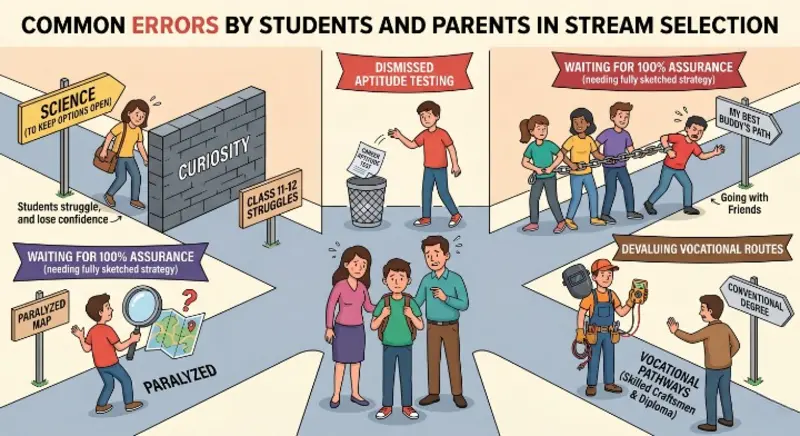
- Choosing Science “just to keep options open” – Science takes real curiosity. Without it, pupils tend to struggle in Class 11-12 and lose the confidence.
- Don’t dismiss aptitude testing – Basic career aptitude tests can tell you a lot. You can find them at plenty of schools and there are free versions online from reliable sites.
- Going into a stream with friends – What works for your best buddy might not work for you. Career pathways are individualized.
- Waiting for 100% assurance – Very few 15 year olds know exactly what they want to accomplish. You don’t need a fully sketched out career strategy – simply an honest, informed option for what to do next.
- Devaluing vocational pathways Skilled craftsmen and diploma holders are in demand and well paid These routes deserve as much respect as conventional degree routes.
A Quick Summary: Career Paths at a Glance
| Stream / Path | Key Subjects | Career Examples |
|---|---|---|
| Science (PCM) | Physics, Chemistry, Maths | Engineering, Architecture, Data Science |
| Science (PCB) | Physics, Chemistry, Biology | Medicine, Pharmacy, Biotechnology |
| Commerce | Accountancy, Economics, Business Studies | CA, Banking, MBA, Entrepreneurship |
| Humanities / Arts | History, Polity, Psychology, Literature | Civil Services, Law, Journalism, Design |
| ITI / Vocational | Trade Skills | Technician, Electrician, Mechanic |
| Polytechnic Diploma | Engineering Disciplines | Diploma Engineer, Lateral B.Tech Entry |
Final Takeaway
The years after Class 10 are genuinely exciting — even if they feel overwhelming right now. Every student you admire, every professional you look up to, was once standing exactly where you are: unsure, curious, and figuring it out.
The best thing you can do is gather good information, reflect honestly on your interests and strengths, talk to people you trust, and then make a thoughtful decision. You don’t need to be certain — you just need to be intentional.
Career options after 10th are more plentiful and more exciting than ever before. Whatever path you choose, commit to it with effort and curiosity — and it will take you somewhere worth going.
FAQs Frequently Asked Questions
Q1. What is the best stream to opt for after class 10?
There is no “best” stream for everyone. The proper stream relies on your interests, ability and professional ambitions. Science is good for students interested in science and medical. Commerce is wonderful for business and finance. Humanities opens the doors to law, civil services and creative fields. Before deciding, take a moment to consider what really interests you.
Q2. Can I shift my stream after Class 11?
This is doable but may be tricky as the syllabus varies greatly throughout streams. Some boards allow stream changes in the first few months of Class 11. If you think you have chosen an incorrect path, discuss it with your school counsellor or principal as soon as possible. Better prevention – spend the time to choose wisely in the first place.
Q3. Is it possible to choose Humanities beyond 10th?
Yes, I am. Humanities is a powerful and adaptable discipline and opens the doors to important vocations like IAS/IPS, law, journalism, psychology, design. It’s a fallacy that Humanities is a “lesser” stream. Arts and Humanities graduates are among of the most successful professionals in India.
Q4. What are the employment options after class 10 without Science?
There are great occupations awaiting students who can’t choose Science. Commerce leads to MBA, CA, banking and entrepreneurship. Humanities leads to law, civil services, media and social work field. Vocational training leading to ITI and polytechnic diplomas lead to rewarding technical careers. The possibilities are really broad.
Q5. At this age how do I determine which career suits me?
You don’t have to know your final career at 15 or 16. Instead, focus on finding your most powerful passions and themes. Career aptitude tests, talking to people who work in subjects you’re interested in and frank discussions with your mentors or school counsellors can all assist. Pick a direction – not a goal – and be open to learning along the way.

The Career Awareness Desk publishes informative articles to help students explore career paths, future opportunities, and skill development.