
| Quick Answer: How can parents support children during board exam preparation? Create a calm study space, help your child follow a realistic timetable, encourage regular revision, and protect their sleep, meals, and exercise. Open conversations, encouragement, sensible phone rules, and fair expectations will help them handle stress and feel confident going into their CBSE Class 10 or Class 12 exams. |
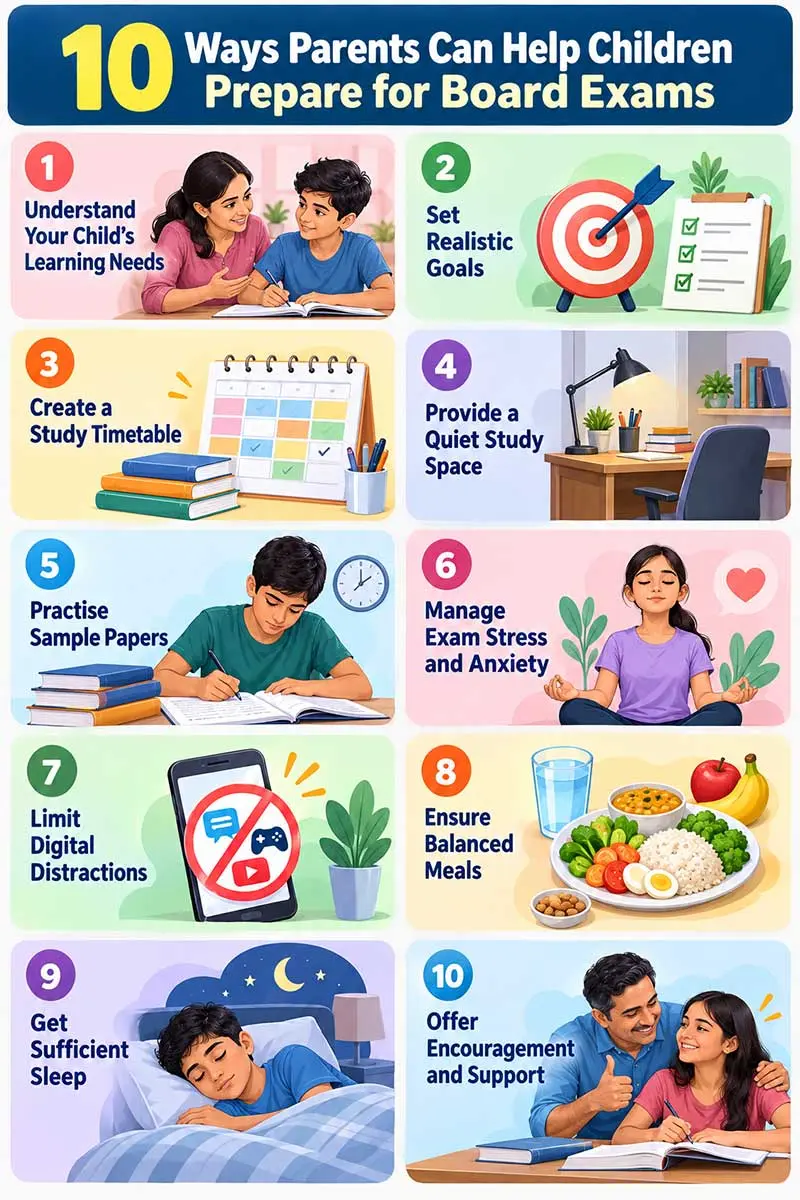
Start by Understanding Your Child
Board exams are a big moment for Indian families, with high hopes, career talk, and plenty of worry about marks.
But children don’t all react to pressure the same way. Some need help getting organised. Others know the syllabus well but struggle with nerves or self-belief.
Before introducing a strict schedule, sit down and talk. A few simple questions help:
- Which subject feels hardest right now?
- What can I do to make preparation easier?
Then really listen, without correcting or comparing. The aim is to understand what your child needs, not to squeeze in more study hours.
Matching your support to the challenge
| Your child’s challenge | How you can help |
| Trouble understanding concepts | Arrange teacher support or supervised practice. |
| Poor time management | Break the syllabus into smaller, manageable tasks. |
| Fear of exams | Listen patiently and introduce sample papers gradually. |
| Frequent distractions | Agree on study periods and device limits. |
| Low confidence | Notice effort, progress, and improvements in understanding. |
| Fatigue or irritability | Review the workload and protect sleep and downtime. |
If you’re looking for subject-specific material, explore the CBSE study resources and the learning materials available through NCERT.
Build a Timetable That Fits Real Life
A good timetable cuts confusion and balances revision, practice, and breaks. An unrealistic one only creates guilt. Plan around where your child actually is: their progress, exam dates, school hours, and energy levels.
Five steps to an effective schedule
- List what’s left. Sort each subject into done, partly understood, and not yet revised.
- Start with the tough chapters. Give them extra practice time.
- Set specific daily goals. Swap “study Science” for “revise chemical reactions and solve ten related questions.”
- Make room for revision. Reading a chapter once is rarely enough. Add written answers and sample papers.
- Check in each evening. Ten minutes to review the day and adjust tomorrow.
A sample daily timetable
Treat this as inspiration, not a rulebook.
| Time | Activity |
| 6:30–7:00 a.m. | Wake up, freshen up, and have breakfast |
| School hours | Attend classes and clarify doubts |
| 4:00–5:15 p.m. | Snack, short rest, then a challenging subject |
| 5:30–6:15 p.m. | Practise questions or numerical problems |
| 6:15–7:00 p.m. | Outdoor activity or physical movement |
| 7:00–7:45 p.m. | Revise another subject |
| 7:45–8:30 p.m. | Dinner and family time |
| 8:30–9:00 p.m. | Recall key concepts and prepare for tomorrow |
| By 10:00 p.m. | Wind down and go to bed |
Some children think best in the morning; others need rest after school. Consistency, focus, breaks, and sleep matter most. For more ideas, take a look at these study timetable strategies for students and adapt them to your child.
Download the printable weekly study planner
Create a Supportive Study Space
Children concentrate better in a comfortable, organised spot. A quiet corner works just as well as a separate room if distractions are low. A few things help:
- Good lighting, a comfortable chair, and a proper desk.
- Books and stationery within easy reach.
- Less noise and fewer errands during study time.
The mood at home matters too. If adults argue about marks or panic about exams, it’s hard for a student to stay calm.
Do you need to monitor every session?
No. Encourage your child to plan their work, tick off finished tasks, and speak up when they need help. Younger students may benefit from short check-ins, but step back as they grow more independent. You’re building self-discipline, not dependence on reminders.
Help With Revision Without Taking Over
You don’t have to be an expert in every subject. Your role is to help your child practise regularly, spot gaps, and find the right academic help.
Encourage active learning
Hours of reading can feel productive, but students also need to practise recalling and applying what they’ve learned:
- Active recall: close the book and explain the main ideas from memory.
- Spaced revision: revisit key concepts over several days instead of cramming.
- Written practice: solve questions and write answers within a time limit.
- Error analysis: review wrong answers and work out why they happened.
One easy way to help: ask your child to explain a concept to you. If it comes out muddled, help them find what to revisit rather than handing over the answer.
Use official sample papers and marking schemes
Sample papers show question formats, and marking schemes show how answers are evaluated. The CBSE Academic website has curriculum information and exam resources, while NCERT textbooks are on the NCERT website. Check that each paper matches your child’s class, subject, and session. Unofficial answer keys can contain errors.
When mock-test marks are low
A poor practice score is a chance to find weak spots, not a reason to criticise. Sort the mistakes into three groups:
- Conceptual errors: the topic isn’t fully understood.
- Careless errors: the concept is clear but the slip was avoidable.
- Time-management errors: the paper couldn’t be finished in time.
Download the mock test mistake analysis sheet
Pick one or two priorities for next week and celebrate progress there, not just the total score.
Manage Exam Stress and Anxiety
A little nervousness is normal and can even motivate. Too much interferes with concentration, sleep, and confidence. Help your child see that results matter, but they don’t define their intelligence, character, or future.
Signs your child may be overwhelmed
- Constant worry about failing or letting the family down.
- Trouble sleeping or frequent tiredness.
- Irritability, crying, or pulling away from family and friends.
- Repeated headaches or stomach aches around exams.
These don’t automatically mean a mental health condition, but if they persist or worsen, they deserve attention.
What helps
Keep conversations reassuring. Say, “Let’s work out which topics need attention first,” rather than, “You should have finished this by now.”
Shrink big tasks. Finishing one chapter brings back a sense of control.
Encourage short breaks. A brief walk or a few slow breaths can settle a restless mind.
Know when to get help. If anxiety affects daily life, talk to a qualified professional or the school counsellor.
| Important: If your child talks about harming themselves or says they can’t keep themselves safe, please seek urgent professional help right away. |
Encourage Healthy Technology Habits
Technology can help with recorded lessons, online practice, and doubt-clearing sessions, but notifications and games wreck concentration. Instead of banning devices, agree on a few clear rules:
- Keep phones off the study desk during focused sessions unless needed for learning.
- Turn off non-essential notifications.
- Decide when entertainment and social media are allowed.
- Keep devices out of the bedtime routine.
Follow the same rules yourself where you can. It’s easier for children to put the phone down when adults do too.
Download the family technology agreement
Online and printed materials: what to watch for
| Method | Best use | Watch out for |
| Textbooks and printed notes | Detailed reading and revision | Passive rereading without practice |
| Educational videos | Understanding tricky concepts | Watching without solving questions |
| Sample papers | Exam practice and time management | Repeating papers without analysing errors |
| AI study tools | Explaining concepts, generating practice questions | Wrong answers and over-dependence |
AI tools can help, but students should check important explanations against textbooks and teachers, and keep practising written answers on their own.
Look After Sleep, Food, and Movement
Studying longer at the cost of sleep, meals, and exercise usually backfires.
Why sleep matters
Sleep supports attention, memory, and emotional balance. Teenagers generally need around 8–10 hours a night. Keep sleep and wake times fairly regular, limit screens before bed, and plan revision early enough to avoid all-night cramming. If sleep problems continue, speak to a healthcare professional rather than assuming it’s only exam stress.
Balanced meals and regular movement
Your child doesn’t need expensive supplements or special “memory foods.” Regular, balanced meals and enough water matter more. Familiar foods like dal, rice, roti, vegetables, curd, eggs, and fruit work well. Try not to let breakfast get skipped or meals replaced by tea, coffee, energy drinks, or sugary snacks.
Movement helps too. A walk, cycling, or a game of badminton is a refreshing break. And remember: rest is part of preparation, not a reward for studying non-stop.
Talk Without Adding Pressure
How you speak during exam season shapes how your child experiences it. Even well-meant reminders feel like threats when repeated all day. Show interest in how they’re learning and feeling, not just marks.
| Instead of saying | Try saying |
| “Your friend has already finished the syllabus.” | “Let’s check your progress and decide what to prioritise.” |
| “You’re wasting your time.” | “Is something distracting you? How can we make study time easier?” |
| “You must score above 95%.” | “Let’s focus on understanding and doing your best.” |
| “You always make silly mistakes.” | “Let’s find the mistakes we can avoid next time.” |
| “You’ll ruin your future if you fail.” | “One exam doesn’t decide your whole future. Let’s prepare as well as we can.” |
Skip the comparisons
Comparing children with siblings, cousins, or classmates dents confidence without improving results. Compare them with their own earlier efforts instead: finishing a paper on time or recalling more without notes is real progress.
What if your child refuses to study?
Try not to label them lazy. Resistance often comes from tiredness, fear of failure, or a tough topic. You might:
- Ask what makes it hard to begin.
- Agree on one small, achievable task.
- Let them pick which subject to start with.
- Offer help without turning it into an argument.
If it continues, talk to teachers about what might be going on.

Printable Weekly Preparation Checklist
Print this and go through it with your child once a week. The point is independence, not policing.
Student: ____________________ Week: ____________________
☐ Reviewed the syllabus and chose weekly priorities
☐ Completed the planned study tasks
☐ Revised previously studied chapters
☐ Practised questions or a sample paper
☐ Reviewed mistakes and cleared doubts
☐ Balanced difficult subjects with easier ones
☐ Kept phone and social media distractions under control
☐ Kept up regular meals, water, and physical activity
☐ Got enough sleep on most nights
☐ Talked about challenges and progress with a parent or teacher
The one-minute parent check-in
At the end of each week, ask your child:
- What went well this week?
- Which topic was the most challenging?
- What would you like to do differently next week?
- Is there anything you need from me?
Keep it short and supportive. If a routine already works, don’t change it just because exams are closer.
Download the weekly check-in sheet
Key Takeaways
- Understand your child’s difficulties before changing their routine.
- Build a realistic timetable with revision, practice, breaks, and sleep.
- Encourage active recall, written practice, and learning from mistakes.
- Treat mock-test results as feedback, not a measure of your child’s worth.
- Support balanced meals, movement, and enough rest.
- Avoid comparisons, threats, unrealistic targets, and constant monitoring.
- Seek professional or school support if anxiety persists.
The most valuable thing you can give your child this season is a home where they feel safe asking questions, admitting mistakes, and working toward goals they can actually reach.
Frequently Asked Questions
1. How can I motivate my child to study for board exams?
Help them set small daily goals and acknowledge progress. Threats, comparisons, and constant criticism usually increase resistance rather than motivation.
2. How many hours should a Class 10 or Class 12 student study daily?
There’s no single right number. Focus on quality study, regular revision, breaks, and enough sleep rather than a rigid hourly target.
3. Should parents force children to follow a strict timetable?
Aim for structured but flexible. If a plan keeps failing, find the underlying problem and adjust it instead of adding stricter rules.
4. What should I do if my child scores low in a pre-board exam?
Stay calm and go through the paper together, looking for conceptual gaps, careless errors, and time problems. A pre-board score is useful feedback, not a prediction of the final result.
5. How can parents reduce board exam stress?
Listen without judging, keep expectations realistic, encourage breaks, and protect sleep. If stress becomes persistent, seek help from a qualified professional or school counsellor.
6. Should phones be completely banned during exam preparation?
Not necessarily. Phones are useful for videos, online tests, and doubt-clearing sessions. Agree on rules that limit entertainment and notifications during study time.
7. What should students eat during board exam preparation?
Offer regular, balanced meals with familiar foods like dal, roti, rice, curd, eggs, and vegetables. Encourage water and go easy on energy drinks and caffeine.
8. How much sleep does a teenager need during board exams?
Around 8–10 hours a night. Keep a consistent bedtime and avoid making late-night study a routine.
9. What if my child is afraid of failing?
Take the fear seriously and ask what exactly worries them. Talk through realistic preparation steps and remind them that exam results don’t define their whole future. If the fear becomes overwhelming, seek professional support.
10. Where can I find reliable resources for CBSE board exam preparation?
Visit the CBSE Academic website for curriculum and exam resources, the CBSE main website for official announcements, and the NCERT website for textbooks and learning materials. Always check the session and subject before using a resource.

Parent Guidance Corner provides supportive resources for parents helping children with education, learning habits, and academic wellbeing.