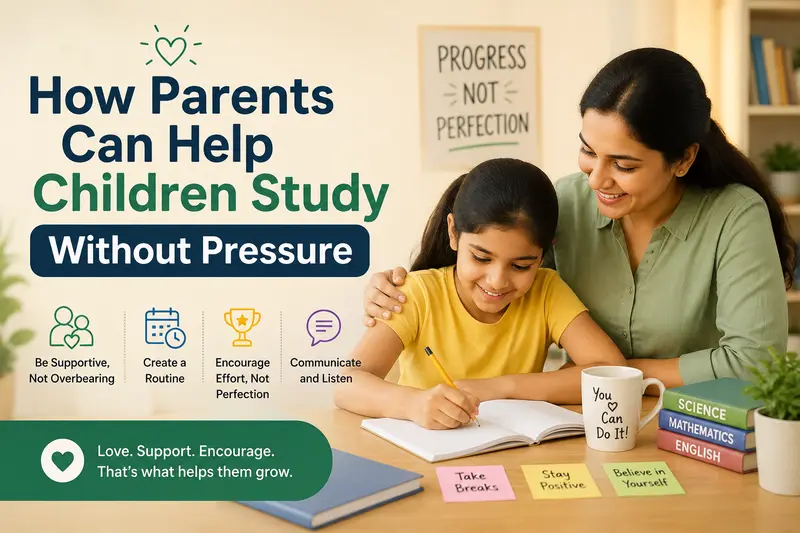
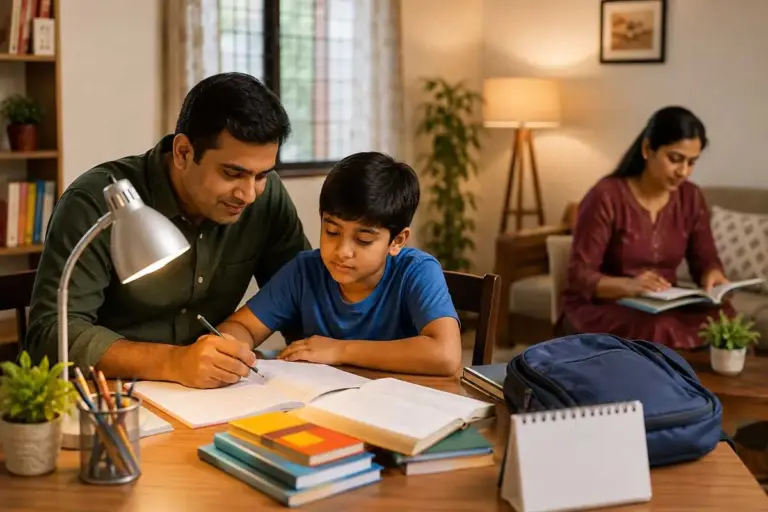
Every parent has had that moment — homework spread across the table, a child staring blankly at a maths problem, and the evening slowly turning tense. The good news is that a “positive learning environment” isn’t about buying a fancier desk or a stack of new reference books. It’s really about the everyday atmosphere at home: whether your child feels safe asking questions, comfortable making mistakes, and free to grow at their own pace.
What Does This Actually Mean?
Think of it less as a classroom and more as a mindset that runs through the house. Kids study better when curiosity is welcomed instead of every slip-up being met with criticism. For most Indian families, that means building a workable rhythm around school hours, tuition, extracurriculars, family duties and exam prep — not a rigid, picture-perfect schedule.
A home that supports learning usually has a few things in common: a reasonably quiet study corner, a predictable routine, easy access to books, realistic expectations, warm communication, decent sleep and food habits, sensible screen-time rules, some room for the child to make their own choices, regular breaks, and recognition for effort — not just marks.
None of this means turning your living room into a second school. It just means learning becomes a normal, low-stress part of daily life.
Why the Home Environment Matters So Much
Kids don’t only learn with a textbook open. Dinner-table conversations, bedtime stories, fixing something around the house, a museum visit, or even a video they saw online — all of it adds up. A child who feels safe saying “I don’t get this” will ask for help early. One who’s afraid of being judged will often hide the struggle until it snowballs.
This matters even more for students following demanding curricula like CBSE, where concepts get tougher every year. The National Education Policy 2020 itself pushes for holistic learning rather than reducing education to exam scores — and a calm home environment is where that philosophy actually gets lived out. It’s worth pairing that with practical routines; CBSE Guide’s piece on how parents can support children during exam season is a useful companion read here.
Done right, this kind of environment builds better study habits, confidence to ask questions, sharper communication and problem-solving skills, self-discipline, reading habits, and a genuine sense of ownership over one’s own learning.
Building a Study Space That Actually Works
You don’t need a spare room. A quiet corner of a bedroom or even the dining area works fine, as long as it’s used consistently.
Keep it simple. A table and comfortable chair, decent lighting, notebooks, basic stationery, the school timetable, a water bottle, and a simple planner are usually enough. If space is tight, a small box or shelf to keep everything together does the job.
Reduce distractions realistically. Complete silence isn’t realistic in most Indian households with several people living under one roof — so don’t aim for it. Instead of “everyone stay silent for two hours,” try something like “let’s keep the TV off between 6:30 and 7:30 while homework gets done.” Small, livable rules stick; extreme ones don’t.
Building a Routine That Doesn’t Cause Daily Arguments
A routine tells a child what’s coming next, and that alone cuts down a surprising amount of homework-related friction. Something like this works as a starting template: after-school snack and rest, some outdoor play, an hour of homework, a short break, then reading or revision, followed by family time and a wind-down before bed. Younger children need shorter stretches; older students prepping for boards may need longer, focused blocks. CBSE Guide’s article on effective study techniques for students goes deeper into structuring these blocks well.
The real goal is consistency, not a perfect timetable.
Use a short daily priority list instead of a long list of instructions — three or four items like “finish the maths worksheet,” “read two pages of science,” or “pack the school bag.” Once the essentials are done, let them enjoy free time. It also quietly teaches planning skills. If you want a ready-made structure for this, CBSE Guide has a CBSE study planner for students worth trying.
What to Say When Kids Struggle
Words matter more than we realise. “You always make silly mistakes” shuts a child down. “Let’s see where it went wrong — which step confused you?” opens things up.
When a low mark shows up, try curiosity instead of judgment: Which questions were hard? Did you run out of time? What should we practise again? That turns a disappointing result into something useful.
And resist the urge to hand over every answer. Ask “What have you tried so far?” or “Can you walk me through how you got that answer?” — it forces them to think aloud and spot their own gaps, which builds independence far better than a quick fix does.
Motivating Without Adding Pressure
Praise effort and strategy, not just intelligence. Instead of “you’re so smart,” try something specific: “you kept trying even though that problem was tough” or “you fixed that mistake on your own.” Specific feedback tells a child exactly what behaviour is worth repeating.
Skip the comparisons. “Look how well your cousin is doing” rarely motivates — it just teaches kids to link learning with competition. Comparing them to their own past performance works much better: “Last week this needed help; today you solved most of it yourself.” That’s real, visible progress.
Keep marks separate from self-worth. A test score reflects one day’s performance, not a child’s intelligence or future. The message that sticks is “we expect sincere effort, and we’ll help you improve” — not “you’re only valuable when you score high.” CBSE Guide’s article on how parents can help children study without pressure explores this balance in more detail.
Managing Technology Without a Full Ban
Screens aren’t the enemy — they bring educational videos, digital textbooks, practice platforms and research tools. The problem is unrestricted entertainment eating into study, sleep and family time. Banning screens altogether usually backfires; clear, shared expectations work better.
Sit down as a family and agree on a few ground rules: no entertainment screens during focused homework, phones kept away unless needed, devices charged outside the bedroom at night, and a clear line between educational and recreational screen use. Age-appropriate consistency matters more than strictness — and so does modelling it yourself. If you’re constantly on your phone during dinner, don’t expect a screen-time rule to land well. CBSE Guide’s online learning resources cover this trade-off in more depth if you’d like a fuller framework.
As children grow, shift from control to teaching judgment — talk about online privacy, spotting unreliable information, cyberbullying, safe searching, and protecting passwords. It’s a life skill, not just a house rule. This also increasingly includes AI tools — CBSE Guide’s piece on how CBSE students can use AI without replacing real study is a good starting point for that conversation.
Raising an Independent Learner
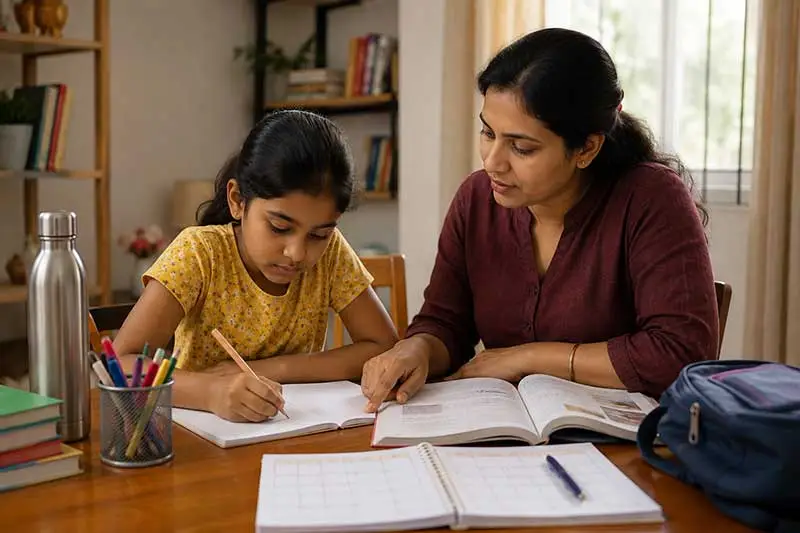
A useful progression looks like this: you demonstrate first (“let me show you”), then work through one together, then let them try the next one alone, and finally have them review their own work. This gradual handover builds real confidence over time.
Also teach kids how to ask for help — not just “I don’t know,” but something specific like “I understand this part, but not why we use this formula next.” That single shift makes it far easier for a teacher or parent to actually help.
Turning Everyday Life Into Learning
You don’t need worksheets for every lesson. Shopping trips can turn into maths practice — comparing prices, calculating discounts, counting change. Cooking or watching a plant grow becomes a science lesson. Reading the newspaper together or keeping a journal builds language skills. Talking about local history or how government works covers social science without anyone opening a textbook. These small moments quietly show kids that learning isn’t confined to school hours.
Mistakes Worth Avoiding
A few patterns tend to make home learning harder than it needs to be: turning every conversation into a study session, obsessing over marks alone, doing too much of the work for them, motivating through fear, building unrealistic schedules, ignoring sleep and physical activity, letting rules differ between parents, and finishing school projects yourself. None of these need to happen perfectly to be avoided — just noticed.
A Simple Weekly Checklist
- Comfortable, consistent study space
- School materials easy to find
- Predictable homework routine
- Adequate breaks
- Regular reading time
- Clear technology rules
- Calm conversations about difficulties
- Effort and improvement recognised
- Some independent work
- Protected sleep and physical activity
- Parents modelling healthy habits
You don’t have to tick every box at once — pick one or two to work on each week.
A One-Week Starting Challenge
Day 1: Organise the study corner. Day 2: Set a realistic after-school routine. Day 3: Talk for ten minutes about what your child enjoys learning. Day 4: Swap one criticism for specific encouragement. Day 5: Set one clear technology rule. Day 6: Turn an everyday task into a learning moment. Day 7: Ask your child what’s helping and what isn’t.
That last step matters most — kids should have a real voice in shaping the environment they’re expected to learn in.
Key Takeaways
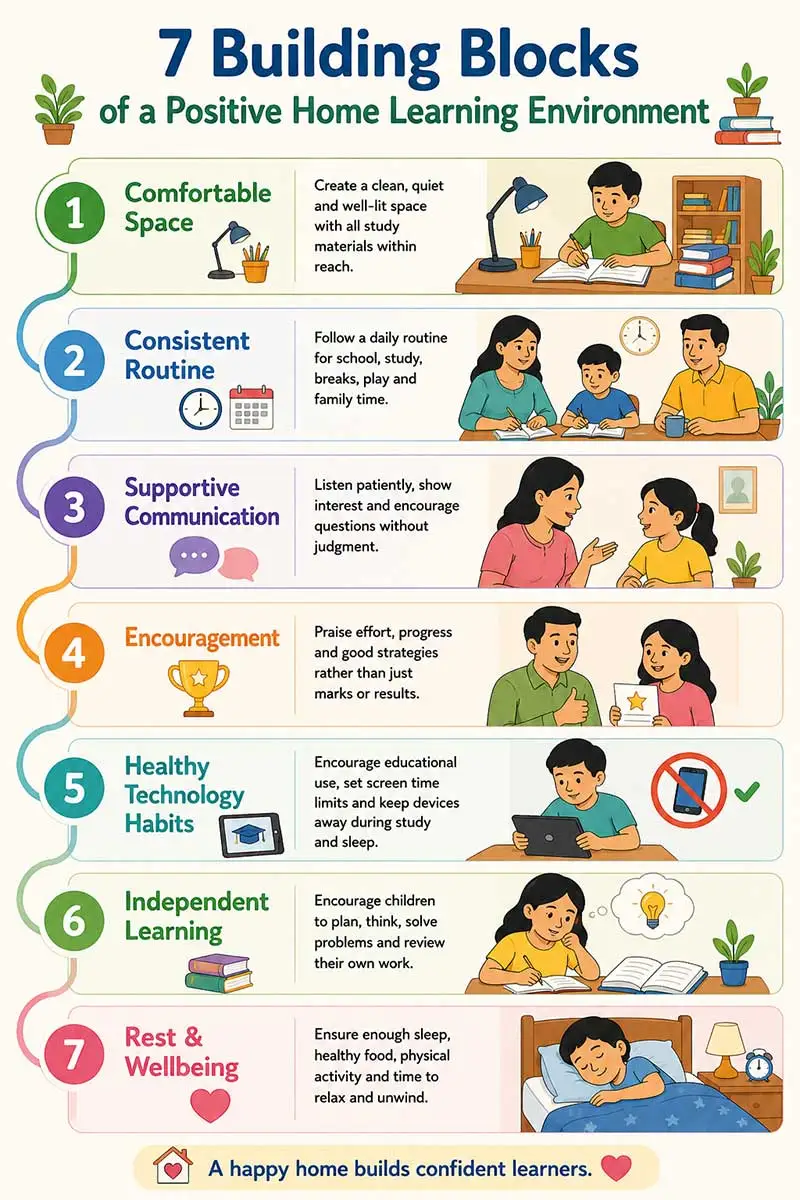
A positive learning environment is built on relationships and routines, not expensive resources. Children should feel safe questioning and making mistakes. Consistent routines cut down homework conflict. Praise effort over marks. Manage technology through clear, age-appropriate rules rather than bans. Everyday life offers real learning opportunities. Independence should be handed over gradually. Sleep, movement, play and family time all support learning. High expectations and emotional warmth can coexist — and the best home environment is one your family can realistically sustain, day after day.
Frequently Asked Questions
My home is small — can I still create a good learning space? Yes. A consistent corner with a table, decent lighting and organised materials works fine. Minimise the big distractions and keep the timing predictable.
Should I sit with my child while they study? It depends on age and confidence — younger children may need more supervision, older ones should be gradually trusted with independence. Stay available without hovering.
My child doesn’t want to study — now what? Find out why first — tiredness, confusion, or being overwhelmed all look different. Break tasks into smaller pieces, offer some choice, and notice real effort.
Should poor marks be punished? Punishment rarely fixes the actual problem. Review calmly, spot the difficulty, and build a specific plan — paired with support, not just consequences.
How much screen time is okay for studying? There’s no universal number. Separate educational use from recreational use, and make sure screens aren’t replacing sleep, movement or real conversation.
How do I raise an independent learner? Slowly pull back the help you give. Ask what they’ve already tried, point them to their notes, and let them check their own work before jumping in.
My child keeps making the same mistakes — why? Don’t label them careless. Look for the actual pattern — a misunderstood concept, rushing, or too little practice — and address that specifically.
Do family conversations really help academically? Yes — they build vocabulary, reasoning and the habit of explaining ideas out loud, which carries straight into schoolwork.
Should the routine be the same every single day? Consistency helps, but build in flexibility for exams, events and off days. A routine should support your child, not add stress.
Authoritative References
- National Education Policy 2020 — Ministry of Education, Government of India
- NCERT — National Council of Educational Research and Training
- CBSE — Central Board of Secondary Education

Parent Guidance Corner provides supportive resources for parents helping children with education, learning habits, and academic wellbeing.