

“Get off your phone and study” is one of the most common lines in homes with school-age children — and one of the least effective, because so much studying now genuinely happens on a screen too. Online classes, research, revision apps, and AI-assisted learning tools have blurred a line that used to be simple: screen on meant leisure, book open meant work. Managing screen time well today means managing which screen time, not just how much.
This guide focuses on practical, collaborative approaches rather than blanket restrictions. It pairs naturally with our guide on how parents can support children during exam season, since screen boundaries tend to matter most — and get hardest to manage — exactly when exam pressure is highest.
Why This Balance Is Harder Than It Used to Be
A generation ago, “screen time” meant television or gaming, and cutting it was straightforward. Now a single laptop might be running an online class, a revision app, a group project chat, and a video break, sometimes within the same hour. Treating all screen time as equally distracting misses genuinely useful study tools; treating all of it as equally productive misses genuine distraction. The goal isn’t less screen time as a number — it’s more intentional screen time.
Start by Separating “Study Screens” From “Leisure Screens”
Before setting any limits, it helps to map out what screen use in your household actually looks like: which apps and sites are genuinely tied to schoolwork, which are purely leisure, and which sit in a grey zone (educational YouTube channels, for instance, are useful but easy to drift away from). This mapping — done together with your child rather than decided for them — makes any later boundary feel based on real categories, not an arbitrary number of hours.
Set Boundaries Together, Not as a Rule Handed Down
Screen time rules that arrive as a unilateral decision tend to trigger resistance and quiet workarounds. Rules built together — where your child has genuine input on when leisure screen time happens and how much feels reasonable — are far more likely to actually hold, because there’s some ownership in them rather than just compliance. This doesn’t mean no boundaries; it means the boundaries are a shared agreement, not a decree.
Using Parental Control Tools Without It Becoming a Power Struggle
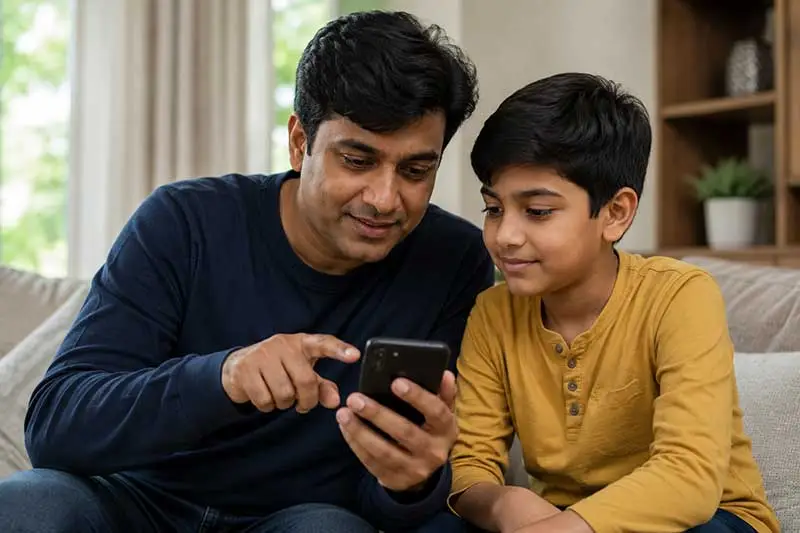
Built-in tools like Google Family Link or Apple’s Screen Time can help enforce agreed boundaries — app limits, downtime hours, content filters — without needing a paid third-party app. The key difference between these tools helping versus backfiring is whether your child knows they’re active and understands why. Used transparently, as an agreed-upon support rather than covert surveillance, they tend to reduce conflict; used secretly, they tend to increase it once discovered.
When Study Itself Requires a Screen
A growing share of genuine study time now happens on a screen — including AI-assisted tools that can tutor, explain, or check work. These are worth encouraging when used well, but worth watching too. Our guide on how students can safely use AI tools for learning is worth reading together with your child, since it covers exactly the line between an AI tool supporting learning and one quietly doing the thinking for them.
Model the Habits You Want to See
Children notice inconsistency quickly — a rule about phones at the dinner table that only applies to them, not the adults, rarely sticks. Modelling the behaviour you’re asking for, whether that’s putting your own phone away during a designated family time or narrating your own boundaries out loud (“I’m going to finish this call and then put my phone away for the evening”), does more to shape habits than any rule alone.
Screen Boundaries During Exam Season Specifically
Screen habits that work fine most of the year often need adjusting as exams approach — not necessarily stricter, but more deliberately structured around revision needs. Our guide to supporting children during exam season covers this transition in more detail; screen time is usually one small piece of a bigger seasonal adjustment, not something to overhaul in isolation.
If Screen Time Battles Are Adding to Your Child’s Stress
Sometimes screen conflict is really a symptom of something else — comparison with classmates online, pressure to keep up appearances on social media, or using screens to avoid a stress they haven’t named yet. Our guide on dealing with peer pressure and academic comparison looks at this from your child’s side, and is worth reading alongside this guide if screen time arguments seem to be about more than just the screen.
A Simple Family Screen Time Agreement

Putting an agreement in writing, filled in together rather than imposed, tends to reduce day-to-day arguments because both sides can point back to something they both agreed to. The American Academy of Pediatrics’ guidance on building a family media plan is a well-established starting framework if you’d like a more detailed version than the one included here.
Tracking Screen Time Patterns Together
Most built-in screen time tools already show weekly usage data, but a simple shared log — filled in together rather than surveilled from a dashboard — makes the data a conversation starter rather than evidence for an argument. Reviewing it together weekly, briefly and without judgement, works better than bringing it up only when a limit has clearly been broken.
Printable PDF Resources
1. Download: Family Screen Time Agreement
Purpose
A simple, fill-in-together template for agreeing on study-screen and leisure-screen boundaries as a family, rather than a rule handed down.
Sections Included
- Study-screen vs leisure-screen categories
- Agreed daily/weekly limits and device-free times
- What happens if the agreement isn’t followed, decided in advance together
2. Download: Weekly Screen Time & Study Time Tracker
Purpose
A printable weekly log to track study-screen and leisure-screen time together as a family, without relying only on an app’s dashboard.
Sections Included
- Daily study-screen and leisure-screen time log
- Notes on what worked or didn’t each day
- End-of-week check-in prompts for parent and child together
Quick Reference: Balancing Screen Time at a Glance
| Approach | Why It Works |
| Separate study screens from leisure screens | Avoids treating all screen time as equally good or equally bad |
| Build boundaries together, not top-down | Shared agreements hold better than rules handed down without input |
| Use parental controls transparently | Reduces conflict compared to hidden monitoring discovered later |
| Model your own screen habits | Children notice and mirror inconsistency between rules and behaviour |
| Adjust (don’t overhaul) during exam season | Screen habits usually need fine-tuning, not a sudden total change |
| Watch for screen conflict masking other stress | Comparison or unspoken pressure sometimes shows up as screen battles |
Frequently Asked Questions
How much screen time is actually reasonable for a school-age child?
There’s no single universal number, since so much depends on how much of that time is genuinely tied to schoolwork. A more useful question than “how many hours” is whether leisure screen time is crowding out sleep, homework, or offline activities your child values.
Should I monitor my teenager’s screen use without telling them?
Transparent monitoring, agreed upon together, tends to work better long-term than covert monitoring — discovering hidden tracking often damages trust more than the original screen time concern was worth addressing.
Is it okay for my child to use AI tools for homework help?
Used well, AI tools can genuinely support learning — the concern is when they replace thinking rather than support it. Our guide on using AI tools safely for learning covers specific ways to tell the difference.
What if my child pushes back hard against any screen time rules?
Pushback often decreases when a child has genuine input into the rule rather than just being told the outcome. If resistance stays intense despite a collaborative approach, it may be worth exploring what’s underneath it — sometimes it’s about the screen, and sometimes it’s about something else entirely.
How do I handle screen time differently for younger vs older children in the same house?
Different ages generally warrant different boundaries, and most children accept this more easily than parents expect, as long as it’s explained honestly rather than left unaddressed. A shared family agreement can still include separate, clearly stated terms for each child.
Final Takeaway
Screen time isn’t the enemy — unintentional, unexamined screen time is. Separating study screens from leisure screens, building boundaries together rather than announcing them, using parental controls transparently, and modelling the habits you want to see cover most of what makes screen time genuinely manageable in a household with a studying child. A written agreement and a shared weekly check-in turn an ongoing source of conflict into a routine conversation instead. If exam season is approaching and you’d like help building a fuller support plan around it, including screen habits, our guide to supporting children during exam season is a good next read.

Parent Guidance Corner provides supportive resources for parents helping children with education, learning habits, and academic wellbeing.