
Open any student’s notebook a week before an exam and you’ll usually find the same thing: pages of dense, copied-down text that made perfect sense in class and means almost nothing now. The notes exist. They just don’t help.
We’ve already covered broad exam-scoring habits in 10 Proven Study Techniques to Improve Exam Scores. This one goes deeper into a single skill that most students never get taught directly: how to take notes that are actually built for revision, not just for the moment you write them down. You’ll get a simple system, what the research says about handwriting versus typing, and a weekly rhythm for turning passive notes into active recall practice.
Why Most Student Notes Don’t Actually Help
Most notebooks fall into one of two traps.
- The transcription trap. Writing down almost everything the teacher says or everything on the board, word for word. This keeps your hand busy but your brain surprisingly idle — you’re copying, not processing.
- The highlighter trap. Underlining or highlighting large chunks of the textbook because it feels productive. Weeks later, a page covered in yellow tells you what seemed important once — not what you actually remember.
Both traps produce notes that look thorough but do very little for revision. Good notes aren’t a record of what was said or printed. They’re a tool built specifically to help a tired, slightly stressed version of you, three weeks from now, get back up to speed fast.
What Makes Notes “Revision-Ready”
Before any specific method, it helps to know what you’re aiming for. Revision-ready notes are:
- Short enough to review in minutes, not hours
- Organised by concept, not just copied in the order they were taught
- Built with your own words, because paraphrasing forces understanding
- Structured so you can test yourself, not just re-read
This last point matters more than students usually realise. If you’re already following proven study techniques like spaced repetition and active recall, your notes need to be built to support them — otherwise you’re using a good study method on notes that were never designed for it.
The Cornell Method, Explained Simply
The most well-known system for revision-ready notes is the Cornell Note-Taking System, developed at Cornell University in the 1950s. It’s held up for decades because it’s simple and it forces you to interact with your notes more than once.
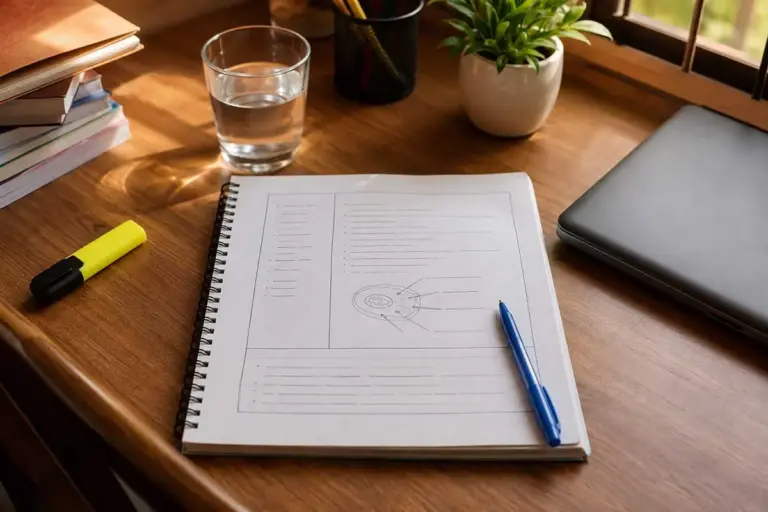
Split your page into three sections:
- Notes column (the largest area). Write your actual notes here during class — key points, examples, diagrams. Use short phrases and abbreviations, not full sentences.
- Cue column (a narrow strip on the left or a section below). Soon after class, go back and write questions or keywords that would trigger each block of notes — “What is Newton’s third law?” next to your notes on it, for instance.
- Summary (a few lines at the bottom). In your own words, sum up the whole page in two or three sentences. If you can’t do this easily, that’s a sign you didn’t fully follow the topic — a useful thing to know before the exam, not during it.
The real power of this layout shows up later: cover the notes column, look only at your cues, and try to recall the material. That single step turns a notebook from a reference document into an actual revision tool.
Handwritten vs Digital Notes: What the Research Actually Shows
This comes up constantly — should you write notes by hand or type them? A comparative research review published via the National Library of Medicine, along with several other studies, points to a consistent pattern: handwriting tends to produce better comprehension, particularly for conceptual and application-based questions, even though typing usually lets you capture more words.
The likely reason is effort, not nostalgia. Typing is fast enough that many students end up transcribing almost verbatim — which is really just fast copying. Handwriting is slower, so it forces you to summarise and rephrase as you go, and that extra processing is what helps the information stick.
That doesn’t mean digital notes are bad. For students juggling multiple devices and apps, a sensible middle ground works well:
- Use handwriting for first-pass class notes and anything mathematical, wherever possible
- Type up a condensed, reorganised version afterwards if you want searchable digital notes
- Avoid typing notes verbatim during a lecture just because you can type fast — speed isn’t the goal
Turning Notes Into Active Recall (Not Just Re-Reading)
Notes only pay off if you revisit them the right way. Re-reading feels productive but is one of the weakest revision methods, because recognising information on a page is much easier than actually recalling it. A better weekly rhythm looks like this:
- Same day: tidy up the day’s notes and fill in the cue column while the class is still fresh
- 2–3 days later: cover the notes, use only the cues, and try to recall each section out loud or on a blank sheet
- End of the week: skim the summaries of everything covered and flag anything you couldn’t recall confidently
This rhythm fits naturally into a broader weekly structure. If you’re still figuring out where revision time actually goes in your week, it’s worth pairing this with a proper study timetable so note review has a fixed slot rather than happening only when an exam is close.
A Simple Weekly Note Review System
You don’t need a complicated app or system to make this stick — a study planner with a recurring 20–30 minute “note review” slot two or three times a week is usually enough. The goal isn’t to reread everything you own — it’s to catch the gaps early, while there’s still time to close them, instead of discovering them the night before an exam.
Common Note-Taking Mistakes That Waste Revision Time
- Copying slides word for word. If a slide or textbook already has the information, your notes should add understanding, not duplicate text.
- Writing in full sentences. Full sentences take longer to write and longer to review. Phrases, arrows, and short-form notation are faster both ways.
- Never reviewing until exam week. Notes that sit untouched for months are almost as good as blank pages by the time you need them.
- One giant, undivided notebook. Without headings, dates, or dividers between topics, finding anything becomes its own project.
- Treating every subject the same way. A method that works for History won’t automatically work for Mathematics — more on that below.
Note-Taking Tips by Subject Type
Science and Mathematics
- Prioritise worked examples and step-by-step methods over long explanations
- Leave space to redo a problem from scratch next to the original, without looking
- Keep a running “formula sheet” page per chapter instead of scattering formulas across notes
Languages, Social Science, and Humanities
- Use the cue column for definitions, dates, or “explain in your own words” prompts
- Group notes by theme or timeline rather than strictly by the order chapters were taught
- For essay-based subjects, note down structures and argument outlines, not full model answers to memorise word for word

Quick Reference: The Weekly Note Review Rhythm at a Glance
| When | What to Do |
| During class | Capture short phrases, keywords, and diagrams in the notes column — skip full sentences |
| Same day | Fill in the cue column with questions and keywords while the class is still fresh |
| 2–3 days later | Cover the notes, use only the cues, and try to recall each section out loud |
| End of the week | Skim the summaries of everything covered and flag anything you couldn’t recall |
| Before exams | Condense each chapter into one Cornell-style master page with cues and a summary |
Frequently Asked Questions
How long should my notes be for one class or chapter?
Short enough to review in 10–15 minutes. If a chapter’s notes take an hour to read through, they need trimming down to key points and cues, not full explanations.
Should I rewrite my notes neatly after class?
Not word for word — that’s just copying again. Instead, use that time to add cues, fix gaps, and write the summary. That’s a much better use of the same effort.
Are typed notes ever the better choice?
Yes, for subjects with a lot of diagrams you’re recreating digitally, group-shared notes, or students who genuinely process better on a keyboard. The research shows a general edge for handwriting, not a rule that applies to everyone.
What if my handwriting is slow and I fall behind in class?
Focus on capturing keywords, numbers, and structure during class, and fill in full understanding afterwards using the cue-and-summary steps. You don’t need to catch every word — you need to catch every idea.
Can I use this method for board exam revision, not just daily classes?
Yes — it works even better here. Condensing a full chapter into a Cornell-style page with cues and a summary is one of the fastest ways to build a revision-friendly master sheet before boards.
Final Takeaway
Good notes aren’t the ones that look the most complete on the day you write them. They’re the ones that still make sense — and still teach you something — a month later, half-asleep, with an exam the next morning. Build that version from the start, and revision stops being a scramble to relearn everything and becomes what it should be: a quick, confident refresh of what you already know.
If you’d like a note-taking and revision plan built around your own subjects and timetable, the Student Success Assistant can help you put one together in a few minutes.

Learning Support Team shares guidance on safe online learning, educational technology, and effective digital study practices.