

Sit any student down after a two-hour study session and ask how much they actually remember, and you’ll often get an honest shrug. Not because they didn’t try. Because somewhere around the ninety-minute mark, their brain quietly stopped absorbing anything new — even though they kept staring at the page.
This happens more often than most students realise, and it’s rarely about intelligence or effort. It’s about the conditions the brain was working in. Healthy study habits aren’t a side topic separate from academics — they’re often the difference between two hours of studying that actually stick and two hours that mostly don’t.
This article looks at the everyday habits — sleep, movement, food, screen time, posture — that genuinely affect how well a student concentrates, and how to build them into a routine without turning study time into a wellness lecture.
Sleep Is Doing More Than You Think
Of everything that affects concentration, sleep is probably the most underestimated and the most sacrificed.
Many students treat sleep as the thing to cut when there’s not enough time — staying up later to finish a chapter, waking up earlier to revise before school. It feels like it’s buying extra study time. Often, it’s borrowing against tomorrow’s concentration to pay for tonight’s.
A tired brain doesn’t just feel sluggish. It struggles specifically with the kind of focused attention that studying requires — following a multi-step Maths problem, holding several related facts in mind while writing an essay, noticing when something doesn’t quite make sense. These are exactly the mental tasks that suffer first when sleep is short.
For most teenagers, somewhere around 8 hours of sleep supports steady concentration the next day. That number will vary a little from person to person, but the pattern is consistent: students who protect their sleep — even during exam season — tend to get through revision faster than those pulling consistent late nights, because they’re not re-reading the same paragraph three times before it sinks in.
If you’re building a daily study routine around exam preparation, sleep deserves a fixed place in it — not something that happens if there’s time left over.
Movement Between Study Sessions Isn’t a Distraction
There’s a common assumption that any time away from the desk is time lost. In practice, the opposite is often true.
Sitting still for long stretches — which is exactly what studying involves — isn’t how the brain works best. Even ten minutes of movement between study blocks can noticeably refresh concentration for the next session. This doesn’t need to be exercise in the formal sense.
A short walk around the house or in a balcony. Some stretching. Even just standing up and moving around for a few minutes between a Physics session and a History session. The point isn’t fitness — it’s giving your body a change of state, which seems to help the brain reset.
Students often resist this because it feels like it’s “wasting” study time. But a five-to-ten-minute movement break between hour-long sessions usually pays for itself in how much more focused the next session feels.
What and When You Eat Affects How You Study
Food doesn’t get talked about much in study advice, but the connection is fairly direct.

Skipping meals before studying — particularly breakfast before a morning study session — tends to backfire. Low blood sugar makes it harder to concentrate, and the discomfort of hunger itself becomes a distraction that competes with whatever you’re trying to focus on.
Heavy meals right before a study session can have the opposite problem — making you sluggish and more inclined toward a nap than a textbook. A lighter meal, with some time to digest before sitting down to study, tends to work better for most students.
Frequent sugary snacks during long study sessions create a pattern of quick energy spikes followed by crashes — and the crash often arrives right in the middle of something you’re trying to concentrate on. Something more sustaining — nuts, fruit, a glass of milk — tends to support steadier energy through a study block.
None of this needs to become a strict diet plan. The simple principle is: eat in a way that keeps your energy steady, not in a way that creates spikes and crashes during the hours you’re trying to focus.
Hydration — The Easiest Thing Most Students Forget
This sounds almost too simple to mention, but it comes up constantly with students who report feeling tired or unfocused during long study sessions.
Mild dehydration affects concentration and alertness more than most people realise. A student deep in a study session for two or three hours, especially with a fan or air conditioning running, can become mildly dehydrated without noticing — and the resulting tiredness gets blamed on the subject, the time of day, or “just not being in the mood,” when a glass of water might have made a real difference.
Keeping water within reach during study sessions — and actually drinking it, not just having it sit there — is one of the lowest-effort habits with a genuinely noticeable effect.
Managing Screen Time Around Study Sessions
This is a sensitive topic for a lot of students, so it’s worth being honest about it rather than simply saying “avoid your phone.”
The issue isn’t that phones are inherently bad for studying. Plenty of students use apps for genuinely useful purposes — checking a concept, verifying a Maths answer, looking something up. The issue is what happens in the gaps.
A five-minute “break” to check messages that turns into twenty-five minutes of scrolling isn’t really a break — it’s a different kind of mental activity that makes returning to focused study harder, not easier. The brain has to disengage from one mode and re-engage with another, and that switching has a real cost.
A few things that tend to help:
- Keep the phone out of reach during active study blocks — not turned off necessarily, just physically distant enough that checking it requires getting up.
- If you use your phone for breaks, set a timer — five or ten minutes, with an alarm. The alarm matters more than the time limit; it’s easy to lose track of time on a phone in a way that’s harder with a clock on the wall.
- Avoid screens for the last 30 minutes before sleep if possible. This connects back to the sleep habit — screen use right before bed tends to make it harder to fall asleep properly, which affects the next day’s concentration.
Posture and Study Space Matter More Than They Seem
Studying for hours in a slouched position, on a bed, with a laptop balanced on your knees, isn’t comfortable in the way it initially feels. Over time, it leads to physical discomfort — back pain, neck strain, headaches — that becomes its own distraction.
A proper desk and chair, even a simple one, makes a meaningful difference over a long study session. Sitting upright with your study material at a reasonable height reduces the physical fatigue that competes with mental focus.
Lighting matters too. Studying in dim light, especially in the evening, tends to cause eye strain that builds up gradually — by hour two, you’re rubbing your eyes more than reading. A well-lit study space, ideally with natural light during the day and adequate lamp lighting in the evening, supports longer, more comfortable study sessions.
Short Breaks Are Part of Studying, Not a Pause From It
There’s a tendency to think of breaks as time away from studying — necessary, maybe, but not really part of the process. In practice, breaks are part of how the process works.
After roughly 45 to 60 minutes of focused study, concentration naturally starts to decline. A short break — five to ten minutes — before returning to the next session helps maintain the quality of attention across a longer study period.
What you do during the break matters. A break spent stretching, getting some water, or just looking out a window tends to leave you more ready to focus than a break spent on social media, which — as mentioned above — tends to extend well past its intended length and leaves the brain in a different mode entirely.
Common Mistakes That Undermine Concentration
Studying in bed. Beyond the posture issues, the brain starts to associate the bed with wakefulness and activity rather than rest — which can affect sleep quality too. A desk, table, or any dedicated study spot works better for both studying and sleeping.
Pulling all-nighters before exams. This feels productive in the moment but tends to backfire. A tired brain on exam day struggles with exactly the kind of recall and clear thinking an exam requires. A solid night’s sleep before an exam is usually worth more than the extra hour of cramming.
Studying through hunger or thirst “to finish the chapter.” The chapter rarely gets finished faster this way — discomfort becomes a growing distraction that slows everything down. A two-minute break to eat or drink something usually saves more time than it costs.
Treating wellness habits as separate from studying. Sleep, movement, food, and study time often get planned as if they’re competing for the same hours — when in reality, the first three are what make the last one work. A supportive approach to studying — one that includes rest and balance rather than treating every hour as study-or-waste — tends to produce better results over time, not worse.
Building These Habits Without Overhauling Everything
The habits above don’t need to be adopted all at once, and trying to change everything in a single week often doesn’t last.
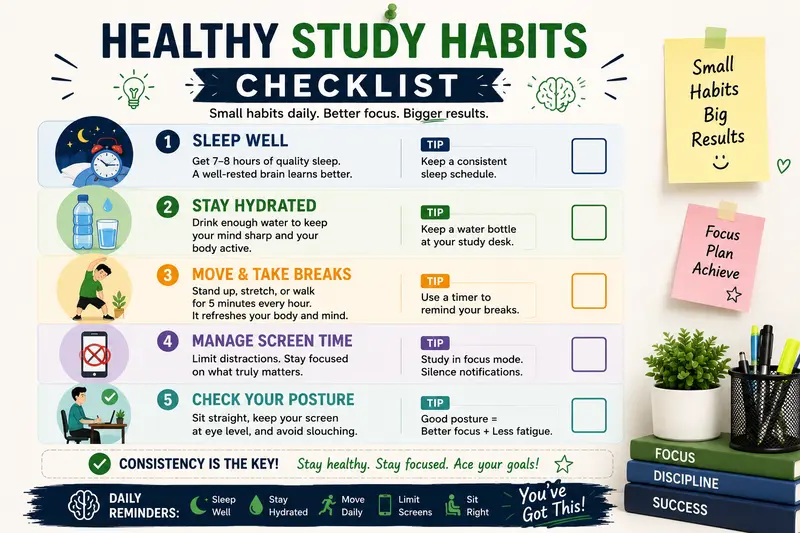
A more realistic approach: pick one or two habits that feel most relevant to your current situation. If sleep has been consistently short, start there — it has the broadest effect on concentration of anything on this list. If screen breaks have been running long, start with the timer habit.
Small, consistent changes tend to stick. A student who reliably gets eight hours of sleep and takes proper breaks will likely concentrate better than one who’s added five new habits this week and abandoned all of them by next week.
Final Takeaway
Healthy study habits aren’t separate from academic performance — they’re part of it. Sleep, movement, food, hydration, screen management, posture, and breaks all directly affect how much a student’s brain can actually take in during study time.
None of these require dramatic lifestyle changes. They’re small, manageable adjustments that compound over weeks and months — and they make every hour of studying more effective, which is often exactly what a busy student needs most.
Frequently Asked Questions (FAQs)
Q1. How many hours of sleep do students need for good concentration?
Most teenagers concentrate best with around 8 hours of sleep per night, though this can vary slightly between individuals. What matters most is consistency — going to bed and waking up at similar times each day helps the brain settle into a rhythm that supports steady focus. Sacrificing sleep for extra study time, especially during exams, often backfires because tired brains take longer to process and retain information.
Q2. Does taking breaks while studying actually help or just waste time?
Breaks genuinely help, as long as they’re short and the activity during the break allows the brain to rest rather than switch to a different demanding task. After about 45 to 60 minutes of focused study, concentration naturally dips, and a five-to-ten-minute break — stretching, walking, getting water — helps restore attention for the next session. Breaks spent on social media tend to run long and leave the brain in a different mode, which can make returning to study harder rather than easier.
Q3. How does food affect a student’s ability to concentrate?
Steady energy supports steady concentration. Skipping meals can cause low blood sugar, making focus difficult. Heavy meals right before studying can cause sluggishness. Frequent sugary snacks create energy spikes followed by crashes, which often hit during a study session. Lighter meals with sustained-energy foods — fruits, nuts, dairy — tend to support more consistent focus through longer study periods.
Q4. Is studying late at night harmful for concentration the next day?
Occasional late nights aren’t harmful in isolation, but a consistent pattern of late-night studying at the cost of sleep tends to reduce concentration the following day — sometimes enough that the extra study time doesn’t actually translate into more learning. For most students, a well-rested morning study session is more productive than late-night studying done while tired, even if the late-night session feels more focused at the time.
Q5. How can students manage phone use during study time without feeling cut off?
Rather than avoiding the phone entirely, keep it physically out of reach during active study blocks and use it deliberately during breaks with a timer set. This reduces the unconscious habit of checking it every few minutes, which is often what disrupts concentration most. For students who use educational apps for studying, having a set time for that — separate from social media use — helps keep both productive.

The CBSE Guide Editorial Team creates helpful educational content for students, parents, and learners across various academic and personal development topics.