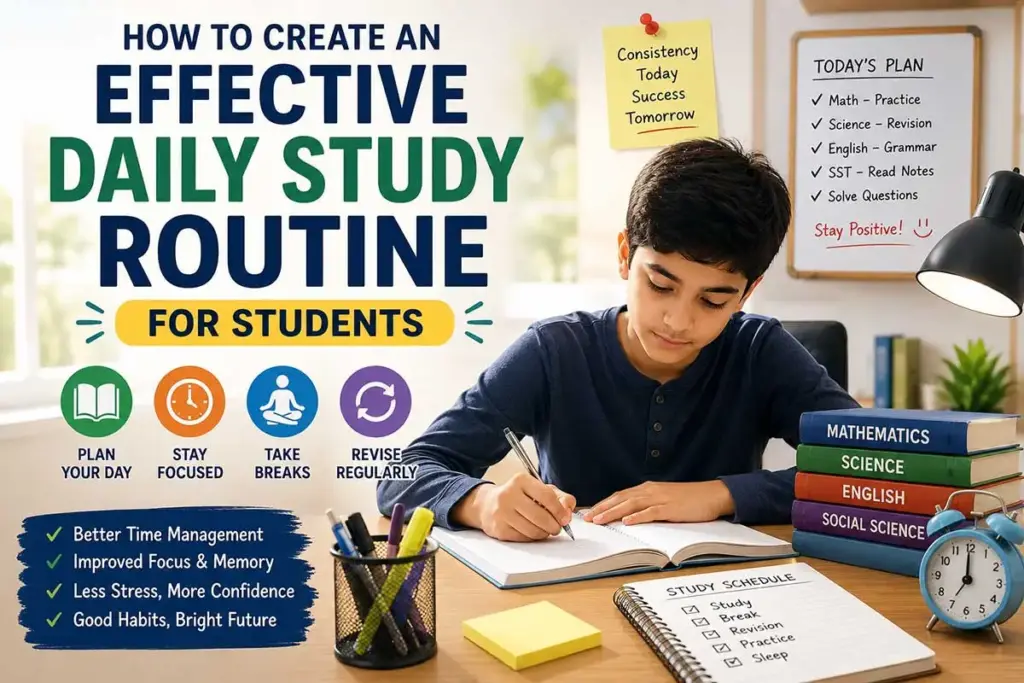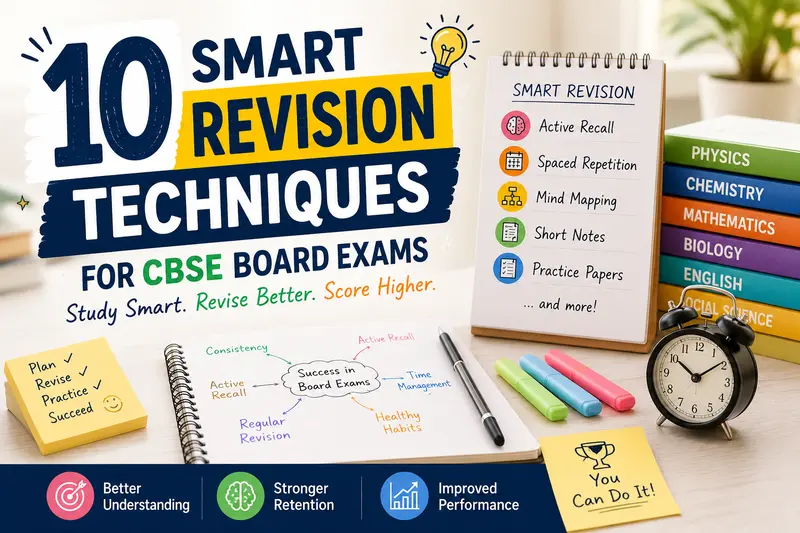
Board exam season can feel like a lot. There are several subjects to revise, a long syllabus to finish, and parents and teachers who clearly want you to do well. Here is the reassuring part: scoring well is not about sitting at a desk for the longest hours. It is about studying in smarter ways, revising often, practising exam-style questions, and keeping your cool when the clock is ticking.
These habits help Class 10 and 12 students most, but they also give Classes 6 to 9 a real head start. Below you will find subject-wise strategies, timetables, mock tests, previous-year papers, and ways to keep stress in check.
Direct answer: What is the best way to prepare for CBSE board exams?
Study the NCERT textbooks thoroughly, follow a realistic timetable, revise with active recall and spaced repetition, solve previous-year and sample papers, and learn from your mistakes through regular practice tests. Steady study, enough sleep, and a calm exam strategy beat last-minute cramming every time.
What Actually Works for CBSE Exam Preparation?
Plenty of students assume that eight to ten hours a day automatically means higher marks. In reality, how you study matters far more than how long you sit there.
Good preparation blends understanding, memory, practice, feedback, and rest. Research on learning and memory backs this up, especially for practice testing and spaced learning. Here is how common habits compare with better alternatives.
| Common study habit | What works better | Why it helps |
| Reading the same chapter again and again | Read once, then recall without looking | Shows what you really remember |
| Highlighting entire pages | Highlight key ideas and turn them into questions | Keeps your mind active |
| Studying one subject all day | Alternate between two or three subjects | Adds variety and regular practice |
| Solving papers without checking answers | Analyse every mistake after each paper | Reveals gaps to fix |
| Memorising model answers word for word | Understand concepts and practise answer structures | Builds flexibility |
| Studying late into the night | Keep a steady sleep schedule | Supports focus and memory |
| Revising only easy chapters | Prioritise weak and high-importance topics | Uses limited time well |
For more ideas, you can explore effective study techniques for students alongside the resources your school and textbooks already provide.
Create a Realistic CBSE Study Timetable
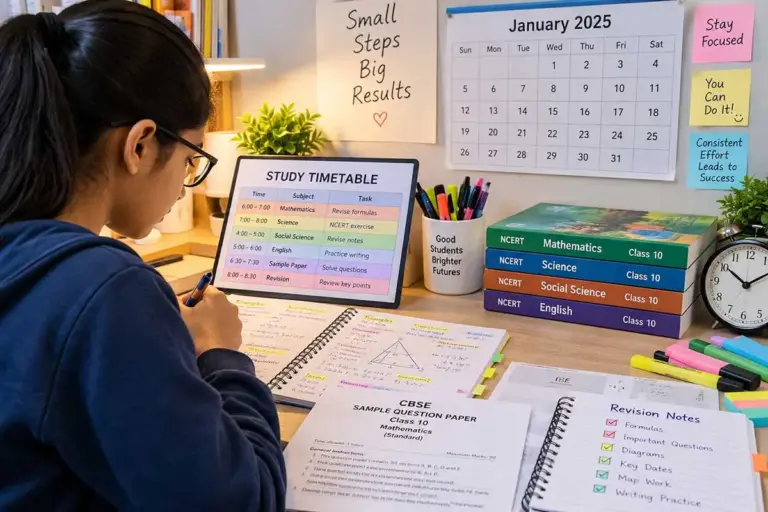
A timetable should keep you organised, not make you feel guilty whenever you miss a task. There is no magic number of study hours, so start with a manageable stretch after school and extend it during preparatory leave if you stay focused and rested. Sessions of 30 to 50 minutes followed by short breaks work well.
Sample daily study timetable
| Time | Activity |
| 6:30–7:00 AM | Quick recall of formulas, definitions, or vocabulary |
| 4:00–4:45 PM | Revise a difficult subject |
| 5:00–5:45 PM | Textbook exercises or numerical problems |
| 5:45–6:15 PM | Physical activity or relaxation |
| 6:15–7:00 PM | Practise a second subject |
| 8:00–8:30 PM | Review mistakes and plan tomorrow |
| Night | Wind down and sleep well |
Download the weekly timetable planner (PDF)
Treat this as an example and adjust it around your school hours, tuition, and energy levels.
Use a priority-based study plan
Sort your chapters into three groups:
- Strong: You understand it and can answer questions on your own.
- Needs revision: You get it, but you forget details or slip up occasionally.
- Weak: You struggle to explain concepts or solve questions without help.
Give most of your time to the weak and needs-revision chapters, and keep short practice sessions going for the strong ones. Try not to skip a chapter just because it feels hard.
Tick a chapter off only after you have tested yourself, not just after reading it.
Download the chapter tracker (PDF)
Use NCERT Textbooks the Right Way
For many subjects, NCERT textbooks are the best place to start. Know your syllabus and the resources your school recommends, rather than leaning only on guidebooks, coaching notes, or online summaries.
The National Council of Educational Research and Training (NCERT) shares textbooks and learning resources on its official website: NCERT official website.
Follow the learn–recall–practise method
For each chapter, try this sequence:
- Learn: Read the concept carefully, along with the examples, diagrams, and definitions.
- Recall: Close the book and explain it aloud, or write the main points from memory.
- Practise: Solve textbook exercises, competency-based questions, and sample-paper questions.
- Check: Compare your answers with reliable solutions or marking guidance.
- Revise: Come back to tricky concepts after a gap.
Where should students find the correct syllabus and sample papers?
The official CBSE website is the place for current curriculum documents, exam updates, sample papers, and marking schemes. Visit the CBSE official website and the CBSE Academic portal.
Always check that a paper or marking scheme matches your exam year and subject code.
Which Revision Techniques Work Best?
Revision works best when you pull information out of your memory instead of rereading the same pages. Two techniques stand out: active recall and spaced repetition.
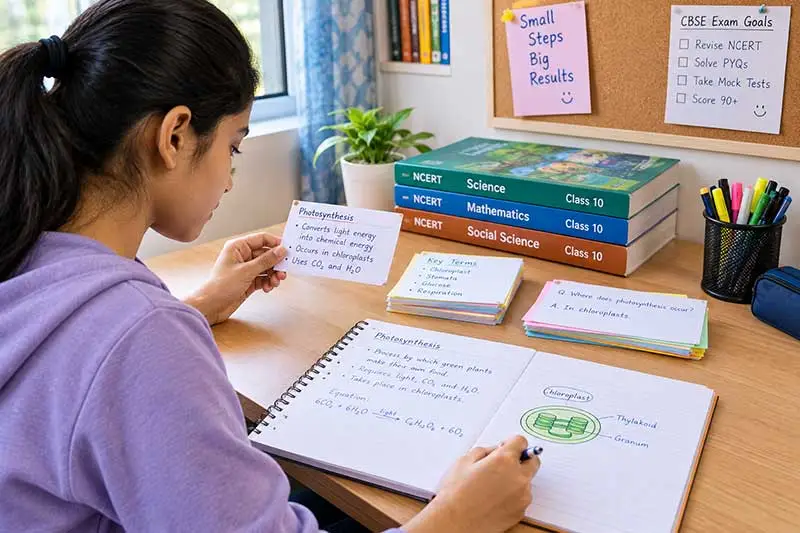
1. Practise active recall
Active recall simply means trying to remember something without looking at your book or notes. After a History chapter, for example, close the book and ask yourself:
- What were the main events?
- What caused them, and what happened afterwards?
- Which dates, people, and terms should I remember?
- Can I explain the topic in my own words?
Then open the book to fill in gaps and fix errors.
2. Use spaced repetition
Rather than revising a chapter once, return to it several times at growing intervals. A handy pattern is the same day, the next day, three days later, and about a week later, with extra visits for difficult topics.
Download the recall and revision log (PDF)
3. Keep a mistake notebook
Use a separate notebook for errors made during practice. Note the question, the mistake, the correct method, and whether it was a concept gap, a careless slip, or a time problem.
Look through it every few days. Fixing repeated mistakes is often worth more than solving dozens of extra questions without reviewing them.
4. Explain concepts in simple language
Try teaching a tough concept to a younger student. If you cannot explain it clearly without peeking at your notes, go back to the basics. This works especially well for Science, Mathematics, Economics, and conceptual parts of Social Science.
For extra revision support, you can explore CBSE study materials and learning resources alongside your prescribed textbooks.
How to Prepare for Each CBSE Subject
Subjects are not all the same, so one revision method will not suit them all.
Mathematics: Practise problems, not just formulas
Reading worked examples helps you understand a method, but only independent practice shows whether you can use it.
- Revise formulas and know when to apply them.
- Do NCERT examples and exercises before moving to harder questions.
- Revisit wrong answers after a short gap.
Science: Connect concepts, diagrams, and applications
Combine understanding with written practice.
- Learn definitions and principles accurately.
- Solve numericals with formulas, substitutions, and units.
- Practise explaining observations and the reasons behind them.
In Physics, focus on concepts and numericals. In Chemistry, revise reactions, equations, and properties. In Biology, link processes to diagrams, functions, and key terms.
Social Science: Understand relationships and structure your answers
Here you need facts, but also causes, consequences, and comparisons.
- Write short chapter summaries.
- Make comparison tables for related ideas.
- Answer in clear points with relevant examples.
Instead of memorising a History answer word for word, organise it into causes, key events, and consequences.
English and other languages: Improve comprehension and writing
Language papers reward regular practice, not last-minute memorising.
- Read passages and practise comprehension questions.
- Review grammar rules and apply them in exercises.
- Practise the writing formats prescribed for your class and year.
For writing tasks, follow the format and word limits, and practise finishing within a realistic time. You can also use English learning resources for school students to build vocabulary, grammar, and comprehension.
Practise Previous-Year Papers and Mock Tests
Solving papers is one of the most practical ways to prepare. It makes question formats familiar, shows how ready you are, and points to topics needing more work. But it only pays off if you analyse your performance afterwards.
When should students start solving sample papers?
Start topic-wise questions as soon as you understand the chapters. Begin full-length mock tests once you have covered a good part of the syllabus and can attempt a meaningful share of the paper. As the exam gets closer, do timed practice more often. Use official CBSE sample papers and marking schemes wherever available.
The right way to analyse a mock test
When you finish a paper, ask yourself:
- Which questions did I get wrong?
- Which ones took longer than expected?
- Did I lose marks because I did not understand the concept?
- Did I leave anything incomplete?
- Did I follow the instructions and manage my time?
Download the mistake log and mock test analyser (PDF)
Sort errors into knowledge gaps, careless mistakes, time problems, and presentation issues. Then revise those chapters and try similar questions again.
How should students use previous-year question papers?
They are great practice, but do not expect questions to repeat exactly. Use them to understand question styles, apply concepts, judge your answer quality, and get comfortable with the format. Combine them with the current syllabus and official sample papers.
For more practice, you can explore CBSE previous-year question papers and make sure they match your class, subject, and current requirements.
How to Write Better Answers in CBSE Exams
Knowing an answer and presenting it well are two different skills. Clear writing helps the examiner find what matters.
- Read the question carefully and see what it asks you to do.
- Follow the command word, such as explain, compare, justify, or calculate.
- Start with a direct opening sentence where suitable.
- Break longer answers into logical points or paragraphs.
- Add formulas, diagrams, examples, or equations when needed.
How should students manage time during an exam?
Split your time according to the marks, difficulty, and instructions of the paper, and keep a few minutes at the end to review unanswered questions and obvious errors. If a question is taking too long, move on when permitted and come back later. Do not polish one answer while others stay unfinished.
Always follow the instructions printed on your actual paper, since duration, sections, and requirements can vary by subject and session.
Reduce Exam Stress and Avoid Burnout
A little nervousness before an important exam is normal. It becomes a problem when it disturbs your sleep, focus, or ability to prepare steadily. Treat your mental and physical well-being as part of your preparation.
Five practical ways to manage exam stress
- Set small daily goals. Three specific tasks feel far more doable than “finish the syllabus”.
- Take regular breaks. A few minutes between focused sessions helps you reset.
- Stay active. A walk, some stretching, or playing outside is a welcome break from books.
- Protect your sleep. Do not trade it for one more chapter. Teenagers generally need around 8 to 10 hours a night.
- Talk about your worries. Parents, teachers, and school counsellors can help you make a realistic plan.
If anxiety becomes severe, lingers, or affects daily life, please reach out to a qualified mental health professional or school counsellor.
A Practical 30-Day CBSE Revision Plan
With a month to go, split your time between revision, practice, and fixing mistakes. Adapt this to your syllabus coverage and exam schedule.
| Period | Main focus | Daily action |
| Days 1–7 | Identify gaps and revise key concepts | Review weak chapters and solve topic-wise questions |
| Days 8–14 | Strengthen subject knowledge | Revise remaining chapters and practise application-based questions |
| Days 15–21 | Timed practice | Attempt sample papers and analyse errors |
| Days 22–26 | Targeted revision | Revisit difficult concepts, formulas, diagrams, and mistake notes |
| Days 27–29 | Final consolidation | Practise selected questions and review important material |
| Day 30 | Light revision and preparation | Check essential notes, organise exam materials, and rest |
Download the 30-day planner (PDF)
If your syllabus is incomplete, use the first two weeks to finish it before intensive paper practice.
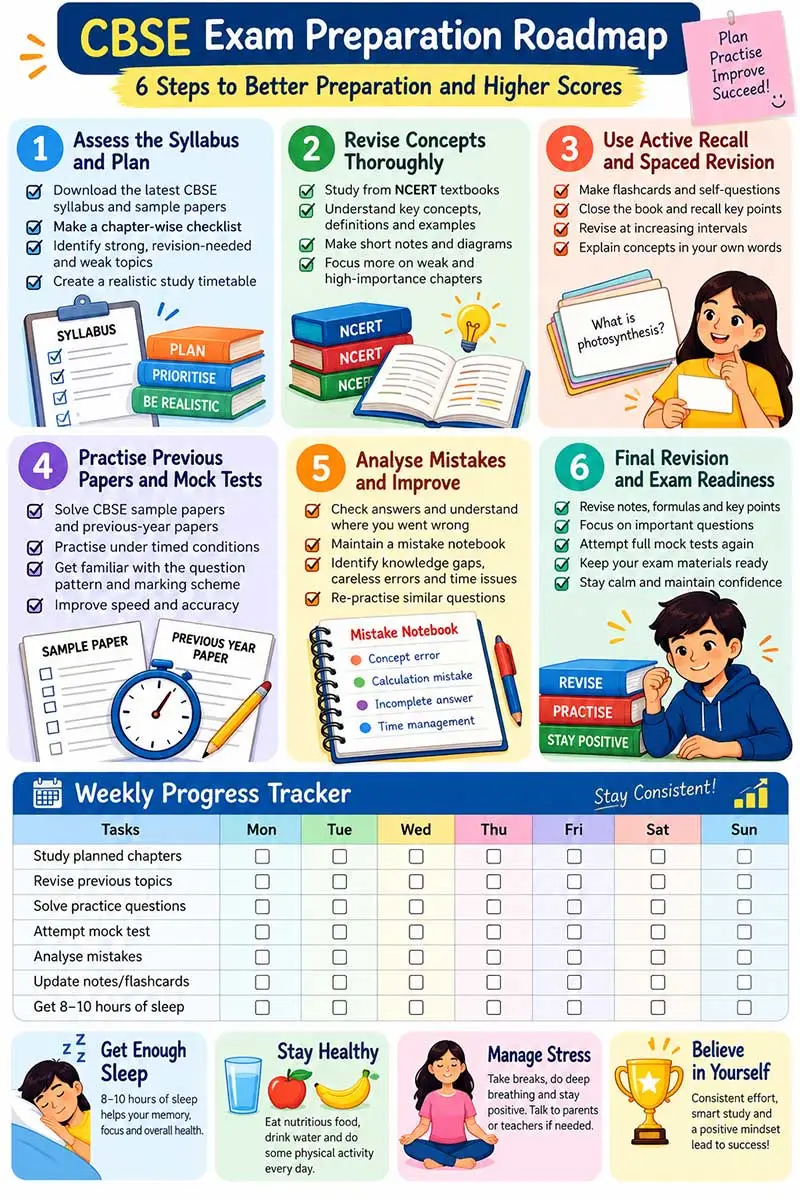
Key Takeaways
- Understand first: Start with the prescribed syllabus and NCERT textbooks.
- Revise actively: Test yourself instead of only rereading.
- Practise exam-style questions: Use official sample papers, previous-year papers, and timed tests.
- Learn from mistakes: Keep a mistake notebook and revisit weak areas.
- Protect your well-being: Sleep, activity, and emotional support are part of good preparation.
The best CBSE preparation strategy is the one you can actually stick to. Small gains in understanding, recall, accuracy, and answer writing add up to real progress.
Frequently Asked Questions
1. What is the most effective way to prepare for CBSE board exams?
Study the prescribed syllabus, understand NCERT concepts, revise through active recall, and practise official sample papers, analysing your mistakes each time.
2. How many hours should I study daily?
No number guarantees high marks. Choose a realistic duration for your schedule and class, and favour focused study with regular breaks over long, distracted hours.
3. Are NCERT textbooks enough for CBSE board exams?
They are a key resource for many subjects. Add official sample papers, marking schemes, and suitable practice questions where needed.
4. How important are previous-year question papers?
They help with question styles and time management, but should not replace syllabus coverage, and questions will not necessarily repeat.
5. When should I start solving CBSE sample papers?
Begin topic-wise practice while revising, then start full-length timed papers once you have covered enough of the syllabus.
6. How can I remember what I study for longer?
Use active recall, spaced repetition, and short self-tests, and explain concepts in your own words to expose gaps.
7. What should I do if I have only 15 days left?
Prioritise unfinished and weak topics, revise essentials, take timed tests, and avoid new resources or overnight memorising.
8. How can I reduce fear and stress before board exams?
Break preparation into small tasks, sleep regularly, take breaks, and talk to a trusted adult or school counsellor if anxiety gets hard to manage.
9. Should I study new chapters the day before an exam?
Focus on familiar concepts, formulas, and common mistakes. If an essential topic is still unfamiliar, review just its basics without losing sleep.

Student Success Desk focuses on practical learning strategies, study techniques, and academic improvement tips for school students.