Quick Answer
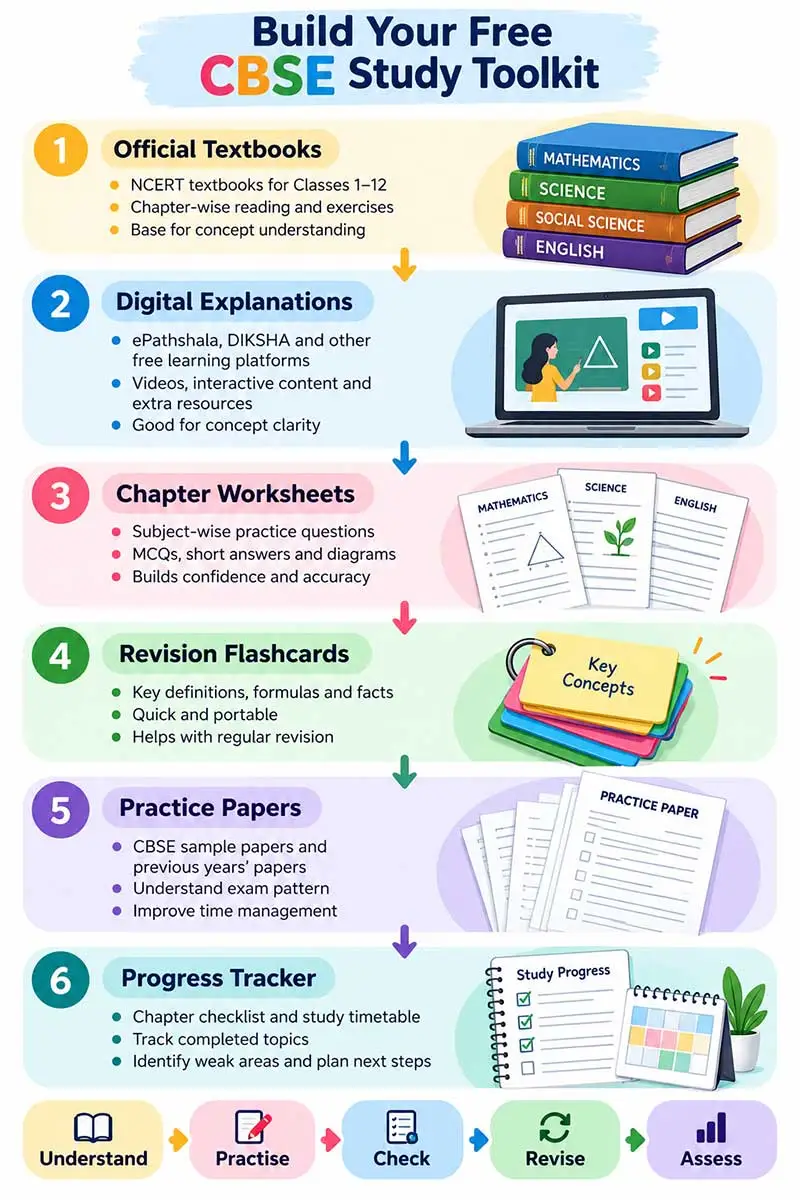
If you want free, reliable help for CBSE studies, start with your NCERT textbooks. Then add ePathshala, DIKSHA and the official CBSE sample papers, and round things out with a few simple printables: chapter checklists, formula sheets, a weekly timetable and a mistake tracker. Put together, these cover everything from understanding a concept to practising questions to seeing how far you have come, and none of it costs a rupee.
1. Why Should CBSE Students Use Free Educational Resources?
Doing well in school exams does not mean buying a stack of guidebooks, signing up for an expensive course, or downloading every learning app you come across.
What really works is much simpler: a few trustworthy resources that match your syllabus, used regularly. That is good news for any student who is already juggling school hours, homework, tuition and extracurriculars, because free resources fit around a busy day without adding to the cost.
Used well, they can help you:
- Understand textbook ideas through clear explanations, videos and worked examples.
- Practise chapter-wise questions before a classroom test.
- Revise definitions, formulas, dates and scientific processes.
- Spot your weak topics before the exam does it for you.
- Keep homework and revision organised with printable planners.
- Get ready for Class 10 and Class 12 boards with official practice papers.
Younger children tend to enjoy worksheets, reading exercises, multiplication tables and activity sheets, which make daily practice feel more like play. As students move into secondary and senior secondary classes, sample papers, marking schemes, chapter summaries and timed practice become far more valuable.
A simple way to think about it: let the NCERT textbook be your foundation, use official resources to learn what the exam expects, and bring in worksheets and learning aids to strengthen whatever still feels shaky.
2. What Are the Best Free Educational Websites for CBSE Students?
You do not need dozens of websites. A small, reliable set is plenty, as long as each one has a clear job.
The platforms below offer free study material or free access to important learning resources. What you will find can vary by class, subject, language and type of content.
2.1 NCERT Textbooks: The Foundation of CBSE Preparation
If you only pick one resource, make it the NCERT textbooks. The official portal offers digital textbooks for Classes 1–12, so you can open the chapter you need without buying another copy.
Here is how students can get the most out of them:
- Read a chapter before the teacher covers it in class.
- Go back over definitions, examples, diagrams and exercises.
- Turn each chapter into a short summary or set of revision notes.
- Mark the ideas that need extra practice.
- Check that any extra worksheets actually cover the right topics.
A tip that helps: keep a chapter checklist for every subject. Tick a chapter off only after you have read it, finished the exercises and gone through your mistakes. And always confirm the current syllabus and prescribed textbook for your class.
2.2 ePathshala: Digital Textbooks and Learning Materials
ePathshala, developed by NCERT, offers digital textbooks along with extra learning content. Depending on what is available, you may find audio, video and interactive material linked to what you are studying.
It works especially well if you like to revise on your phone or want something to study from while travelling.
To use it well:
- Choose your class and subject.
- Open the textbook or chapter you are working on.
- Look at the related digital resources, where available.
- Jot down short notes as you go.
- Close the material and try the questions on your own.
2.3 DIKSHA: Curriculum-Linked Digital Learning
DIKSHA is a national digital learning platform for students, teachers and parents. You will find textbooks, videos, interactive activities and practice material, and you can filter by board, class, subject and language.
For CBSE students, it is a handy way to meet a concept in a different format. Say a Science diagram just is not making sense. A short explanatory video might be all it takes before you go back to the textbook.
Try this: scan the QR code printed in a compatible textbook, or search the platform for your topic. Before you use anything, check that the class, board and subject match yours.
2.4 CBSE Official Sample Papers and Marking Schemes
If you are in Class 10 or Class 12, the official sample question papers are some of the most useful free resources you can find. CBSE publishes sample papers and marking schemes for applicable exam sessions.
They show you how questions are framed, how the paper is structured, how marks are distributed and how answers are expected to be written.
Here is what to do with them:
- Practise under timed conditions.
- Learn how to organise a long answer.
- Check that you have addressed every part of the question.
- Compare your answers with the marking scheme.
- Note which topics need more revision.
Make sure you download the papers for the correct academic session. And remember that sample papers support your regular chapter practice. They are not a replacement for it.
2.5 Previous Years’ Question Papers
Previous years’ papers are another good way to practise exam-style questions. They help you judge your time management, find gaps in your preparation and get comfortable with different question formats.
After finishing a paper, sort your mistakes into types:
- Conceptual: you did not fully understand the topic.
- Recall: you forgot a definition, fact, formula or date.
- Application: you understood the idea but could not use it in the question.
- Presentation: your answer was missing steps, keywords or a clear structure.
- Time: you spent too long on certain questions.
Doing this makes revision far more purposeful than looking at the final score and moving on.
2.6 Other Free Learning Resources
Depending on what you need, a few other resources are worth a look:
| Resource | Best use | Keep in mind |
| Khan Academy | Concept explanations and guided practice in supported subjects | Check that it matches your CBSE chapter and level |
| National Digital Library of India | Finding educational books and learning materials | Access and download conditions may vary |
| School-provided digital portals | Teacher notes, homework and class-specific worksheets | Follow your teacher’s instructions and the current syllabus |
| Educational videos | Visual explanations and demonstrations | Verify the facts, then return to the textbook |
The aim is not to collect as many resources as possible. It is to pick the one that solves the problem in front of you.
3. What Free Printable Resources Should Every CBSE Student Have?
Digital platforms are great for explaining ideas. Printables do a different job: they help you practise, stay organised and remember what you have learned.
You can make any of the following in a notebook or print them on plain A4 paper. They suit students from the primary classes right up to senior secondary, with a few changes for age and subject.
3.1 Chapter Completion Checklist
A chapter checklist stops you from moving on before you have really understood the basics.
Printable template:
| Task | Completed |
| Read the textbook chapter | ☐ |
| Understood the main concepts | ☐ |
| Reviewed examples and diagrams | ☐ |
| Completed textbook exercises | ☐ |
| Solved additional practice questions | ☐ |
| Checked answers and corrected mistakes | ☐ |
| Revised the chapter without looking at notes | ☐ |
Keep a separate checklist for each subject. For younger children, a shorter version with just three or four tasks works better.
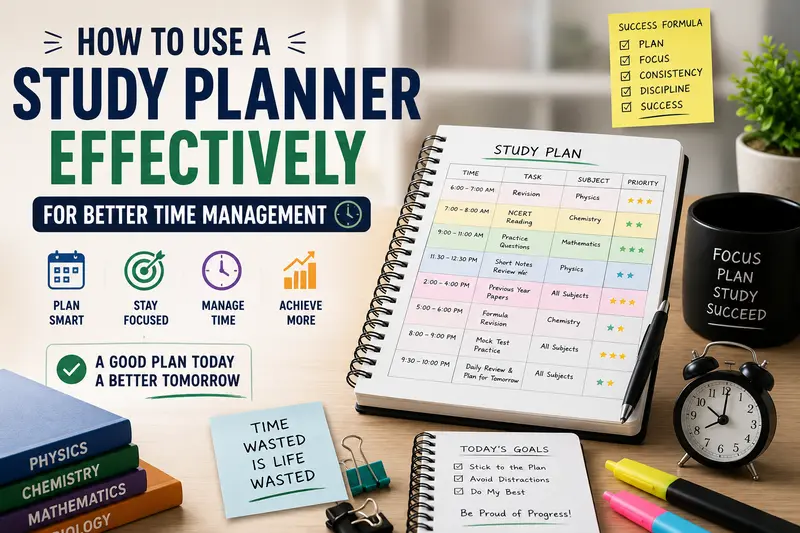
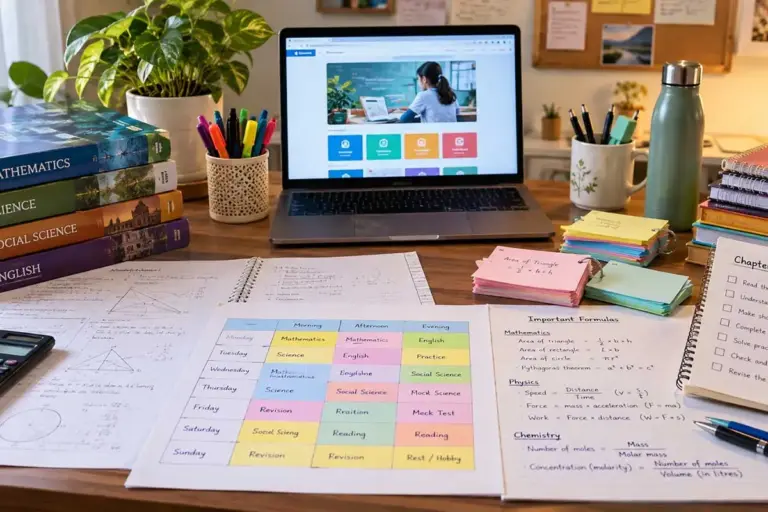
3.2 Weekly Study Timetable
A good timetable is a realistic one. It makes room for schoolwork, revision, practice, rest and a bit of fun.
| Day | Main study task | Practice task | Review |
| Monday | Mathematics chapter | Solve 10 questions | Correct errors |
| Tuesday | Science concepts | Label a diagram and answer questions | Recall key terms |
| Wednesday | English | Grammar and writing practice | Review corrections |
| Thursday | Social Science | Revise a topic using short notes | Recall dates and concepts |
| Friday | Difficult subject | Complete a short test | Record weak areas |
| Saturday | Two subjects | Worksheets or sample questions | Revisit mistakes |
| Sunday | Weekly revision | Short self-test | Plan next week |
Treat this as an example, not a rulebook. Adjust it around your school hours, tuition, homework, exams and the way you learn best.
If you would like a more structured approach, take a look at this CBSE Study Planner for Students.
3.3 Formula Sheets and Quick-Revision Cards
Formula sheets are a lifesaver in Mathematics, Physics, Chemistry and any other subject where you need to recall things quickly.
A good one includes:
- The formula or rule itself.
- What each symbol stands for.
- Units, where they matter.
- One short worked example.
- A common mistake to watch out for.
A Physics card, for instance, could show how speed, distance and time are related, followed by one simple numerical problem.
Flashcards are great for vocabulary, scientific terms, historical events, geography facts, grammar rules and definitions. Write the question on one side and the answer on the other.
Go through your cards at widening gaps: the next day, three days later, then a week later. Spend extra time on the ones you keep getting wrong.
3.4 Chapter-Wise Worksheets
Worksheets turn passive reading into active practice. They can include multiple-choice questions, fill-in-the-blanks, matching, short answers, application-based problems and diagram labelling.
The format should suit the subject:
- Mathematics: calculations, word problems and step-by-step solutions.
- Science: labelled diagrams, observations, reasoning questions and experiments.
- English: comprehension passages, vocabulary, grammar and writing tasks.
- Social Science: map work, timelines, source-based questions and short notes.
- Primary classes: number recognition, reading comprehension, handwriting and simple activities.
Before you print a worksheet, check that the questions match the current syllabus and your class. A colourful worksheet is not automatically a useful one. It should practise one clear learning goal.
3.5 Mistake Tracker
A mistake tracker helps you learn from wrong answers instead of repeating them test after test.
| Date | Subject and topic | Mistake | What to do next |
| 12 Oct | Mathematics: Fractions | Incorrect calculation | Solve five similar questions |
| 13 Oct | Science: Electricity | Confused two definitions | Review notes and explain the difference |
| 14 Oct | English: Grammar | Incorrect verb form | Complete a short grammar exercise |
Look through the tracker every weekend. Once you have corrected a mistake, try a similar question without peeking at the answer.
It is especially handy in the weeks before exams, when your time is better spent on the errors that keep coming back than on revising every topic equally.
4. Which Free Resources Are Best for Each Class and Subject?
The right resource depends on your age, your subject and what you are trying to achieve. A Class 3 student may get the most from short activities and reading practice, while a Class 12 student probably needs timed papers and detailed answer evaluation.
Recommended resources by class group
| Class group | Resources to prioritise | Suggested learning aid |
| Classes 1–2 | Textbooks, picture-based activities, reading practice, simple digital content | Reading chart and number practice sheet |
| Classes 3–5 | Textbook exercises, worksheets, vocabulary cards, basic quizzes | Weekly homework checklist |
| Classes 6–8 | Chapter summaries, concept videos, subject worksheets, diagrams, maps | Chapter completion tracker |
| Classes 9–10 | NCERT textbooks, syllabus checklists, sample papers, previous papers | Revision timetable and mistake tracker |
| Classes 11–12 | Prescribed textbooks, subject-specific practice, official sample papers, marking schemes | Formula sheets, chapter tracker, mock-test log |
These are general suggestions. Always confirm the prescribed books, syllabus and exam requirements for your academic session.
How can students choose resources for individual subjects?
Mathematics: Start with worked examples and textbook exercises. Use a worksheet to practise similar questions, then write your errors in a mistake tracker. Keep one separate sheet for the formulas and methods you need to revise often.
Science: Read the chapter and make sure you understand the diagrams and processes. Bring in a video only when a concept still feels unclear. Practise numericals, labelled diagrams, definitions and application-based questions.
English and other languages: Mix reading comprehension, grammar, vocabulary and regular writing. A simple vocabulary notebook works well for unfamiliar words, their meanings and an example sentence for each.
Social Science: Make timelines, map-practice sheets, comparison charts and short topic summaries. Practise answering in your own words rather than memorising whole paragraphs you have not understood.
If you are in Class 10 or 12, have a look at the official CBSE sample papers and marking schemes before you begin serious board-exam practice.
5. How Can You Build a Free Weekly Study System?
Gathering resources is only the first step. What turns them into learning is a routine you can repeat.
Here is a simple seven-day rhythm you can adapt to your own school schedule.
Monday: Plan the week. Write down homework, upcoming tests and difficult chapters. Pick three realistic goals and set aside study sessions for them.
Tuesday and Wednesday: Learn and practise. Read the relevant textbook sections, watch an explanation if you need one, and work through chapter exercises or worksheets.
Thursday: Revise. Use flashcards, short notes, formula sheets and self-testing to revisit earlier topics.
Friday and Saturday: Check your progress. Take a short test or try some exam questions. Check your answers, log your mistakes and practise the weak spots.
Sunday: Review and reset. See what you completed, go back to the mistakes that keep recurring and plan the coming week. Leave some time free for rest and hobbies too.
If you want more help with planning, you can read CBSE Study Resources Every Student Should Know About. Above all, pick a routine you can actually keep up, and resist the urge to redesign your timetable every few days.
6. How Can Students Use Free Resources More Effectively?
Even the best resources will not do much if you only read or watch them passively. These habits can make every study session count for more.
Follow the textbook-first method
Read the relevant textbook section before opening anything else. Work out exactly what you do not understand, then use an explanation, video or worksheet to clear up that specific difficulty.
Afterwards, go back to the textbook to lock the idea in.
Use active recall
Close the book and try to explain the topic out loud, or write the main points from memory. After a Science chapter, for example, try drawing the process diagram without looking.
Then compare your attempt with the source and fix anything you missed or got wrong.
Practise before checking answers
Try the questions on your own first, then look at the solutions. If an answer is wrong, find out why and solve another similar question.
For board classes, official marking schemes show you what examiners look for. Just remember that a marking scheme is a guide to how answers are assessed, not a stand-in for learning the subject.
Download materials for offline use
If you share a device or your internet is unreliable, download textbooks and permitted materials ahead of time, and keep the files organised by class, subject and chapter.
For example:
- Class 9 → Mathematics → Chapter 1
- Class 9 → Science → Chapter 1
- Class 9 → English → Reading Practice
This saves time hunting for files and makes revision easier on the road or during an internet outage.
Review your progress every week
At the end of each week, ask yourself three questions:
- Which topics can I now explain without any help?
- Which mistakes did I keep making?
- What are the three most important tasks for next week?
A simple progress record often shows improvement more honestly than the confidence you feel after a study session.
7. What Mistakes Should Students Avoid When Using Free Resources?
Free resources are valuable, but using them without a clear purpose can waste time and leave you more confused than before.
Downloading too many worksheets
A folder with dozens of worksheets can feel productive, but finishing and reviewing a handful of relevant ones is usually worth more. Pick practice material based on the chapters you have studied and the mistakes you need to fix.
Depending entirely on videos
Videos can make hard concepts easier to grasp, but watching an explanation is not the same as being able to answer questions yourself. After each video, read the textbook, write out some practice or take a short self-test.
Using outdated study materials
CBSE syllabuses, prescribed textbooks and exam requirements can change. Make sure what you are using matches the current academic session, especially in a board exam year.
Memorising answers without understanding them
Memorisation has its place when it comes to definitions, formulas and facts. But you should also practise explaining concepts, applying rules and tackling questions you have not seen before.
Ignoring copyright and source reliability
Stick to official educational portals and legitimate learning resources. Stay away from suspicious download sites, pirated textbooks and files that ask for personal information they do not need. NCERT textbooks are copyrighted, so being able to download them for study does not give you permission to republish or sell copies.
For more on choosing study methods that suit you, see Effective Study Techniques for Students.
8. How Can Parents and Teachers Support Students?
Parents and teachers can help children make the most of free resources without piling on extra work.
Parents can:
- Set up a quiet, comfortable place to study.
- Help younger children find worksheets suited to their age.
- Encourage regular reading and independent problem-solving.
- Look over completed checklists and celebrate steady effort.
- Resist turning every free hour into another study session.
Teachers can recommend reliable resources for particular chapters, prepare worksheets at different levels and use short quizzes to spot learning gaps. They can also ask students to explain how they reached an answer, rather than looking only at the marks.
Families exploring more digital options may find Best Free Online Learning Platforms for School Students useful.
The goal is to make learning easier to reach and easier to manage, not to give students more tasks to tick off.
9. Key Takeaways
- Start with official resources. NCERT textbooks, ePathshala, DIKSHA and CBSE exam materials give you a solid base.
- Use printables with a purpose. Checklists, worksheets, flashcards, formula sheets and mistake trackers each help at a different stage of learning.
- Match resources to your class. Younger children do well with activities and foundational practice, while board students need syllabus-aligned revision and exam practice.
- Keep a steady routine. A weekly timetable helps you balance homework, learning, revision and self-checks.
- Practise active recall. Close the book, answer questions on your own and go over your mistakes instead of just rereading.
- Verify every resource. Check its accuracy, relevance, academic session and source before you rely on it.
- Choose progress over quantity. A few well-chosen resources used regularly beat dozens of downloads you never open.
10. Frequently Asked Questions
1. What are the best free educational resources for CBSE students?
NCERT textbooks, ePathshala, DIKSHA, official CBSE sample papers, previous years’ question papers and syllabus-aligned worksheets are all good places to begin. Printable checklists and revision cards can help you stay organised as you prepare.
2. Where can CBSE students download free NCERT textbooks?
Head to the official NCERT Textbooks portal, which has digital textbooks for Classes 1–12. Just choose your class, subject, language and book.
3. Are CBSE sample papers available for free?
Yes. CBSE publishes sample question papers and marking schemes on its official website. Pick the right class, subject and exam session before you start practising.
4. Which free resources are best for Class 10 board exam preparation?
Class 10 students should focus on the prescribed textbooks, the current syllabus, official sample papers, marking schemes, previous years’ papers and chapter-wise practice. A revision checklist and a mistake tracker can show you where to spend more time.
5. Can students prepare for CBSE exams without buying extra guidebooks?
Yes. You can build a strong preparation routine from prescribed textbooks, official exam materials, free digital resources and relevant practice worksheets. Extra books may help some learners, but they are not essential for everyone.
6. Which free resources are suitable for primary school students?
For Classes 1–5, good options include NCERT textbooks, ePathshala, DIKSHA, reading exercises, basic Mathematics worksheets, vocabulary cards and age-appropriate activities. Parents and teachers can choose material that suits each child’s level.
7. How can students make their own printable study resources?
A notebook or a simple document is enough for weekly timetables, chapter checklists, flashcards, formula sheets and mistake trackers. Give each one a single purpose, use clear headings and leave enough room for answers and notes.
8. Is DIKSHA useful for CBSE students?
Yes. DIKSHA hosts content from NCERT, CBSE and other participating education bodies, including textbooks, videos, quizzes and practice material. Just check that whatever you open matches your class and syllabus.
9. How should students organise downloaded study materials?
Set up folders by class, subject and chapter, and use clear file names. Keep the latest syllabus and exam resources where you can find them quickly, delete duplicate or outdated files, and back up your important notes. Download only from reliable sources.
10. How many educational resources should a student use?
There is no magic number. A practical starting set is one prescribed textbook, one reliable source of explanations for when you get stuck, a set of relevant practice questions and a simple revision tracker for each subject. Add more only when they solve a specific learning need.
Student Success Desk focuses on practical learning strategies, study techniques, and academic improvement tips for school students.