

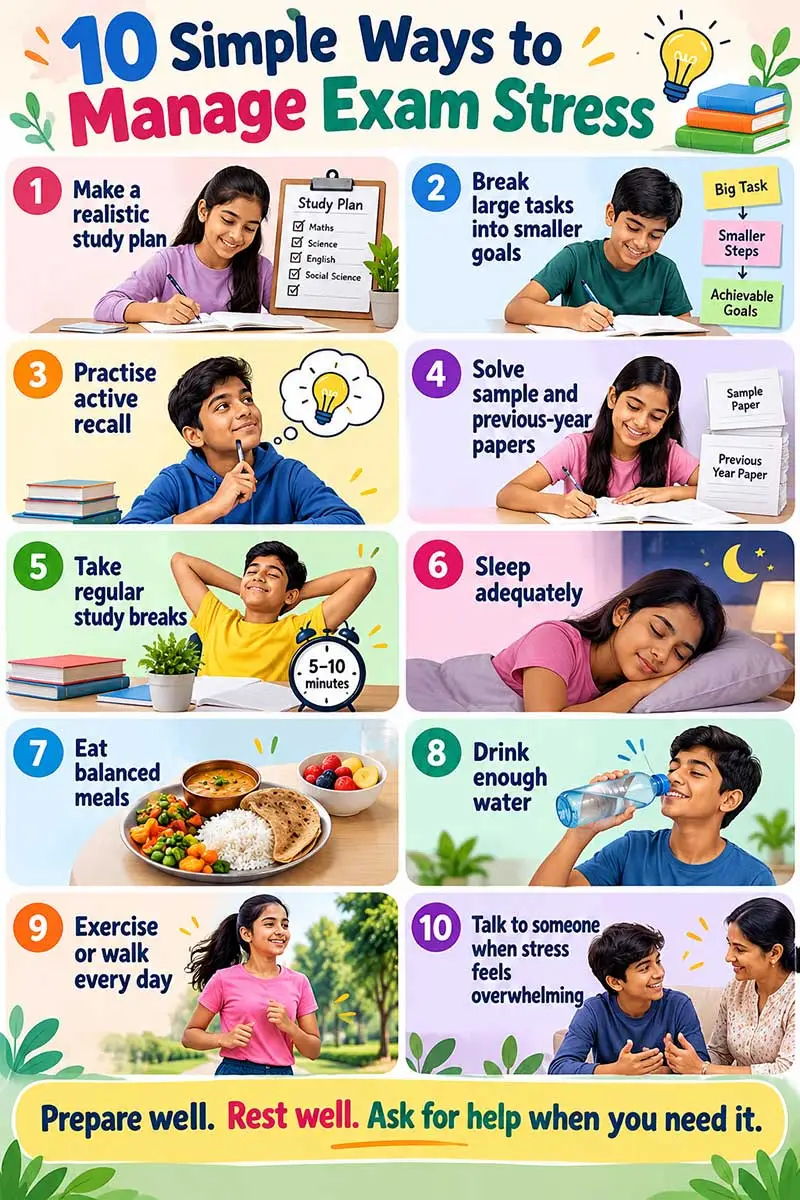
Students manage exam stress best by sticking to a realistic study schedule, breaking big tasks into smaller ones, sleeping enough, eating properly, staying active, cutting down distractions, and taking breaks without guilt. When the pressure feels like too much, talking to a parent, teacher, friend, or counsellor genuinely helps.
What Exam Stress Actually Feels Like
A bit of nervousness before an exam is normal — it’s what pushes you to revise and pay attention. Exam stress becomes a problem when it starts eating into sleep, focus, appetite, or confidence.
You might recognise it as worrying constantly about marks, struggling to concentrate, headaches, irritability, racing thoughts, poor sleep, eating too little or too much, blanking out at the thought of the exam hall, comparing yourself to classmates, or putting things off because the syllabus feels endless.
None of this means a student is weak. It usually just means they need a better plan, more rest, or some support. The Ministry of Education’s MANODARPAN initiative treats stress and emotional wellbeing as a genuine part of student development, and offers resources for students, parents, and teachers alike.
Why Exams Feel So Stressful
Pressure shows up from different directions, and knowing where yours is coming from makes it easier to deal with.
| What’s going on | What it sounds like | What actually helps |
| Huge syllabus | “I’ll never finish this” | Break it into smaller chunks |
| Fear of failing | “One bad exam ruins everything” | Focus on the next task, not the whole outcome |
| Parental pressure | “I have to top the class” | Talk through realistic goals together |
| Poor time management | “There’s just no time” | Build a priority-based timetable |
| Comparing yourself | “Everyone’s ahead of me” | Track your own progress instead |
| Feeling unprepared | “I don’t know anything” | Start with the weakest chapter, not the whole book |
| Not sleeping | “I’ll just study all night” | Protect sleep, study in your productive hours |
| Phone distractions | “I’ll study after one more scroll” | Keep the phone out of reach while studying |
For a lot of Indian students, exam prep happens on top of school, tuition, coaching, homework, and family responsibilities. So the goal isn’t to squeeze in more hours — it’s to make a plan that actually fits your life.
So, How Do You Actually Manage It?
You don’t need to get rid of every worried thought. You just need habits that make the pressure easier to carry.
Focus on what you can control. You can’t control how hard the paper is or what marks you’ll get. You can control how you prepare, how you use your time, whether you practise questions, how much you sleep, what you eat, and whether you ask for help. When it all feels like too much, just ask: “What’s the next useful thing I can do?” If the answer is “revise two pages” or “take a ten-minute break,” start there.
Build a study plan you’ll actually follow. A timetable should reduce confusion, not add another layer of pressure. Instead of “study maths for four hours,” try something specific — “revise quadratic equations, solve 15 problems, check my mistakes.” A good planner covers the subjects that need urgent attention, chapters due for revision, practice sessions, breaks, meals, some physical activity, and enough sleep. CBSEGuide’s CBSE Study Planner for Students is a solid framework for turning all of this into manageable blocks, and their daily study routine for students can help you stay consistent without losing your whole day to studying.
Try sorting chapters by priority. Split topics into three buckets: high priority (the ones you find genuinely difficult), medium (understandable, but needs revision), and low (you already know this). This stops you from spending hours polishing what you’re already good at while the hard chapters sit untouched.
Study smarter, not just longer. More hours doesn’t automatically mean more learning. Active recall (closing the book and trying to remember), practice testing, spaced revision, keeping a list of repeated mistakes, explaining a topic out loud, and mind maps all do more for retention than passive re-reading. CBSEGuide’s smart study techniques guide walks through several of these, and their CBSE revision techniques are useful specifically for final board-exam prep.
Practise with real papers. An unfamiliar format is often what makes an exam feel scarier than it needs to be. Revise the material, attempt a previous-year paper under the actual time limit, check your answers properly, note what keeps going wrong, fix it, and try another paper later. CBSEGuide’s guide to solving previous-year question papers treats these papers as rehearsals rather than just another source of questions — which is the right way to think about them.
Actually take breaks. Studying non-stop feels productive, but your concentration doesn’t agree. Try roughly 40–50 minutes of focused work, then a 5–10 minute break — stand up, stretch, drink some water, look away from the screen. A break isn’t wasted time; it’s part of how attention works. Just watch out for the five-minute break that quietly turns into thirty because of your phone.
Protect your sleep. It’s tempting to treat sleep as time you can “borrow” for revision, but showing up exhausted makes it harder to concentrate, recall what you studied, and manage your time in the exam. Try to sleep and wake at roughly the same time each day, finish intense studying before bed, keep your phone away from the bed, and save the last part of the evening for lighter revision rather than cramming. MANODARPAN’s guidance for students also stresses this same balance of sleep, food, learning, and activity.
Eat properly and stay hydrated. You don’t need a special “exam diet” — just regular, balanced meals instead of relying on sugar, caffeine, or energy drinks to get through the day. Rice or roti, dal or pulses, vegetables, fruit, curd, a protein source you like, and plenty of water cover most of it. Skipping meals to “save time” for studying usually backfires, and mild dehydration alone can leave you feeling more tired than you realise.
Move your body. You don’t need an intense workout during exam season — a 15–30 minute walk, some stretching, yoga, or a game outdoors is enough to break up long hours of sitting. A little stretching in the morning, short movement breaks between study sessions, and a walk in the evening go a long way. The point is balance, not one more thing to perform at.
Deal with the panic when it hits. Some students know the material cold and still freeze the moment they see the question paper. If that happens, put both feet on the floor, breathe in slowly, breathe out slowly, repeat a few times while relaxing your shoulders, and then ask yourself: “Which question can I answer first?” Start there instead of staring at the whole paper at once.
Catch the unhelpful thoughts. “I will fail” can become “I’ll focus on preparing as well as I can.” “Everyone is better than me” can become “my own progress is what matters here.” This isn’t about pretending things are fine — it’s about swapping catastrophic thinking for something you can actually act on.
What Parents Can Do
Parents shape the emotional temperature at home more than they often realise. Asking “how can I help?” instead of “how did the test go?”, keeping the house quiet enough to study in, encouraging regular meals and sleep, noticing effort rather than just results, skipping comparisons with siblings or classmates, and simply listening when your child wants to talk all make a real difference. CBSE’s 2026 guidance on mental health specifically asks schools to help parents avoid piling on academic pressure and to respond to distress with empathy rather than criticism. CBSEGuide’s guide on supporting children during exam season has more practical ideas for this.
Habits Worth Dropping
A few things tend to make exam stress worse rather than better: all-nighters, skipped meals, comparing study hours with friends, constant social media checking, starting a brand-new topic at the last minute, an unrealistic timetable, only revising your favourite subjects, ignoring the same mistakes over and over, too much caffeine, panicking over one bad mock test, and treating marks as a measure of your worth. One rough practice paper doesn’t say anything about your ability — it’s just information about what to fix next.
A Simple Routine to Adapt
There’s no perfect timetable, but a shape like this — wake up and eat breakfast, tackle your hardest subject first, short break, practice questions, lunch, second subject, evening walk or hobby time, one more practice block, light revision at night, and sleep at a consistent hour — gives most students enough structure without boxing them in. Adjust it to your own school hours, coaching schedule, and energy levels.
A Quick Daily Checklist
Tick off what applies each day: followed a realistic plan, finished the most important task, practised active recall or questions, took real breaks, drank enough water, ate proper meals, moved your body, kept phone use in check, relaxed a little, avoided comparing yourself to others, and protected your sleep. Missing a few items sometimes is completely normal — the point is spotting patterns, not chasing a perfect score.
When It’s Time to Ask for Help
Exam stress is common, but no student should have to manage serious distress on their own. If the pressure becomes constant and starts affecting sleep, eating, school, or daily life, it’s time to talk to a trusted adult, school counsellor, psychologist, or doctor.
If a student ever has thoughts of self-harm or doesn’t feel safe, that calls for immediate help from a trusted adult or an emergency mental-health service — not something to handle alone. India’s National Task Force student-support resource currently lists Tele-MANAS at 14416 or 1800-891-4416, available 24/7, and Manodarpan at 8448440632 for student emotional support. CBSE also runs free psycho-social counselling for Class X and XII students in its 2026 exam cycle, including a 24-hour IVRS line and access to trained counsellors during set hours. You can find more through the official CBSE counselling resources and MANODARPAN student well-being resources.

The Short Version
Managing exam stress really comes down to looking after both your preparation and yourself. Build a realistic plan instead of an overloaded one. Break big chapters into small wins. Use active recall, practice questions, and spaced revision. Work through previous-year papers under real conditions. Take actual breaks. Protect your sleep. Eat properly and stay hydrated. Move your body. Keep your phone in check. Swap catastrophic thoughts for ones you can act on. And ask for help — from parents, teachers, counsellors, or professionals — when it gets hard to manage alone.
The goal was never to study every waking hour. It’s to walk into the exam with enough knowledge, practice, and a clear enough head to actually use it.
Frequently Asked Questions
1. What’s the best way to reduce exam stress?
Realistic planning, regular revision, enough sleep, decent meals, some movement, real breaks, and support from people around you — together, not in isolation. Focus on the next manageable task rather than the whole syllabus at once.
2. How do I stop feeling nervous before an exam?
Prepare ahead of time, practise previous-year papers, skip the last-minute cramming, sleep properly, and breathe slowly when the nerves hit. In the hall, start with the question you understand best.
3. Should I pull an all-nighter before an exam?
Generally, no — it leaves you tired exactly when you need to concentrate and recall things clearly. Revise what matters, prep for the morning, and protect your normal sleep as much as you can.
4. How many hours should I study during exams?
There’s no magic number — it depends on your age, subjects, and how you concentrate. How well you study matters far more than how many hours you clock.
5. Does exercise actually help with exam stress?
Yes. Even light activity like walking, stretching, or yoga gives you a healthy break from sitting and studying for hours on end. You don’t need an intense routine during exams.
6. What should I be eating during exams?
Regular, balanced meals with carbs, protein, vegetables, and fruit, plus plenty of water. Don’t let caffeine or sugary snacks replace actual food.
7. How can parents ease exam pressure?
By encouraging without judging, supporting healthy routines, skipping comparisons, recognising effort as well as results, and helping the child get professional support if the distress looks serious.
8. What if I feel completely overwhelmed?
Stop, pick one manageable task, take a short break, and talk to someone you trust. If it ever involves thoughts of self-harm, get help immediately rather than trying to push through alone.
9. Do breaks actually waste study time?
No — short, planned breaks help you stay focused for longer. Just make sure the break stays a break, and doesn’t quietly turn into an hour on your phone.
10. How do previous-year papers help with anxiety?
They make the exam format familiar, so you’re not encountering it cold. Practising with them helps with timing, structure, and spotting your own weak areas before it counts.

Wellness & Balance Team shares educational content focused on healthy routines, study-life balance, and student wellbeing.