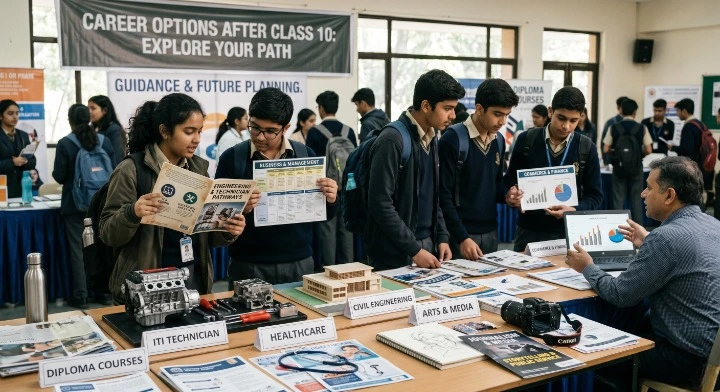

Not every Science student wants to sit for NEET or JEE — and that’s completely fine. If you’re one of them, you’re probably tired of hearing “so what will you do instead?” every time the topic comes up. Here’s the good news: Science opens doors to biotechnology, data science, architecture, psychology, pharmacy, nursing, agriculture, defence, aviation, environmental science, design, and a lot more. What matters isn’t your entrance-exam rank — it’s your subjects, your interests, and where you actually want to end up.
Is NEET or JEE Really the Only Way Forward?
Not at all.
For most Indian students, picking Science in Class 11 quietly turns into “JEE for engineering or NEET for medicine.” That narrow lens can make it feel like skipping these exams means running out of options.
It doesn’t. Science gives you a foundation broad enough to walk into healthcare, research, technology, environment, agriculture, aviation, design, mathematics, psychology, and plenty of interdisciplinary fields. Even CBSE’s senior-secondary curriculum reflects this, offering Physics, Chemistry, Biology, Mathematics, Computer Science, Biotechnology, Data Science, and AI-related subjects side by side. Students who want to see how those subjects branch out into different fields can browse this breakdown of the different branches of science and the careers they lead to, which is a handy starting point before narrowing things down. For a more official take, NCERT’s own resources are built to help school students explore careers rather than treat one exam as the finish line.
So the real question isn’t “what do I do if I don’t clear JEE or NEET?” It’s: which career actually fits my strengths, and what’s the smartest route to get there?
Best Career Options Without NEET or JEE
| Career | Suitable Background | Typical Degree | NEET/JEE Required? |
| Data Scientist | PCM/PCMB | BSc/BTech/BCA + specialisation | No* |
| Biotechnology | PCB/PCMB | BSc/BTech Biotechnology | No* |
| Pure Science Research | PCM/PCB/PCMB | BSc/BS-MS/MSc | No* |
| Architecture | PCM | B.Arch | Not JEE, for most routes* |
| Nursing | PCB | BSc Nursing | Depends on institution/state |
| Pharmacy | PCB/PCM/PCMB | B.Pharm | Usually not NEET* |
| Agriculture | PCB/PCM/PCMB | BSc Agriculture | No* |
| Environmental Science | PCB/PCM/PCMB | BSc Environmental Science | No* |
| Statistics | PCM/PCMB | BSc Statistics | No* |
| Psychology | Any eligible combination | BA/BSc Psychology | No* |
| Defence | PCM/PCMB | NDA route after Class 12 | No JEE/NEET |
| Aviation | PCM | Aviation-related programmes | No JEE/NEET |
| Food Technology | PCM/PCB | BTech/BSc Food Technology | No* |
| Forensic Science | PCB/PCMB | BSc Forensic Science | No* |
| Geology | PCM/PCB | BSc/BS Geology | No* |
*Admission rules vary by institution, university, and state — always check the latest official notification before assuming anything.
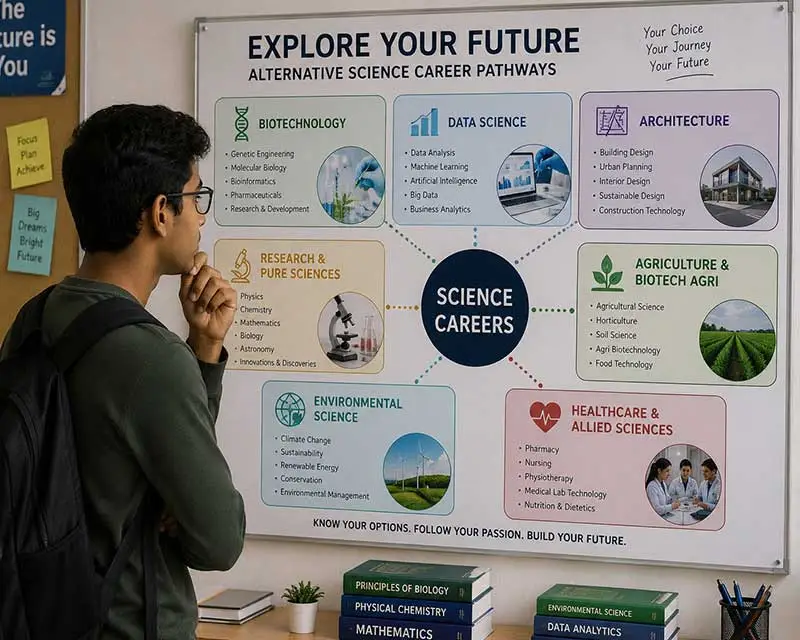
A Quick Tour of the Strongest Options
Pure science and research is for students who’d rather ask “why?” than just memorise the formula. Physics, Chemistry, Mathematics, Biology, Statistics, Geology, Astronomy — pick your obsession, follow it through a BSc into an MSc or integrated programme, and you can land in universities, labs, pharma companies, or industry R&D as a researcher or computational scientist, not just a teacher.
Biotechnology sits where biology, chemistry, and technology meet — genetic engineering, molecular biology, bioinformatics, industrial and agricultural biotech. If you love Biology but have zero interest in treating patients, it’s worth a serious look, usually via BSc/BTech Biotechnology followed by an MSc or specialisation.
Data science and AI suits anyone who enjoys Mathematics, computers, and puzzles. You don’t need JEE — many universities run their own entrance tests or merit-based admissions for BSc Data Science, BCA, BSc Computer Science, or similar courses. Start early: pick up Python, statistics, Excel/SQL, and a bit of data visualisation. Even a small side project, like analysing cricket stats, tells you more about whether you’ll enjoy this than any career quiz.
Architecture works well if you like Mathematics, Physics, and design together. The usual path is a B.Arch, often through NATA, though some institutions run their own admission routes — so double-check before you commit.
Pharmacy is healthcare without the MBBS route. A B.Pharm covers pharmacology, drug formulation, quality control, and clinical research, opening doors into pharma companies, hospitals, regulatory affairs, and drug development. Admission rules differ by state, so verify what your target college actually requires.
Nursing and allied healthcare go far beyond MBBS — nursing, physiotherapy, medical lab technology, radiology, optometry, public health, and nutrition are all real, independent career paths for PCB students, not “backups” to medicine.
Agriculture today is as much about technology as it is about soil — genetics, precision farming, drones, remote sensing, and climate-smart practices are all part of the modern BSc Agriculture, horticulture, or food technology route.
Environmental science is for students who care about climate change, pollution, and sustainability as much as they care about Science itself — think environmental engineering, conservation, renewable energy, and ESG-related roles.
Forensic science blends Biology and Chemistry with crime-scene investigation, DNA analysis, toxicology, and digital forensics — a BSc Forensic Science is the usual entry point, with postgraduate specialisation afterward.
Statistics and mathematics don’t have to funnel into engineering. Actuarial science, quantitative research, economics, risk analysis, and financial analytics are all strong, well-paying paths for a mathematically-minded student.
What Works Best for PCM, PCB, and PCMB Students
PCM students aren’t limited to engineering. Consider data science, statistics, computer science, architecture, physics, defence, aviation, merchant navy, geology, economics, or actuarial science. Someone who loves Math but hates building machines might be happier in Statistics than in a B.Tech.
PCB students can explore biotechnology, microbiology, biochemistry, forensic science, pharmacy, nursing, physiotherapy, nutrition, agriculture, environmental science, food technology, psychology, public health, or life sciences. The key distinction: loving Biology doesn’t mean you have to want to treat patients.
PCMB students get flexibility as their reward — technology, life sciences, and interdisciplinary research are all on the table, from bioinformatics to computational biology to AI. The catch is workload. Take PCMB because you genuinely want both subjects, not just to “keep options open.”
Careers on the Rise
A few fields are growing fast: bioinformatics (biology + statistics + computing), computational biology, AI and machine learning, climate and sustainability, renewable energy, robotics, cybersecurity, and geospatial technology (GIS and satellite data, applied to everything from agriculture to urban planning). CBSE’s evolving curriculum — with Python, AI, and environmental education now built in — reflects this shift toward tech-first careers.
How to Actually Choose
Don’t pick something just because it skips NEET or JEE. Run it through this five-step filter instead.
- Know your strongest subjects. Do you enjoy Maths? Biology? Labs? Computers? Design? Explaining concepts to others? Your answers narrow the field fast.
- Know how you like to work. People-facing → healthcare, psychology, education. Computer-focused → data science, AI, cybersecurity. Lab-based → biotech, chemistry, forensics. Outdoors → agriculture, geology, environmental science. Creative → architecture, design, science communication.
- Check eligibility before you fall in love with a course. Don’t trust a random Instagram post claiming “you can become X without any entrance exam.” Rules change by university, state, and year — always confirm with the official notification.
- Compare the whole pathway, not just the course name: degree → specialisation → skills → internships → postgraduate requirements → actual job roles. A shorter degree isn’t automatically the easier career.
- Test it before committing years to it. Try a beginner Python project for data science, watch a molecular biology lecture for biotech, sketch a basic design for architecture, or research a local environmental issue. Your genuine reaction tells you more than any career quiz will.
For more structured help, CBSEGuide’s career guidance section and its Student Success Assistant are useful for exploring interests further.
Entrance Exams Beyond NEET and JEE
Skipping NEET or JEE doesn’t necessarily mean skipping entrance exams altogether — many programmes just use different ones:
| Area | Possible Admission Route |
| Architecture | NATA or institution/state-specific route |
| Defence | NDA |
| Central university programmes | CUET-UG, where applicable |
| Research programmes | Institution-specific tests |
| Design | Institution-specific entrance tests |
| State universities | State-level or university-specific admission |
| Private universities | Entrance test or merit-based |
| Healthcare (non-MBBS) | Course/state/institution-specific |
For CUET, always check the National Testing Agency’s official CUET portal rather than relying on outdated coaching material — admission rules can shift from one academic year to the next. For subject-wise practice, students can use CUET UG preparation books with chapterwise MCQs and solved papers.
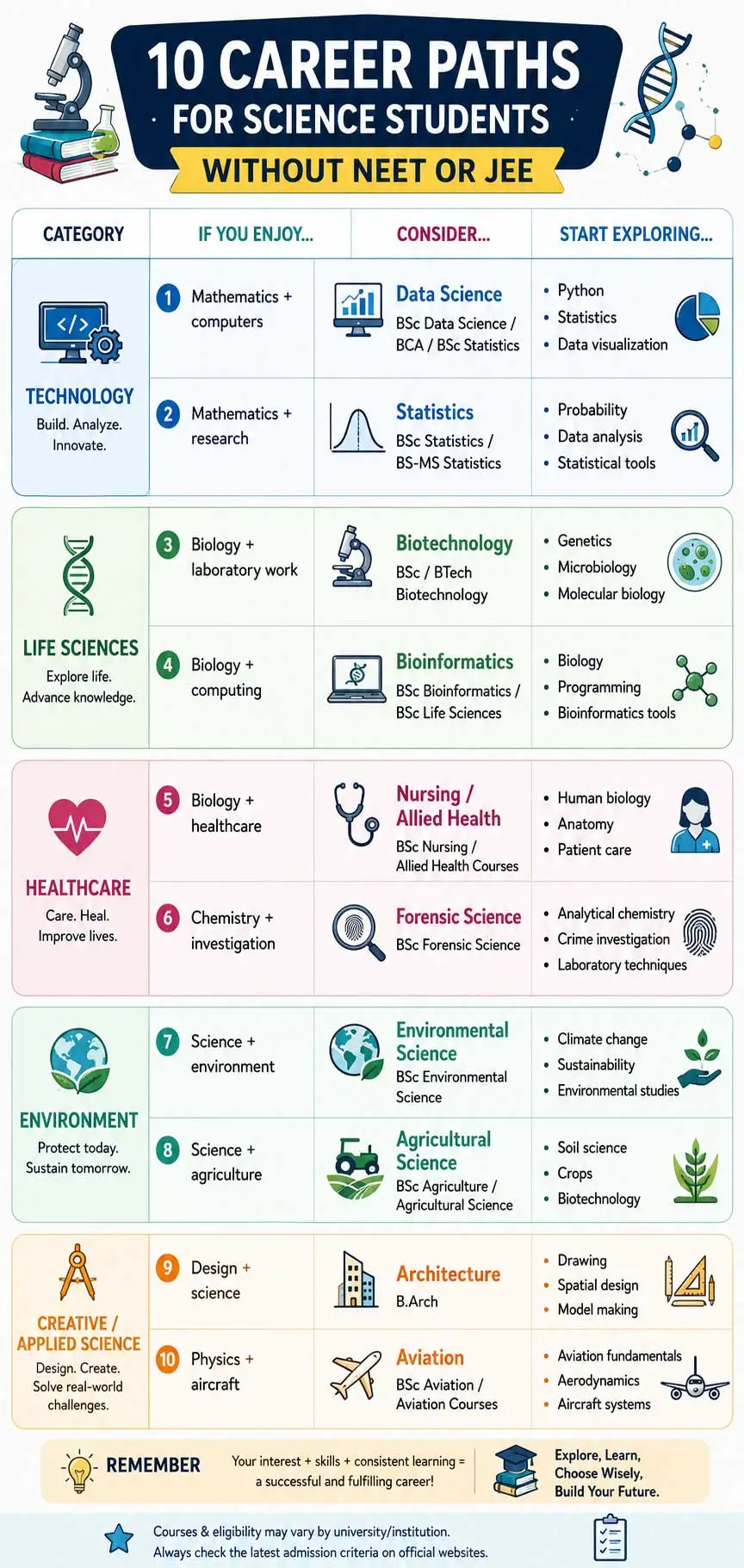
Key Takeaways
- NEET and JEE aren’t the only routes for Science students.
- PCM students can explore data science, statistics, architecture, defence, aviation, and pure science.
- PCB students can consider biotechnology, pharmacy, nursing, allied healthcare, agriculture, and forensic science.
- PCMB students have the broadest interdisciplinary options — at the cost of a heavier workload.
- Emerging fields like AI, bioinformatics, and sustainability are worth watching closely.
- Never choose a course just because it skips an entrance exam — check the latest eligibility rules directly with the institution.
Students prepping for Class 12 can also lean on CBSEGuide’s exam preparation resources and its list of online learning platforms to strengthen their overall strategy.
Frequently Asked Questions
1. What are the best career options for Science students without NEET or JEE?
Biotechnology, pure sciences, data science, statistics, architecture, pharmacy, nursing, agriculture, environmental science, forensic science, aviation, and defence — the right one depends on your subjects, interests, and eligibility.
2. Can a PCB student have a good career without NEET?
Yes — biotechnology, pharmacy, nursing, physiotherapy, microbiology, biochemistry, forensic science, agriculture, and pure biological sciences are all open to PCB students.
3. Can PCM students study something other than engineering?
Absolutely — mathematics, statistics, physics, architecture, data science, economics, defence, aviation, and geology are all realistic options.
4. Is biotechnology a good career without NEET?
Yes, especially if you enjoy biology, lab work, and research. It opens into pharmaceuticals, agriculture, diagnostics, and industrial biotech.
5. Can Science students become data scientists without JEE?
Yes. Many universities offer BSc and related programmes through their own entrance tests or merit-based admissions.
6. Can I pursue architecture without JEE?
Yes — NATA is the major aptitude test for architecture, though some institutions use their own admission routes.
7. Which career suits a Science student who dislikes Biology?
Lean into Mathematics and technology — data science, statistics, computer science, architecture, aviation, or defence.
8. Which career suits a Science student who dislikes Mathematics?
Biotechnology, microbiology, pharmacy, nursing, environmental science, or agriculture are natural fits.
9. Should I take PCMB just to keep every option open?
Not necessarily. It adds flexibility but also workload — take it because you want both subjects, not out of indecision.
10. How should I choose a career if I don’t want NEET or JEE?
Start with your strongest subjects, shortlist three to five careers, research their eligibility, talk to people in the field, and try a small hands-on project before deciding.
Final Word
Skipping NEET or JEE doesn’t mean giving up on Science, and it definitely doesn’t mean settling for a “second-best” career. Science is a foundation, not a single destination — a student who loves Maths might end up in statistics or data science, someone drawn to Biology might thrive in biotech or research, and another might find their fit in architecture, agriculture, or forensic science entirely. The smartest choice isn’t the one with the flashiest entrance exam. It’s the one where your interests, abilities, and the actual pathway line up.
This article is meant for educational career exploration. Eligibility rules, entrance exams, and admission procedures can change between academic years — always verify current requirements directly with the relevant university, examination authority, or government body before making admission decisions.

The Career Awareness Desk publishes informative articles to help students explore career paths, future opportunities, and skill development.