February arrives and something shifts in most households where a Class 10 or Class 12 student lives. The textbooks that sat comfortably on the shelf all year suddenly look overwhelming. Parents start worrying. Students start panicking. And somewhere in that chaos, the actual work of revision gets harder than it needs to be.
Here’s what experienced teachers will tell you: it’s rarely the student’s ability that determines board exam results. More often, it’s how they revise in those final weeks. The right revision techniques for CBSE exams don’t just help you cover more — they help you retain more, stress less, and walk into the exam hall with genuine confidence.
These ten techniques are practical, proven, and built for real students with real time pressures.
Why Most Revision Doesn’t Actually Work
Before getting into what works, it’s worth naming what doesn’t — because a lot of students spend weeks doing things that feel productive but aren’t.
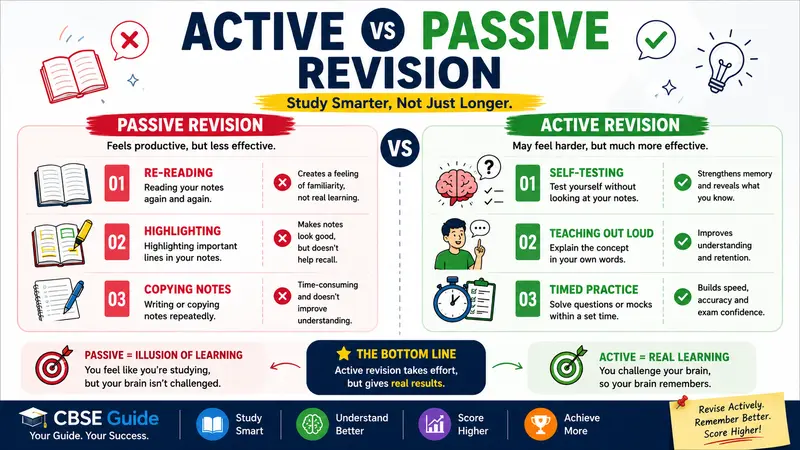
Re-reading chapters from start to finish is the most common one. It feels like studying. It isn’t, really. Your eyes move across the words, your brain stays mostly passive, and by the next morning you’ve retained very little.
Highlighting everything is another. A page where every third line is yellow or pink isn’t a revision tool — it’s just a colourful page.
The techniques below are different. They involve active recall, spaced practice, and structured review — which is how the brain actually consolidates information for long-term use.
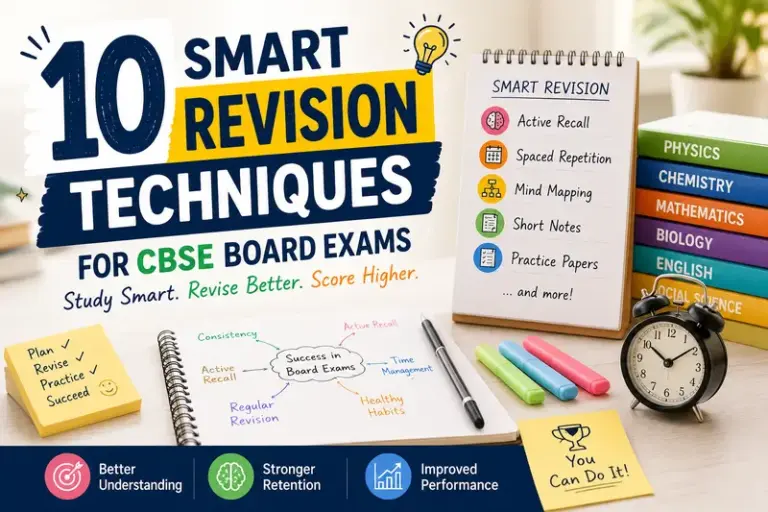
10 Revision Techniques for CBSE Exams That Actually Help
1. Start With the CBSE Syllabus, Not Your Textbook
This sounds obvious but most students skip it. Before you open a single chapter, download the official CBSE syllabus for your subject and go through it carefully.
Mark which units carry more weight. Identify the chapters you’re genuinely comfortable with versus the ones you’ve been avoiding. This gives you a revision map — something you can actually plan around — rather than just starting from Chapter 1 and hoping for the best.
Teachers often say the students who struggle most in boards are those who revised everything equally. Prioritising based on marks weightage is simply smarter.
2. Use the Previous Years’ Question Papers as Your Compass
CBSE question papers from the last five to ten years are freely available, and they’re one of the most underused revision tools students have.
Go through them not just for practice, but for patterns. Which theorems come up every year in Maths? Which poets appear most frequently in English literature? Which chapters in Biology seem to generate questions in every paper?
Once you spot the patterns, you know where to focus. Not to ignore everything else — but to know where the exam is most likely to test you hard.
3. Make Short Notes in Your Own Words
Not fair notes. Not beautiful notes. Short, messy notes in your own words — the kind you’d scribble to explain something to a friend.
When you write a concept down in your own language, you’re not copying — you’re processing. Your brain has to understand something before it can rephrase it, which is exactly the kind of active engagement that makes information stick.
For a chapter like Heredity in Biology or Nationalism in History, try summarising the entire chapter in one page. If you can do that, you actually know the chapter. If you can’t, you know exactly where the gap is.
4. Teach It Out Loud — Even If No One Is Listening
This one feels strange until you try it. Pick a concept — say, the working of the human eye in Physics, or the impact of the French Revolution in History — and explain it out loud as if you’re teaching it to someone.
No notes. No textbook. Just you, speaking.
What comes naturally? What do you stumble on? The stumbling points are where your understanding has a gap. This is far more accurate feedback than re-reading the chapter and thinking “yes, I know this.”
Some students record themselves on their phone and play it back. Others talk to a sibling or a wall. The method doesn’t matter. Speaking forces clarity in a way that silent reading never does.
5. Practice Spaced Revision — Don’t Leave Chapters Behind
Most students revise a chapter once and move on, never returning to it until the last week. By then, a lot of it has faded.
Spaced revision means deliberately coming back to a chapter after a few days, then again after a week, then again before the exam. Each time, you don’t re-read the whole thing — you test yourself on it. Can you recall the key points? Can you solve a question from it without help?
It takes more planning than linear revision, but it’s genuinely worth it. Topics stay fresh because your brain keeps being asked to retrieve them, which is how long-term memory actually works.
6. Solve NCERT Examples and Exercise Questions — Every Single One
This applies especially to Maths and Science. CBSE board papers are built heavily around NCERT. Not textbooks in general — NCERT specifically.
Students often use reference books for extra practice and skip several NCERT exercise problems because they seem simple. That’s a mistake. Some of the most direct board questions come straight from NCERT examples or are slight variations of exercise questions.
Go through every solved example in your NCERT chapters. Understand the method. Then solve every exercise problem independently. If a question type trips you up, that’s a signal — not something to scroll past.
7. Make a Formula and Definition Sheet for Every Subject
In the final days before an exam, you don’t have time to flip through chapters. You need quick access to everything critical — formulas, definitions, theorems, dates, key terms.
Create a single revision sheet per subject. One or two pages, handwritten, covering everything you need to remember quickly. Formulas for Physics. Key reactions for Chemistry. Important dates and events for History. Literary devices and quotes for English.
These sheets serve two purposes: making them forces you to identify what’s truly important in each subject, and using them in the days before the exam gives your memory a final, focused refresh.
8. Attempt Full-Length Mock Tests Under Exam Conditions
There’s a difference between knowing something and being able to use it under time pressure. Timed practice bridges that gap.
Set aside three hours. Sit at your desk without your phone. Attempt a full past paper in one sitting — same conditions as the real thing. When time is up, stop.
Then check your answers honestly. Where did you run out of time? Where did you leave questions blank even though you “knew” the topic? Time management in board exams is a skill that only develops through practice under actual time pressure.
Doing this at least twice for each major subject before the exam is something most high-scoring students have in common.
9. Focus on Answer Writing, Not Just Knowledge
Knowing the right answer and writing it well in a board exam are two different skills. CBSE marking schemes reward specific things — keywords, structured points, correct diagrams with labels, value-based responses.
Practice writing answers the way the marking scheme expects. For a 5-mark question in Social Studies, you need structured points, not a single paragraph. For a derivation in Physics, each step needs to be clearly shown. For an essay-type answer in English, the introduction and conclusion matter.
Look at CBSE sample papers and their marking schemes (available on the official CBSE website). They show you exactly what evaluators are looking for — use that knowledge.
10. Protect Your Sleep and Take Short Breaks
This one gets left out of most revision guides because it doesn’t sound academic enough. But it belongs here.
The brain consolidates memory during sleep. A student who studies until 2 am and wakes up exhausted is not in better shape than one who studied until 11 pm and slept well. Sleep is not wasted revision time — it’s when the revision you did actually gets stored.
Short breaks during study sessions matter too. Studying for four hours straight without pausing tends to produce diminishing returns after the first ninety minutes or so. A ten-minute break — away from your phone ideally — helps you return with better focus.
Board exams are a marathon, not a sprint. Students who manage their energy well across weeks of preparation tend to perform better than those who burn out early.
Common Revision Mistakes to Avoid
Even with good intentions, students fall into patterns that hurt more than help. A few worth watching for:
Starting too late. Two weeks is not enough time to revise twelve months of content properly. Revision should ideally begin six to eight weeks before your first paper.
Revising only what you already know. It feels good to go over topics you’re comfortable with — but it’s the difficult chapters that need your time and energy.
Ignoring diagrams and maps. In subjects like Biology, Geography, and Physics, diagrams carry marks. Practise drawing and labelling them from memory, not just recognising them in the book.
Skipping the writing practice. Reading through an answer in your head and actually writing it out are very different. Your hand needs to be as prepared as your mind.
Final Takeaway
The weeks before CBSE board exams are long, and they’re not always comfortable. But students who approach revision with a real plan — who prioritise smartly, practise actively, and take care of themselves along the way — almost always feel more ready on exam day than those who simply study more hours.
These revision techniques for CBSE exams aren’t complicated. They just require consistency. Pick the ones that fit how you work, build them into your daily schedule, and trust the process.
The preparation you do now will show up when it matters most.
Frequently Asked Questions (FAQs)
Q1. How early should I start revision for CBSE board exams?
Ideally, six to eight weeks before your first exam. This gives you enough time to cover all subjects without rushing, identify weak areas, do timed mock tests, and still have a few days at the end for light review. Starting revision just two or three weeks before the exam makes it very hard to cover everything properly.
Q2. How many hours a day should I study during board exam revision?
There’s no single right answer — it depends on the student. Most students find that six to eight focused hours a day is more effective than ten to twelve hours with frequent distractions. Quality of attention matters more than the number of hours you’re sitting at a desk. Short, consistent sessions with breaks tend to work better than marathon study days.
Q3. Is it better to revise one subject per day or multiple subjects? Most students find it more effective to cover two to three subjects per day rather than spending an entire day on one. This keeps your mind engaged and ensures you’re revisiting all subjects regularly rather than spending too much time on favourites and neglecting others.
Q4. How should I revise for CBSE Maths effectively?
Maths revision is almost entirely about practice — you can’t revise Maths by reading. Solve NCERT exercises, attempt past-year questions, and do full timed tests. When you get a problem wrong, don’t just check the answer — understand the step where your method went wrong and redo the problem from scratch.
Q5. Should I study from reference books or stick to NCERT for boards?
For CBSE boards, NCERT is the foundation. Most questions — especially in Science, Maths, and Social Studies — are directly based on NCERT content. Reference books are useful for extra practice and deeper understanding, but they should come after NCERT is thoroughly covered, not instead of it.

Student Success Desk focuses on practical learning strategies, study techniques, and academic improvement tips for school students.