

Quick Answer
If you’ve ever sat down to study and felt your attention drift within minutes, the Pomodoro Technique is worth trying. It’s a simple way of studying in short, focused bursts with regular breaks built in — classically, 25 minutes of work followed by a 5-minute breather. After four rounds, you take a longer break. Nothing fancy about it, but for a lot of students it does two things at once: it makes it easier to actually start, and it stops a study session from quietly turning into two hours of half-attention.
What Is the Pomodoro Technique?
The Pomodoro Technique is, at its core, a way of chopping study time into short, focused chunks separated by short breaks. That’s really all it is — no app, subscription, or elaborate planner required.
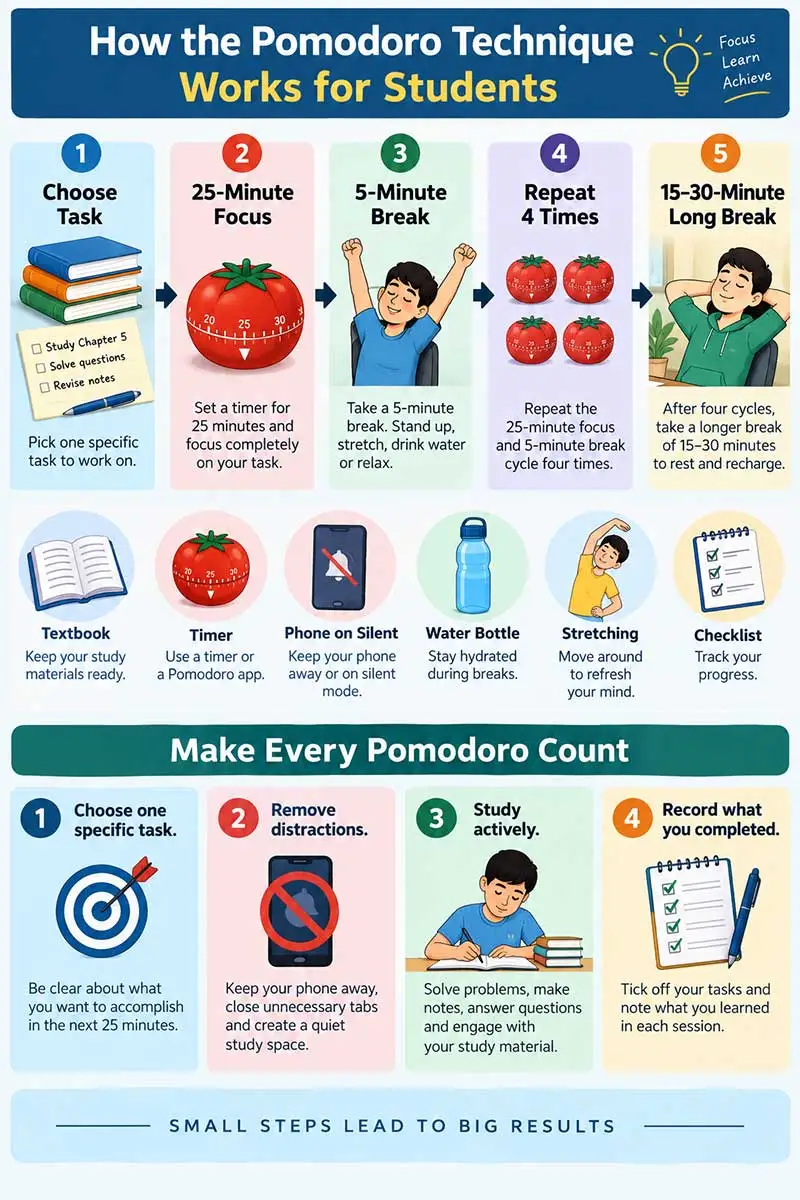
The classic rhythm looks like this:
25 minutes study → 5 minutes break → repeat
After four of these rounds, you take a longer break — usually somewhere between 15 and 30 minutes.
The method was put together in the late 1980s by Francesco Cirillo, and it caught on largely because it asks so little of you upfront. There’s no system to learn — just a timer, one task, and a genuine intention to focus for the next 25 minutes.
For a CBSE student, an evening might look something like this:
- 25 minutes: Solve five Mathematics problems
- 5 minutes: Stretch and drink water
- 25 minutes: Continue Mathematics
- 5 minutes: Take a short break
- 25 minutes: Review mistakes
- 5 minutes: Rest
- 25 minutes: Complete another set of questions
What actually matters here isn’t the timer — it’s the clean separation between real, focused study and real rest. One doesn’t bleed into the other.
That idea lines up with a broader shift in how learning is talked about these days: it’s not about how many hours you clocked at your desk, but what you actually understood and can do afterward. CBSE’s own guidance leans the same way, pushing for active, experiential, student-centred learning rather than passive rote memorising.
How Does the Pomodoro Technique Work?
The mechanics are refreshingly simple.
Step 1: Choose one specific task
Skip vague goals like:
“Study Science.”
Instead, try something like:
“Read the first two sections of the Carbon and Its Compounds chapter and answer five questions.”
A specific task is just easier to start — there’s no ambiguity about what “done” looks like.
Step 2: Set a timer
Set it for 25 minutes and commit to that one task for the whole stretch.
Step 3: Work without intentional distractions
Put your phone somewhere else, or at least switch on Do Not Disturb. Resist the pull of WhatsApp, Instagram, YouTube, or whatever notification just lit up.
If another task pops into your head mid-session, jot it on a quick “later” list instead of chasing it right then.
Step 4: Stop when the timer ends
When the 25 minutes are up, stop — even mid-sentence — and take your break.
Step 5: Take a 5-minute break
Stand up, drink some water, stretch, walk around, or just rest your eyes for a moment.
Step 6: Repeat
After four Pomodoro sessions, take a longer break.
None of this is set in stone. If 25 minutes feels too short once you’re in the groove, there’s nothing wrong with shifting to 40/10 or 50/10 sessions instead.
Why Is Pomodoro Useful for Students?
1. It makes starting easier
“Study for three hours” can feel like a wall. “Focus for 25 minutes” feels doable. That small shift in framing is often enough to get past procrastination.
2. It creates a clear study boundary
It’s easy to sit with a textbook for two hours while actually spending a chunk of that time checking messages or staring blankly at the page. Pomodoro gives the session an actual beginning and end, so there’s less room for that drift.
3. It encourages regular breaks
Studying non-stop isn’t automatically the same as studying well. Short, deliberate breaks tend to make a long study stretch far more manageable — and the Ministry of Education’s own student-support resources make a similar point, encouraging structured schedules that balance learning with healthy routines and everyday life.
4. It helps you measure focused work
Instead of “I studied all evening,” you can say “I completed four focused sessions and revised two topics.” That’s a far more honest picture of what actually got done.
5. It works well with homework and revision
It’s especially handy for the tasks students tend to keep pushing off:
- Mathematics practice
- Science numericals
- English writing
- NCERT exercises
- Flashcard revision
- Previous-year questions
- Project work
- Reading difficult chapters
For more ideas on structuring your day, see this daily study routine for students.
How to Use Pomodoro for CBSE Studies
Pomodoro shouldn’t turn into yet another rigid timetable you feel guilty about breaking. Think of it instead as a study-block system that sits inside a realistic routine.
Here’s what an evening might look like for a Class 10 student:
| Time | Activity |
| 4:30–5:00 PM | Snack and rest |
| 5:00–5:25 PM | Mathematics – Algebra |
| 5:25–5:30 PM | Break |
| 5:30–5:55 PM | Mathematics – Practice questions |
| 5:55–6:00 PM | Break |
| 6:00–6:25 PM | Science – Concept revision |
| 6:25–6:30 PM | Break |
| 6:30–6:55 PM | Science – Active recall |
| 6:55–7:20 PM | Longer break |
| 7:20 PM onward | Homework, dinner and lighter revision |
The point isn’t to fill every single minute. A realistic timetable leaves room for school, tuition, homework, meals, exercise, family time, sleep, and relaxation — alongside the focused study blocks.
Our guide on creating a perfect study timetable for CBSE students walks through how to build these blocks around a student’s actual schedule.
What Should You Do During a Pomodoro Session?
A session works best when the task asks something of you — not when you’re just passively sitting with it.
Good activities
- Solving Mathematics problems
- Writing answers
- Creating mind maps
- Practising diagrams
- Answering questions from memory
- Revising flashcards
- Explaining a concept aloud
- Solving sample questions
- Reading a difficult section and making brief notes
Less effective activities
- Repeatedly reading the same page
- Highlighting almost every sentence
- Watching unrelated videos
- Organising stationery for 20 minutes
- Switching between multiple study apps
- Checking messages “for just a minute”
The timer’s real job is to protect your attention — not just to keep your body parked at the desk. That’s very much in line with CBSE’s own pedagogical guidance, which pushes for learning that’s constructive, experiential, and participatory rather than passive fact-absorption.
For a broader collection of methods, explore these smart study techniques every student should know.
Pomodoro Study Schedule for Indian Students
The right schedule really depends on age, workload, and how long you can genuinely concentrate.
For Classes 6–8
20–25 minutes study + 5 minutes break
Two or three sessions in an evening is plenty at this stage.
For Classes 9–10
25–40 minutes study + 5–10 minutes break
Lean toward the longer end for problem-solving or writing practice.
For Classes 11–12
40–50 minutes study + 10 minutes break
Longer sessions tend to suit Physics numericals, Chemistry problems, Mathematics practice, and detailed revision.
During board-exam preparation
It’s fine to string together several focused blocks into a longer revision stretch, but sleep and regular breaks still need to be protected.
There’s no rule that says everyone has to use 25-minute sessions. The right length is simply whichever one lets you concentrate genuinely, without running yourself into the ground.
How to Use Pomodoro for Different Subjects
Mathematics
Use one session to learn or review a concept, and a separate one to actually solve problems.
Example:
- Pomodoro 1: Review quadratic equations
- Pomodoro 2: Solve textbook problems
- Pomodoro 3: Solve additional questions
- Pomodoro 4: Review mistakes
Watching someone else solve problems for the whole session doesn’t count — your own practice is the part that actually builds the skill.
Science
Break a chapter into smaller pieces, for example:
- Session 1: Read and understand the concept
- Session 2: Make a concept map
- Session 3: Answer questions without looking at notes
- Session 4: Review errors
Social Science
This is where Pomodoro pairs especially well with active recall. Rather than reading a history chapter four times over, read it once and spend the next session answering questions purely from memory.
Languages
Give separate sessions to:
- Grammar
- Writing
- Literature
- Vocabulary
- Reading comprehension
A 25-minute block is usually enough to write one answer or work through one specific grammar point.
25/5 vs 50/10: Which Study Session Is Better?
Honestly, there’s no universal winner — it comes down to the student and the task.
| Feature | 25/5 | 50/10 |
| Study time | 25 minutes | 50 minutes |
| Break | 5 minutes | 10 minutes |
| Best for | Younger students, difficult starts | Older students, deeper work |
| Good for | Revision, short tasks | Problem-solving, writing |
| Mental demand | Lower | Higher |
| Easy to start | Very easy | Moderate |
| Flexibility | High | High |
Try one approach for a week and see how it feels. If 25 minutes cuts you off right as you’re finally getting into the problem, bump it up to 40/10 or 50/10. If 50 minutes starts inviting distractions, scale back to 25/5.
Pomodoro is a framework, not a rulebook.
Common Pomodoro Mistakes Students Should Avoid
Mistake 1: Treating every break as phone time
A five-minute break can quietly become thirty once Instagram, YouTube, or WhatsApp enters the picture. Stand up, stretch, or drink water instead.
Mistake 2: Starting the timer without a task
A timer with no defined task wastes the most useful part of the whole method. Decide what you’re doing before you press start.
Mistake 3: Making sessions too ambitious
Don’t set yourself up with “Finish the entire Chemistry chapter in one Pomodoro.” Pick something you can realistically finish.
Mistake 4: Ignoring fatigue
Pomodoro isn’t a promise to keep going forever. If you’re genuinely exhausted, take a real break.
Mistake 5: Confusing sitting time with learning
Four Pomodoros of actively solving questions will usually beat four distracted hours of half-reading.
Mistake 6: Becoming obsessed with the timer
The goal is better learning — not racking up the highest possible Pomodoro count.
How to Combine Pomodoro With Active Recall and Revision
Pomodoro gets a lot more powerful once you pair it with other proven learning habits.
A simple four-session cycle might look like this:
Pomodoro 1 — Learn
Read a section and make sure you actually understand it.
Pomodoro 2 — Recall
Close the book and write or say out loud everything you can remember.
Pomodoro 3 — Practise
Solve questions without peeking at the answers.
Pomodoro 4 — Review
Check your mistakes and note what still needs another pass.
Put together, that’s focused time management, active recall, and practice all working at once.
Spacing things out over several days helps too. For example:
- Day 1: Learn the topic
- Day 2: Quick recall
- Day 4: Practice questions
- Day 7: Review
- Later: Test yourself again
Our guide to smart revision techniques for CBSE board exams goes deeper into spaced revision, question practice, and exam prep.
For a broader comparison of learning approaches, see these effective study techniques for students.
Printable Pomodoro Study Checklist
Feel free to copy or print this.
My Pomodoro Study Tracker
Date: _______________ Subject: _______________ Topic: _______________
| Session | Task | Completed? |
| Pomodoro 1 | ______________________ | ☐ |
| Pomodoro 2 | ______________________ | ☐ |
| Pomodoro 3 | ______________________ | ☐ |
| Pomodoro 4 | ______________________ | ☐ |
After the Sessions
- What did I learn?
- What can I recall without notes?
- Which questions did I get wrong?
- What should I revise tomorrow?
- Did I take proper breaks?
- Did I avoid unnecessary phone use?
Students who want a broader planning system can also use this CBSE study planner and printable checklist.
When Should Students Not Use Pomodoro?
It’s a genuinely useful method, but it isn’t the right fit for everything.
You might prefer uninterrupted time when you’re:
- Writing a long essay
- Taking a full-length mock test
- Solving an examination paper
- Reading an engaging chapter
- Participating in a live class
- Completing an experiment or practical activity
Stopping every 25 minutes in the middle of a three-hour mock exam, for instance, would just work against you. For the real test, practise under the actual exam duration — which lines up with NTA’s own preparation resources, which emphasise tracking time, speed, and accuracy while practising papers.
How Parents and Teachers Can Support Pomodoro Study
Parents don’t need to hover over every timer. What helps more is creating the conditions where focused study is actually possible.
A few things that go a long way:
- Provide a reasonably quiet study area.
- Help reduce unnecessary interruptions.
- Encourage realistic goals.
- Respect scheduled breaks.
- Avoid comparing study hours with other students’.
- Ask what the student accomplished rather than just how many hours they put in.
Teachers, meanwhile, can introduce Pomodoro-style blocks for independent practice, revision, or homework planning — while letting students adjust the duration to what actually works for them.
The bigger goal here is raising independent learners who can plan, monitor, and reflect on their own learning — not just follow someone else’s timer.

Key Takeaways
- The Pomodoro Technique divides study into focused work sessions and planned breaks.
- The classic format is 25 minutes of study followed by 5 minutes of rest.
- Four sessions can be followed by a longer break.
- Choose a specific task before starting the timer.
- Keep phones and unnecessary notifications away during focused sessions.
- Pomodoro works particularly well with active recall, practice questions, and spaced revision.
- Adjust the timing to 40/10 or 50/10 if 25/5 doesn’t suit you.
- The objective is effective learning, not maximum hours at a desk.
- A good study plan also leaves room for sleep, meals, exercise, school, and relaxation.
- Consistency matters more than hitting a perfect number of Pomodoro sessions.
Frequently Asked Questions
1. What is the Pomodoro Technique for students?
It’s a time-management method where students study for a focused period — traditionally 25 minutes — followed by a short break. After several rounds, they take a longer break.
2. Is Pomodoro good for CBSE students?
Yes. It helps break large chapters, homework, and revision into manageable chunks, and works especially well alongside active recall, problem-solving, and regular revision.
3. How many Pomodoros should a student do in a day?
There’s no fixed number. Starting with two to four sessions a day and building up gradually — based on workload, age, and concentration — works fine for most students.
4. Can I use Pomodoro for Mathematics?
Definitely. It suits Mathematics particularly well since you can dedicate separate sessions to learning concepts, solving problems, checking answers, and reviewing mistakes.
5. What should I do during a Pomodoro break?
Take an actual break — drink water, stretch, walk around, rest your eyes. Steer clear of anything likely to turn five minutes into thirty.
6. Is 25 minutes enough to study?
Often, yes — the point is uninterrupted concentration, not a magic number. If 25 minutes feels too short for a given task, gradually experiment with 40 or 50 minutes instead.
7. Should I use my phone as a Pomodoro timer?
You can, but the phone itself tends to be the distraction. A basic clock, watch, or dedicated timer often works better if notifications keep pulling your attention away.
8. Does Pomodoro improve memory?
Not directly — it mainly structures your time and attention. For real retention gains, pair it with active recall, spaced revision, and practice testing.
9. Can I use Pomodoro during board-exam preparation?
Yes, for organising revision, question practice, and weak-topic work. Just make sure to also practise full-length papers under realistic exam conditions, without artificially stopping every 25 minutes.
10. What is the best Pomodoro schedule for students?
There isn’t one universal answer. Beginners often start with 25/5, while students needing longer concentration may prefer 40/10 or 50/10. The right schedule is whichever one supports focused learning without wearing you out.
Final Word
The Pomodoro Technique isn’t a shortcut to academic success, and no timer can substitute for actually understanding, practising, or revising material. What it does offer is simpler than that: it turns an overwhelming study task into a series of manageable steps.
For a CBSE student juggling school, tuition, homework, projects, and exam prep, that kind of structure can make studying feel a lot less daunting — and a lot more doable.
Start with just one focused session today.
Choose one task. Set the timer. Put the phone away. Study. Take the break. Then repeat.
Authoritative References
- CBSE – Pedagogy and Learning Practices
- CBSE – Competency-Based Learning Guidelines
- NTA – National Test Abhyas and Time Management Resources
- Wikipedia – Pomodoro Technique

Learning Support Team shares guidance on safe online learning, educational technology, and effective digital study practices.