
Somewhere along the way, staying up until 2 a.m. to finish a chapter started looking like dedication. It isn’t. It’s borrowed time — and like anything borrowed, it eventually has to be paid back, usually in the form of a foggy brain during the exact test you stayed up for.
We’ve covered concentration habits broadly in Healthy Habits That Improve Concentration While Studying. This post goes deeper into the one habit that quietly affects almost everything else — sleep — including how much students actually need, what it does for learning, and why the phone next to your pillow might be undoing half your revision.
How Much Sleep Do You Actually Need?
According to CDC and American Academy of Sleep Medicine guidance, recommended sleep varies by age:
- Ages 6–12 (primary/middle school): 9–12 hours per 24-hour period
- Ages 13–18 (secondary/senior secondary): 8–10 hours per 24-hour period
Most middle and high school students fall well short of this on school nights — national survey data consistently finds well over half of teenagers getting less sleep than recommended. If that sounds normal to you, it’s worth asking normal compared to what: most of your classmates being under-slept doesn’t mean under-sleeping is harmless.
Mythbusting: “I Function Fine on 5 Hours”
- Myth: Some people just need less sleep, and pushing through tiredness is a sign of discipline.
- Reality: True short-sleepers who function normally on 5–6 hours are genuinely rare. Most students who say this have simply adapted to feeling tired as their baseline — they don’t notice the cost because they’ve forgotten what alert feels like.
- Myth: You can “catch up” on sleep over the weekend.
- Reality: Weekend catch-up sleep helps a little, but it doesn’t fully reverse a week of sleep debt, and swinging between very different weekday and weekend sleep schedules can make Monday mornings feel like jet lag.
- Myth: An all-nighter before an exam beats a full night’s sleep with less revision.
- Reality: Sleep is when your brain files away what you studied. Skipping it to cram more in often means you remember less of both the new material and what you already knew.
What Sleep Actually Does for Your Brain During Exam Season
Sleep isn’t downtime for your brain — it’s active processing time. This is when short-term memories from the day get consolidated into longer-term storage, which is exactly why a solid revision plan and a consistent sleep schedule work better together than either alone. Studying hard and then sleeping poorly is a bit like saving a document but never hitting confirm — the work happened, but it didn’t fully stick.
Beyond memory, adequate sleep also supports attention span, emotional regulation, and reaction time — all of which matter on exam day, not just during revision.
Why Screens Before Bed Make It Worse
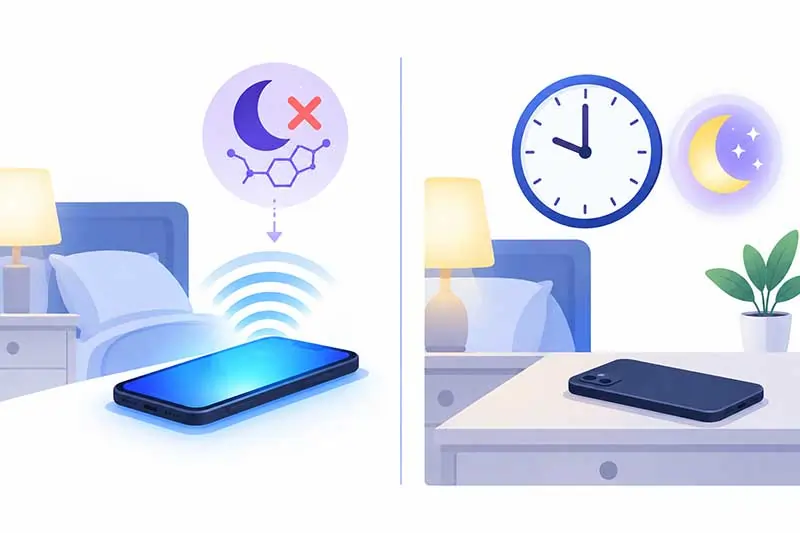
Phones, laptops, and tablets emit blue-enriched light that suppresses melatonin, the hormone that signals to your body that it’s time to sleep. Research on bedtime screen use has found that the vast majority of students use a screen within an hour of bedtime, and that reducing blue light exposure before sleep measurably improves sleep quality scores.
It’s not just the light, either. Scrolling, messaging, or watching something engaging keeps your mind active exactly when it should be winding down — so even without the blue light, late-night screen use tends to delay both the time you fall asleep and how deeply you sleep once you do.
Building a Wind-Down Routine That Actually Works
A consistent wind-down routine trains your body to recognise “it’s almost bedtime” the same way a study routine trains your brain to focus once you sit down at your desk.
- Set a screen curfew 30–45 minutes before bed, and charge your phone outside arm’s reach
- Keep your bedtime and wake time consistent, even on weekends, within about an hour
- Dim bright overhead lights in the last hour before bed — your body reads bright light as “stay awake”
- Avoid caffeine (including tea and cola) in the late afternoon and evening
- Use the last 15–20 minutes for something calm and non-academic: light reading, stretching, or simply lying down and relaxing
Sleep and Study Schedule — Fitting Both In

The most common reason students sacrifice sleep isn’t laziness — it’s a study schedule that doesn’t leave room for it. If your evenings regularly run past midnight, the fix usually isn’t willpower, it’s the schedule itself. A study timetable that starts earlier in the evening, or shifts some revision to a focused morning block, protects your sleep window without cutting your actual study time.
Treat your sleep window the same way you’d treat a fixed class period — not something to shrink first when the day runs long, but a non-negotiable block the rest of the schedule is built around.
When Exam Stress Disrupts Sleep
Sometimes the problem isn’t habits — it’s a racing mind that won’t switch off before a big test. If exam anxiety is what’s keeping you up, that’s worth addressing directly; Managing Exam Anxiety: Practical Tips for Students covers strategies that help calm pre-exam nerves, which often improves sleep as a side effect even before you change anything else.
Printable PDF Resources
1. Download: Student Sleep Hygiene Checklist
Purpose
A one-page nightly checklist covering the habits that most affect sleep quality, so you can quickly spot what’s working against you.
Sections Included
- Screen curfew and bedroom environment check
- Caffeine and evening habits check
- Wind-down routine checklist
- Consistent schedule tracker
2. Download: 7-Day Sleep & Study Tracker
Purpose
A simple daily log to track bedtime, wake time, hours slept, and next-day focus, so you can see the real connection between your sleep and how your study sessions actually go.
Sections Included
- Bedtime and wake time columns
- Total hours slept
- Screen cutoff time
- Next-day energy and focus rating
Quick Reference: Better Sleep During Term Time at a Glance
| Habit | Why It Matters |
| Know your target | 8–10 hrs (ages 13–18) or 9–12 hrs (ages 6–12) per CDC/AASM guidance |
| Set a screen curfew | Blue light and mental stimulation both delay falling asleep |
| Keep a consistent schedule | Irregular sleep times disrupt your body’s internal clock more than short sleep alone |
| Protect your sleep window | Build your study timetable around it, don’t shrink it first when short on time |
| Address exam-night racing thoughts | Anxiety management often improves sleep as a side effect |
Frequently Asked Questions
Is it okay to nap during the day if I didn’t sleep well at night?
A short nap of 20–30 minutes can help with alertness, but napping late in the afternoon or for over an hour can make it harder to fall asleep that night — treat naps as a small top-up, not a replacement for a full night’s sleep.
What if my school start time makes 8–10 hours impossible?
Focus on what’s in your control: a consistent bedtime, an earlier wind-down, and protecting weekend sleep from swinging too far in the other direction. Even partial improvement reduces sleep debt.
Does exercise help or hurt sleep?
Regular daytime exercise generally supports better sleep. Vigorous exercise very close to bedtime can be overstimulating for some students, so earlier in the day or early evening tends to work best.
Is it better to sleep more or study more the night before an exam?
Past a certain point, sleep. Once you’ve done a reasonable revision pass, an extra hour of sleep typically helps recall and focus more than an extra hour of tired, low-quality studying.
Can I use my phone as my alarm without it disrupting sleep?
You can, but keep it face-down or in Do Not Disturb mode and out of arm’s reach, so it doesn’t tempt you into scrolling if you wake up during the night.
Final Takeaway
Sleep isn’t the part of your schedule to cut when things get busy — it’s the part that makes the rest of your schedule actually work. Know your target range, protect a consistent wind-down routine, put the phone down before bed, and build your study timetable around your sleep window instead of the other way around. A well-rested brain that studied for two hours will usually outperform an exhausted one that studied for four.
If you’d like help building a study schedule that actually protects your sleep window, the Student Success Assistant can help you put one together in a few minutes.

Wellness & Balance Team shares educational content focused on healthy routines, study-life balance, and student wellbeing.