
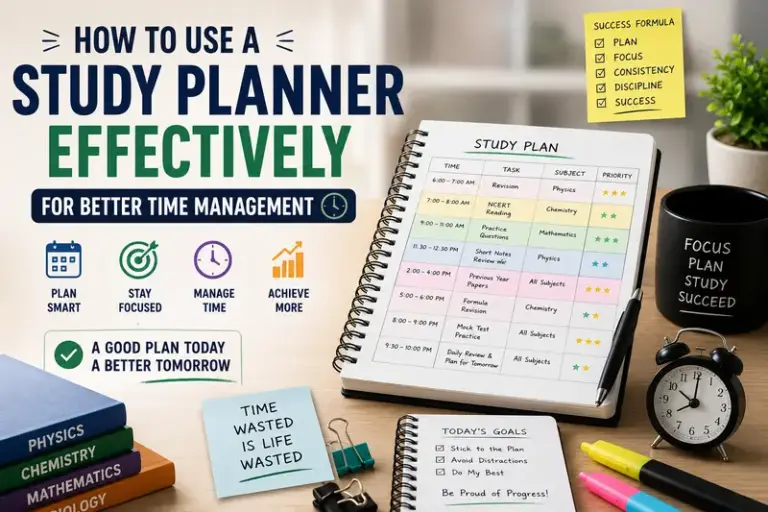
Most students who struggle with time management aren’t struggling because they’re lazy or disorganised by nature. They’re struggling because nobody ever showed them how to plan study time in a way that actually holds up through a busy school week.
A study planner for students sounds simple — write down what you need to study, follow the plan, done. But anyone who’s tried it knows it rarely works that cleanly. You plan three hours for Maths and spend forty minutes finding your notes. You schedule Chemistry right after school when your brain has nothing left. The plan falls apart by Wednesday, and by Friday you’ve abandoned it entirely.
The good news is that these aren’t character flaws. They’re planning mistakes — and they’re fixable. This article walks through how to actually build and use a study planner that works, not just in theory, but through the messy reality of a student’s actual week.
Why Most Study Plans Fail Before the Week Is Over
Before getting into what works, it helps to understand why plans usually break down.
The most common reason is over-planning. Students sit down on Sunday evening, full of optimism, and schedule every hour from 5 pm to 10 pm across six subjects. It looks productive on paper. But it doesn’t account for the day you come home exhausted, the extra homework that arrives on Tuesday, or the fact that some subjects genuinely take longer than estimated.
A plan that has no flexibility built in doesn’t survive contact with a real week. When one block slips, it throws off everything after it — and once a plan feels broken, most students abandon it rather than adjust it.
The second reason is that students plan tasks rather than outcomes. “Study History” for two hours tells you where to sit but not what you’ll actually accomplish. “Write summary notes for Chapter 4 and attempt five exercise questions” is a task with a clear endpoint. You know when it’s done.
These two shifts — building in flexibility and planning outcomes rather than tasks — make more difference to how well a planner works than any colour-coding system or app.
How to Set Up a Study Planner That’s Actually Usable
Start With What You Already Have
Before writing a single study block, map out your fixed commitments for the week. School hours, tuition classes, family commitments, any recurring activities that aren’t optional. These are the anchors — everything else builds around them.
Then look at the time that’s actually available, not the time that exists in theory. If you arrive home from school at 4 pm and genuinely need thirty minutes to decompress before you can focus, your first study block starts at 4:30 pm, not 4:00 pm. Planning for the person you wish you were rather than the person you actually are is how plans stop working by day two.
Assign Subjects Based on Energy, Not Alphabetical Order
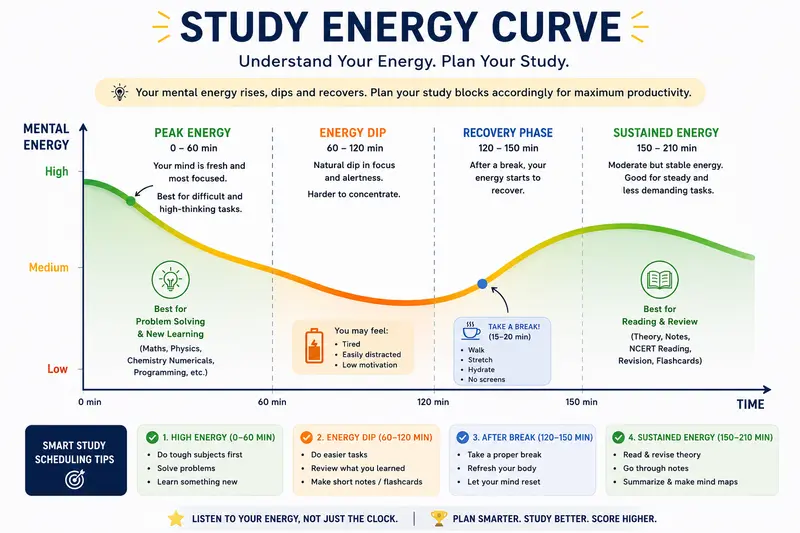
This sounds minor but it isn’t. The subject you study first in a session gets your sharpest attention. The subject you study last gets what’s left.
Maths, Physics, and other subjects that require active problem-solving belong earlier in a study session — or on days when your energy is higher. Subjects that involve reading, making notes, or reviewing content you already know can work later in the evening when concentration is naturally lower.
A lot of students do it backwards. They start with the easiest subject because it feels less daunting, and by the time they get to Maths, they’re running on empty. Rearranging that order alone can noticeably improve how much they actually retain from each session.
Plan Specific Outcomes for Each Block
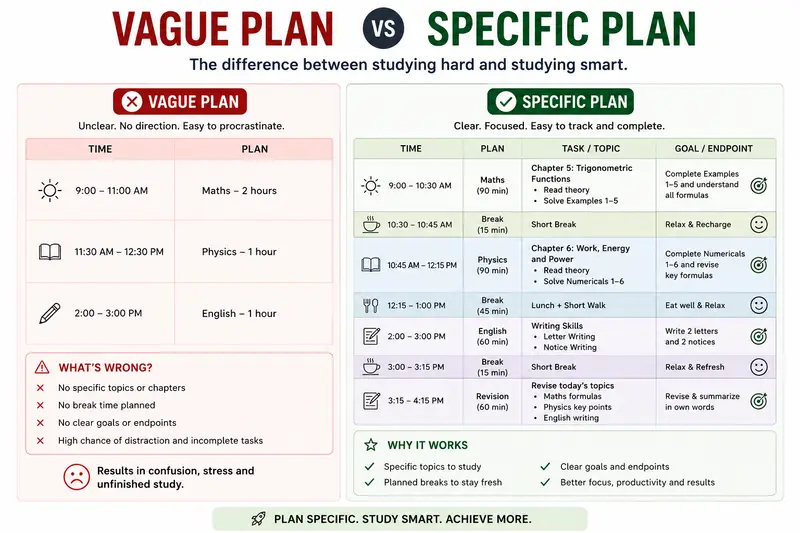
Instead of writing “Physics — 1 hour,” write something like:
- Revise Chapter 4 (Moving Charges and Magnetism) — read NCERT, write derivation notes
- Attempt 5 numericals from NCERT Exercise 4.2
When the hour ends, you know exactly what you did — and more importantly, whether you finished it. If you didn’t, you know exactly where to pick up next time.
This specificity also helps with the procrastination that often precedes study sessions. Staring at “Physics — 1 hour” gives the brain nothing to grab onto. A specific task is easier to start.
Build in Buffer Time, Not Back-to-Back Blocks
A daily study routine that runs from 5 pm to 9 pm with four back-to-back one-hour blocks has no room for anything to run over. And something always runs over.
A more realistic structure might look like:
- 5:00–6:00 pm — Maths (specific chapter or exercise)
- 6:00–6:15 pm — short break
- 6:15–7:15 pm — Physics or Chemistry
- 7:15–8:00 pm — dinner / family time
- 8:00–9:00 pm — lighter subjects or revision of the day’s learning
The buffer slots matter. They’re not wasted time — they’re what prevents a ten-minute overrun from derailing the rest of the evening.
Use Weekly Goals Alongside Daily Plans
A daily planner tells you what to do today. A weekly view tells you whether you’re on track overall.
At the start of each week, set two or three concrete goals — not “study hard” but things like “finish NCERT exercises for Chapters 3 and 4 in Chemistry” or “complete one full past paper for Maths.” These weekly anchors give your daily plans a direction.
At the end of the week, review honestly. Did you hit your weekly goals? If not, why? Was the goal unrealistic? Did something unexpected come up? Did certain subjects consistently get pushed aside?
That weekly reflection is what turns a study planner from a wishlist into something that actually improves over time.
What a Good Study Planner Looks Like in Practice
Here’s a concrete example of how a Class 11 student might structure a study week — not as a template to copy, but as something to think from.
Subject load: Physics, Chemistry, Maths, English, Biology (dropped Maths Add-on)
Fixed commitments: School 8 am–2 pm, Chemistry tuition Monday and Wednesday 4–5 pm, free Saturday afternoon
Weekly goals set on Sunday:
- Complete Physics Chapter 6 (Electromagnetic Induction) — read + derivation notes + 8 numericals
- Revise Chemistry Unit 3 (Electrochemistry) — notes and NCERT questions
- One Maths test paper (timed)
Actual daily plan (Monday):
- 5:00–6:00 pm — Physics Chapter 6, NCERT reading and concept notes
- 6:00–6:10 pm — break
- 6:10–7:00 pm — English (grammar exercises from workbook)
- 8:30–9:30 pm — Biology (shorter revision block — lighter energy needed)
This isn’t elaborate. It’s specific, realistic, and built around the actual week — including the tuition on Monday which means no heavy session right after school.
If you’re also working on subject-specific exam preparation — for instance, building a Class 12 Physics board exam revision strategy — your weekly planner is where that strategy gets scheduled into real time. The strategy tells you what to do; the planner tells you when.
Choosing Between Paper and Digital Planners
This question comes up often and the honest answer is: use whichever one you’ll actually use.
Paper planners have a tactile quality that many students find useful — physically writing a plan creates a small sense of commitment that digital entries sometimes don’t. They’re also distraction-free. You can’t accidentally spend twenty minutes on social media while filling in a notebook.
Digital planners — apps like Notion, Google Calendar, or even a simple notes app — are easier to adjust mid-week, easier to carry everywhere, and better for students who want to set reminders or track completion across devices.
The planner that works is the one that’s open and in use. If a beautiful journal stays on the shelf because it feels too precious to write in, it’s not helping anyone.
Common Mistakes Students Make With Study Planners
Planning too much. A plan that schedules every hour of every day leaves no room for life. Build in at least one completely unstructured evening per week — not because rest isn’t valuable, but because the brain needs time that isn’t accounted for.
Never reviewing the plan. A planner that doesn’t get reviewed doesn’t improve. Five minutes at the end of each day — “did I finish what I planned? What slipped?” — makes each subsequent day’s planning better.
Using the planner to feel productive without actually studying. Spending forty-five minutes designing a colour-coded weekly schedule is a form of procrastination. The planner is a tool. The studying is the work. Don’t let one replace the other.
Abandoning the plan after one bad day. Every student has days when nothing goes as planned. One missed session doesn’t break a revision schedule — abandoning the plan because of one bad day does. Adjust and continue.
The Link Between a Study Planner and a Daily Routine
A study planner and a daily routine are related but different. The routine is the consistent structure of your day — when you wake up, when you study, when you eat, when you sleep. The planner is what you fill the study blocks with on any given day.
Both matter. A good routine makes planning easier because you always know roughly when studying happens. The planner makes the routine productive because it directs that time toward specific things.
If your daily routine isn’t yet consistent enough to plan around, that’s worth addressing first. A structured daily study routine for students gives you the foundation that makes any planner far more effective in practice.
Final Takeaway
A study planner for students isn’t about having the most detailed schedule or the most organised notebook. It’s about knowing what you’re going to do before you sit down, having enough flexibility to handle real life, and reviewing regularly enough that the plan keeps getting better.
Start with what’s realistic this week, not what’s ideal in theory. Plan specific tasks rather than vague subject blocks. Build in buffer time. Review at the end of each week and adjust. That’s the whole system — and it works for students who actually use it.
Frequently Asked Questions (FAQs)
Q1. How do I make a study planner as a student?
Start by writing down your fixed weekly commitments — school, tuition, activities. Then identify the study time genuinely available on each day. For each study block, assign a specific subject and a specific outcome: not “study Maths” but “complete NCERT Exercise 9.3 and review Chapter 9 notes.” Review what you accomplished at the end of each day and adjust the next day’s plan accordingly. Keep the first version simple — you can always add detail as the habit builds.
Q2. How many hours should a student study per day?
There’s no single right answer, as it depends on grade level, subject load, and how efficiently a student works. Most Class 10–12 students benefit from three to five focused hours of studying outside school per day during exam preparation periods. Outside of exam months, two to three hours of quality study is often sufficient. What matters more than total hours is whether the time is genuinely focused — a distraction-free two hours is more productive than a half-distracted four hours.
Q3. Should I study the same subjects every day or rotate them?
Rotating subjects across the week — rather than spending entire days on one subject — generally works better for retention. It also ensures no subject gets consistently neglected. Most students benefit from touching their core subjects (Maths, Physics/Chemistry) at least four to five times per week, while subjects with heavier content but fewer problems (History, Biology) might work well with three deeper sessions per week.
Q4. What should I do when my study plan keeps failing?
First, check whether the plan is realistic. Most failed plans were over-ambitious from the start — too many hours, no buffer time, no flexibility. Rebuild the plan with less in it, not more. Second, identify whether specific subjects or time slots consistently slip. If Monday evenings never work as planned, stop scheduling your hardest work there. Plans that keep failing aren’t evidence of a character problem — they’re evidence that the plan itself needs adjusting.
Q5. Is a paper planner or a digital app better for students?
Use whichever you’ll actually open and maintain. Paper planners work well for students who find writing things down creates a stronger sense of commitment and who prefer a distraction-free planning process. Digital tools work well for students who want to set reminders, adjust plans quickly, or access their schedule across devices. The best planner is the one you actually use — not the most elaborate one.

The CBSE Guide Editorial Team creates helpful educational content for students, parents, and learners across various academic and personal development topics.