

Most students want to study regularly. But consistency is often harder than it sounds. School assignments, tuition, mobile phone distractions and exam pressure can make studying stressful and unorganized. That is why it is important to create a proper daily study routine for the students.
A good study routine is not about studying long hours without taking a break. It’s about smart studying, staying focused and developing healthy habits that get better over time. Whether a student is in primary school, high school or preparing for board exams, a structured routine can improve concentration, reduce stress and help in better time management.
This guide is designed to give you practical and realistic ways to build a study routine that actually works in real life.

Why You Should Study Every Day
Students with a regular study plan are more confident and less rushed in exams. A routine helps the brain to develop consistency and discipline.
Here are some of the key benefits:
- Time management improved
- Less exam stress
- Better focus and memory
- More balanced daily routine
- improved sleeping habits
- Boosting confidence before exams
A routine also aids students in avoiding the confusion and anxiety that accompanies last minute studying.
Know Your Daily Schedule First
The best study schedule for a student can be drawn up only when one understands how his day is being spent at present.
Students should ask themselves:
- School hours
- Coaching or tuition classes
- Time for homework
- Journey time
- Meal breaks
- Play or physical activity
- Sleep routine
A study plan should be a natural part of everyday life. It is difficult to stick to a timetable for more than a few days if it is too rigid or unrealistic.
Example
A Class 8 student coming back from school at 4 PM may not be ready to study right away. A 30-minute break to snack and relax can help focus later in the evening.
Set Clear, Realistic Study Goals
A common mistake students make is setting goals that are too big.
Rather than saying:
‘I will do all the Science chapters today.’
Give this a try:
“I will review one Science chapter and work five questions.”
Smaller goals are more attainable and help students stay motivated.
Examples of Daily Goals
- Rewrite a Math Concept
- Read 2 pages of social science notes
- Practice 20 minutes English grammar
- Solve one section of one sample paper
Specific goals help students track their progress better.
Pick The Right Time to Study
Each student learns differently. Some students are better in the morning, others in the evening.
The best routine is the one that works with a student’s natural energy levels.
Morning Study Works Well For
- Memorizing
- Courses on reading theory
- Revision before school
Evening Study Works Well For
- Homework
- Sample questions
- Study group
- Subjects of a creative nature
Students should try stuff out and realize when they’re most awake and attentive.
Make a Balanced Study Schedule
The best study schedule for a student is one that includes time for study and time for relaxation.
Studying for hours on end usually leads to less focus. Breaks during short study sessions are more effective
Sample Daily Study Schedule for Students
This is a simple example for school going students:
| Time | Activity |
| 6:00 AM – 6:30 AM | Wake up and freshen up |
| 6:30 AM – 7:00 AM | Quick revision |
| School Hours | School |
| 4:30 PM – 5:00 PM | Snacks and rest |
| 5:00 PM – 6:00 PM | Homework |
| 6:00 PM – 6:30 PM | Break or outdoor play |
| 6:30 PM – 7:30 PM | Difficult subject practice |
| 7:30 PM – 8:00 PM | Dinner |
| 8:00 PM – 8:45 PM | Light revision or reading |
| 9:30 PM | Sleep |
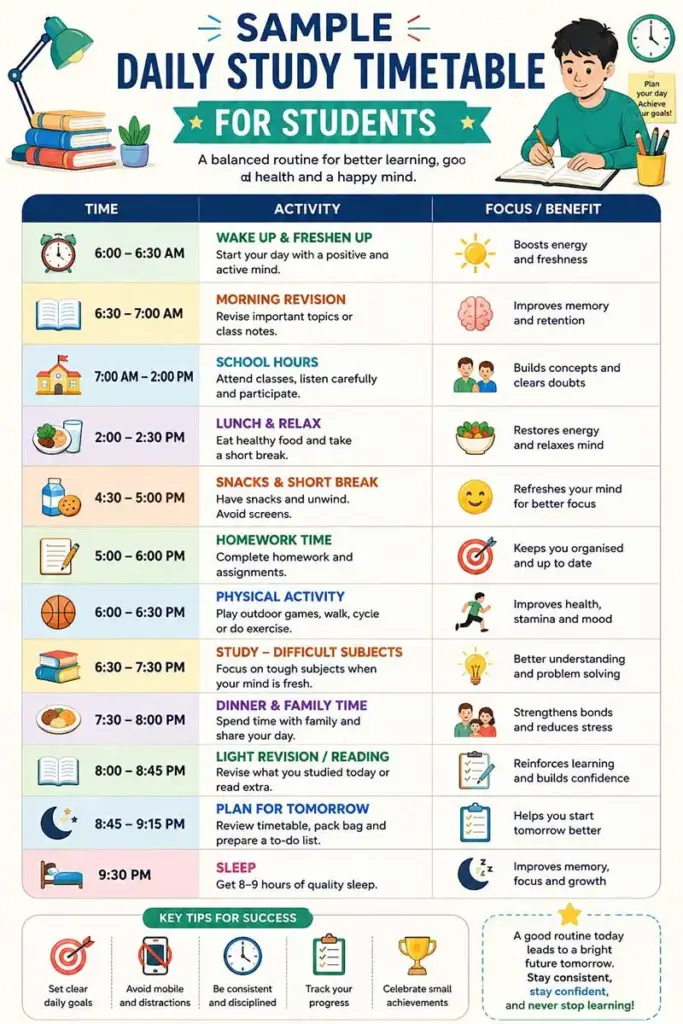
This is only a sample. Students should choose times according to their school schedule and personal needs.
Tackle Harder Topics First
Most students delay difficult subjects because they feel it is hard. But perhaps it is better to learn difficult subjects when your mind is fresh.
For instance:
- Do your math practice before you get tired
- Dedicated hours to study Science concepts
- Leave lighter stuff like reading or revision for later
This method stops students from skipping important topics.
Use Short Study Sessions
Long study hours without breaks can cause mental fatigue.
Many students can use a simple technique:
- Study for 25-40 minutes
- Pause for 5–10 minutes
In breaks, students can:
- Stretch
- Drink water
- Walk around
- Let their eyes rest
Take breaks from social media scrolling, which can decrease your concentration.
Organize Your Study Materials

A messy study space can be distracting.
Students must keep:
- Notes
- Textbooks
- Pens & writing materials
- Schedule
- Homework list
all in one neat place.
Clean and quiet study environment helps concentration and saves time.
Lessen Distractions While Studying
Mobile phones are one of the biggest distractions students face.
Easy ways to cut down on distractions are:
- Study with your cell phone out of reach
- Disable notifications
- Learning in a Silent Room
- Using a simple desk instead of studying on the bed
Parents can also help students by establishing a calm learning environment at home.
Make Revision a Routine
Many students just focus on studying new topics and forget to revise.
Revising is important as it helps to strengthen memory and improve confidence.
Good Revision Habits
- Revise class notes every day
- Weekly review of tough topics
- Sample questions for practice
- Use flashcards for quick learning
A 15-20 minute revision each day can make a big difference during the exams.
Sleep And Exercise Matter
A healthy routine is not just about studying.
Students should be able to:
- Proper sleep
- Physical movement
- Relaxation
- Healthy meals
Lack of sleep impacts memory, concentration and mood.
School students should get about 8 hours of sleep. Exercise such as walking, cycling, yoga or outdoor games also help to reduce stress and improve concentration.
Change the Routine During Exams
During exams, regular school-day routines may require slight modifications.
When studying for tests:
- More time for revision
- Solve previous year’s question papers
- Focus more on the weak subjects
- Cut back on unnecessary screen time
But students should be wary of study schedules that are so extreme that they lead to burnout.
Pulling an all-nighter before exams is usually less effective than steady preparation over time.
Typical Mistakes Students Should Avoid
Even the best study plan can go haywire if students make some common mistakes.
1. Unrealistic timelines
Some students plan 10-12 hours of study per day and can’t stick to it on a consistent basis.
Start with small steps and build up.
2. Not Taking Breaks
Continuous studying decreases concentration and energy.
3. Imitating Another Person’s Routine
All students learn differently. Not everyone can follow a topper’s routine.
4. Study Without Goals
Students often waste time unwittingly when they don’t have clear goals.
5. Missing Sleep
Studying late every day can reduce memory retention.
Tips for Parents to Support Study Routines
Parents have a great role to play in instilling discipline among the students.
Helpful ways parents can help include:
- Encouraging consistency over perfection
- Valuing effort
- Avoiding excessive pressure
- Providing a peaceful place to study
- Helping kids cope with distractions
Constant criticism usually gets you nowhere, but positive encouragement does.
How to Stay Motivated as a Student
Motivation rises and falls naturally. That’s standard.
To help students stay motivated, they can:
- Small victories tracked
- Rewarding yourself for a job well done
- Sometimes studying with friends
- Using colorful notes or planners
- Remembering the long-term goals
Consistency is more important than perfection.
Better to study 1 hour every day regularly than to study long hours randomly once in a week.
The Bottom Line
Establishing a daily study routine for your students isn’t about strict rules or endless hours of study. The aim is to establish a balanced schedule that encourages learning, health and consistency.
The best routines are doable, adaptable and easy to follow. Students should just concentrate on bettering themselves, not on comparing to others.
Good planning, regular revision, healthy habits and achievable goals can help students to study more effectively and feel more confident in school and exams.
Frequently Asked Questions
What is the perfect study schedule for students in a day?
An ideal routine would involve a good mix of study time, breaks, sleep and physical activity. It should depend on the student’s learning style and school schedule.
How many hours should a student study in a day?
Study hours vary by age, class level, and goals. Many school students utilise 2-4 focused study hours outside school with consistent revision.
How to keep a study schedule consistent for students?
Students can stay consistent by setting realistic goals, sticking to a schedule, limiting distractions, and taking regular breaks.
Do students have to stay up late or get up early to study?
It is a matter of personal preference. Some students concentrate better in the morning; some learn better in the evening.
How can parents help kids stick to a study schedule?
Parents can help by providing a quiet place to study, encouraging healthy habits and supporting children without putting them under undue pressure.

Student Success Desk focuses on practical learning strategies, study techniques, and academic improvement tips for school students.


Very informative article.